

If you've ever tried to follow the usual fitness advice for anxiety, you may have had a confusing experience. You start moving because people say exercise will help. Then your heart pounds, your chest tightens, your breathing gets shallow, and instead of feeling calm, you feel trapped in the exact sensations you’re trying to escape.
That experience can make you believe exercise isn’t for you. It can make you think your body is too sensitive, too reactive, too broken.
It isn’t.
A good 6 week exercise plan for anxiety has to do more than improve fitness. It has to rebuild trust between your body and your mind. It has to respect panic sensitivity, lower the odds of overwhelm, and teach your nervous system that movement can feel safe again.
An Exercise Plan That Understands Your Anxiety
Many people with anxiety don’t struggle because they “lack discipline.” They struggle because standard workout advice often ignores what panic feels like from the inside. A trainer may call a racing heart “good intensity.” An anxious nervous system may hear “danger.”
That mismatch matters.
Short-term exercise plans can absolutely create real physical change. A structured six-week regimen combining diet and bodyweight-focused exercise produced significant physiological improvements, including a 6.3% decrease in body fat, along with meaningful strength gains in a study published in the Journal of Exercise and Nutrition (study details here). That matters because it shows six weeks is long enough to feel a real shift in your body.
But for an anxious person, physical results alone aren't the point. The deeper win is learning that increased breathing, warmth, effort, and muscle fatigue don’t always mean danger.
What an anxiety-aware plan does differently
A traditional transformation plan often asks one question first: “How hard can you push?”
An anxiety-aware plan starts somewhere else:
- Can you stay present while moving
- Can you notice effort without spiraling into fear
- Can you finish the session feeling steadier rather than shaken
- Can you come back tomorrow without dread
Those questions sound softer, but they build something stronger. They build consistency.
Exercise becomes healing when your nervous system experiences it as manageable, repeatable, and safe.
That’s why this 6 week exercise plan uses gentle progression, longer recovery, and simple movement patterns. It still helps you get stronger. It still improves endurance. It still gives structure. It just refuses to treat panic sensitivity like laziness.
If you need support beyond workouts, it helps to pair movement with practical reflection and self-monitoring. That’s where mental health tools for anxiety can complement the process. They give language to what you’re feeling, which lowers the shame that so often keeps people stuck.
Hope is not wishful thinking
Healing from anxiety usually doesn’t arrive in one dramatic moment. It often begins in quieter ways. A walk that doesn’t scare you. A set of squats that raises your heart rate without triggering a spiral. A stretch session where your breath finally drops.
Those moments count.
This plan is built for that kind of progress. Not performative suffering. Not “no pain, no gain.” Real progress you can repeat.
Why High-Intensity Workouts Can Worsen Anxiety Symptoms
For someone without panic sensitivity, a hard interval session can feel energizing. For someone with anxiety, the same session can feel like an ambush.

Your body doesn’t always distinguish between “I’m sprinting” and “something is wrong” if the sensations are intense enough. Fast heartbeat, breathlessness, dizziness, heat, shaky limbs, chest pressure. Those are common exercise sensations, but they’re also common panic sensations.
That overlap is why some popular plans backfire.
A future-dated report described by Human Fit Project says a 2025 study in the Journal of Anxiety Disorders found that 68% of individuals with anxiety experienced worsened symptoms from standard high-intensity workouts, and dropout rates were three times higher than non-anxious groups (reported here). Even if you’ve never seen that research, the pattern will probably sound familiar if you’ve ever quit a program after one terrifying workout.
The problem isn’t effort itself
Movement is not the enemy. The issue is often how quickly intensity rises and how little recovery the plan allows.
Common triggers include:
- Short rest periods that keep your heart rate high when you already feel hyperaware of it
- Burpees, jump circuits, and all-out intervals that spike breathing fast
- Group classes with pressure to keep up even when your body is signaling overload
- Aggressive language like “push through it” or “don’t stop” that teaches you to override warning signs instead of listening to them
If you’ve panicked during workouts, that doesn’t mean you failed exposure. It often means the session outran your current sense of safety.
Why avoidance starts so fast
Panic teaches by association. If a treadmill session leads to terror, your brain can start linking treadmills, gyms, increased heart rate, and even workout clothes with threat. Then the avoidance loop grows.
It often looks like this:
| Situation | Body sensation | Brain interpretation | Result |
|---|---|---|---|
| Brisk cardio | Heart pounding | “This feels like a panic attack” | Fear rises |
| Fear rises | Breathing gets tighter | “I’m losing control” | Session stops |
| Session stops | Relief appears | “Avoiding saved me” | Exercise feels dangerous next time |
That loop is not weakness. It’s a nervous system trying to protect you.
If this pattern feels familiar, a practical guide to fight or flight management can help you understand what your body is doing during those moments, so the sensations feel less mysterious and less powerful.
A workout that helps anxiety is one you can recover from mentally, not just physically.
Gentle consistency beats dramatic intensity
The fitness world often celebrates exhaustion. Anxiety recovery usually responds better to predictability.
That means slower warm-ups. Fewer “finishers.” Longer rests. Room to pause without shame. It may look modest from the outside, but it’s often the first approach that an anxious body can trust.
I’ve seen this in practice and lived it personally. The breakthrough wasn’t learning to dominate my body. It was learning to stop treating every surge of sensation like proof that I was unsafe.
A calmer approach doesn’t make you less capable. It makes you more likely to stay with movement long enough to benefit from it.
Building Your Foundation of Safety and Calm
Before you worry about sets, reps, or what week you’re on, make movement feel safe enough to begin. This is the part people skip. For anxious exercisers, it’s often the part that changes everything.

You do not need to “toughen up” before starting. You need a system that lowers uncertainty. That includes your breathing, your environment, and the way you measure effort.
Start with a calming entry ritual
Pick one simple sequence you’ll do before every session. Keep it brief and repeatable so your body starts linking it with safety.
A useful pre-workout ritual might include:
- Sit or stand still for a moment and notice your feet on the floor.
- Exhale longer than you inhale for a few rounds without forcing the breath.
- Look around the room slowly and name a few neutral objects.
- Say the plan out loud in plain language, such as “I’m doing a short walk and a few easy strength moves.”
- Remind yourself you can slow down at any time.
That last step matters. Anxiety eases when you know you have options.
For people who need sensory-friendly ways to come back into the present, these neurodivergent-friendly grounding techniques offer practical ideas you can adapt before or during exercise.
Learn belly breathing without overcomplicating it
A lot of anxious people are told to “just breathe,” which isn’t helpful when you already feel breath-focused. What works better is practicing calm breathing outside of distress, then bringing it into movement in small doses.
Try this:
- Place one hand on your chest and one on your belly. You’re not trying to be perfect. You’re just noticing where the breath goes.
- Inhale gently through your nose if comfortable. Let the lower hand move more than the upper one.
- Exhale slowly and fully. Don’t blast the air out. Let the exhale taper.
- Repeat for a short stretch of time until your shoulders soften a bit.
The purpose isn’t to force relaxation. The purpose is to give your body a familiar pattern when sensations rise.
Practical rule: Don’t wait until panic is high to practice regulation. Rehearse calm when you’re already safe.
Use effort as information, not a challenge
One of the best tools for anxious exercisers is the Rate of Perceived Exertion, often shortened to RPE. You don’t need a watch or chest strap to use it. You just ask, “How hard does this feel right now?”
For this plan, think about effort in three zones:
| RPE zone | What it feels like | Best use |
|---|---|---|
| Easy | You can breathe comfortably and talk in full sentences | Warm-ups, recovery, anxious days |
| Moderate | You feel engaged and warmer, but still in control | Most sessions in this plan |
| Too much | Speech gets choppy, breath feels alarming, panic thoughts rise | Your signal to slow down |
For now, stay mostly in easy to moderate. That doesn’t mean you’re doing nothing. It means you’re training inside your current window of tolerance.
Later in your routine, pair this with muscle release. Many people find The Anxiety Checklist's relaxation method useful after movement because it helps the body come down instead of carrying activation into the rest of the day.
A short guided option can help you practice that downshift. Use this after a walk, strength session, or stretching block.
Build safety into the environment
Your workout setting can either support your nervous system or challenge it too soon.
Choose conditions that help you stay steady:
- Pick a familiar location. A quiet room, a calm corner of the gym, or a predictable walking route works well.
- Stay near comfort cues. Water, a bench, an exit, a phone, or a supportive person nearby can reduce anticipatory fear.
- Use calming audio if it helps. Music, nature sounds, or a familiar voice can soften hypervigilance.
- Avoid sensory overload at first. Crowded classes, mirrors, blaring music, and chaotic programming can wait.
You are not “feeding the anxiety” by setting up a supportive environment at the beginning. You’re building enough safety to make repetition possible.
The 6-Week Anxiety-Relief Exercise Plan
A good 6 week exercise plan doesn’t need to be extreme to work. For untrained individuals, a successful structure often uses 3 full-body workouts per week, starting with foundational movements and gradually increasing volume or intensity (overview here). That basic framework works well for anxiety too, with one major adjustment. We progress only as fast as your nervous system can stay engaged without feeling cornered.
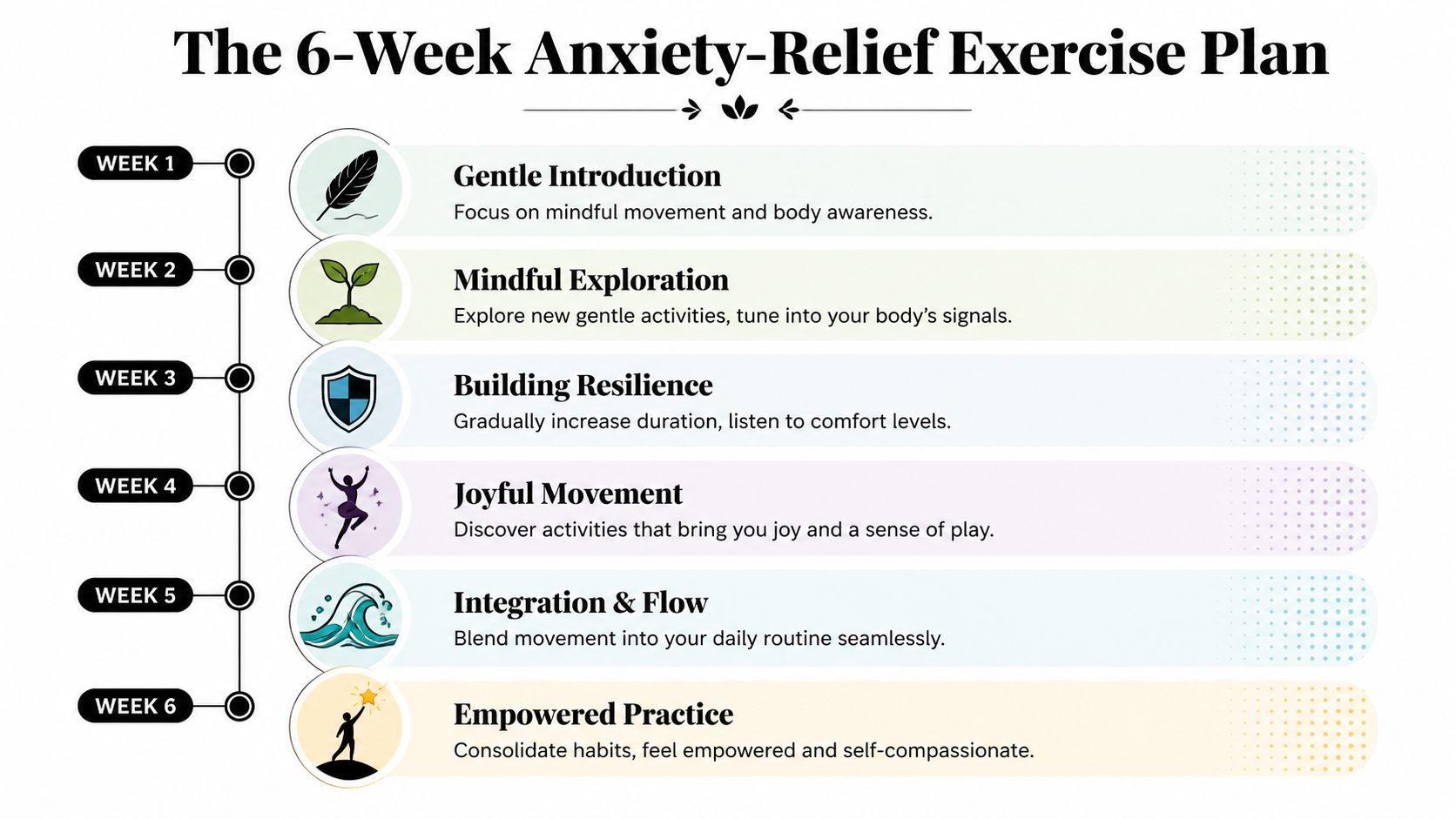
Think of this as a guided rebuild. Three movement days each week. Gentle cardio, simple strength work, mobility, and enough repetition to create trust.
Weekly rhythm
Use this loose schedule:
- Day 1 full-body strength plus a calm warm-up
- Day 2 easy cardio or walking
- Day 3 full-body strength
- Day 4 rest or light stretching
- Day 5 easy cardio
- Day 6 full-body strength or gentle yoga-based mobility
- Day 7 full rest
If three strength sessions feels like too much at first, shorten them rather than quitting the structure. Keep the appointment. Reduce the dose.
Week 1 and Week 2
These first two weeks are about proving that exercise doesn’t need to feel like an attack.
Use sessions that last a manageable amount of time. Start with a slow warm-up, then do a few foundational movements:
- Chair squats or bodyweight squats
- Wall push-ups
- Glute bridges
- Supported rows with a band if you have one
- Bird dogs or dead bug variations
- A short, easy walk
Keep the pace calm. Rest generously between movements. If you’re using dumbbells already, choose a load that feels controlled and boring rather than dramatic.
A sample strength day might look like this:
| Movement | How to do it |
|---|---|
| Chair squat | Sit back to a chair and stand again with control |
| Wall push-up | Hands on wall, body straight, press away slowly |
| Glute bridge | Lift hips gently, pause, lower without rushing |
| Bird dog | Reach opposite arm and leg, then switch sides |
Panic sensitivity note
If your heart rate rises and you feel the familiar alarm, slow down before the fear snowballs. Put a hand on your ribs, lengthen the exhale, and remind yourself, “My body is working. I can reduce the pace.”
This is also a good stage to set small targets using The Anxiety Checklist on smart goals. Not “be fearless.” Something concrete, like “complete three short sessions this week without judging my pace.”
Week 3
By now, the movements should feel less foreign. This week adds a little more time or a little more challenge, but not both at once.
You can progress by:
- adding a round to your strength routine
- taking a slightly longer walk
- moving from wall push-ups to a countertop
- holding light dumbbells for squats
- adding a few minutes of gentle cycling if that feels less triggering than walking
Notice the difference between effort and alarm. Effort feels like work. Alarm feels like urgency. You’re allowed to train with the first and avoid tipping into the second.
If a plan only works on your best days, it isn’t a stable plan.
For people who eventually want a more structured walking-to-running path, Swift Running's 5K plan can be a useful next step after this six-week base, especially if you’re ready to build confidence with gradual run exposure.
Week 4
Many people make the classic mistake of starting to feel better, then doubling the challenge. Symptoms then spike, and they conclude they’ve gone backward.
Don’t do that.
Week 4 is better used for consolidation. Keep the structure. Slightly refine form. Notice recovery. Ask whether you finish sessions feeling clear enough to continue your day.
Try these upgrades:
- Squat with a pause at the bottom to improve control
- Incline push-up on a sturdy counter
- Hip hinge drill to learn deadlift mechanics without heavy loading
- Marching in place or easy step-ups if cardio still feels safe
- Gentle yoga flow focused on hips, shoulders, and breath
If you wake up unusually keyed up, substitute mobility for cardio. That’s adjustment, not failure.
A simple check-in method
After each session, write one line for each of these:
- Body. Did I feel steadier, tighter, or about the same?
- Mind. Did the session lower fear, raise fear, or mix both?
- Recovery. Do I need food, water, rest, or calming time?
This is how you learn your personal response pattern instead of relying on generic advice.
Week 5
Here the plan starts to make you feel a little more capable. Not because it gets brutal, but because you start doing things that once felt intimidating.
A strength day might now include:
- bodyweight squats or goblet squats
- countertop or bench push-ups
- band rows or one-arm dumbbell rows
- glute bridges or light Romanian deadlift patterning
- standing overhead press with light weights if that movement feels comfortable
- a relaxed cooldown walk
Cardio can stay simple. Brisk walking is enough. Light cycling is enough. Dancing in your living room is enough. A gentle elliptical session is enough.
The key question is whether you can stay connected while doing it.
| If this happens | Do this |
|---|---|
| Breathing starts to feel panicky | Slow pace, extend exhale, reduce range of motion |
| You feel lightheaded | Stop, sit or stand supported, breathe normally, hydrate if needed |
| Your thoughts say “I can’t handle this” | Drop intensity and finish with an easier version instead of quitting entirely |
| You feel strong and calm | Add a small progression next session, not five at once |
Week 6
The final week is not a test of toughness. It’s a week of noticing what’s different.
You may notice better stamina. More ease with body sensations. Less fear about sweating or increased heart rate. More confidence entering the session because you already know how to recover if anxiety rises.
Use this week to repeat your most successful sessions. Choose the movements that gave you confidence and do them with clean, calm effort.
A strong final week often looks like this:
- One steady walk or bike session where you keep a moderate, manageable rhythm
- Two or three full-body sessions using the movements you trust most
- One longer mobility or stretching practice
- One intentional reflection on what you can do now that felt hard at the start
Your biggest win may not be a visible body change. It may be the moment your body feels active without feeling unsafe.
Beginner and experienced modifications
If you’re newer or more panic-sensitive:
- use wall or chair versions longer
- keep sessions shorter
- choose walking over intervals
- pause often and on purpose
If you have more training experience but a sensitive nervous system:
- keep familiar lifts
- lower intensity for a few weeks
- lengthen rest periods
- avoid all-out finishers
- focus on rhythm, form, and recovery quality
The plan is successful if you can keep going. That’s the standard.
Making It a Lifelong Practice for Fearless Living
At the end of six weeks, many are tempted to ask, “What’s next?” The better question is, “What can I keep doing without losing myself in the process?”

The point of this 6 week exercise plan is not to survive a challenge and then crash. It’s to build a relationship with movement that still works when work gets busy, sleep gets messy, or anxiety flares.
Consistent six-week training programs have been shown to improve cardiovascular health by reducing arterial stiffness by up to 9.4% in healthy young men (reported in this PMC study). That matters because calmer, steady training can support your long-term health, not just your mood in the moment.
What sustainability actually looks like
Sustainable exercise is less exciting than social media makes it seem. It looks like repeating basics, adjusting when needed, and refusing the all-or-nothing trap.
That often means:
- Keeping a minimum baseline such as walks, mobility, or a short strength circuit during hard weeks
- Letting intensity flex with your nervous system instead of forcing the same output every day
- Separating discomfort from danger with the skills you built in earlier weeks
- Tracking patterns so you know what helps and what overloads you
Plateaus happen. Missed workouts happen. Bad anxiety days happen. None of that cancels your progress.
Use food and recovery as support, not pressure
Exercise feels more tolerable when recovery is solid. That includes sleep, hydration, regular meals, and simple nutrition habits that don’t increase obsession.
If you want a straightforward starting point, understanding clean eating principles can help you think in terms of basic food quality and consistency rather than rigid perfection. For anxious people, “simple and steady” usually works better than dietary extremes.
You can also support the bigger picture through diet and lifestyle for anxiety relief, especially if you’ve noticed that stress, caffeine, skipped meals, or poor sleep make exercise feel harder to tolerate.
When you fall off track
You probably will at some point. Everyone does.
The key is not to restart by punishing yourself. Restart by shrinking the plan:
| If you stopped because of | Restart with |
|---|---|
| A panic flare | a short walk and your calming entry ritual |
| Exhaustion | stretching or mobility only |
| Low motivation | one song’s worth of movement |
| Overdoing it | the last version of the plan that felt safe |
A lifelong practice doesn’t require perfect streaks. It requires a way back.
Your New Partnership with Body and Mind
If anxiety has made your body feel unpredictable, exercise can start to feel like a negotiation with fear. Every sensation gets questioned. Every heartbeat gets monitored. Every workout becomes a test of whether you’ll cope.
It doesn’t have to stay that way.
A well-built 6 week exercise plan can become something much deeper than a routine. It can become evidence. Evidence that your body is not your enemy. Evidence that sensation does not equal catastrophe. Evidence that healing often grows through repetition, not force.
A different way to see progress
Progress may mean you walked longer. It may mean you completed more strength sessions. It may also mean something quieter:
- you noticed fear sooner and responded more gently
- you stopped a spiral before it became panic
- you returned to movement after a hard day
- you let your body work without interpreting every signal as danger
Those are real victories.
Your body isn’t trying to betray you. It’s trying to protect you with old alarm patterns. Gentle movement teaches it a new story.
That’s why this approach works when harsher ones don’t. It treats fitness and nervous system healing as partners. It leaves room for fear without handing fear the steering wheel.
Freedom often starts small
A calmer walk. A steadier breath. A squat that raises your heart rate and doesn’t send you running. Those moments can look ordinary from the outside.
Inside, they can be life-changing.
If you’ve followed this plan, even imperfectly, you’ve already practiced something powerful. You’ve stayed in relationship with your body. You’ve replaced dread with curiosity, pressure with pacing, and punishment with care.
That is how fearless living often begins. Not by never feeling anxious again, but by learning that anxiety doesn’t get the final vote.
If you want practical support beyond this plan, The Anxiety Checklist offers a structured way to track symptoms, habits, triggers, and recovery tools so you can build your own steady system for panic relief and everyday confidence.