



Some people find themselves feeling like anxiety is only part of the story. Their chest tightens, their thoughts race, and then something else joins in. Sleep falls apart. Motivation disappears. Irritability rises. A few days later, they start wondering whether they're weak, broken, or somehow failing at recovery.
They're not.
When several mental health struggles show up together, it can feel chaotic and personal. In reality, it's common enough that clinicians have a name for it: comorbidity, or comorbid mental disorders. That phrase can sound cold, but the idea is simple. More than one condition or symptom pattern is active at the same time, and each one can influence the others.
If you've been trying to heal from anxiety while also dealing with low mood, panic, sleep disruption, compulsive habits, or reliance on alcohol or other substances to cope, your experience makes sense. It isn't a sign that recovery is out of reach. It usually means your nervous system needs a more connected plan.
That shift matters. Once you stop treating your symptoms like unrelated failures, you can begin to see the pattern. And when you can see the pattern, you can work with it. That's where hope starts to become practical.
The Weight of Juggling More Than Just Anxiety
A lot of people know this feeling without knowing the term for it. You wake up already tense. By noon, you're exhausted from scanning for danger. At night, your body is tired but your mind won't switch off. Then, after a few rough weeks, anxiety turns into something heavier. You don't just feel keyed up. You feel flat, discouraged, and disconnected.
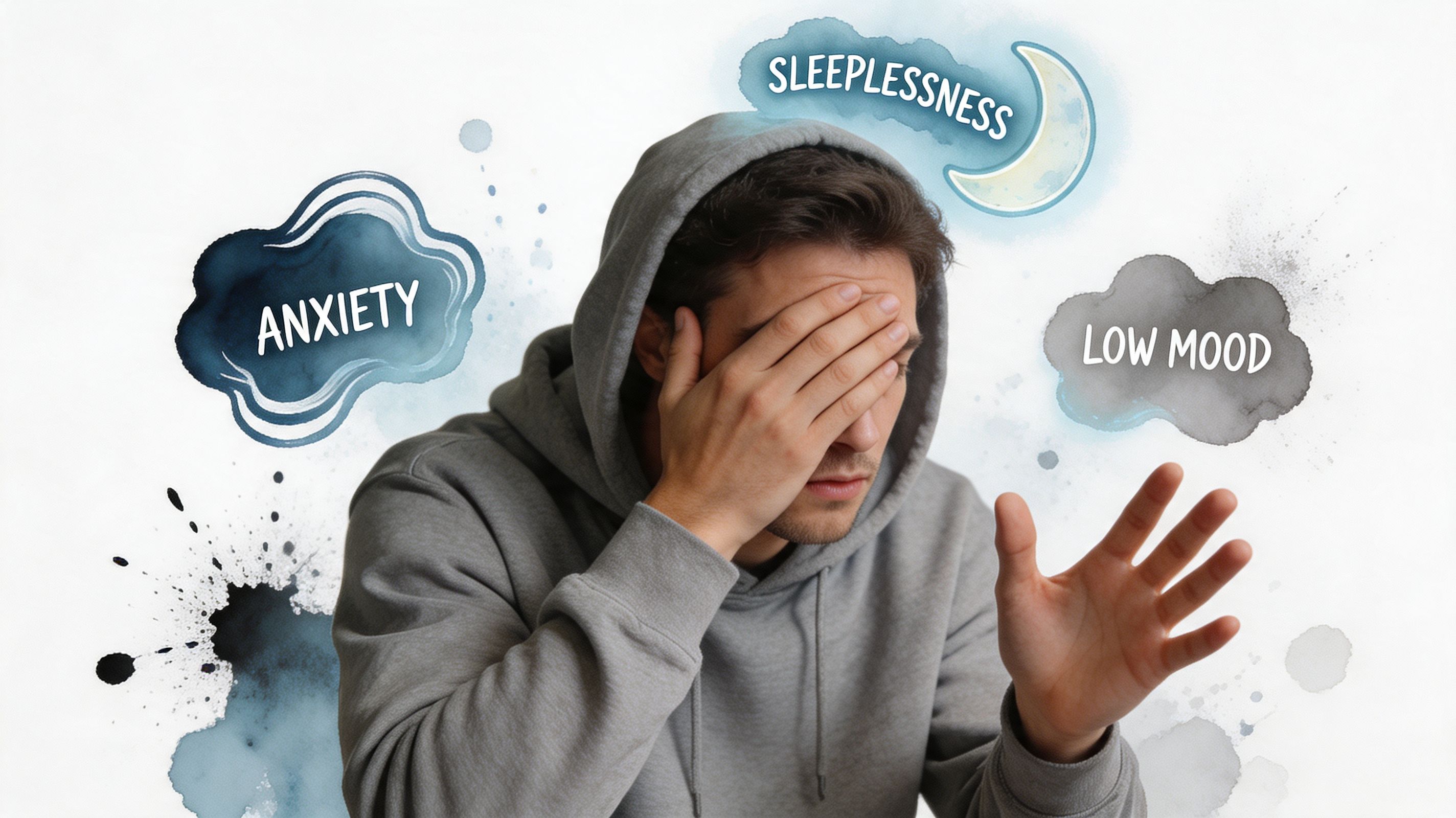
That mix can be frightening because it blurs the lines. Is it panic? Is it depression? Is it burnout? Is it just lack of sleep making everything worse? Many people keep pushing through, hoping one fix will solve everything. They read breathing tips for panic, try to sleep earlier, cut caffeine, and still feel like they're carrying too much at once.
When the struggle has a name
Psychiatric comorbidity means two or more mental health conditions are happening together. That's all. It's not a verdict. It's a useful description.
For someone with anxiety, this might look like:
- Anxiety plus low mood: You're worried all day, then too drained to do basic tasks.
- Anxiety plus insomnia: You dread bedtime because your body feels alert when it should be winding down.
- Anxiety plus substance use: You use alcohol, cannabis, or another coping habit to get temporary relief, then feel worse later.
You don't need to have every symptom neatly sorted before you deserve support.
For many people, the first real relief comes when they stop asking, "What's wrong with me?" and start asking, "How are these symptoms connected?" That question is gentler, more accurate, and more useful.
If you're trying to make sense of those connections on your own, an anxiety self help platform can give structure to what otherwise feels like a blur. Structure doesn't solve everything, but it often lowers the panic that comes from confusion.
Hope starts with understanding
Living panic free doesn't begin with having zero symptoms tomorrow. It begins with understanding what you're dealing with today. Once you recognize that multiple symptoms can travel together, your experience starts to feel less random. And less random usually means less terrifying.
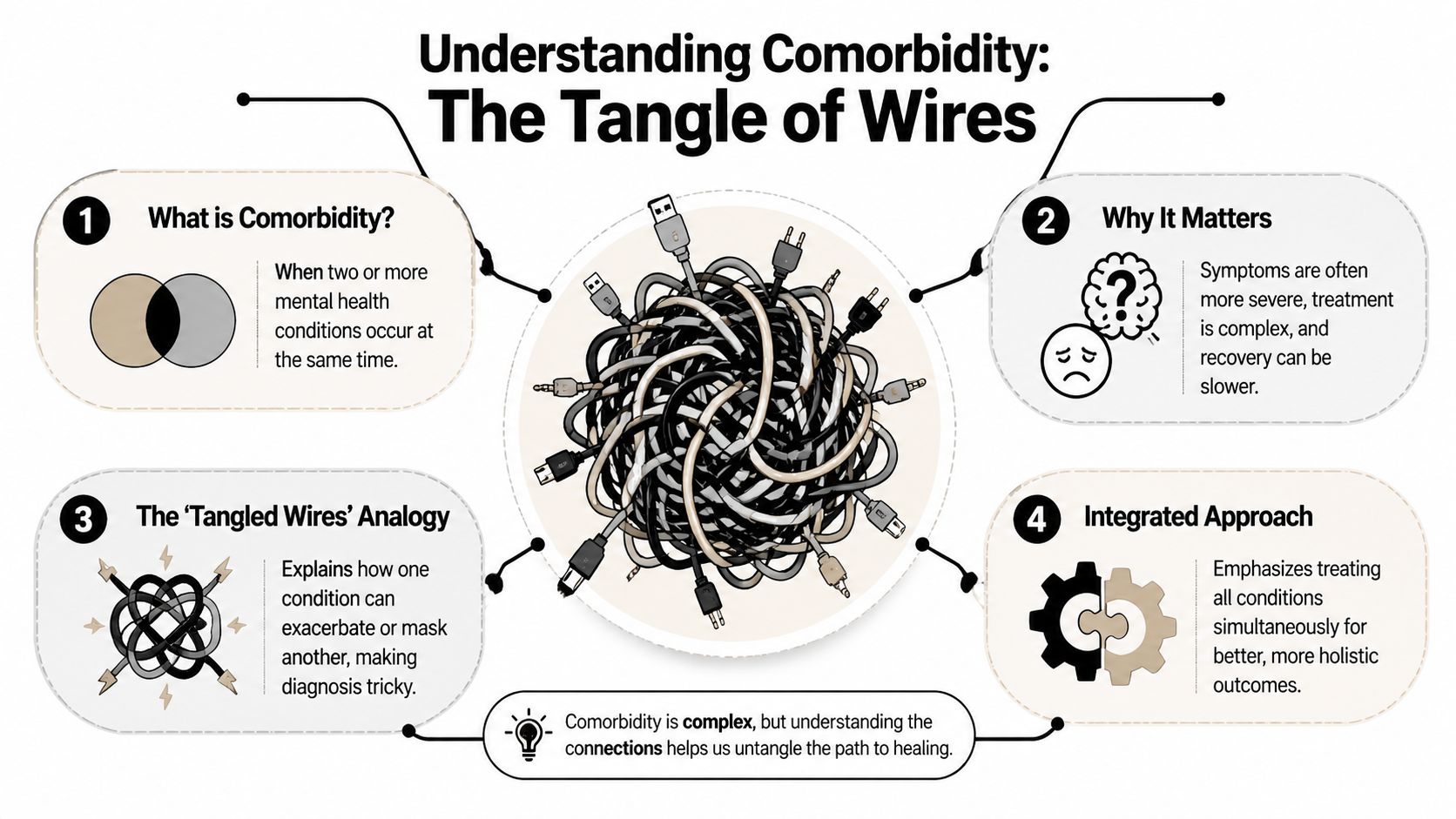
Understanding Comorbidity The Tangle of Wires
Living with comorbid mental disorders can feel like trying to sort out several problems at once while your mind keeps sounding the same alarm. You work on sleep, but worry keeps your body alert. You calm a panic spike, but low mood makes it hard to keep up the habits that help. The symptoms overlap, interrupt each other, and blur the picture.
That overlap is what comorbidity means in real life. More than one condition is present, and the conditions affect each other. They may share symptoms, feed the same stress cycle, or hide behind whichever problem feels loudest that day.
What the tangle usually looks like
A helpful way to understand comorbidity is to look at how the pieces interact.
- Shared symptoms: Trouble concentrating, irritability, restlessness, fatigue, and sleep disruption can belong to more than one condition.
- Mutual reinforcement: Anxiety can disrupt sleep. Poor sleep can sharpen anxious thoughts. Ongoing exhaustion can make hopelessness feel heavier.
- Masking: Panic may get most of your attention because it feels urgent, while depression, burnout, or substance use keeps shaping the rest of the day.
- Common roots: Trauma, chronic stress, health strain, and learned coping patterns can contribute to several issues at once.
This is why a single label often feels incomplete. Labels can guide treatment, but the larger pattern explains why life feels so hard.
Why single-focus treatment can fall short
If treatment only aims at one symptom cluster, progress can stall. Someone might learn panic skills but feel too depleted to practice them consistently. Someone else might improve sleep briefly, then slide back because fear still keeps the nervous system activated at night.
A simpler rule helps here. Treat the full pattern, not only the loudest symptom.
That is the idea behind integrated care. The question shifts from "Which diagnosis matters most?" to "What keeps this whole cycle going, and what helps several parts of it at once?" If you want a plain-language example, this overview of integrated care for co-occurring disorders shows how combined treatment can address overlapping needs.
Clarity lowers fear
People often assume a more complex picture means less hope. In practice, clear mapping usually makes the next steps easier. Once you can see how the pieces connect, the situation feels less random and more workable.
It helps to picture your symptoms as parts of one feedback system. If anxiety keeps sleep light, poor sleep will lower your stress tolerance the next day. Lower stress tolerance can make panic, irritability, or shutdown come faster. That does not mean you are stuck. It means small changes in one area can create relief in another.
| Part of the pattern | What it can feel like | Better question to ask |
|---|---|---|
| Anxiety | Racing thoughts, dread, body tension | What sets off my alarm response? |
| Sleep disruption | Trouble falling asleep or staying asleep | What keeps my system activated at night? |
| Low mood | Numbness, hopelessness, low drive | What is stress or anxiety draining from me each day? |
| Coping habits | Avoidance, checking, substances, isolation | What brings short relief but keeps the cycle going? |
This perspective matters because comorbidity is not a sign that healing is out of reach. It often means healing needs to be integrated. Many people find that easier to grasp through structured learning instead of scattered searching. If that would help you, these anxiety self-help guides can help you sort the pattern into something clearer, calmer, and more manageable.
Anxiety's Most Common Companions
You might wake up already tense, spend the day fighting waves of worry, and then wonder why your mood has gone flat, your sleep is a mess, or you need something, anything, to calm down by night. That pattern can feel like anxiety is spreading into every corner of life.
It is also a common clinical picture.
In a study of 214,206 participants from the All of Us Research Program, mood disorders affected 22.14% and anxiety disorders affected 20.96%, with strong overlap between categories, making them the most common diagnoses in that sample according to JAMA Psychiatry. For many people, that is relieving to hear. A second diagnosis, or several overlapping symptom clusters, does not mean your case is unusually broken. It often means your nervous system has been carrying too much for too long, and the strain is showing up in more than one way.
Anxiety and depression often travel together
Anxiety and depression often work like a smoke alarm that never stops ringing. At first, your system stays on high alert. You scan for danger, replay conversations, brace for what could go wrong, and burn through energy trying to stay ahead of fear. After a while, that constant strain can leave you exhausted, discouraged, and emotionally flat.
That is one reason anxiety and depression show up together so often. A separate analysis of data from over 13,000 participants found a dominant anxiety-depression factor that explained about 35% of the variance in mental health disorders and was linked to 2.5-fold higher odds of suicidal ideation in this study on disorder structure. The point is not to alarm you. It is to show that this pairing deserves careful attention, especially if you have been telling yourself you should be able to push through it on your own.
Other conditions that commonly cluster with anxiety
Anxiety also commonly appears alongside sleep problems, substance use, stress-related disorders, and OCD-related patterns. As noted earlier from the same JAMA Psychiatry study, these categories showed up often enough to matter in everyday care, even though some were less common than anxiety and mood disorders overall.
This overlap makes sense. Anxiety affects the body, attention, sleep, habits, and sense of safety. When one system stays activated for too long, other parts of life usually feel it too.
| Co-occurring Condition | Key Overlapping Symptoms | How the pattern often works |
|---|---|---|
| Depression | Fatigue, low motivation, hopeless thinking, withdrawal | Persistent fear drains energy and enjoyment. Low mood then makes it harder to do the routines that reduce anxiety. |
| Sleep disorders | Restlessness, exhaustion, irritability, brain fog | Anxious arousal makes sleep lighter and more fragile. Poor sleep then makes the brain more reactive the next day. |
| Substance use disorders | Short relief, rebound anxiety, sleep disruption, shame | Alcohol or drugs may numb distress briefly, but the aftereffects often increase anxiety and avoidance. |
| Stress-related disorders | Hypervigilance, tension, panic, avoidance | Trauma and chronic stress can keep the nervous system stuck in protection mode. |
| OCD and related patterns | Intrusive thoughts, checking, reassurance seeking, repetitive behaviors | Anxiety can lock onto uncertainty and push repetitive attempts to feel safe or certain. |
Overlap can make labels confusing
Often, people struggle with this aspect. They notice one symptom and assume they know the whole problem. But "I can't stop thinking" could mean worry, rumination, intrusive thoughts, panic anticipation, or several of those at once. "I don't want to go out" could come from panic, depression, trauma, shame, or exhaustion.
A tangled extension cord is a useful comparison here. From a distance, it looks like one knot. Up close, you can see several cords looped through each other. You do not fix that by yanking harder. You fix it by identifying which strand is which.
If leaving home, being in crowds, or feeling trapped has become part of your pattern, it can help to learn what is agoraphobia. The goal is not to collect labels. The goal is to understand what your anxiety is attaching to, so your self-help tools and professional support can match the actual pattern.
That clarity creates hope. Once you can name the companions anxiety tends to bring with it, treatment stops looking like a fight against a mystery and starts looking more like coordinated care, daily skill-building, and steady progress.
Why Healing Can Feel Like One Step Forward Two Steps Back
Many people with comorbid mental disorders work hard and still feel like progress keeps slipping away. They calm one symptom, then another one flares. They start sleeping better, then panic spikes. They reduce panic attacks, then a flat, heavy mood makes it hard to keep practicing the skills that helped.
That stop-start pattern isn't proof that healing isn't working. It's often what happens when one part of the system improves while another part still needs attention.
Why diagnosis gets messy
Mental health symptoms don't line up in tidy rows. Anxiety can look like agitation, stomach distress, trouble concentrating, or insomnia. Depression can look like fatigue, withdrawal, and low motivation. Trauma-related symptoms can include hypervigilance, avoidance, and disturbed sleep. Substance use can both hide and intensify the whole picture.
A global World Health Organization analysis found that having one lifetime mental disorder increased the risk of developing a subsequent one, with a median hazard ratio of 12.1, reported in the World Mental Health Surveys analysis. That's one reason people can feel like symptoms are unfolding in sequence rather than all at once. What starts as one issue can create conditions for another.
Why treatment can feel uneven
Single-disorder treatment can still help. But when symptoms interact, recovery may feel like a game of whack-a-mole.
A few examples make this easier to see:
- Panic work without addressing low mood: You know what to do during a panic spike, but you can't find the drive to practice exposure or routines.
- Sleep work without addressing fear: You improve bedtime habits, but your nervous system still treats the night like a threat.
- Mood support without addressing avoidance: You feel slightly better emotionally, yet your world stays small because fear still controls where you go and what you do.
Recovery often feels inconsistent when the plan is too narrow for the pattern.
The frustrating aftershock
Even after a panic episode passes, many people don't bounce back right away. They feel wrung out, shaky, emotionally raw, and more vulnerable to low mood or hopeless thoughts. That post-panic period can distort your view of recovery and make yesterday's progress feel fake.
If that sounds familiar, these solutions for post-panic attack recovery can help you understand the aftereffects without assuming you're back at the beginning.
Healing gets steadier when the plan accounts for the whole loop, not just the moment the symptoms peak.
Your Integrated Toolkit for Reclaiming Your Life
The most hopeful truth about comorbid mental disorders is this. You do not need a perfect system to begin feeling better. You need a connected one.

A connected plan doesn't force you to choose between self-help, therapy, or medication support. It lets each one do its job. That's especially important because many people aren't getting full care right away. In one review, up to 60% of patients with psychiatric disorders were seen only by primary care providers, who often failed to recognize them, and only 13% of this care was considered minimally adequate, according to research on mental and physical comorbidity care gaps.
That gap is frustrating, but it also explains why so many people need practical tools at home while they seek better support.
Start with what you can track
When symptoms are tangled, memory becomes unreliable. You may think, "I'm always anxious," or "Nothing helps," but the situation is more nuanced. Tracking gives you something more solid than fear-based guesswork.
A good self-management system usually includes:
- Sleep notes: What time you went to bed, how long it took to fall asleep, awakenings, and how rested you felt.
- Body signals: Chest tightness, nausea, dizziness, headaches, muscle tension, appetite shifts.
- Thought patterns: Catastrophizing, reassurance seeking, self-criticism, looping what-ifs.
- Behavior patterns: Avoidance, overchecking, isolation, doomscrolling, alcohol or substance use for relief.
- Triggers and buffers: Stressful interactions, skipped meals, conflict, exercise, sunlight, supportive conversations.
That doesn't need to become obsessive. The point isn't surveillance. The point is pattern recognition.
Build routines that serve more than one symptom
The most useful habits are the ones that help multiple problems at once. A short daily walk can reduce physical tension, improve sleep pressure, interrupt rumination, and restore a sense of movement when depression is flattening your day. A predictable wake time can support panic recovery, sleep regularity, and emotional steadiness all at once.
Try building around multipurpose actions:
- Keep wake time steady. Even after a rough night, getting up at a consistent time helps retrain your body clock.
- Eat before your system crashes. Long gaps without food can make anxiety sensations louder and can worsen irritability.
- Reduce avoidance in small doses. Tiny exposures matter. Sitting with discomfort for a few minutes counts.
- Name the state you're in. "I'm activated." "I'm shut down." "I'm craving escape." Clear naming often lowers confusion.
- Use one calming ritual daily. Breathing, stretching, prayer, journaling, or a quiet walk all work if done consistently.
Clinical shortcut: If a habit helps anxiety, sleep, and mood at the same time, keep it high on your list.
Choose therapy that fits complexity
Not every therapy approach is built the same way. Some treatments focus tightly on one disorder. That can be useful when the picture is straightforward. But when symptoms overlap, many people do better with approaches that target the common processes underneath them, such as avoidance, emotional reactivity, perfectionism, shame, and rigid thinking.
Helpful therapy conversations often include questions like:
| What to ask | Why it matters |
|---|---|
| Do you assess for more than one condition at a time? | It shows whether the clinician expects overlap instead of treating symptoms in isolation. |
| How do you handle anxiety with depression or sleep problems together? | You want a plan that reflects real life, not textbook categories. |
| Will we track symptoms and behavior patterns over time? | Progress is easier to see when it is measured consistently. |
| How do you prioritize what we work on first? | Good treatment often starts with safety, stability, and the symptoms that keep the whole cycle going. |
A lot of people also benefit from therapies that teach emotional regulation and distress tolerance, not just thought challenging. If your anxiety comes with panic surges, shutdown, impulsive coping, or relationship strain, those skills can make the rest of treatment easier to use.
This brief video offers a helpful overview for people trying to understand dual diagnosis and integrated treatment in a more human way.
Be careful with fragmented medication management
Medication can be useful for some people, especially when symptoms are intense, persistent, or disabling. But comorbidity makes coordination more important. If one clinician prescribes for sleep, another for anxiety, and another for mood, things can get confusing quickly.
A few practical questions help:
- Who has the full medication list? One prescriber should have the clearest overall view.
- What symptom is each medication supposed to target? If nobody can answer that clearly, the plan may need review.
- What changes should I track after a start, stop, or dose adjustment? Write down shifts in sleep, panic, energy, and emotional steadiness.
- What non-medication tools will support this plan? Medication works better when it's part of a larger strategy, not the whole strategy.
Make the plan feel survivable
People often abandon good plans because the plan asks too much. If you're dealing with anxiety plus depression or insomnia, you probably don't need a complicated routine with ten moving parts. You need a short list of actions you can still do on a bad day.
A survivable plan might be:
- One grounding practice
- One sleep-supportive boundary
- One small exposure
- One daily note about mood and anxiety
- One point of contact with another person
That is enough to begin. Panic-free living usually isn't built through one dramatic breakthrough. It's built by making your system feel safer, clearer, and less alone over time.
When to Seek Professional Help and How to Find the Right Fit
Self-help can carry a lot of weight, but there are times when it shouldn't carry all of it. If symptoms are escalating, your functioning is shrinking, or your safety feels uncertain, professional help stops being optional and starts becoming part of protection.

This can feel hard to act on, especially when care is expensive, hard to find, or uneven in quality. Those barriers are real. A 2024 analysis found that higher socioeconomic deprivation scores were associated with more comorbidities and fewer available mental health facilities in this Frontiers in Public Health study. Sometimes the problem isn't reluctance. It's access.
Signs it's time to reach out
Look less at whether you're "sick enough" and more at whether life is getting smaller or riskier.
Consider professional support if:
- Your symptoms are worsening: Panic, hopelessness, compulsive behavior, substance use, or sleep disruption keep intensifying.
- Daily functioning is slipping: Work, school, parenting, hygiene, finances, or relationships are becoming hard to manage.
- You're avoiding more and more: Your world is shrinking around fear.
- You're using harmful coping more often: Alcohol, drugs, self-neglect, or repeated unsafe behaviors are becoming your main relief.
- You don't feel safe: If you're having thoughts of harming yourself or feel unable to stay safe, seek urgent local support right away.
Getting help is not an admission that you failed self-help. It's a decision to widen your support.
What the right fit sounds like
A strong clinician doesn't need to use perfect buzzwords, but they should think in an integrated way. You want someone who asks broad questions, not just the quickest diagnostic ones.
Listen for signs like these:
- They ask about sleep, mood, panic, trauma, and coping habits together.
- They want a timeline of how symptoms developed.
- They discuss behavior patterns, not just labels.
- They explain why treatment is being prioritized in a certain order.
- They welcome collaboration with a prescriber or primary care clinician when needed.
If a provider acts as though only one symptom matters, or dismisses the rest as background noise, keep looking if you can.
Ways to search when options are limited
The system isn't always easy to understand, so it helps to search strategically.
| Search goal | What to look for |
|---|---|
| Outpatient therapy | Clinicians who mention anxiety, depression, trauma, insomnia, or co-occurring disorders |
| Medication support | One prescriber willing to review the full picture and coordinate carefully |
| Higher level of care | Programs that evaluate multiple conditions together rather than focusing on one diagnosis only |
| Telehealth | Providers licensed in your area who can offer integrated assessment if local care is thin |
If you're exploring program-based care and want a starting point for comparing options, this list of Paramount Recovery Centers' recommended facilities may help you understand what dual-diagnosis treatment settings can look like.
And if you're not sure where to begin at all, a simple first step is to get help for anxiety through a focused support page that can point you toward immediate next actions.
You are allowed to advocate for yourself
You can bring notes. You can ask for clarification. You can say, "My anxiety is not my only issue." You can ask how a clinician thinks about overlapping conditions. You can switch providers if the fit is poor.
Those aren't demanding behaviors. They're protective ones.
Building Your Path to a Fearless Life One Step at a Time
You notice your heart race before work, cancel dinner because your mood drops by afternoon, then lie awake wondering whether you are getting worse. A week like that can make life feel chaotic. It often is not chaos. It is a pattern.
Comorbidity often works like crossed wires in the same system. Anxiety can disturb sleep. Poor sleep can lower your stress tolerance. Low mood can increase withdrawal. Withdrawal gives anxiety more room to grow. Once you can see the loop, you are no longer guessing in the dark. You are working with a map.
This kind of overlap is common, as noted earlier. Common does not mean minor. It means your experience makes sense, and it means there are workable ways to respond.
A fearless life is not a life with zero anxiety. It is a life where anxiety no longer gets the final vote. Panic stops acting like proof that everything is falling apart. A hard day stays a hard day. It does not have to become a story about failure or permanent setback.
Start smaller than your fear says you should.
Try this simple sequence:
- Name one repeating pattern
- Write down what tends to come before it
- Stabilize one basic habit, such as sleep, meals, or movement
- Do one small thing you usually avoid
- Notice what helps by even 10 percent
That is enough to begin. Really.
If you feel overwhelmed, do not aim to rebuild your whole life this week. Aim to catch one link in the chain today. Maybe panic hits harder after two nights of poor sleep. Maybe sadness makes you isolate, and isolation turns your thoughts louder and sharper. That kind of noticing is practical. It helps you make better choices tomorrow instead of judging yourself for yesterday.
Healing also gets easier when you stop measuring progress in all-or-nothing terms. Many people with overlapping conditions improve in layers. First, symptoms feel less mysterious. Then recovery from setbacks gets faster. Then daily life opens back up. You may still have anxious moments, but they stop controlling your schedule, your relationships, and your sense of what is possible.
This is how integrated healing grows. One clear observation. One steadier routine. One less avoidant choice. Repeated often enough, small actions can change the whole system.
Healing from comorbid mental disorders is possible. It becomes more manageable when you understand what is connected and respond to the full pattern with patience and skill. You can build stability. You can feel safe in your own mind more often. You can live a full life with much less fear.
If you're ready for a practical first step, The Anxiety Checklist can help you organize symptoms, track patterns, and build a more integrated plan for healing from anxiety, panic, and the connected struggles that often come with them.