


Your heart starts pounding in the middle of a meeting. The screen blurs. Your hands go cold, then shaky. You try to keep listening, but your body feels like it has already decided something terrible is happening. A lot of people in this moment think, “I’m losing control,” or worse, “I can’t do this job anymore.”
If that’s where you are right now, take this in first. An anxiety attack at work feels overwhelming, but it is not the end of your stability, your competence, or your career. It’s a surge. It passes. And with the right support, many people move from barely coping to feeling steady, capable, and no longer ruled by panic.
This experience also doesn’t happen in a vacuum. Work can strain even a strong nervous system. That matters because recovery is not only about what you do in the moment. It’s also about what happens after, what you say, what you change, and how you heal.
Table of Contents
- Your World is Spinning But You Are Not Alone
- In the Moment Your First Five Minutes of Relief
- Navigating the Aftermath with Your Colleagues
- Returning to Your Desk and Your Confidence
- Building Your Resilience to Live Panic Free
- From Surviving an Attack to Thriving at Work
Your World is Spinning But You Are Not Alone
You might be sitting at your desk trying to act normal while your chest is tight and your thoughts are racing. Or maybe you stepped into a bathroom stall, a stairwell, or your car because being seen feels unbearable. One minute you were answering emails. The next, your body hit the alarm.
That swing from normal to terrified is one of the hardest parts. People often feel ashamed because the reaction seems to come out of nowhere. But it usually doesn’t. It often shows up when stress has been building for a while, especially in environments with pressure, conflict, overload, or uncertainty.

In the American Psychological Association’s 2023 Work in America survey, 77% of workers reported experiencing work-related stress in the last month, and stressors like harassment and verbal abuse, reported by 22% and 31% of workers respectively, can trigger acute anxiety symptoms including panic attacks, according to the APA’s workplace health and well-being findings.
That doesn’t mean every stressed worker will have panic. It does mean you are not weak, dramatic, or uniquely broken for reacting to a strained system. Sometimes the body says “too much” before the mind has put those words together.
You do not need to earn compassion by being at your absolute worst. This moment already counts.
If you want a clearer understanding of what’s happening in your body, it can help to learn about anxiety and panic attacks in plain language. If you’re in a leadership role, it also helps to look at practical ways to improve team wellbeing so the environment itself puts less strain on people.
There is a way through this. Not just through the next ten minutes, but through the cycle itself. You can learn how to steady your body, reduce the fear of it happening again, speak up more confidently, and build a work life that no longer keeps your nervous system on edge.
In the Moment Your First Five Minutes of Relief
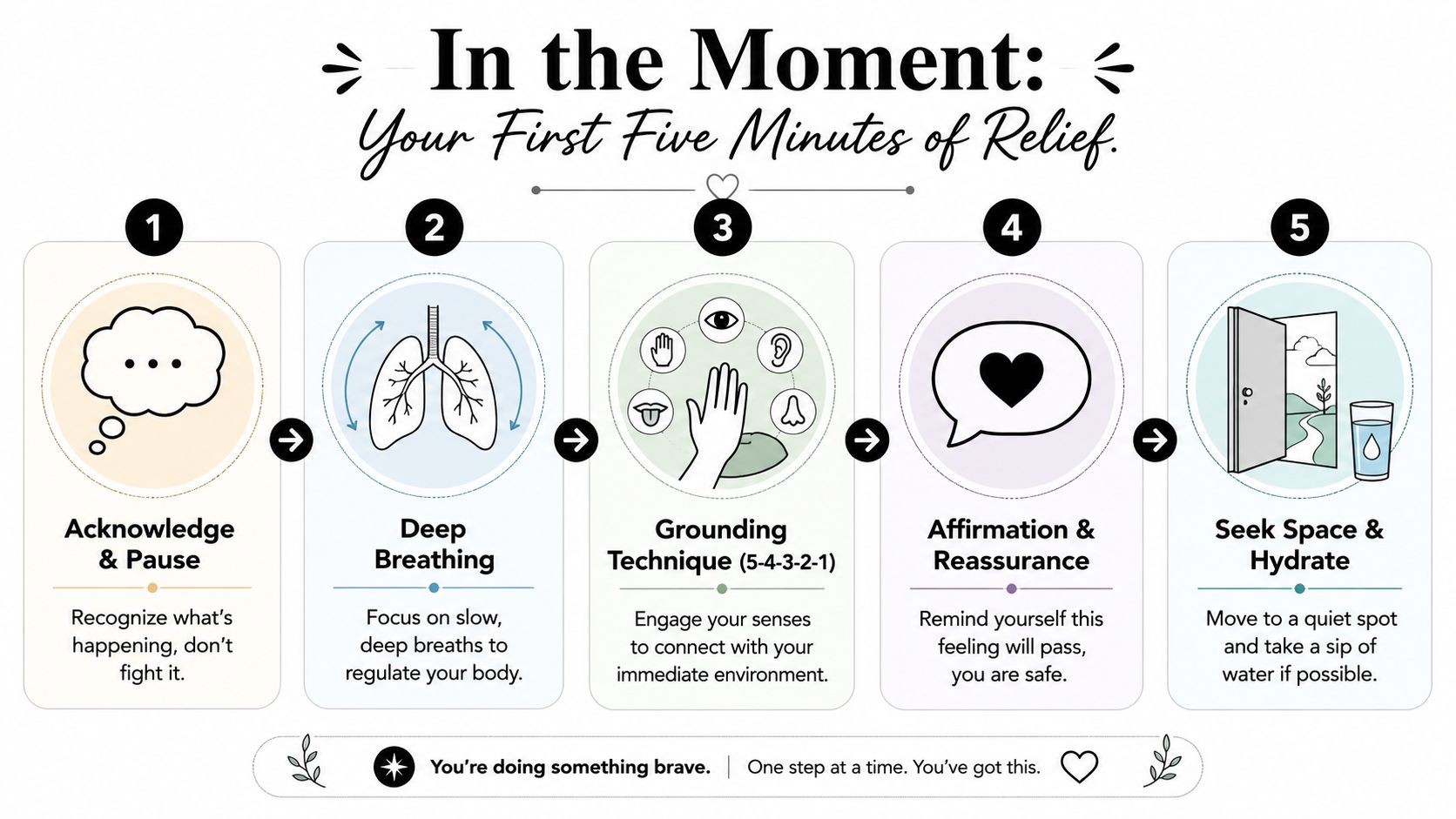
When panic rises, your brain stops being a great strategist. That’s why you need a short script, not a clever one. Keep it simple. Get yourself somewhere quieter, reduce stimulation, and help your body come down without fighting it.
A useful reminder before you do anything else. Clinical guidance suggests panic attacks are brief and typically peak within 10 to 20 minutes, so the goal isn’t to force the feeling to disappear. The goal is to reduce escalation and ride the wave safely, as explained in this clinical guidance on panic attacks at work.
Step one retreat from stimulation
Leave the audience. Leave the open office. Leave the bright, noisy space if you can.
A bathroom, stairwell, empty meeting room, outside bench, or parked car can all work. The point is not escape forever. It’s reducing the extra input that keeps your alarm system firing.
Use one sentence with yourself: “This is panic. It will pass.”
Practical rule: Don’t debate with the panic. Name it, lower stimulation, and buy your body a little room.
Step two anchor your senses
Once you’re in a quieter spot, orient to what is around you. Panic pulls attention inward toward danger. Grounding turns attention outward toward the present.
Try the 5-4-3-2-1 method:
- Five things you see around you
- Four things you feel such as your shoes, the chair, the wall, your sleeves
- Three things you hear
- Two things you smell
- One thing you taste
If that feels like too much, simplify it. Hold a cold water bottle. Press both feet into the floor. Name the color of three objects in the room.
A guided tool can help when your mind goes blank. Some people use app-based prompts or SOS features to walk through grounding and anxiety breathing techniques without having to remember the steps themselves.
A short guided explanation can also help some people settle enough to follow through:
Step three reset your breathing
You do not need a perfect breathing pattern. You need a slower one.
Try this:
- Exhale first. Make the out-breath longer than feels natural.
- Inhale gently through the nose. Don’t gulp air.
- Pause briefly. Keep the pause soft, not forced.
- Exhale slowly again. Let your shoulders drop.
If counting helps, use a quiet count that feels manageable. If counting makes you tense, skip it and just focus on making the exhale longer than the inhale.
What usually doesn’t help in this moment:
- Arguing with the fear. Telling yourself “this is ridiculous” often adds more pressure.
- Rapid deep breathing. That can worsen lightheadedness.
- Flooding yourself with questions. “Why now? What if people noticed? What if this means something is wrong?” can drive the spiral.
- Rushing back too soon. Your body may need a few extra minutes after the peak passes.
The first five minutes are about safety, not performance. You are not failing by stepping away. You are interrupting a biological surge before it snowballs.
Navigating the Aftermath with Your Colleagues
Once the wave starts to ease, a different fear often kicks in. “What do I say now?” For many people, that part feels almost as stressful as the attack itself.
You do not owe everyone a full explanation. Disclosure at work is a choice, and for recurring episodes it’s often a practical one. Stigma keeps many people silent, but having a plan for what to say is one of the most useful ways to reduce future panic around work interactions, as discussed in this piece on managing panic attacks at work.
Quick scripts for the workplace
Here are simple scripts you can use without overexplaining.
Our GitHub: https://github.com/anxietychecklist
| Situation | What You Can Say |
|---|---|
| A colleague asks if you're okay | “I'm having a rough anxiety moment. I'm handling it and just need a few quiet minutes.” |
| You need to leave a meeting | “I need to step out briefly. I'll rejoin if I can, or I'll follow up afterward.” |
| Your manager notices something is off | “I had an acute anxiety episode and need a short reset before I decide whether I can continue today.” |
| You want limited disclosure | “I'm dealing with a health issue that flared up. I need a bit of privacy and a little time.” |
| You need support for recurring attacks | “I've been managing recurring anxiety symptoms at work, and I'd like to talk about adjustments that would help me stay functional.” |
These scripts work because they are short, calm, and specific enough to guide the next step. They also help if you struggle with social anxiety and fear of judgment, which can make even basic workplace conversations feel loaded.
How to decide what to do next
After an anxiety attack at work, don't ask only, “Can I push through?” Ask, “What will help me recover without making tomorrow harder?”
A simple way to decide is to sort the next hour into one of three lanes:
- Take a short break if your symptoms are easing and your thinking is returning. Sit somewhere quiet, hydrate, and avoid jumping straight into a high-stakes task.
- Switch to a low-concentration task if you can function but still feel shaky. Administrative work, light email, or organizing your to-do list is often better than presenting, complex analysis, or conflict-heavy conversations.
- Call it for the day if you still feel physically activated, foggy, tearful, or afraid you'll retrigger quickly.
If you need accommodations, you do not have to present your entire personal history. You only need enough clarity to start a useful conversation.
For recurring episodes, it's worth planning one conversation before the next hard day arrives. You might ask for flexible breaks, a quiet space, a modified meeting load, or a temporary reduction in a specific trigger task. Relief in the moment matters. A work plan matters just as much.
Returning to Your Desk and Your Confidence
Many people expect to feel normal once the physical symptoms drop. Instead, they feel wrung out, embarrassed, fragile, or hyperaware of everyone around them. I often call this the panic hangover. Your body has spent a lot of energy on alarm. Of course you feel depleted.
The panic hangover is real
You may replay the moment again and again. Did anyone notice? Did I sound strange? What if it happens tomorrow? That mental checking is understandable, but it can foster the next round of fear.
Try a more accurate interpretation. An anxiety attack at work is not proof that you are incapable. It is evidence that your nervous system got overloaded and needs a different response than shame.
A useful reframe is this:
“My body had a stress surge. I responded. Now I recover.”
That statement does two things. It lowers self-attack, and it keeps the event from turning into a story about your identity.
A gentler way back into work
If you return to your desk, make the first task easy to start and easy to stop. Open one email. Update one list. Review one document. Don't test your confidence by choosing the hardest thing on your plate.
A few small choices help people regain footing:
- Lower the bar for the next hour. Aim for steadiness, not brilliance.
- Reduce extra stimulation. Silence nonessential notifications and step away from group chatter if you can.
- Stay factual with yourself. “I had a surge of anxiety” is more stabilizing than “I made a fool of myself.”
- Notice avoidance early. If you start wanting to avoid every meeting, every call, or that particular desk area, treat that as a signal to get support rather than obeying the fear automatically.
Some people also find it helpful to make one private note after the episode. Write down what was happening before it started, what helped, and what made it worse. That turns a frightening blur into usable information.
Confidence usually doesn't return in one dramatic moment. It returns in small, ordinary acts of re-entry. One meeting attended. One honest conversation. One day you thought would be impossible, completed more calmly than the last.
Building Your Resilience to Live Panic Free
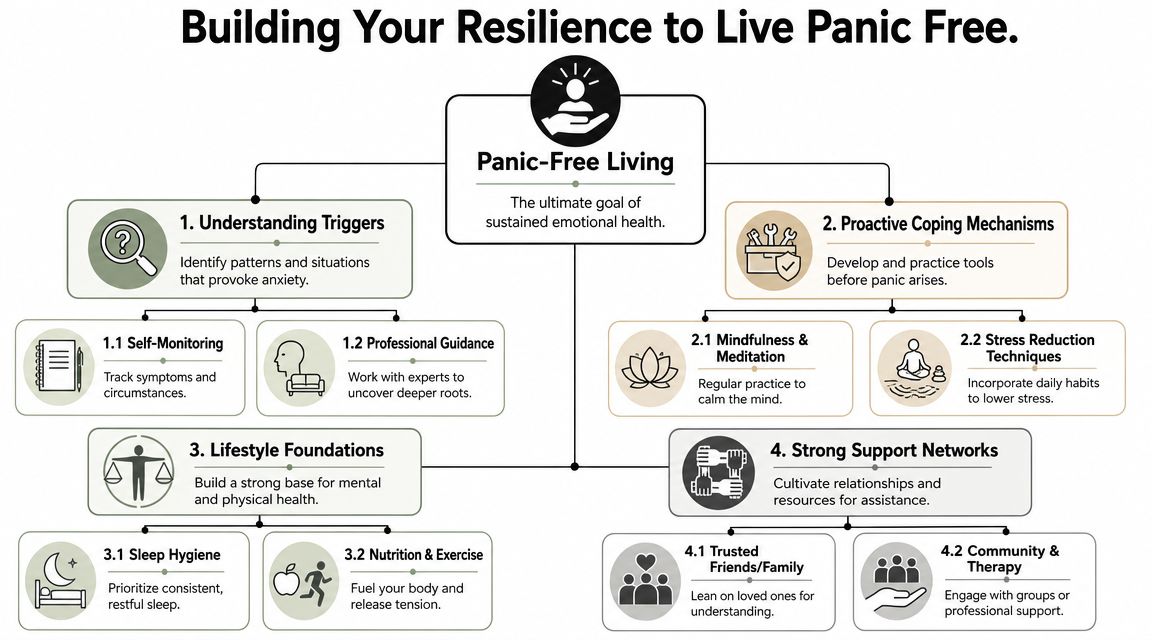
Lasting change usually doesn't come from mastering one emergency trick. It comes from lowering your baseline vulnerability, understanding your patterns, and retraining the fear response so work no longer feels like a minefield.
Research-supported treatment for panic often involves psychotherapy such as CBT, and a structured prevention plan combines daily stress regulation, trigger tracking, and graded exposure to avoided situations. Ignoring factors like poor sleep, heavy caffeine reliance, and having no workplace support plan can increase vulnerability, according to the National Institute of Mental Health's overview of panic disorder and treatment.
Stabilize the body that carries your mind
A stressed nervous system is more reactive. That does not mean panic is “just lifestyle.” It does mean your body needs a steadier foundation if you want fewer false alarms.
Focus on the basics that reduce vulnerability:
- Protect sleep. Irregular sleep leaves many people more physically keyed up the next day.
- Watch stimulants carefully. If caffeine is pushing your body toward jittery, wired, or chest-tight sensations, it may be feeding the cycle.
- Move on purpose. Gentle exercise, walking, and regular physical release can help discharge tension.
- Create recovery edges around work. Remote and hybrid jobs can blur the line between “working” and “recovering,” so build a real off-ramp when the workday concludes.
For some people, resilience also includes spiritual practices that slow the mind and widen perspective. If that fits you, reading plain-English Bible verses can be one calming resource alongside therapy and practical coping tools.
Track the pattern not just the episode
Panic feels random when you only remember the peak. It starts making sense when you log the lead-up.
Pay attention to questions like these:
- What happened before the attack? A difficult call, conflict, too many meetings, no lunch break, a specific manager, a crowded commute?
- What was happening in your body? Little sleep, too much coffee, skipped meals, tension all morning?
- What did you fear would happen? Fainting, crying, being judged, making a mistake, losing your job?
When people track triggers consistently, they often notice that the issue isn't “work” as a whole. It's a cluster of conditions. Maybe it's back-to-back meetings with no decompression. Maybe it's customer-facing conflict. Maybe it's the pressure of being visibly “on” all day.
Retrain the fear cycle
The deepest healing often comes when you stop organizing your life around avoiding panic. In CBT, that may include learning how panic works, challenging catastrophic interpretations, and gradually re-entering situations your brain has labeled dangerous.
That gradual re-entry matters. If a conference room, presentation, elevator, or Monday stand-up has become linked with fear, rushing in can overwhelm you. Avoiding it forever teaches your brain the situation really was unsafe. Graded exposure sits between those extremes.
One practical support option is effective anxiety reduction steps. Another is using a structured tool like The Anxiety Checklist, which offers an SOS mode for acute moments and longer-term features such as guided meditations, thought journaling, exposure tools, and educational content. Used consistently, tools like these can help turn insight into habit.
Healing doesn't always mean never feeling anxiety again. Often it means this: the sensations stop running your decisions, the fear of the next attack fades, and your life gets larger while panic gets smaller.
From Surviving an Attack to Thriving at Work
An anxiety attack at work can make your world shrink fast. You may start doubting your body, your judgment, and your future. But the attack is not a verdict. It is a signal.
Signals can be answered.
Sometimes the answer is better in-the-moment care. Sometimes it's a conversation with a manager. Sometimes it's therapy, medical support, workload changes, stronger boundaries, or facing the specific situations you've started to avoid. If work itself has become loaded with dread, it may also help to spend time understanding ergophobia and how fear can attach itself to the workplace.
What matters most is this. Panic is treatable. The fear of panic is treatable too. People do recover from recurring attacks. They give presentations again. They sit in meetings again. They go to work without scanning for exits all day.
Seeking professional help is not a last resort. It is one of the clearest ways to take your life back.
If your attacks are recurring, intense, or changing how you live, reach out to a licensed therapist, doctor, or other qualified mental health professional. Ask for a plan, not just reassurance. Real healing is built step by step, and those steps can lead somewhere much better than mere survival. Calm, confidence, and a panic-free life are possible.
If you want structured support between therapy sessions or while you're building your own recovery plan, The Anxiety Checklist offers practical tools for both immediate relief and long-term anxiety care, including a free SOS mode, guided calming exercises, and self-paced CBT-based resources.