

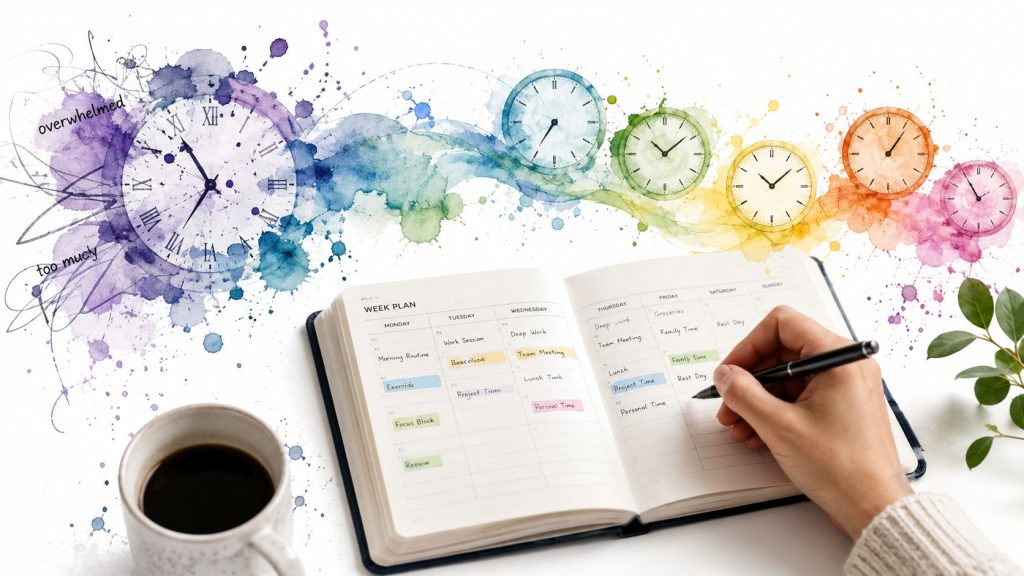
You're staring at your day, and it already feels too small for what's on it. The email keeps waiting. The report is still unfinished. Your phone keeps lighting up with reminders, and somehow even simple tasks feel heavy, slippery, and oddly urgent at the same time.
That feeling isn't laziness, and it isn't a character flaw. Anxiety time management is really a nervous-system problem first and a scheduling problem second. When your body is on alert, time doesn't feel neutral anymore. It can feel like a threat, a trap, or a test you're already failing.
The good news is that this can change. You do not need a perfect planner or a stricter personality. You need a calmer structure, a few SOS tools for the hard moments, and a way to keep rebuilding the pattern without shaming yourself every time the day goes sideways.
Table of Contents
- When the Clock Becomes the Enemy
- How Anxiety Warps Your Sense of Time
- Your Anxiety-Aware Daily Planning Template
- Micro-Tasks and Panic-Safe Time Blocking
- SOS Tools, Worry Time, and CBT Anchors
- When Time Management Backfires and How to Reset
- A Hopeful Path to Panic-Free Days
When the Clock Becomes the Enemy
It's 9:12 a.m. You meant to start at 9:00. The report is open, the inbox is open, and your body has already decided something is wrong. You reread the same line in an email five times, then check the calendar, then the clock, then the email again. Ten minutes pass, and your brain turns that into proof that the whole day is slipping away.
That's the moment a schedule stops being a neutral tool and starts feeling like a threat. Anxiety makes time feel louder, faster, and more dangerous than it really is. Research on worry and time structure found that people with more organized, purposeful, and planned use of time reported less worry and better psychological adjustment, while a fragmented or unstructured sense of time was linked to more worry, which helps explain why chaos in the day can feed chaos in the mind (science-direct abstract).
Why structure helps, but rigidity doesn't
There's an important difference between structure and overcontrol. Structure gives your brain something to trust. Overcontrol gives it another way to panic. That's why a good anxiety plan isn't about stuffing every minute, it's about creating enough predictability that your nervous system can settle.
A calm day usually starts before the hard feeling fades. It starts when the plan is simple enough that you can still use it while anxious.
That's also why general productivity advice often backfires. A tight to-do list can make an already worried person feel like they've failed before they've begun. If you're trying to find support for a deeper pattern, it can also help to find private anxiety diagnosis help so you're not trying to puzzle this out alone.
For people looking to compare different self-support approaches, the broader set of mental health tools for anxiety can be useful as a reference point. The key idea is simple, though. Calm time management is not about becoming more disciplined. It's about helping your body stop treating the clock like a danger signal.
How Anxiety Warps Your Sense of Time
Anxious time distortion usually shows up in patterns, not in one dramatic moment. Once you can name the pattern, you can stop arguing with yourself and start responding more cleanly.
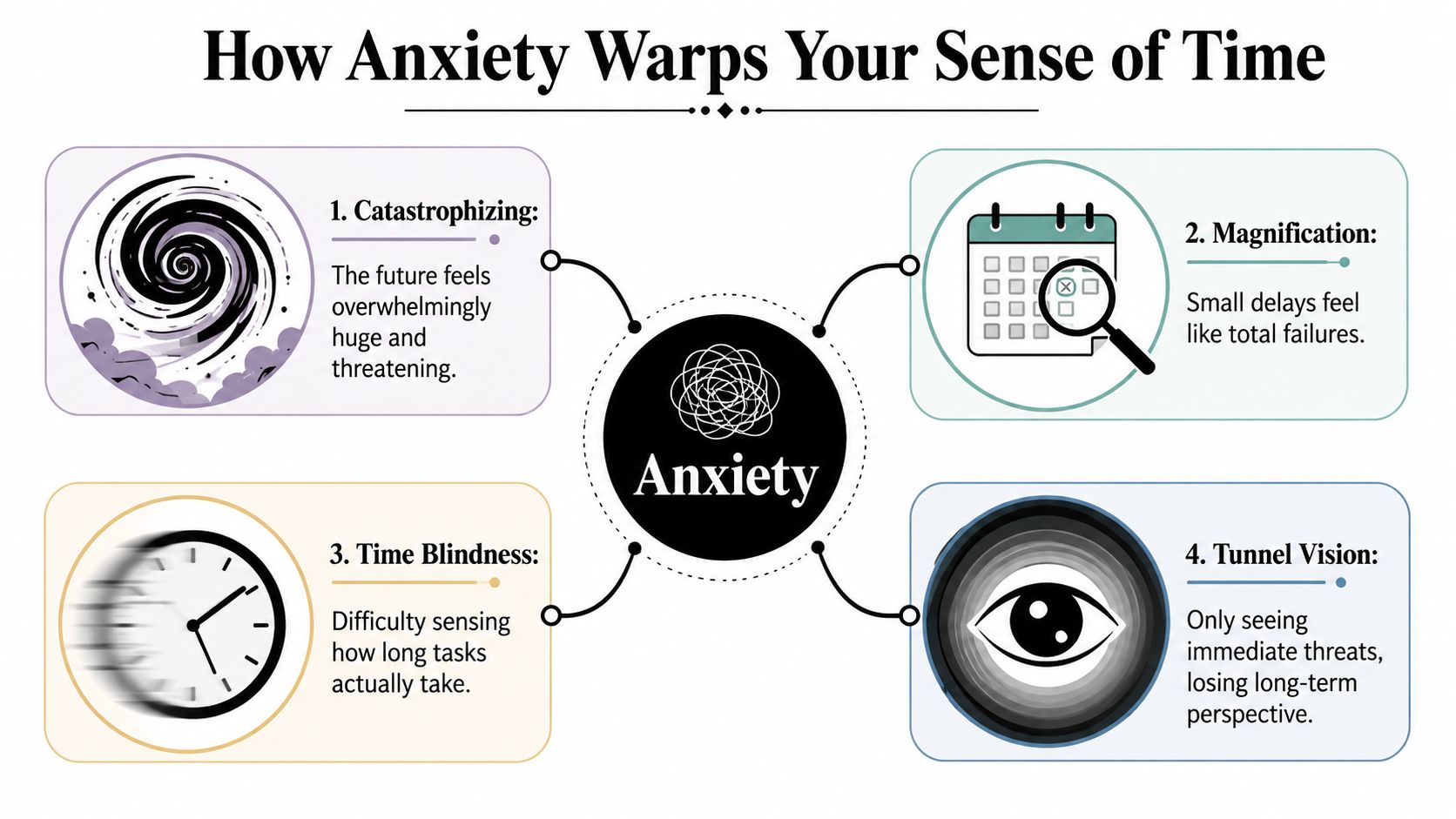
Catastrophizing the clock
This is the thought that one missed deadline means everything is collapsing. You're twenty minutes late sending a message, and your brain says the day is ruined. The result is usually not better performance, but more panic and less action.
Avoidance loops
Avoidance often looks productive from the outside. You reorganize folders, reread instructions, or tweak your notes because starting the primary task feels too big. A short task can disappear into an hour of “getting ready,” and the clock only makes that spiral worse.
Perfectionist scheduling
This is the habit of packing the day so tightly that any interruption feels like failure. A single delay then knocks out the rest of the plan, not because the work was impossible, but because the system had no breathing room. If you need a practical comparison point for how people build time around attention limits, time blocking for ADHD shows how a structured day can still leave room for real life.
Somatic hijacking
Sometimes the body takes over before the mind can think. Your chest tightens, your stomach drops, and time seems to freeze or race. You may sit there staring at a task you know is small, but your nervous system treats it like a threat.
If you've noticed this pattern in yourself, the same kind of mental looping often shows up with worry, rumination, and mental checking. For that, coping with overthinking and anxiety can help you label the pattern instead of feeding it.
The point is not to diagnose yourself. It's to recognize which trap is active so you can choose the right response instead of trying the same fix for every kind of anxiety.
Your Anxiety-Aware Daily Planning Template
The most useful morning plan is not the longest one. It's the one your brain can still use when you're already tense. A pragmatic randomized controlled trial found that a group-based time-management intervention produced statistically significant improvements in time-management skills, organization, emotional regulation, and self-efficacy, with most gains sustained at 3 months, using a capture, clarify, organize, reflect, engage task triage with weekly review (trial).
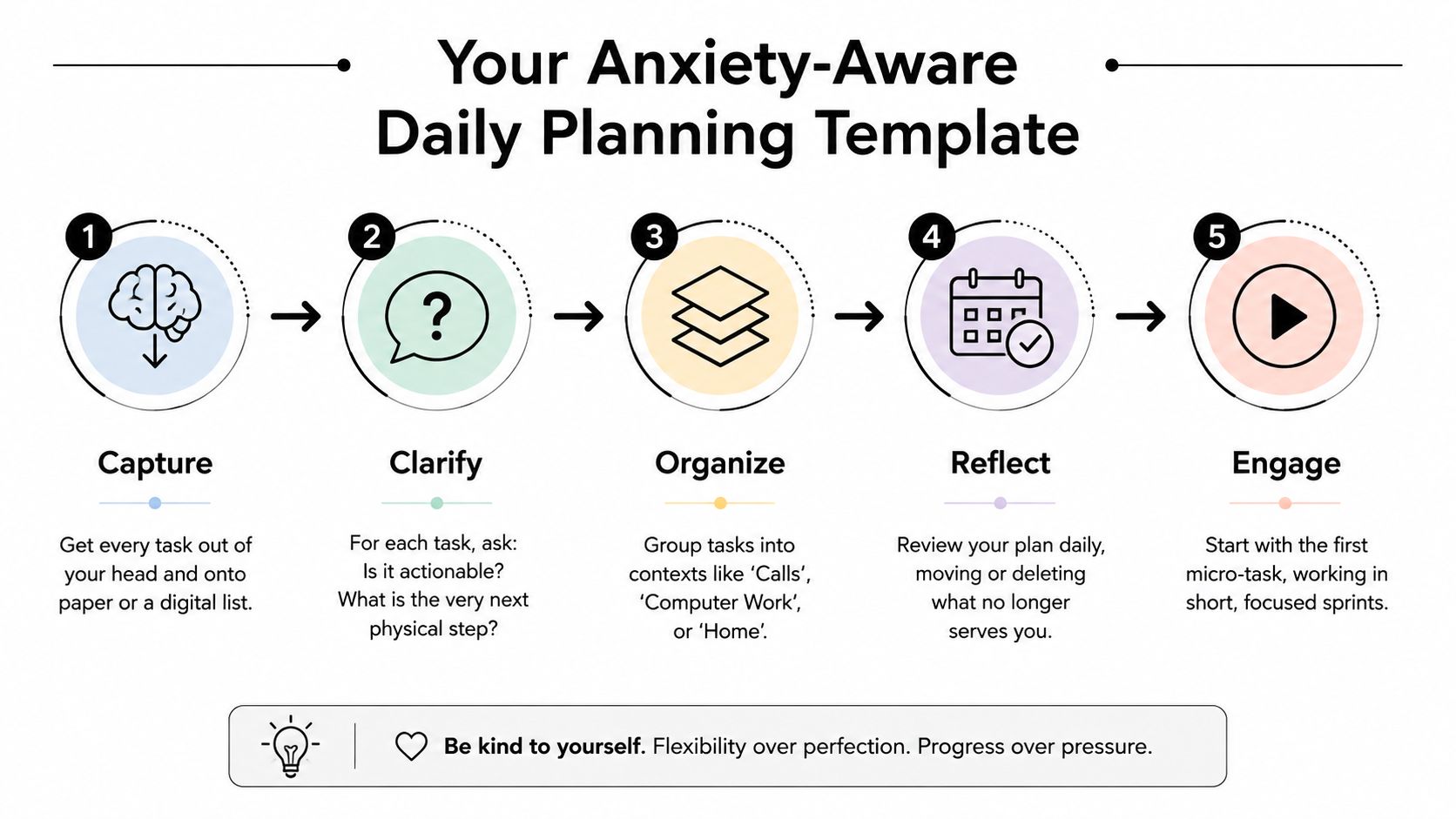
Start with capture
Take everything out of your head. The work report, the appointment, the text you keep meaning to send, the bill, the dentist call. Don't sort yet, just capture. When anxious people keep tasks in working memory, they often feel like the mind is trying to carry too much at once.
Clarify what the task really is
Ask one question, what's the next physical step? Not “finish report.” More like “open the document and write three bullet points.” Vague tasks trigger vague fear, and vague fear is hard to move.
Organize by context, not by guilt
Group tasks by where they happen or what kind of energy they take. Calls in one place. Computer work in another. Home tasks in another. If you're a student, parent, or caregiver, this helps because the list stops pretending that every task has the same emotional cost.
Reflect before you begin
A brief review keeps the plan honest. What still matters today? What should move? What can wait without harm? You cut the list down to three meaningful priorities instead of trying to carry everything at once.
Engage with the smallest real start
Begin with the first micro-step, not the whole project. If the report is looming and you're already socially anxious about sending it, your first move might just be opening the file and naming the document. For people who want more general support for planning around anxiety, anxiety self-help guides can be a helpful companion.
A simple grounding cue makes the whole thing easier. One slow breath, shoulders down, feet on the floor, then one action. That's not a productivity trick. It's a way to tell your body the day is not an emergency.
Practical rule: if the plan feels like pressure, it's too big. Shrink it until it feels doable while anxious, not only when calm.
Micro-Tasks and Panic-Safe Time Blocking
Big projects often fail in the first ten seconds, not because they're impossible, but because they feel too undefined. Micro-tasks reduce that threat. They give your nervous system a tiny win, which often matters more than motivation.
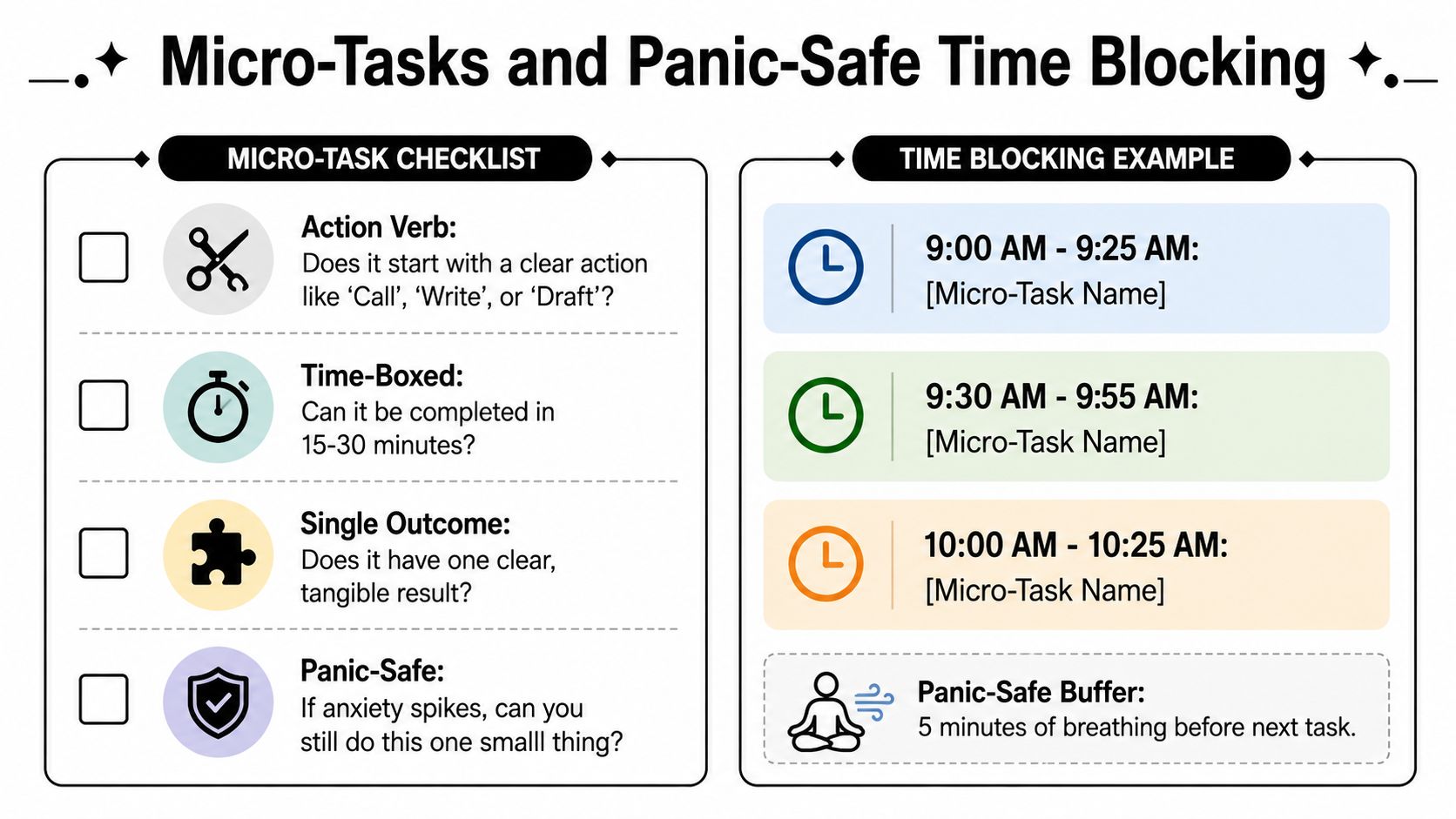
A simple micro-task recipe
| Step | What to Do | Why It Helps |
|---|---|---|
| Name it | Give the task one clear action verb. | The brain handles a clear target better than a foggy one. |
| Shrink it | Make it small enough to fit a short block. | Less anticipatory anxiety, less freezing. |
| Define done | Decide what “finished” looks like for now. | Prevents endless polishing and second-guessing. |
| Add a buffer | Leave a pause before the next thing. | Your body gets time to settle before it has to switch again. |
Two examples that feel real
If you've got a backlog of difficult emails, don't start with “clear inbox.” Start with “open the inbox and answer one message to the safest person.” Then take a break, even if it's brief. If you're facing a dreaded report, begin with “write the title and three rough bullets.” That is enough for the first block.
For people who use time-blocking more actively, SMART goals for panic relief can help you keep the task small enough to survive a spike in anxiety. The block itself should be honest, too. If you're running low on energy, schedule a low-capacity window instead of pretending it's a high-focus morning.
A modified Pomodoro can help when the mind is jumpy. Work for a short stretch, then take a real pause with no shame attached. If anxiety spikes before the end, stop the block and count that as information, not failure.
If the first task still feels impossible, make it smaller again. A panic-safe task is one you can do while your body is uneasy.
SOS Tools, Worry Time, and CBT Anchors
A plan only works if you know what to do when the plan falls apart. That's why the most stable anxiety time management systems include a fast rescue step, a daily worry ritual, and a longer-term way to change the thought habits underneath the panic.
The NHS recommends setting aside 10 or 15 minutes every day or so to write worries down, make a plan for what can be solved, and accept the rest, often before bed (NHS worry-time guidance). That fits naturally into a schedule because it gives the mind a place to put the noise instead of letting worry leak into every hour.
A three-layer toolkit
First, use an SOS routine when you feel flooded. A short grounding sequence, slow breathing, and a quick prompt can help when the mind goes blank. Then use worry time later, when you're not in the middle of a spiral, so the brain doesn't turn every thought into an emergency.
Third, keep a weekly CBT habit. That might be thought journaling, belief experiments, or noticing one repeated fear and testing it gently in real life. For a clear overview of those methods, find CBT therapy guidance can be a practical starting point.
How the layers work together
- Seconds: Ground your body when the panic hits.
- Hours: Contain worries in a set window instead of carrying them all day.
- Weeks: Challenge the beliefs that keep telling you time is running out.
For a more body-first option, grounding techniques for anxiety can help when thoughts are too loud to argue with. The point is not to choose one method and hope it fixes everything. The point is to build a stack of responses that match the size of the problem.
Worry gets smaller when it has a container. Without one, it expands into the whole day.
When Time Management Backfires and How to Reset
Sometimes the planner becomes part of the problem. You start checking the system more than doing the work, and each missed block feels like evidence that you're failing at being organized. For someone already overwhelmed, that can trigger shame, avoidance, or a hard shutdown.
Research shows the relationship between time management and anxiety is not one-directional, and a rigid system may intensify guilt or avoidance for people already overwhelmed, which is why flexibility is built into evidence-based protocols (review).
Warning signs that your system has gone too far
If opening the planner makes your shoulders tense, the plan has become a threat cue. If you keep reshuffling tasks instead of starting them, the system is probably too detailed for your current state. If one missed morning makes you want to skip the whole day, the structure needs to soften, not harden.
A calm reset protocol
- Shrink the plan: Choose one priority, not five.
- Drop the time blocks for today: Use a single start point instead of a full schedule.
- Return to one grounding round: Breathe, orient, and settle the body first.
- Restart tomorrow: Rebuild with one priority and a smaller list.
That's not giving up. It's adjusting the dose. Flexibility protects momentum, especially when your nervous system is already tired.
If you've spent years turning every slip into a moral verdict, this part matters. The goal is not to perform perfect control. The goal is to keep coming back to the next useful step without turning the whole day into evidence against yourself.
A Hopeful Path to Panic-Free Days
The long view matters because change is easier to trust when you can see what to do on different kinds of days. On a good day, you can plan ahead and handle bigger work. On a hard day, stay with micro-tasks and simple time blocks. On a panic day, do the single next essential thing, ground your body, and reach for support.
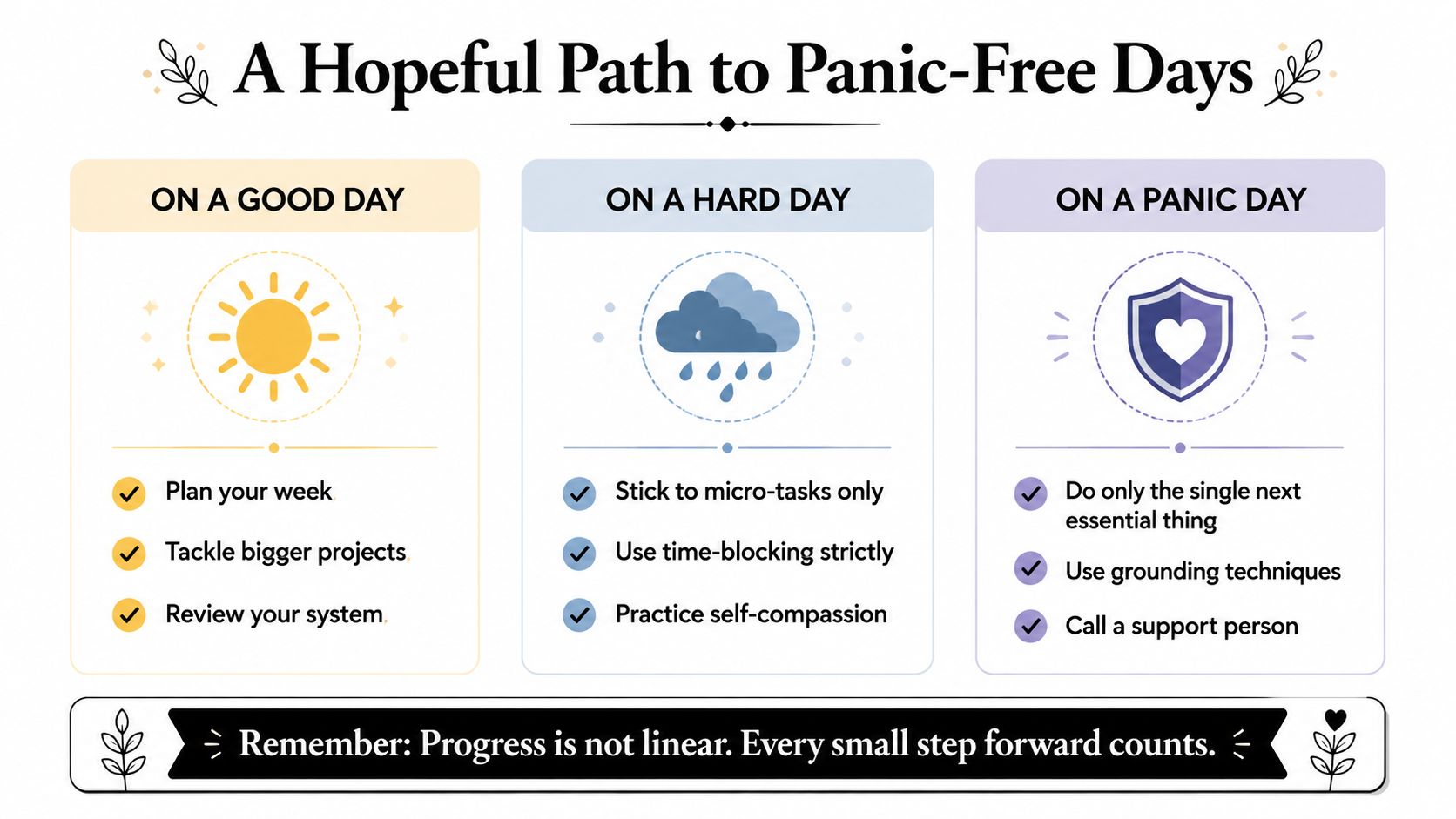
Structured digital programs that pair scheduling with self-monitoring can produce sustained improvement over time, which is a hopeful sign if you've been worried that this will never get easier. The change doesn't have to be dramatic to be real. It just has to be repeatable.
You can rebuild a calm relationship with time. You do not have to do it perfectly. Small, steady steps count.
If today is messy, don't use that as proof that the method failed. Use the method again tomorrow, smaller if needed, and let the body learn what safety feels like in real time.
If you want a calmer way to handle anxious days, The Anxiety Checklist can walk with you through grounding, daily structure, and longer-term tools without asking you to do everything at once. Use it when you need a quick SOS reset, a steadier routine, or a way to keep rebuilding after a rough day.