



If you find yourself avoiding eye contact, know this: it's rarely a reflection of your character. More often, it’s a sign your brain is trying to manage social overload. This isn't a permanent state you're stuck in. There’s a clear and hopeful path toward feeling more comfortable and connected, and this guide is here to walk you through it.
Your Path to Confident Connection

Feeling cut off from others because you avoid eye contact is an incredibly common struggle, but it doesn't have to define your life. Think of it as a subconscious defense mechanism—your mind's attempt to turn down the volume on social signals that feel too intense. This could be rooted in anxiety, past experiences, or even just the unique way you process the world.
But this is not a life sentence. Hope isn't just a feeling; it's the first step in a very real, achievable plan for change. You absolutely can heal from this anxiety and live a panic-free life.
How We'll Get There
This guide is designed to shed light on the real reasons you might struggle with eye contact, from your brain chemistry to the unwritten social rules we all navigate. We'll give you practical, step-by-step strategies to help you move forward at your own pace. The goal isn't to force yourself into awkward, prolonged stares. It's about building genuine comfort and turning something that feels scary into a tool for connection.
This process is about:
- Understanding the "why" behind the avoidance to take the fear out of it.
- Building skills slowly with manageable, low-pressure exercises.
- Noticing the small wins to create momentum and prove to yourself that healing is possible.
- Retraining your brain to see social interactions as safe, not as a threat, so you can live without panic.
As you start down this path, you'll find it's deeply connected to learning how to build self-confidence, which is a huge piece of the puzzle.
This journey is about taking back your power from anxiety so you can live a more fearless life—one glance at a time. You have the capacity to heal and connect authentically.
The way forward begins with understanding that your body and mind are simply trying to protect you. By learning new strategies, you can teach them that they no longer need to. For instance, even the way you hold your body can have a surprising impact on your mindset. You can learn more about using power poses to boost your confidence and reduce anxiety in our detailed guide.
Decoding the Meaning of an Averted Gaze

When you avoid eye contact, you’re sending a nonverbal signal—but it’s a signal that gets scrambled in translation all the time. To others, looking away can come across as disinterest, dishonesty, or even disrespect. But for you, it’s probably just a way to manage a flood of social or sensory input, a subconscious move to feel safe.
Think of it like a social volume dial. For many people, especially those with anxiety or sensory sensitivities, the intensity of a direct gaze feels like that dial is cranked all the way up. Looking away isn’t meant to be rude; it’s a desperate attempt to turn down the noise so you can actually think and process the conversation.
The Misinterpretation Trap
In a job interview or a serious conversation, this coping mechanism can be easily misunderstood. An averted gaze might be read as a lack of confidence or, worse, dishonesty. This creates a painful gap between what you intend and how others see you, and that misreading can have real consequences.
This often triggers a vicious cycle we call a ‘gaze trap.’ You start feeling anxious about how your lack of eye contact is being judged. That anxiety then makes it even harder to make eye contact. You're caught in a loop where the fear of being seen as "avoidant" is the very thing that paralyzes you.
The core problem isn’t your inability to look at someone; it’s the fear of what they will think when you don’t. Breaking free starts with understanding that their perception is not your reality.
These repercussions are especially significant at work. Research from institutions like Harvard Business School shows that when leaders avoid eye contact, it can lower psychological safety and make employees less likely to speak up. In a high-stakes meeting, dodging a gaze can signal fear or disinterest, potentially stalling a career.
Understanding the context behind an averted gaze is a crucial part of learning how to read social cues and managing a social anxiety disorder. By learning to separate your intent from someone else’s perception, you can start to dismantle the self-consciousness that keeps you stuck and pave the way for more authentic, panic-free connections.
How Cultural Norms Shape Eye Contact
The unwritten rules of eye contact feel so natural, it's easy to assume they're universal. But they aren't. What comes across as polite and respectful in one part of the world can feel aggressive or even dishonest in another. This global patchwork of social cues is a huge piece of the puzzle if you find yourself struggling to avoid eye contact.
In many Western countries, like the United States and parts of Europe, direct eye contact is the gold standard. It’s often read as a sign of confidence, honesty, and genuine interest. If you don't meet someone's gaze, they might see it as a red flag, pegging you as shy, aloof, or even untrustworthy. But that’s just one way of looking at it, literally.
A Global Perspective on Gaze
In many East Asian cultures, the rules are basically flipped. Holding a direct, steady gaze, especially with an elder or someone in a position of authority, is often seen as rude, confrontational, or a direct challenge. The respectful thing to do is to avert your eyes.
It’s a similar story in many Latino, Caribbean, and African communities, where children are often taught to lower their eyes when an elder speaks to them. It’s a simple, nonverbal way to show deference and acknowledge the social structure.
Understanding that your struggle isn't a personal failing but a potential cultural mismatch is liberating. It reframes the behavior from "What's wrong with me?" to "What are the rules of this specific social context?"
This cultural divide isn't just anecdotal; the research paints a clear picture. One 2013 study found that people in Japan and East Asia often perceive a direct gaze as aggressive. In fact, the data showed that Asians are 25-40% more likely than Westerners to interpret someone making eye contact as angry.
Contrast that with Western norms, where other studies show that avoiding eye contact for too long can slash a person's perceived honesty by as much as 30%. For the 264 million people worldwide living with anxiety, trying to navigate these clashing expectations can be a massive source of stress and panic. It's so pronounced that some surveys of Western expats in Tokyo report a 45% increase in stress just from trying to manage these different nonverbal cues. To dig deeper, you can read additional research on eye contact norms.
Finding Hope in Cultural Context
Realizing that the intense pressure to maintain constant eye contact is a cultural construct—not a universal law of human behavior—can be a massive relief. It takes the blame off you.
Suddenly, your instinct to avoid eye contact isn’t inherently “wrong.” It might just be out of sync with the expectations of your current environment. This knowledge is power. It gives you the context to move through different social situations with a little more grace and a lot less self-judgment, lighting a clear path toward healing from anxiety and living panic-free.
Understanding the Anxious Brain and Eye Contact
If you find yourself struggling to meet someone’s gaze, know this: it’s not a character flaw. It’s not some personal failing. What you’re experiencing is a deeply wired survival response, and understanding why it happens is the first real step toward calming your nervous system and taking back control.
The whole story starts deep inside your brain’s ancient survival center. Tucked away in there is a small, almond-shaped cluster of neurons called the amygdala. Think of it as your brain’s hyper-vigilant smoke detector, constantly on the lookout for danger. For someone living with anxiety, that smoke detector is often dialed up way too high, making it incredibly sensitive.
Your Brain on High Alert
When your amygdala is this overactive, even something as neutral as direct eye contact can get flagged as a threat. Your brain doesn't really stop to tell the difference between the "danger" of an angry predator and the "danger" of an intense, face-to-face social moment. It just screams, "Threat detected!"
This false alarm triggers the body’s fight-or-flight response, flooding your system with stress hormones like adrenaline and cortisol. Suddenly your heart is pounding, your palms get sweaty, and you feel an almost unbearable urge to get away. Looking down or turning away becomes your brain's quickest escape hatch. You can learn more about this process in our complete guide to the fight-or-flight response.
This kicks off a frustrating, self-reinforcing cycle:
- The Trigger: You make eye contact with someone.
- The Alarm: Your amygdala goes off, signaling "Danger!"
- The Response: You instinctively avoid eye contact to escape the intense discomfort.
- The Reinforcement: The wave of relief that follows convinces your brain that eye contact was the real threat all along, making you more likely to avoid it next time.
Realizing this isn't a choice but a conditioned reflex can be incredibly liberating. It means you aren't broken. And if your brain can learn this fear, it can absolutely unlearn it.
This isn't just theory; it’s a well-documented coping mechanism. A fascinating 2022 study used eye-tracking glasses and found that people instructed to avoid eye contact in crowded places did so by consistently looking down. Their gaze on faces plummeted from a typical 20-30% to less than 10%. For the 1.2 billion people worldwide living with social anxiety, this shows just how much averting your gaze is a real-world tactic to turn down the volume on perceived threats. You can dig into the full findings of this eye-tracking research to see the science for yourself.
Knowing this isn't just interesting—it's empowering. It proves your brain is just doing its job, trying to protect you, even if its methods are a bit outdated. With the right strategies, you can gently retrain it, showing it that you are safe and clearing the path for more confident connections and a panic-free life.
Your Step-By-Step Plan to Build Eye Contact Confidence
Feeling a little hopeful is a great first step, but having a concrete plan is what creates real, lasting change. This is your practical, step-by-step guide to gently building your comfort with making eye contact.
The goal here is progress, not perfection. We're going to teach your brain that you are safe, one small step at a time, paving the way to a life with less panic.
To do this, we’ll lean on a proven method from exposure therapy, where you gradually and safely face the things that make you anxious. Instead of throwing yourself into a high-stakes meeting, you’ll start small and build your way up. This process shows your nervous system that what it thinks is a threat is actually harmless.
Start with Safe and Controlled Practice
Your journey begins in a space where you have total control and zero social pressure. This first phase is all about getting comfortable with the simple act of looking, without any fear of judgment.
- Mirror Work: The first and safest person to practice with is you. Stand in front of a mirror and just try to hold your own gaze for a few seconds. Notice any feelings that bubble up, but don't judge them. Making this a daily habit helps normalize the sensation.
- Media Practice: Put on your favorite TV show, a movie, or a YouTube video. Practice making "eye contact" with the people on screen. Since they can't look back, it’s a perfect, no-risk way to get used to focusing on someone’s face.
Once you’ve practiced these steps for a bit and feel a little more comfortable, you're ready to start taking your new skills into the real world.
Gentle Techniques for Real-World Interactions
When you feel ready, you can start using a few specific techniques to make real-life eye contact feel much less intimidating. These strategies break the interaction down into manageable pieces, which keeps that overwhelmed feeling at bay.
The diagram below shows the lightning-fast mental shortcut that often leads to averting your gaze when anxiety kicks in.
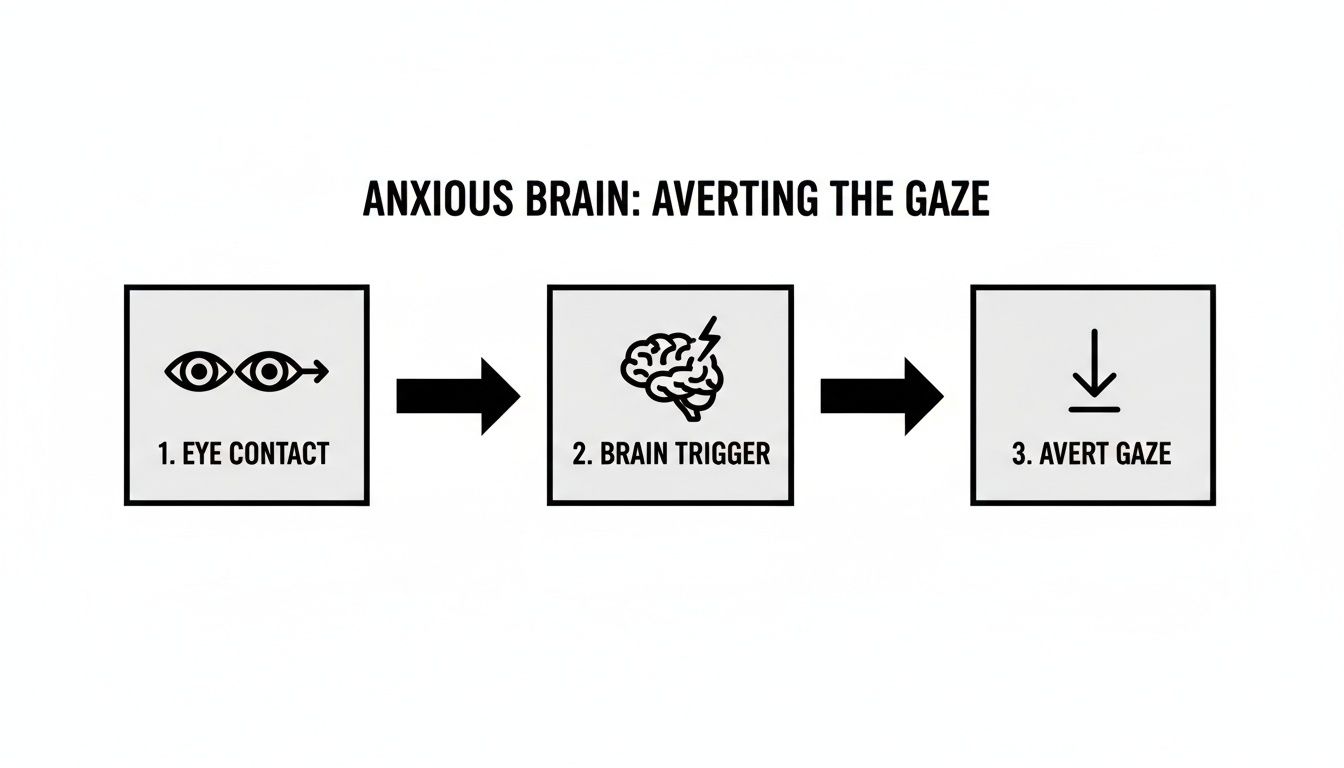
This simple flow—from eye contact to brain trigger to looking away—is the automatic cycle we want to interrupt with gentle, conscious practice.
Two powerful techniques can help you do exactly that:
-
The 3-Second Glance: When you're talking to a cashier or just passing someone on the street, challenge yourself to hold a soft gaze for just three seconds before naturally looking away. This short duration is completely normal in conversation and helps you build tolerance without feeling trapped.
-
The Triangle Gaze: Instead of forcing yourself to stare directly into someone's eyes, imagine a small, upside-down triangle on their face connecting their two eyes and their mouth. Let your gaze drift gently between these three points. This makes you appear engaged and natural, but it gives you somewhere else to look besides right into their pupils.
This gentle, consistent practice is how you retrain your brain. Each time you successfully complete a small step, you are sending a powerful message to your amygdala: "See? We are safe."
This kind of systematic approach is often organized using a tool called a fear ladder. You can learn more about how to create your own personalized exposure plan by checking out our guide on the Fear Ladder anxiety tool.
By creating your own ladder, you build a clear, hopeful roadmap that takes you from avoidance to confident, panic-free connection.
How to Support Someone Who Avoids Eye Contact
If you care about someone who struggles to make eye contact, your support can be a game-changer. It’s easy to feel confused or even a little hurt by it, but your patience and understanding can be the very thing that helps them feel safe enough to connect without fear.
The first and most important step? Reframe what their behavior actually means. When someone you care about avoids eye contact, it’s almost never about dishonesty, disrespect, or a lack of interest in you. See it for what it really is: a coping mechanism. Their brain is working overtime to manage overwhelming anxiety or sensory input, not to push you away.
Create a Safe Conversational Space
You can actively help by gently shifting the environment to lower the pressure. The goal isn’t to “fix” them but to create a space where connection feels easier and more natural. This small adjustment can offer immense relief and show them that a conversation doesn't have to be a source of panic.
Here are a few practical ways to do that:
-
Change the Scenery: Instead of a direct, face-to-face conversation across a table, try side-by-side activities. Going for a walk, taking a drive, or just watching a movie together creates opportunities for conversation without the unspoken demand for constant eye contact.
-
Offer Gentle Language: Avoid phrases that can feel like a command, such as, "Look at me when I'm talking to you." This will almost certainly spike their anxiety. Instead, use language that validates their experience and removes any sense of blame.
A simple, "I'm always here to listen, whether you're looking at me or not," can be incredibly powerful. It tells them you value what they have to say more than how they say it.
- Don't Take it Personally: This is a big one. It's crucial to remind yourself that their need to avoid eye contact is about their internal state of comfort, not their feelings for you. Understanding this allows you to stay in their corner as a supportive ally, rather than becoming another source of pressure they have to manage.
When you offer compassion instead of judgment, you become an active part of their healing. You show them that genuine connection is possible without them having to sacrifice their own sense of safety, reinforcing the hope that they can navigate the world without anxiety calling all the shots.
Common Questions About Eye Contact and Anxiety
When you're trying to get a handle on anxiety around eye contact, a lot of questions pop up. Getting clear, real-world answers can make all the difference, showing you that feeling better isn't just a fantasy—it's completely achievable. Let's tackle some of the most common concerns.
Is It Ever Okay to Avoid Eye Contact?
Of course. The goal here isn't to win a staring contest. Nobody holds intense, unbroken eye contact all the time. That would feel unnatural and, honestly, pretty intimidating for everyone involved. It’s perfectly normal to glance away when you're thinking or just need a second to reset.
The issue isn't looking away; it's avoiding eye contact out of a deep-seated fear that's running the show and messing with your life. The real aim is to get to a place of comfortable, confident connection, where you decide when to look away, not your anxiety.
The hope isn't to force constant eye contact. It's to turn avoidance from a fear-based reflex into a conscious choice, giving you back the power to connect on your own terms.
How Can I Practice Without Feeling Overwhelmed?
The secret to building confidence without sending yourself into a panic is to start small and keep the stakes low. Practice in places where you feel totally safe. You could even begin by making eye contact with characters on TV or in a YouTube video. It sounds silly, but it works.
Once you’re comfortable with that, try brief, low-pressure interactions with people you won't see again, like a cashier or the person making your coffee. You can use tricks like the “Triangle Gaze”—casually shifting your gaze between their eyes and mouth—to make it feel less intense. Each time you do this, you're teaching your nervous system that you’re safe, building the momentum you need to live without panic.
When Should I Seek Professional Help?
If avoiding eye contact is just one piece of a bigger social anxiety puzzle that’s getting in the way of your work, friendships, or relationships, reaching out for professional help is a smart, courageous move. Especially if you're having panic attacks or feel like you’ve hit a wall with your own efforts, a therapist can offer the structured support you need to heal.
A professional can guide you through proven methods like Cognitive Behavioral Therapy (CBT) and help you build a personalized plan for getting better. If you're on the fence about whether your anxiety is "bad enough" for therapy, a screening tool can give you some clarity. The Generalized Anxiety Disorder 7-item (GAD-7) scale is a great place to start.
At The Anxiety Checklist, we believe in giving you practical tools to take your life back from anxiety. The Fearless Living system offers a step-by-step framework to manage anxiety, stop panic in its tracks, and build confidence that lasts. Regain control and start your journey toward fearless living today.