

If you’ve ever been jolted from sleep by a racing heart, a crushing weight on your chest, and a sudden, overwhelming wave of terror, you know the uniquely isolating fear of a nighttime anxiety attack. It feels chaotic, life-threatening, and leaves you shaken, often terrified to even try falling back asleep.
But here is the most important truth to hold onto in those moments: this experience is manageable, and you absolutely can heal from it.
You Can Reclaim Your Nights from Panic
Living a life free from the dread of nighttime panic isn't some far-off dream—it's an achievable reality. This isn't about learning to "cope" forever. It’s about fundamentally retraining your body’s response to anxiety and turning that deep-seated fear into a sense of empowerment.
The journey begins with understanding that you are not broken, and you are far from alone in this.
A surprisingly Common—and Understandable—Experience
Waking up in a state of panic is far more common than most people realize. It’s not a sign of personal weakness or that you’re “losing it.” In fact, it’s a known phenomenon with a clear biological basis.
Research shows that a huge portion of people with panic disorder deal with these nocturnal attacks. One detailed analysis found that 47.9% of individuals with a panic disorder diagnosis have had them.
The timing isn't random, either. Studies show that around 80% of these episodes strike during the first third of the night, as you transition through lighter, non-REM sleep. During this stage, your brain can more easily misinterpret a normal bodily sensation—like a muscle twitch or a shift in your breathing—as a major threat, triggering the body's alarm system.
This isn't just a psychological event; it's physiological. Your body's "fight-or-flight" system has been accidentally switched on. Understanding this transforms the experience from a terrifying mystery into a solvable problem.
Shifting from Fear to Action
The path to healing starts with a powerful shift in perspective. Instead of feeling like a victim of these attacks, you can become an active participant in your own recovery. That feeling of helplessness is one of the worst parts of nocturnal panic, but you have far more control than you think.
This journey is all about learning and practicing a new set of skills—tools you can pull out not only during an attack but also in your daily life to build a stronger resilience to anxiety.
These skills include:
- Immediate Grounding Techniques: Simple, in-the-moment actions to anchor yourself in the present when you wake up in a panic.
- Targeted Breathing Methods: Specific exercises that send a direct "all-clear" signal to your over-activated nervous system.
- Cognitive Reframing: The skill of challenging and changing the terrifying thoughts that pour gasoline on the panic fire.
- Proactive Lifestyle Adjustments: Small, consistent changes to your daily habits that create a foundation of calm and well-being.
Why Hope Is Your Most Powerful Tool
Hope isn't just a nice feeling; it's a critical engine for healing. When you truly believe you can get better, you're motivated to take the small, consistent steps that create real, lasting change. Every time you successfully ride out an attack or practice a new coping skill, you're gathering evidence that proves your own strength.
For example, learning and mastering controlled breathing is a game-changer. By focusing on your breath, you can directly influence your heart rate and calm your body down, proving to yourself—in real time—that you can steer the ship out of the storm. We take a deeper dive into these methods in our guide on breathing exercises for anxiety, which gives you practical techniques you can start using today.
The road to a panic-free life is a process of unlearning old, wired-in fear responses and building new, calmer ones. It’s about more than just surviving the nights; it's about thriving during the days, confident in your ability to handle whatever comes your way. You have the capacity to heal, and this guide is your first step toward taking back your nights—and your life.
Understanding Why Nighttime Panic Attacks Happen
When an anxiety attack shatters the quiet of the night, your first instinct is pure survival. But once the immediate crisis passes, you’re often left with a haunting question: "Why on earth did that just happen?" The experience is so jarring it can make you feel completely lost, even questioning your own sanity.
Let’s get one thing straight: you are not "going crazy." Waking up in a panic isn't a sign of weakness. It's a sign that your body’s highly efficient alarm system has simply misfired.
Understanding the mechanics behind this frightening event is the first real step toward taking back control. It’s what turns the terrifying unknown into something tangible—a problem you can actually solve.
Is It a Nightmare or Nocturnal Panic?
Most people assume they were just having a terrible nightmare, but that’s often not the case. While a bad dream can absolutely trigger a panicked awakening, a true nocturnal panic attack frequently strikes out of a deep, dreamless, non-REM sleep.
This distinction is crucial for your peace of mind. It means you didn't "cause" the attack by dreaming of something scary. It feels like it came from nowhere because, in a way, it did—springing not from a story in your mind but from a brief glitch in your body’s sleep-to-wake transition.
- Nightmare-Induced Panic: You wake up with a racing heart after remembering bits of a frightening dream. The fear is tied directly to the dream's content.
- Nocturnal Panic Attack: You are violently jolted awake by the physical symptoms—a pounding heart, a feeling of choking, profuse sweating—with no preceding dream you can recall. The terror is a reaction to the sudden, unexplained physical sensations.
Recognizing this difference helps you see that your body is the source of the false alarm, not your conscious mind. This is a key insight, as it shifts the focus from fearing your own thoughts to understanding your body's signals.
Your Brain's False Alarm System
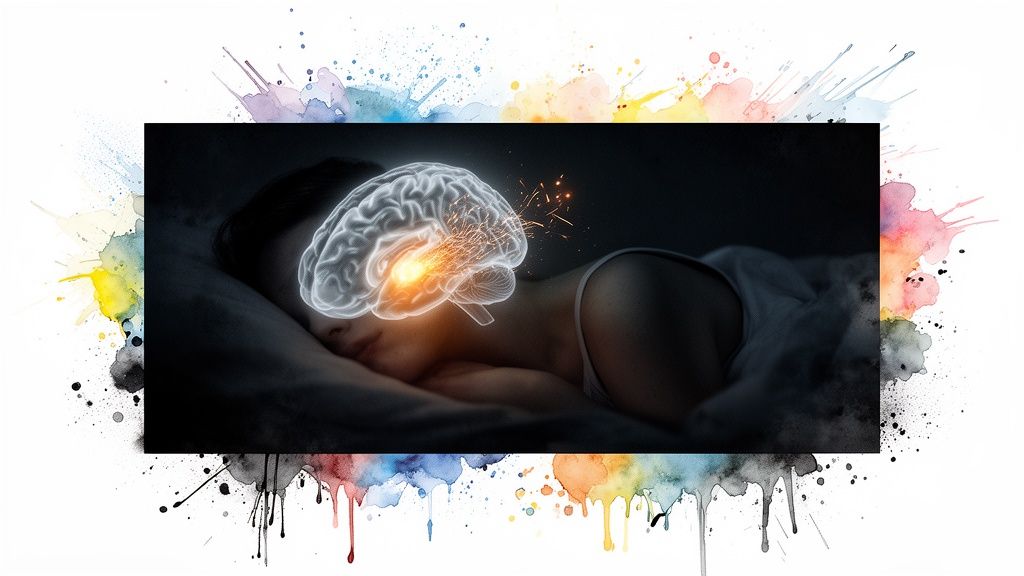
So, what is actually happening in your brain and body? It all comes down to a small, almond-shaped part of your brain called the amygdala. Think of it as your body's hyper-vigilant threat-detection center.
During certain transitions between sleep stages, your brain can become momentarily disoriented. In that brief confusion, it might misinterpret a perfectly normal physiological shift—like a change in your heart rate, a muscle twitch, or a deeper breath—as a sign of mortal danger.
In that split second, your amygdala hijacks your system. It screams, "DANGER!" and floods your body with adrenaline and cortisol. This is the "fight-or-flight" response, the ancient survival mechanism designed to save you from a predator. The result is a sudden cascade of terrifying symptoms that yanks you from sleep.
Your heart isn't pounding because you're dying; it's pounding because your brain is trying to save your life from a threat that doesn't exist. This is a false alarm, not a real fire.
Understanding this process is incredibly empowering. It’s not some dark mystery; it’s a biological process that went awry. And because it's a process, it can be influenced and retrained. For a deeper look into the symptoms and cycle of panic, our guide on what a panic attack feels like can provide more clarity.
This knowledge gives you a foundation of hope. If you can understand the mechanism, you can learn to intervene, calm the system, and teach your brain that it’s safe. You absolutely can heal from this.
How to Redesign Your Day for Panic-Free Nights

Lasting peace from nighttime panic isn’t won in the darkness; it’s built in the daylight. While the grounding techniques we’ve covered are crucial for surviving an attack, true, sustainable healing comes from proactively creating a life that is less hospitable to panic in the first place.
This is where hope turns into action.
You have the power to redesign your days to create calmer, panic-free nights. This isn’t about piling on more stress with a rigid, complicated routine. It's about making small, intentional choices that slowly build a powerful fortress of calm around your sleep.
Fortify Your Mind Before Bed
One of the sneakiest triggers for a middle-of-the-night anxiety attack is going to bed with a mind full of unresolved stress. Even after you fall asleep, your brain keeps working on those problems, leaving you vulnerable to being jolted awake by panic.
A simple "brain dump" journaling practice can work wonders here. About an hour before you plan to sleep, take just ten minutes to write down everything that's on your mind—big or small. Don't try to solve anything or censor yourself. The goal is just to get the thoughts out of your head and onto paper, signaling to your brain that it's okay to let go for the night.
Once the worries are out, shift your focus to gratitude. List three specific things that went well during your day. This isn't just fluff; it's a practice that actively rewires your brain to seek out positives, creating a much calmer mental state as you drift off.
Prepare Your Body for Deep Rest
Your body holds onto the day's stress just as much as your mind does. That physical tension you feel in your shoulders or jaw is a major contributor to anxiety, and releasing it sends a direct signal to your nervous system that it’s safe to relax.
Progressive Muscle Relaxation (PMR) is a fantastic technique for this. Start with your toes: tense the muscles for five seconds, then release them completely for ten seconds, really noticing the difference. Work your way up your body—calves, thighs, glutes, and so on. This practice makes you acutely aware of what tension feels like, and more importantly, what true relaxation feels like.
This isn't just about relaxing your muscles; it's about breaking the connection between a physical sensation and a panicked thought. You're teaching your body that it can let go, which in turn calms your mind.
The connection between sleep and mental health isn't just a personal struggle; it’s a massive global issue. Poor mental health accounts for 16% of disease in adolescents worldwide. In the U.S. alone, an estimated 7.7 million adults suffer from PTSD, and a staggering 91% of them report symptoms of insomnia. The economic impact is also immense, with insomnia-related errors in the workplace costing the U.S. economy $31.1 billion annually. These numbers underscore just how vital proactive sleep hygiene is.
Your Anti-Anxiety Sleep Hygiene Checklist
Creating a solid sleep routine is one of the most powerful things you can do to prevent nocturnal panic. It’s not about perfection, but consistency. Use this checklist to build a nightly wind-down that tells your body and mind it’s time for rest.
| Habit/Action | Why It Works | Simple First Step |
|---|---|---|
| Set a Caffeine Curfew | Caffeine has a half-life of 5-6 hours, meaning a 3 PM coffee can still be active in your system at 9 PM, making deep sleep difficult. | No caffeine after 2 PM. Switch to herbal tea or water in the afternoon. |
| Limit Alcohol Before Bed | While it might make you feel drowsy, alcohol disrupts sleep later in the night, leading to lighter, more fragmented rest where panic can thrive. | Avoid alcohol at least 3 hours before bed. If you do drink, have a glass of water for every alcoholic beverage. |
| Avoid Late-Night Sugar | A sugary snack can spike and then crash your blood sugar, which can trigger the release of stress hormones like adrenaline and cortisol. | If you need a late snack, choose something with protein and healthy fat, like a small handful of almonds or a piece of cheese. |
| Create a "Screen-Free" Hour | The blue light from phones, tablets, and TVs suppresses melatonin production, the hormone that tells your body it's time to sleep. | Put your phone away at least 60 minutes before bed. Read a physical book, listen to a podcast, or do some light stretching instead. |
| Keep Your Bedroom Cool & Dark | A cool, dark, and quiet environment is optimal for sleep. Your body temperature naturally drops as you prepare for rest. | Invest in blackout curtains and set your thermostat to between 60-67°F (15-19°C). |
Start by picking just one or two of these habits to implement this week. Small, sustainable changes are far more effective than trying to overhaul your entire routine at once.
Making these mindful choices is incredibly empowering. For a deeper dive into how your daily intake affects your anxiety levels, you can explore more about lifestyle and diet changes for anxiety management.
Every small adjustment is a concrete step you’re taking to protect your peace. Remember, you are not a passive victim of anxiety; you are the architect of your own healing.
Your Toolkit for Long-Term Freedom From Anxiety
Getting through a panic attack in the dead of night is one thing. Building a life where they don't happen in the first place? That's the real goal. It’s a shift from just surviving the night to creating long-term, sustainable peace. And it all starts with one core belief: you can fully recover and live a life free from panic.
This isn't about fighting an endless war against anxiety. It's about building a personalized toolkit of strategies that get to the root of the problem. Think of it as actively rewiring your brain's responses and taking back your power, one day at a time. Instead of bracing for battle every night, you’re building a foundation so solid that the battles just stop happening.
A huge piece of this puzzle is learning to see your thoughts for what they are—mental events you can observe, question, and even change, not absolute truths. This is the heart of what makes Cognitive Behavioral Therapy (CBT) one of the most powerful tools for overcoming panic.
Uprooting the Fearful Thoughts That Fuel Panic
An anxiety attack in the middle of the night is a raw, physical experience. But it's the thoughts that hook into the fear that keep the cycle spinning. Thoughts like, "I'm dying," "I'm losing control," or "This will never end" are like pouring gasoline on the fire.
The idea isn’t to force these thoughts away. It’s to get curious and challenge them. The next time a scary thought hijacks your brain, try stepping back and asking some pointed questions:
- Is this thought 100% true? Have I had this thought before? Did the thing I feared actually happen?
- What's a more realistic way to look at this? Instead of "I'm having a heart attack," you could practice a more balanced thought: "This feels terrifying, but I know it's a false alarm from my nervous system. It has always passed before, and it will pass this time, too."
- What would I say to a friend thinking this exact same thing? It’s amazing how much more compassion and logic we can offer someone else. It's time to offer it to ourselves.
This practice is called cognitive reframing, and it’s a skill you can strengthen over time. It creates a tiny, crucial gap between a scary physical feeling and a catastrophic thought—and in that gap, you find your power again.
Externalize Your Worries to Regain Control
Anxiety loves to live in the chaotic, abstract space inside your head. One of the most effective ways to shrink it down to size is to get it out of your head and onto paper. When you use a structured tool, you turn those vague, overwhelming fears into something concrete and manageable.
A simple "thought record" is a fantastic place to start. When anxiety hits, grab a notebook and write down the situation, the automatic thought that popped up, the emotions you felt, and then—this is the important part—intentionally write a new, more balanced thought.
Doing this consistently does more than just calm you down in the moment. It creates a logbook of your own progress. Over time, it proves to you that your fears are often just that—fears, not facts—and that you are absolutely capable of changing your own mind.
Hope is not a passive wish; it is an active practice. Every time you challenge a fearful thought or use a tool from your kit, you are casting a vote for a future free from panic. You are actively building your own recovery, one small step at a time.
This isn't just a mental game, either. It has a real, tangible impact on your physical state. As you build out your toolkit, even your environment starts to matter. For instance, considering how your mattress affects your mood and mental health is a small but valuable part of creating a sleep space that signals calm and safety to your nervous system.
Building Resilience with Actionable Steps
Healing isn’t a straight line. It's a series of small, positive actions that build on one another. Tracking your progress and layering in new, healthy habits is the best way to see just how far you’ve come.
Create Your Personal Roadmap:
- Identify Your Triggers: Keep a simple log of when your anxiety spikes. What time of day is it? What were you doing or thinking about? What stressors were in play? Over time, you'll start to see patterns, which gives you a map of where to focus your efforts.
- Schedule "Worry Time": This sounds counterintuitive, but it works. Set aside 15 minutes each day to let your brain worry on purpose. If an anxious thought pops up outside that window, jot it down and tell yourself you'll deal with it during your scheduled time. This teaches your brain to contain anxiety instead of letting it run the show all day (and night).
- Practice Physical Release: Your body literally holds onto stress, which can make you more vulnerable to panic. You have to give that tension somewhere to go. Integrating practices that discharge this physical stress is a non-negotiable. For a simple but incredibly powerful technique, check out our guide on using Progressive Muscle Relaxation for anxiety.
Every recovery story is built on these kinds of small, consistent actions. It's the person who starts by challenging just one negative thought a day. It's the person who commits to five minutes of muscle relaxation before bed, even when they’re tired and don’t feel like it.
These are the steps that transform you from someone who has anxiety into someone who is actively healing from it. This journey is about so much more than just getting through the night—it’s about building a resilient, empowered, and meaningful life where you're the one in charge. Freedom isn't just possible; it's waiting for you.
When You Might Need Professional Support
While self-help strategies can be incredibly powerful for managing an anxiety attack in the middle of the night, there are times when bringing in a professional isn’t just a good idea—it’s a game-changer.
Thinking about getting help isn’t a sign that you’ve failed. Far from it. It’s a sign of profound strength and self-awareness. It means you’re ready to add an expert guide to your team, someone who has a map for the very territory you’re trying to navigate. This isn’t a last resort; it’s a proactive, hopeful step toward getting your life back.
Ruling Out Physical Causes First
Before you dive deep into anxiety-focused solutions, it’s smart to check in with your doctor. Some medical conditions can perfectly mimic the terrifying symptoms of a nocturnal panic attack, and getting a clean bill of health can bring a huge sense of relief.
Your doctor can run some straightforward tests to rule out issues like:
- Sleep Apnea: This condition can cause you to stop and start breathing during sleep, leading to sudden, gasping awakenings that feel exactly like a panic attack.
- Thyroid Issues: An overactive thyroid, or hyperthyroidism, can rev up your system, causing a racing heart, sweating, and intense feelings of anxiety.
- Heart Conditions: Though less common, certain heart rhythm problems can trigger sudden and alarming symptoms, especially at night.
Getting these possibilities off the table is empowering. It lets you know your body is safe, so you can focus all your energy on tackling the anxiety head-on.
Recognizing the Signs It's Time for More Support
So, how do you know when self-help isn’t quite enough? There’s no magic formula, but if you're nodding along to the points below, professional guidance could make a world of difference.
Acknowledging you need support is the first step toward building a life where anxiety no longer makes the rules. It’s a courageous decision that opens the door to powerful, evidence-based healing strategies and a future you control.
Consider reaching out to a professional if you’re noticing:
- Increasing Frequency: The attacks are happening more often, shifting from a once-in-a-while nightmare to a regular part of your week.
- Fear of Sleep: You start dreading bedtime. The thought of going to sleep fills you with anxiety because you’re afraid another attack is waiting for you.
- Daytime Impact: The exhaustion and fear are spilling into your days, affecting your work, your relationships, and your ability to just enjoy life.
- Avoidance Behaviors: You find yourself avoiding things you think might trigger an attack—like a certain food, a late-night movie, or even traveling.
If any of this sounds familiar, a therapist can give you the tools and structure to break these patterns and get back in the driver's seat.
Finding Hope and Healing in Therapy
Therapy for anxiety isn't about endlessly rehashing your past. It’s a practical, skills-based approach designed to give you your life back, and the results speak for themselves. Cognitive Behavioral Therapy (CBT), in particular, is seen as the gold standard for panic, with a success rate of 80-90%.
CBT works by teaching you how to break the panic cycle. You’ll learn to:
- Identify the catastrophic thoughts that pop up and fuel the fear ("I'm having a heart attack," "I'm losing control").
- Challenge those thoughts by looking at them with logic and real-world evidence.
- Reframe them with more balanced, realistic, and calming alternatives.
A good therapist acts like a coach, guiding you through these techniques and tailoring them to your specific triggers. They help you build a mental toolkit to manage not just the attacks themselves, but the underlying anxiety that causes them. To get a better sense of what this involves, you can learn more about psychotherapy for anxiety and see how it works.
Reaching out for help is a profound act of self-advocacy. It’s you, declaring that you believe a panic-free life is possible—and that you're ready to take the steps to make it your reality.
Answers to Your Biggest Questions About Nighttime Anxiety Attacks
After being jolted from sleep by panic, your mind is probably racing. It's a terrifying experience, and it’s completely normal to feel disoriented, scared, and full of questions. Getting clear, honest answers is the first step toward reclaiming your nights and trusting your body again.
Let’s walk through some of the most common fears that surface after a nighttime attack and get you the reassurance you need.
Can a Nighttime Anxiety Attack Actually Hurt Me?
This is usually the first and most urgent question, and I want to be crystal clear: no, a panic attack itself is not physically dangerous, even though it feels like it is.
The pounding heart, the feeling that you can’t breathe, the shaking—it’s all your body’s “fight-or-flight” system going off by mistake. It’s a false alarm. The attack won’t cause a heart attack or make you stop breathing. Once a doctor has confirmed there are no other underlying medical issues, you can hold onto this fact like a lifeline.
The feelings are terrifyingly real, but the danger is not. Reminding yourself of this truth, even mid-panic, is a powerful way to calm your nervous system.
Every time you get through an attack, you’re gathering proof that you are safe and that you can handle it. The real work is learning to manage the fear of the symptoms, not surviving a physical threat.
Why Do I Only Get Panic Attacks When I’m Asleep?
Waking up straight into a panic attack feels bizarre and deeply unsettling. It often happens as your brain shifts between sleep stages. In that in-between state, your brain can misinterpret a perfectly normal body sensation—like a change in your heart rate or a muscle twitch—as a sign of extreme danger.
It’s often not even linked to a specific nightmare. Your brain’s fear center (the amygdala) just accidentally hits the panic button, flooding your system with adrenaline. Things like lingering daytime stress, unresolved worries, or even too much caffeine can make your nervous system more “on edge” and prone to these nighttime glitches.
Understanding this can take away some of its power. It’s not some hidden, dark part of you that only comes out at night. It's a physiological misfire, and you can absolutely learn to manage it by calming your system before you even get into bed.
How Can I Stop Being Afraid to Go to Sleep?
After an attack, it makes perfect sense to start dreading sleep. Your bed, which should be a place of comfort, can suddenly feel like a danger zone. The goal here is to gently reteach your brain that your bedroom is a safe place.
There’s a powerful CBT-based strategy for this. If you get into bed and feel that familiar anxiety creeping in, don't lie there and wrestle with it. Get up. Go to another room and do something quiet and frankly, a little boring, for 15-20 minutes. Read a dull book (no thrillers!), listen to calm music, or do some light stretching.
Only go back to bed when you start to feel sleepy again. If the anxiety returns, repeat the process. You might have to do this a few times at first, but it teaches your brain a critical new rule: your bed is for sleep, not for worrying. It breaks the anxious association and helps you build back your confidence, one peaceful night at a time.
At The Anxiety Checklist, we believe that living a life free from panic is not just a dream, but an achievable goal. Our system provides a structured, step-by-step path to help you understand your anxiety, challenge your fears, and build a toolkit for lasting peace. Take the first step toward reclaiming your nights and your life at https://anxietychecklist.com.