


The benefits of positive thinking go way beyond just having a cheerful attitude. Think of it as a powerful, science-backed strategy for healing both your mental and physical health. If you're wrestling with anxiety and panic, shifting your mindset toward optimism is one of the most important first steps you can take to reclaim control and build a life that isn't ruled by constant worry. There is a way to heal, and this is where it begins.
Your Journey from Anxiety to Hope

When you're stuck in a cycle of chronic anxiety and panic, it can feel like you’re lost in a relentless storm with no end in sight. The constant worry, the racing heart, the fear of the next attack—it’s exhausting and can leave you feeling completely hopeless.
But what if you had a compass to help you navigate that storm and find your way to safety? That’s what this guide is all about. It’s here to show you that positive thinking isn't just a flimsy cliché. It's a practical, evidence-backed tool that offers real hope and a clear path to taking back control over your mind, your body, and your life.
The First Step to a Panic-Free Life
The path to healing from anxiety and living panic-free starts with a single, powerful shift in your belief system. Hope isn't just a feeling you wait for; it’s an active choice. It's the decision to believe that you can heal and that you have the power to influence your own mental state.
Think of this guide as your roadmap. It's packed with real, actionable strategies that can help you move from a place of constant fear to one of calm and resilience. Countless people, including our own founder, have walked this exact path by learning how to retrain their brains. They are proof that a panic-free life is not just a dream, but an achievable reality.
"Our brains are wired for survival, not happiness. This is known as The Negativity Bias, the tendency to focus more on negative events and threats than on positive ones."
This built-in bias is exactly what keeps the anxiety cycle spinning. Constructive positive thinking is the skill of intentionally pushing back against it. It’s about learning to challenge the catastrophic thoughts that fuel panic and swapping them out for more balanced, empowering ones. You'll learn that you can absolutely heal from anxiety and live a life free from panic. For a broader look at fostering emotional health, exploring different strategies on how to improve mental wellbeing can be incredibly helpful.
By committing to this process, you’re taking the most important step of all. Using structured tools like the Anxiety Checklist app can help you turn these ideas into concrete habits, guiding you from feeling hopeless to a place of genuine confidence and peace.
Understanding Constructive Positive Thinking
Let's get one thing straight right away. When we talk about the power of positive thinking, we’re not asking you to force a smile and pretend your problems don’t exist. That’s toxic positivity, and frankly, it’s a frustrating and invalidating approach that can make you feel even worse.
Instead, the real path toward healing from anxiety involves a skill we call constructive positive thinking. This isn't a personality trait you’re born with; it’s a practical tool you can learn. It offers a tangible way to find hope and start building a life that isn’t dictated by panic.
Think of it like this: chronic anxiety programs your mind to have a powerful "threat filter." This filter is incredibly good at its job, catching every negative thought, potential danger, and worst-case scenario. It keeps your world feeling scary and overwhelming, forcing you to stay on high alert.
Constructive positive thinking is the act of consciously adjusting that filter. You're not trying to ignore the negative stuff. You’re simply training your brain to also notice your own strengths, see potential solutions, and find opportunities for growth and healing.
From Disaster to Challenge
This mental shift is the difference between an automatic thought like, "This is a disaster," and a more balanced one: "This is a challenge, and I have what it takes to handle it." The first one fuels panic; the second one builds resilience. It starts with recognizing you have a choice in how you interpret what’s happening.
This skill has a name: cognitive reframing. It’s not some complicated psychological jargon—it's a simple, powerful mental habit that is central to healing.
Here’s what it looks like in action:
- Your Anxious Thought: "My heart is racing. I must be having a heart attack. I'm going to die."
- Your Reframed Thought: "My heart is racing, which is an uncomfortable but harmless symptom of anxiety. I've felt this before, and it always passes. I can use my breathing techniques to calm my body down."
See the difference? You’re not denying the physical feeling. You're just changing the story you tell yourself about it. That simple change is enough to alter your entire emotional and physical response. It's a powerful way to fight back against the cognitive distortions that anxiety loves to use. You can dive deeper into identifying these thinking traps in our guide on challenging cognitive distortions.
Rewriting Your Mental Habits
The negative thought patterns that trigger anxiety and panic are, at their core, just deeply ingrained mental habits. And like any habit, they can be identified, challenged, and eventually replaced with something more constructive. This is where the real hope lies—your current state of mind isn’t permanent. You have the power to change it.
Hope isn't about waiting for the storm to pass. It’s about learning to navigate your ship in the storm. Constructive positive thinking gives you the skills to take the helm.
The first step is to treat your thoughts as separate from yourself. You are not your anxiety. You are the person experiencing the anxiety, and you have the power to change how you relate to it. Every single time you catch a catastrophic thought and choose to reframe it, you weaken the old, anxious neural pathway and build a new one for calm and clarity.
This is a methodical practice, not wishful thinking. To really master it, try weaving different positive thinking exercises into your daily life. You’re not just hoping for a panic-free future—you're actively building it, one thought at a time.
The Physical Benefits of an Optimistic Mind
The connection between your mind and your body isn't just a saying—it's a powerful, biological reality. When you're stuck in a state of chronic anxiety, your body is constantly marinating in stress hormones like cortisol. This isn't just an unpleasant feeling; it's a physiological state that can lead to serious health problems over time.
Think of your body's stress response as a fire alarm. It’s designed to go off during a real emergency—the "fight or flight" response—and then shut right back down. For someone with anxiety, however, that alarm gets stuck in the "on" position.
This constant state of high alert keeps your system flooded with hormones that, in the long run, are damaging. This prolonged exposure can contribute to a host of physical issues, from high blood pressure and a weakened immune system to chronic inflammation and digestive problems. It’s clear proof that your mental state directly impacts your physical well-being.
And this is where positive thinking becomes such a crucial tool for healing. It offers a direct way to counteract these harmful effects and safeguard your long-term health.
Protecting Your Body from Chronic Stress
An optimistic mindset acts as a powerful counterbalance to the physical toll of anxiety. It’s not about pretending stress doesn't exist, but about changing how your body reacts to it. Cultivating positive thoughts helps deactivate that constant "fight or flight" response, allowing your body to return to a state of balance, healing, and repair.
When you practice constructive positive thinking, you help lower the production of cortisol. This simple mental shift kicks off a cascade of positive physical effects:
- It Strengthens Your Immune System: Research shows that optimistic people often have stronger immune responses. With less cortisol suppressing your immune function, your body gets better at fighting off everything from common colds to more serious infections.
- It Reduces Inflammation: Chronic stress is a major driver of inflammation throughout the body, which is linked to numerous diseases. A positive outlook helps calm this inflammatory response, protecting your joints, organs, and overall health.
- It Lowers Blood Pressure: By easing the tension in your mind, you also ease the tension in your cardiovascular system. Positive thinking has been consistently linked to lower blood pressure, reducing the strain on your heart and arteries.
This offers incredible hope. You have the power to protect your physical body from the damaging effects of anxiety, and it starts with learning to manage your thoughts. It’s a proactive strategy for long-term wellness.
The Overwhelming Evidence for a Healthier Heart
The link between a positive mindset and physical health isn’t just theory; it's backed by hard science. Some of the most compelling evidence comes from research on cardiovascular health, showing that optimism can be a remarkably effective shield for your heart.
Optimism is more than a feeling; it’s a form of health insurance for your heart and body. By cultivating a positive outlook, you are actively reducing your risk of future health problems and building a foundation for a long, vibrant life.
A landmark study from Johns Hopkins Medicine provided stunning proof of this connection. Researchers followed individuals with a family history of heart disease and discovered that those with a positive outlook were one-third less likely to have a heart attack or other cardiovascular event over a period of 5 to 25 years. This was true even for participants who already had the highest risk factors.
Even in the general population, the numbers were striking. Positive thinkers were 13% less likely to experience these events compared to their pessimistic counterparts. These findings highlight the tangible, life-saving benefits of cultivating optimism. You can explore the fascinating details of this research on the power of positive thinking and heart health.
The takeaway is clear and incredibly empowering. Learning to manage your anxiety through constructive positive thinking isn't just about feeling better mentally in the moment. It is one of the most significant steps you can take today to protect your physical health, reduce your risk of chronic illness, and build a more resilient, healthier future. It is a genuine pathway to healing, from the inside out.
How Positive Thinking Rewires Your Brain
Think of your brain less like a fixed circuit board and more like a dense forest. When you live with chronic anxiety, your thoughts carve deep, familiar paths of worry and fear. Over time, these become the default routes your mind travels, making catastrophic thinking feel automatic, almost instinctual.
But here’s the game-changer: you get to be the trailblazer. The science of neuroplasticity shows us that our brains are remarkably adaptable. By practicing constructive positive thinking, you’re not just wishing for a better mood—you’re actively forging new neural pathways. You're building a superhighway for calm and resilience, and with every use, it becomes stronger and more accessible than the old, overgrown trails of anxiety.
This isn't just a feel-good metaphor; it's biology in action. When you intentionally shift your focus toward gratitude, optimism, or simple joy, your brain gets the message and responds by changing its own chemistry. This is the foundation of true and lasting healing.
The Feel-Good Chemistry of Positivity
Thinking positive thoughts does more than lift your spirits in the moment. It actually alters the neurochemicals that can either fuel anxiety or help you break free from it.
- Serotonin: Often called the brain's "feel-good" chemical, serotonin is a key player in regulating your mood. It promotes a sense of well-being and calm. Deliberately focusing on positive experiences and thoughts can naturally boost its levels, helping you maintain a more stable, peaceful state.
- Dopamine: This is the neurotransmitter of motivation and reward. When you practice new, positive habits—like reframing a negative thought—your brain releases a little hit of dopamine. This reinforces the new behavior, making it easier and more rewarding to build lasting change.
This chemical shift is where the real power lies. It shows that by consciously guiding your thoughts, you can change how you feel on a fundamental, biological level. It’s a clear path away from the constant hum of anxiety and toward a state of genuine balance and freedom.
Bringing Your Brain's CEO Back Online
When anxiety flares up, it triggers the body’s ancient "fight or flight" response. This survival mechanism is so powerful that it effectively hijacks the most evolved part of your brain: the prefrontal cortex. Think of this area as your brain’s CEO—it's in charge of rational thinking, problem-solving, and keeping your emotions in check.
During a panic attack, that CEO is essentially knocked offline. The more primitive, fear-driven parts of your brain take the wheel, which is why it feels impossible to "think" your way out of panic. Constructive positive thinking is the practice that helps get your CEO back in the corner office.
By activating the prefrontal cortex, positive thinking quiets the brain's screaming alarm bells. It restores your ability to think clearly, assess situations logically, and regain emotional control.
This neurological shift has profound real-world effects. A more optimistic mindset doesn't just stay in your head; it kicks off a powerful chain reaction that leads to better physical health.
The flowchart below shows just how directly an optimistic mind can lead to a healthier body.
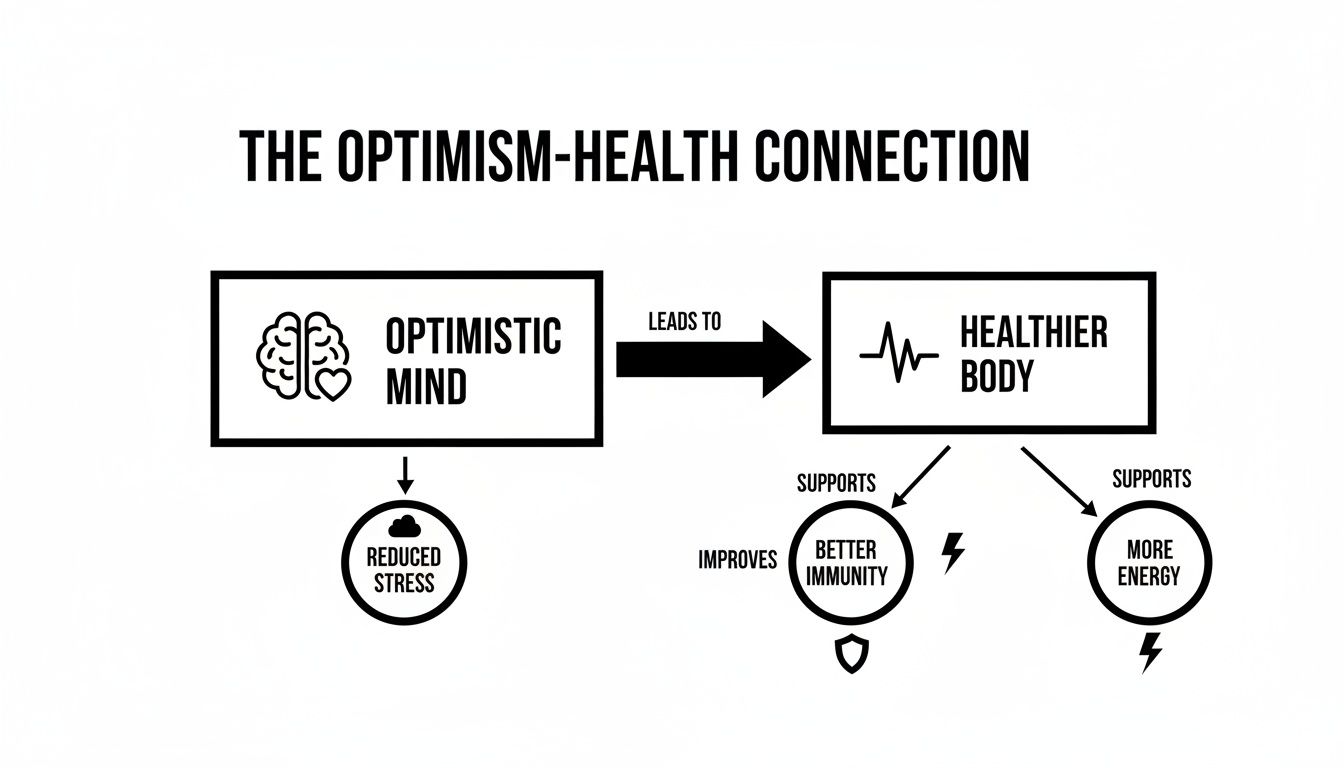
It’s clear that looking on the bright side isn't just about feeling happier emotionally; it's a direct route to improving your physical well-being.
Your thought patterns—whether they lean toward anxiety or optimism—create a cascade of real, physical effects in your body. Let's break down the direct mind-body impact.
Positive vs. Negative Thinking Mind-Body Impact
| Area of Impact | Effect of Negative Thinking (Anxiety Default) | Effect of Constructive Positive Thinking |
|---|---|---|
| Brain Chemistry | Floods brain with cortisol (stress hormone), depletes feel-good neurotransmitters. | Boosts serotonin and dopamine, promoting calm, focus, and motivation. |
| Nervous System | Keeps "fight or flight" response on high alert, leading to chronic tension and fatigue. | Activates the parasympathetic nervous system (rest and digest), promoting relaxation. |
| Heart Health | Increases heart rate and blood pressure, raising the long-term risk of cardiovascular disease. | Lowers blood pressure and reduces strain on the heart, improving cardiovascular health. |
| Immune Function | Suppresses the immune system, making you more vulnerable to illness and infection. | Strengthens the immune response, increasing resistance to colds and other illnesses. |
| Coping Ability | Narrows focus to threats, making it harder to problem-solve or see solutions. | Broadens perspective, improves creative problem-solving, and builds long-term resilience. |
As you can see, the choice between these two thought patterns has consequences that go far beyond your mood. It's a choice that directly shapes your physical health and your ability to navigate life's challenges.
A Cascade of Health Benefits
The mind-body connection isn't just talk; it's backed by decades of solid research. Studies show that people with an optimistic outlook don't just feel better—they live healthier, longer lives.
Research from institutions like the Mayo Clinic consistently finds that optimists have a lower risk of heart disease, an increased lifespan, and even greater resistance to the common cold. This isn't a coincidence. A positive mindset helps lower inflammation, improve cardiovascular function, and bolster your immune system.
This is the ultimate message of hope: you can heal. By consistently practicing new ways of thinking, you're not just putting a bandage on your anxiety symptoms. You are rewiring your brain and building a new foundation for lasting mental and physical wellness. Our guide on using meditation for anxiety offers another powerful tool to support this brain-changing journey.
Building Resilience to Face Panic Attacks
Resilience is one of the most important tools you can have when you're healing from anxiety. It’s not about becoming fearless or never feeling distress. True resilience is how quickly you bounce back when things get tough—and maybe even come out a little stronger on the other side.
This is where positive thinking really proves its worth. By practicing a constructive, realistic kind of optimism, you can build the mental fortitude needed to ride out the intense storm of a panic attack. It gives you the hope and the tools to believe you can get through this and live a life free from panic.
Think of your mindset like a muscle. Every time you face a panic symptom and jump to a catastrophic thought, you’re reinforcing the fear pathway. But when you choose to see it differently, you strengthen your resilience. This section is all about learning how to shift that narrative.
Redefining Your Relationship with Panic
For so many people, the scariest part of anxiety isn't the panic attack itself—it's the constant, nagging dread of the next one. This is often called the "fear of the fear," and it’s the very engine that keeps the panic cycle spinning. It’s an exhausting, secondary layer of anxiety that keeps you perpetually on edge.
Constructive positive thinking is your best strategy for dismantling this cycle. It helps you reframe the entire experience. Instead of seeing a panic attack as a sign that you’re losing control or in mortal danger, you can learn to see it for what it is.
A panic attack is a temporary and harmless surge of adrenaline. It's an intense but brief biological event that your body is fully equipped to handle. It is not a sign you are breaking, but a sign that your 'fight or flight' system is overactive—and you have the power to help it calm down.
This simple shift in perspective is incredibly empowering. It moves you from being a victim of your symptoms to an active participant in your own recovery. You start to understand that while the feelings are intense and deeply uncomfortable, they are not actually dangerous. This realization is a cornerstone of healing.
From Threat to Manageable Event
A resilient mindset doesn’t see challenges as catastrophic threats. It sees them as manageable events that you can learn from. When you feel those first familiar signs of panic—the racing heart, the dizziness, the tight chest—an anxious mind immediately defaults to the worst-case scenario.
A resilient mind, on the other hand, has been trained to take a different path:
- It acknowledges the feeling without judgment: "Okay, I feel that adrenaline kicking in."
- It validates the experience: "This feels scary, but I know exactly what it is. It's just anxiety."
- It recalls past successes: "I’ve been through this before, and I have always been safe on the other side."
- It activates coping tools: "Time to use my breathing exercises to help my nervous system settle."
This internal dialogue transforms an oncoming panic attack from a moment of pure terror into a problem to be solved. You start building undeniable proof of your own ability to cope, which is the very foundation of living a life free from panic.
This approach is backed by solid research. For instance, a study published in PMC showed that adults trained in positive thinking saw significant gains in resilience, a more positive outlook, and greater life satisfaction—and these effects were long-lasting. The researchers highlighted that building this mental skill is directly linked to better coping during hardship and lower overall distress. You can explore more of these findings on resilience and positive thinking.
By changing your perspective, you begin to build unshakeable confidence in your ability to handle whatever your anxiety throws at you. You learn that healing isn’t about getting rid of all fear, but about knowing, deep down, that you are stronger than your fear. That is the essence of a truly panic-free life.
Your Action Plan for Fearless Living

Knowing the science behind positive thinking is a great start. But real healing happens when you roll up your sleeves and put that knowledge to work. This is where you go from reading about hope to actually creating it—building a life where you call the shots, not your anxiety.
Think of it as turning a vague hope into a concrete plan. This is your toolkit for making those mental shifts stick, so the benefits of positive thinking aren't just something you understand, but something you feel every single day.
Turning Knowledge into Daily Habits
The first step? Stop just learning and start doing. You need a system that helps these new mindsets become second nature. One of the best places to start is with our 93-point interactive Anxiety Checklist, a spreadsheet designed to help you pinpoint the exact cognitive traps that are fueling your anxiety.
Instead of feeling steamrolled by a wave of negative thoughts, you can use the checklist to spot them, name them, and push back. It’s how you stop those anxious thought spirals before they even get going. You’re building a conscious awareness of your own mental wiring so you can change it.
From there, it’s all about consistency. We show you how to use simple habit trackers to build routines like a daily gratitude journal or visualization exercises. These aren’t just one-off tasks; they are skills. And just like lifting weights, practicing these techniques strengthens your brain's pathways for optimism and calm.
A panic-free life doesn't happen by accident. It's the result of consistent, intentional action. Tracking your habits creates a powerful feedback loop that proves to you, day by day, that you are capable of healing.
Your Path to a Panic-Free Reality
When you actively track your symptoms and your progress, something powerful happens. You start building a feedback loop of positive reinforcement. Seeing tangible proof that your anxiety is shrinking—fewer panic attacks, less daily worry—cements your new mindset and gives you the hope to keep going.
You’re basically collecting undeniable evidence of your own strength and resilience.
This kind of structured approach gives you a clear, supportive path to apply everything you’ve learned. It’s no longer about wishful thinking for a better future; it’s about taking real, concrete steps today to create that reality for yourself.
To make this even easier, you can reinforce these positive messages with tools like our guided affirmation app, which helps make positive self-talk an effortless part of your routine.
This is your action plan. It's the "how-to" for taking the science of optimism and making it your lived experience. A fearless, panic-free life isn't just possible—it’s the destination at the end of this practical, step-by-step journey.
Frequently Asked Questions About Positive Thinking
As you start to explore this, it’s completely normal to have questions or even a healthy dose of skepticism. Let’s tackle some of the most common concerns to give you some clarity. The truth is, you have more power than you think to heal from anxiety and live a life free from panic.
Can Positive Thinking Really Stop My Panic Attacks?
Positive thinking isn’t a magic button that shuts down a panic attack mid-crisis. Think of it more as a long-term healing strategy that dismantles the very thought patterns that fuel panic in the first place.
By consistently challenging those scary, fear-based thoughts, you’re actively weakening the anxiety pathways in your brain. It’s like mental training. With each repetition, you build the skill to short-circuit the fear cycle before it spirals out of control. It's a vital piece of the puzzle that empowers you to regain control and, over time, live a life with far fewer—or even zero—panic attacks.
I've Tried to Just Be Positive Before and It Failed. Why Is This Different?
That’s an incredibly common—and valid—experience. The whole "just be positive" mantra is a form of toxic positivity. It asks you to slap a smile on top of real, painful feelings, and that almost never works.
This approach is completely different. It's not about forced happiness; it’s about learning a structured skill we call constructive positive thinking.
This method is about acknowledging how you actually feel while deliberately choosing to focus on your ability to cope and find solutions. Using practical tools, like thought-challenging worksheets, turns this into a methodical practice instead of just wishful thinking. That's what creates real, sustainable change and offers a genuine path to healing.
How Long Does It Take to See Real Results?
The timeline is different for everyone, but the single most critical factor is consistency. Many people start to feel small but noticeable shifts in their mood and outlook within just a few weeks of daily practice—a little more hope, a little less dread.
More significant, lasting changes—like a lower baseline of anxiety and feeling more resilient against panic—usually take a few months to really take hold. Remember, you're rewiring years of mental habits. Every single day you practice, you're strengthening your brain's muscles for calm and resilience. This gradual but steady progress is what builds the foundation for a life free from panic. To dive deeper into this, you might find the resources in our Anxiety University helpful.
The journey to fearless living is a skill you build day by day. With The Anxiety Checklist, you get a structured, step-by-step system to turn these concepts into your new reality. Take control of your thoughts and start building your panic-free life today by visiting https://anxietychecklist.com.