



That sudden, terrifying sensation of dizziness paired with a surge of panic is a confusing and isolating experience. But you're not alone. The connection between vertigo and anxiety symptoms is very real, often creating a vicious cycle where anxiety triggers dizziness, and that dizziness then fuels even more fear. The most important message to hold onto is this: there is a clear path to healing, and you can learn to live a life free from panic.
Understanding the Anxiety-Dizziness Cycle
If you've ever felt the world tilt unexpectedly, followed by a wave of intense fear, you know the powerful grip of this cycle. It's a disorienting experience that can make you question your own body and mind, leaving you feeling vulnerable and constantly on edge.
But here’s the most important thing to know: this is not just "in your head," and you are not broken. This feeling is a common, well-understood phenomenon. Your mind and your body's balance system are incredibly connected. When anxiety strikes, it can directly create physical sensations of being off-balance or lightheaded. In turn, that frightening physical symptom becomes a new source of worry, locking you in a self-perpetuating loop.
Breaking the Feedback Loop
To regain control, the very first step is understanding what’s happening. This is often called the anxiety-dizziness feedback loop, and seeing it for what it is can be a game-changer. It’s the moment you stop blaming yourself and start seeing a clear path forward toward a calm and steady life.
Here’s how it usually unfolds:
- Anxiety Strikes: A stressful thought or situation triggers your body's fight-or-flight response.
- Physical Symptoms Appear: This response causes very real physiological changes, including lightheadedness or a feeling of unsteadiness.
- Fear Escalates: The sudden dizziness is terrifying, and your brain interprets it as a new, immediate threat. Is something physically wrong? Am I losing control?
- Anxiety Amplifies: This fear feeds right back into your anxiety, making it stronger and locking the cycle in place.
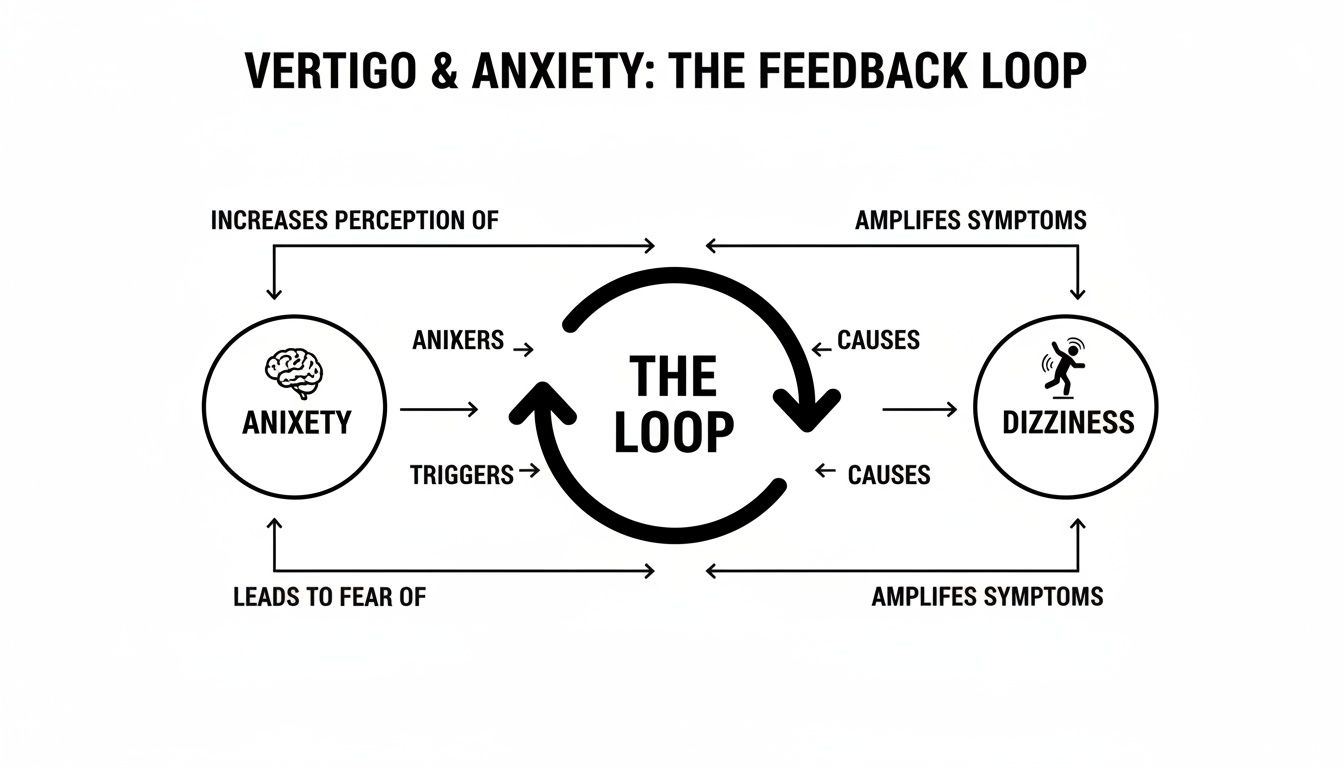
As you can see, by addressing either the initial anxiety or your reaction to the dizziness, you can interrupt the cycle and find relief. This is where hope begins. This is how you take your power back.
You Are Not Alone in This Experience
If you feel like you're the only one going through this, the data tells a different story. The overlap between anxiety and vertigo symptoms is remarkably common. In fact, research shows that approximately 50% of patients who see a doctor for vertigo or dizziness also have a condition like anxiety.
This isn't a coincidence. It confirms that your experience is real, shared by many, and has a clear, evidence-based link. You are walking a path that many others have walked before, and they have found their way to the other side.
Recognizing that your symptoms have a name and a logical pattern is profoundly empowering. It transforms the experience from a mysterious, terrifying event into a solvable problem.
While the psychological link is critical, it's also helpful to understand the physical side of things, like navigating specific types of vertigo. The more you know, the less you'll fear the unknown. Knowledge is your most powerful tool.
The journey to feeling steady again—both mentally and physically—starts right here, with understanding this connection and learning the strategies to dismantle it. Structured programs and resources like https://anxietychecklist.com/anxiety-university are designed to give you that knowledge, replacing fear with actionable steps and a deep-seated belief in your ability to heal.
Anxiety Dizziness vs. True Vertigo At a Glance
So, how can you start telling the difference? While a doctor’s diagnosis is essential, some key differences can offer clues. Use this quick comparison to begin differentiating between dizziness from anxiety and vertigo from a physical, inner-ear issue.
| Symptom | Anxiety-Related Dizziness | Vestibular Vertigo |
|---|---|---|
| Primary Sensation | Feeling lightheaded, woozy, foggy, or like you might faint. Often described as "unreal." | A distinct spinning or rotational sensation. The room feels like it's moving, or you feel like you're moving when you're not. |
| Triggers | Often follows stressful thoughts, crowded spaces, intense emotions, or panic attacks. | Usually triggered by specific head movements, changes in position, or can occur spontaneously. |
| Duration | Can be fleeting or last for hours, often waxing and waning with your anxiety level. | Episodes are often brief but intense (seconds to minutes), though a sense of imbalance can linger. |
| Associated Symptoms | Racing heart, shortness of breath, sweating, trembling, feeling of dread or doom. | Nausea, vomiting, ear fullness, hearing loss, tinnitus (ringing in the ears), and nystagmus (involuntary eye movements). |
Remember, this table is just a starting point. It's common to have overlapping symptoms, and only a healthcare professional can give you a definitive diagnosis.
When you're caught in the whirlwind of vertigo and anxiety symptoms, it’s easy to feel completely lost. Is the world actually spinning, or is this "just" panic? Is something physically wrong with me, or is it all in my head?
This constant state of confusion is exhausting. But you can learn to translate what your body is telling you and get back in the driver's seat. This isn't just about feeling better in the moment; it's the first real step toward a life free from that panic.
Most importantly, know this: your experience is real, whether its roots are in your inner ear or your nervous system. The goal isn’t to dismiss what you’re feeling but to finally understand it. That clarity is power—it helps you explain what’s happening to a doctor and, just as crucially, to yourself.

Decoding Your Dizziness: Anxiety vs. Vertigo
Let's cut through the fog and get clear on these sensations.
Think of anxiety-related dizziness as being on a boat that's gently rocking in a foggy harbor. You might feel woozy, unsteady, lightheaded, or just plain "off." This feeling often creeps in alongside stress or spikes during intense moments, like walking into a crowded store or even just thinking about something you're dreading.
True vestibular vertigo, on the other hand, is a whole different beast. It’s like being strapped to a carousel that refuses to stop. It’s a distinct, undeniable spinning or rotational sensation. The room itself feels like it's in motion, and it can hit you out of the blue, often with no emotional trigger. You might just roll over in bed and suddenly find your world tilting violently.
Anxiety Dizziness: This feels like being woozy, lightheaded, or unsteady. It’s often described as a floating or foggy feeling that comes and goes with your stress levels.
Vestibular Vertigo: This is a clear, often intense spinning or rotational sensation. It's the feeling that you—or the room around you—are moving when you're perfectly still.
Seeing this distinction is your first major step toward untangling the confusing signals your body sends. But remember, symptoms can and do overlap, which is why getting a professional diagnosis is so important.
The Physical Reality of Anxiety-Induced Dizziness
It’s crucial to understand that the dizziness from anxiety is not "all in your head." It’s a very real, physical response.
When your anxiety kicks in, it can trigger or worsen dizziness in a few key ways. During a panic response, a surge of adrenaline jacks up your heart rate and blood pressure. On top of that, the rapid, shallow breathing (hyperventilation) common in anxiety attacks actually lowers the carbon dioxide in your blood. This causes the blood vessels leading to your brain to narrow, which is what creates that classic lightheaded, dizzy feeling.
This shows how anxiety can produce sensations that feel just like true vertigo, even when your inner ear is working perfectly.
Understanding the real, physical processes behind your symptoms is incredibly validating. It helps you stop blaming yourself and see that these sensations are a logical, albeit terrifying, response to stress. For a deeper dive into what's happening in your body, our comprehensive guide on the fight-or-flight response can shed more light.
The most hopeful message is that because these symptoms are a learned response, they can be unlearned. You have the power to retrain your brain and calm your nervous system, breaking the cycle of panic for good.
Healing isn't just about managing symptoms; it’s about taking your life back. It starts with building a foundation of knowledge and self-compassion. As you start to grasp the "why" behind your vertigo and anxiety symptoms, the fear of the unknown begins to fade. In its place, you’ll find a clear path forward.
To get an even fuller picture of your body's unique responses, you might explore whether a blood test for anxiety could offer additional insights. This knowledge empowers you to seek the right kind of help and, most importantly, to trust in your own ability to get better.
Why Anxiety Makes You Physically Dizzy
That dizzy, off-balance feeling you get when you’re stressed? It’s not “all in your head.” It's a very real, very physical reaction happening inside your body, and it all comes down to an ancient survival mechanism: the fight-or-flight response.
When your brain senses danger—whether it’s a genuine threat or just an anxious thought—it hits the panic button. This floods your system with stress hormones like adrenaline, getting you ready to either fight or run for your life. Your heart races, your muscles clench, and your breathing changes. These aren't glitches; they're features of a system designed to protect you.

The Surprising Role of Your Breath
One of the fastest ways anxiety triggers dizziness is by changing how you breathe, often without you even noticing. It's a process called unconscious hyperventilation.
During a stress response, you might start taking shallow, rapid breaths. Think of it as your body trying to gulp down extra oxygen to fuel your muscles for a quick escape. This is brilliant if you're outrunning a predator, but not so helpful when the threat is a worrying thought.
This over-breathing throws your blood chemistry out of whack. You end up blowing off too much carbon dioxide (CO2), which makes your blood more alkaline. This change causes the blood vessels leading to your brain to temporarily tighten, reducing blood flow just enough to cause that classic lightheaded, woozy feeling. It’s not dangerous, but it sure is unsettling.
How Muscle Tension Affects Your Balance
Anxiety doesn’t just live in your head; it takes up residence in your body, especially in your muscles. If you're chronically stressed, chances are your neck, shoulders, and jaw are in a constant state of low-grade tension.
This isn’t just about aches and pains—it can directly mess with your sense of balance. Here’s what’s happening:
- Neck Muscle Strain: Your neck muscles are filled with tiny sensors called proprioceptors, which constantly tell your brain where your head is in relation to your body. When these muscles are clenched, they can send scrambled, "unstable" messages.
- Conflicting Signals: Your brain suddenly gets mixed signals. Your eyes and inner ear might be saying, "We're standing perfectly still," but your tense neck muscles are screaming, "We're wobbly!" This sensory mismatch is what creates that feeling of unsteadiness or even a mild, swirling vertigo.
Understanding the biology behind your vertigo and anxiety symptoms is the first step toward reclaiming your life. It moves the experience from the realm of terrifying mystery to a set of understandable—and manageable—physical reactions.
Once you realize that hyperventilation and muscle tension are the main culprits, a clear path forward starts to emerge. You’re not to blame for these physical responses. In fact, this knowledge is empowering. It shows that you can learn to regulate your breathing and release that tension, which in turn calms your nervous system and stops the dizziness. Healing isn't a vague hope; it’s a practical process of retraining your body’s responses, and it is entirely within your reach.
How to Stop a Dizziness and Panic Attack In The Moment
When the world starts to tilt and your heart hammers against your ribs, it feels like everything is spinning out of control. It’s a terrifying moment. But it’s also a moment you can learn to navigate.
Having a real, concrete plan is your anchor in the storm. This isn't about just hoping the feelings disappear; it's about actively giving your brain and body a new set of instructions to follow. You can guide yourself back to solid ground.

This is about reclaiming control, one breath at a time. Let’s break down the most effective techniques you can use the second you feel that familiar wave of panic and dizziness start to build.
Use Grounding to Anchor Your Mind
When dizziness and panic hit, your mind gets hijacked by a flood of "what if" thoughts, spiraling toward the worst-case scenario. The key is to pull your focus out of the chaos in your head and plant it firmly in the physical world. This is called grounding.
One of the simplest and most powerful ways to do this is the 5-4-3-2-1 Method. It forces your brain to concentrate on your senses, which slams the brakes on the panic cycle.
- 5: Name FIVE things you can see. A crack in the ceiling, a pen on the table, a speck of dust on the floor. Get specific.
- 4: Acknowledge FOUR things you can feel. The texture of your jeans, the cool surface of a desk, your feet pressing into your shoes, the hair on your arms.
- 3: Listen for THREE things you can hear. The quiet hum of your computer, a distant siren, the sound of your own breathing.
- 2: Identify TWO things you can smell. The faint scent of coffee, the soap on your skin. If you can't smell anything, just name two smells you enjoy.
- 1: Notice ONE thing you can taste. The lingering taste of mint from your toothpaste, or simply the neutral taste of your own mouth.
This exercise isn’t magic—it’s neurology. It short-circuits the panic response by giving your brain a different job to do, leaving less mental bandwidth for fear. It yanks you back into the present and reminds you that, right here and right now, you are safe.
Regulate Your Body with Box Breathing
As we covered earlier, that lightheaded, dizzy feeling is often fueled by hyperventilation. Box Breathing is a game-changing technique that directly tackles this by slowing your heart rate and calming your revved-up nervous system.
Picture a box with four equal sides. Each side represents one step of the pattern, and each step lasts for a count of four.
- Inhale slowly through your nose for 4 seconds.
- Hold your breath gently for 4 seconds.
- Exhale slowly and completely through your mouth for 4 seconds.
- Hold the empty breath for 4 seconds.
Repeat this cycle four or five times. The deliberate, steady pace puts an end to over-breathing. This helps restore the carbon dioxide balance in your bloodstream, easing that frightening lightheadedness. For more guided practices, you might find it helpful to explore other breathing exercises for anxiety.
By consciously controlling your breath, you send a powerful signal to your brain that the danger has passed. You are telling your body it is safe to stand down from high alert.
Find Stability and Reassure Yourself
In the heat of an attack, your first instinct might be to run or escape, but what you really need is stability.
- Sit or Lie Down: The second you feel dizzy, take away the fear of falling. Find a chair, sit on the floor, or lie down. If you can, elevating your feet can help improve blood flow to your brain.
- Find a Focal Point: Vertigo makes your eyes feel unsteady, which only amplifies the spinning sensation. Instead, fix your gaze on one single, unmoving object—a picture frame, a light switch, a book on a shelf. This is called gaze stabilization, and it gives your brain a fixed point of reference to help it reorient.
- Use a Self-Reassurance Mantra: Your mind is going to feed you a steady stream of catastrophic thoughts. You need to fight back with a simple, powerful truth. Repeat it to yourself, out loud if you can: "This is a panic symptom. It feels awful, but it is not dangerous. This will pass."
These in-the-moment tools are more than just a temporary fix. They are the first steps in retraining your brain. Every single time you use one, you prove to yourself that you are not helpless. You’re building the skill and the confidence to know that when these episodes hit, you have what it takes to find your footing again.
Long-Term Strategies For Living Panic-Free
Knowing how to ride out a dizzy spell or a panic attack is a vital skill. But true, lasting freedom isn’t just about getting through the crises—it's about creating a life where they barely happen in the first place.
This is where the real work—and the real hope—begins. You’re moving from constantly putting out fires to rebuilding the house so it’s no longer flammable.
The goal here isn't just to survive the dizzy spells. It's to fundamentally rewire your brain's response to them, reclaiming a life where you feel in control, not your symptoms. And it’s completely possible.
Reframe Your Thoughts With Cognitive Behavioral Therapy
At the very core of the anxiety-vertigo cycle are those terrifying, automatic thoughts. A moment of unsteadiness isn’t just a physical feeling. For your anxious brain, it's an immediate, catastrophic signal: "I'm having a stroke," "I'm about to faint in public," or "This is it, I'm dying."
This is where Cognitive Behavioral Therapy (CBT) becomes your most powerful ally. It’s built on a game-changing idea: it's not the dizziness that causes panic, but your thoughts about the dizziness.
By learning to catch, question, and change these automatic thoughts, you strip them of their power.
- Identify the Thought: The second you feel that dizzy sensation, what’s the first thing your mind screams? Write it down. For example: "Here it comes again. I'm losing control."
- Challenge the Thought: Now, play detective. What’s the actual evidence? Has this feeling ever led to the disaster you fear? What's a more realistic explanation? For example: "I’ve felt this exact sensation hundreds of times, and it was always anxiety. It feels awful, but it's not dangerous."
- Reframe the Thought: Craft a new, more balanced and truthful thought to put in its place. For example: "This is just my body's stress alarm. I know this feeling, and I know how to turn the volume down. I can breathe through this."
Over time, this practice becomes second nature. You’re training your brain to stop its knee-jerk leap to the worst-case scenario, effectively stopping the flood of panic before it even starts.
Build Your Toolkit With Structured Support
Trying to tackle this all on your own can feel like trying to find your way out of a forest without a map. This is why structured programs and tools can make all the difference, giving you a clear, step-by-step path forward.
The most freeing realization in recovery is that anxiety follows predictable patterns. Once you learn the patterns, you can build a system to dismantle them. Healing is not a matter of luck; it's a matter of strategy.
Tools like the Anxiety Checklist app are designed to give you that strategic edge. They provide a framework, complete with checklists and guided worksheets, that walks you through the core principles of CBT and other proven techniques. This kind of structure helps you build the consistent, daily habits that create real change, so you never feel lost or unsure of what to do next.
Your Daily Habit Tracker for Anxiety and Vertigo Management
To see what’s really working for you, it helps to track your daily habits and how they affect your symptoms. This simple tracker can help you connect the dots between your actions and how you feel, showing you your personal triggers and what helps you feel your best.
| Habit | Mon | Tue | Wed | Thu | Fri | Sat | Sun |
|---|---|---|---|---|---|---|---|
| 7-8 hours sleep | |||||||
| 10 min gentle walk | |||||||
| Reduced caffeine | |||||||
| Practiced deep breathing | |||||||
| Thought reframing exercise | |||||||
| Drank 8 glasses of water |
Just put a checkmark on the days you complete a habit. At the end of the week, look back and see if you can spot any patterns between the habits you kept and the days you felt calmer and more grounded.
Optimize Your Lifestyle to Regulate Your Nervous System
While the mental work is crucial, you can also build a powerful foundation of calm right in your daily life. Simple lifestyle adjustments can help regulate your nervous system, making it less reactive to stress and less likely to trigger vertigo and anxiety symptoms.
Think of your nervous system like a car alarm. When you’re dealing with chronic anxiety, that alarm is often set to be hyper-sensitive—the slightest bump sets it off. These habits help turn down that sensitivity.
- Prioritize Sleep: Seriously. Aim for 7-9 hours of quality sleep. A sleep-deprived brain is an anxious brain, period. It makes you far more vulnerable to panic.
- Manage Caffeine: As a stimulant, caffeine can perfectly mimic anxiety symptoms like a racing heart and jitters. Try cutting back slowly and see how it impacts your baseline anxiety and dizziness. You might be surprised.
- Incorporate Gentle Movement: You don't have to run a marathon. Things like walking, gentle yoga, or tai chi are fantastic for burning off stress hormones like adrenaline and boosting mood-stabilizing endorphins.
Healing from anxiety-induced vertigo isn't about finding one magic bullet. It’s about building an arsenal of small, consistent habits that, over time, add up to monumental change. It's a journey of practice, patience, and the unwavering belief that a calm, panic-free life isn't just possible—it's waiting for you.
When To See a Doctor For Vertigo Symptoms
While learning to manage the link between vertigo and anxiety on your own is empowering, there are times when calling in a professional is the smartest move you can make. Seeing a doctor isn't a sign that you've failed—it's a powerful step toward getting clarity and, most importantly, peace of mind.
Getting a proper diagnosis is the single most important thing you can do. It takes all those terrifying "what if" scenarios that anxiety loves to create and replaces them with a clear, actionable plan you can actually trust.
Red Flag Symptoms Requiring Immediate Attention
Even though anxiety is a frequent culprit behind dizziness, some symptoms are non-negotiable and need a doctor's immediate attention. If you experience any of the following along with vertigo, it's crucial to get checked out right away to rule out anything more serious.
This isn't meant to scare you, but to empower you.
- Sudden or Severe Onset: A vertigo attack that hits you out of the blue and feels much more intense than anything you've felt before.
- Neurological Signs: Dizziness paired with numbness or drooping on one side of your face, weakness in an arm or leg, slurred speech, or sudden trouble talking or swallowing.
- Vision Changes: Abrupt double vision, blurred vision, or a sudden loss of sight.
- Hearing Loss: A sudden and unexplained loss of hearing in one or both ears.
- Intense Headache: A severe headache that comes on with the dizziness, often described as "the worst headache of your life."
- Loss of Consciousness: Fainting or passing out, especially if it happens more than once.
- Inability to Walk: Suddenly losing your coordination or being unable to stand or walk without help.
If any of these red flags pop up, please call emergency services or head to the nearest emergency room.
Demystifying the Diagnostic Process
Trying to figure out the healthcare system can feel like a job in itself. But knowing who does what can make the entire process feel much less intimidating. Depending on your symptoms, you might see a few different specialists.
A correct diagnosis is the cornerstone of healing. It transforms fear of the unknown into a concrete plan of action, setting you firmly on the path to recovery.
Here’s a quick breakdown of who you might see on your journey:
- General Practitioner (GP) or Primary Care Physician: This is your starting point. Your GP will go over your medical history, do a physical exam, and might run some initial tests. Think of them as your gateway to specialized care.
- ENT (Ear, Nose, and Throat) Specialist: If your GP thinks an inner ear problem is at play, they’ll send you to an ENT. Also known as otolaryngologists, these doctors are the experts on vestibular disorders like BPPV, Meniere's disease, and vestibular neuritis. They have specific tests to check how your inner ear is functioning.
- Mental Health Professional: If physical causes are ruled out—or if it becomes clear that anxiety is a huge piece of the puzzle—seeing a therapist or psychiatrist is the next logical move. They can arm you with strategies like CBT and discuss whether medication could be helpful. You can learn more about when seeing a psychiatrist for anxiety is a good idea.
Understanding these roles helps you ask the right questions and make sure you're getting the most complete care possible. It’s a critical step toward getting your life back from the grip of panic and dizziness.
Your Questions About Vertigo and Anxiety, Answered
When you're caught between the spinning sensations of vertigo and the racing thoughts of anxiety, it’s easy to feel lost and overwhelmed. But getting clear, direct answers is the first step toward reclaiming your balance—and your peace of mind.
This isn't about just "coping." It's about understanding what's happening in your body and mind so you can take back control. Let's tackle some of the most pressing questions that come up on this journey.
Can I Really Heal From Anxiety-Induced Dizziness?
Yes. Absolutely. Let’s get that clear right away. While it feels completely overwhelming and endless in the moment, healing from anxiety-induced dizziness isn't just possible—it's a realistic goal that countless people have achieved.
Think of it this way: your brain has learned to associate the feeling of dizziness with danger, kicking off a fear response. Healing is a two-part process. You work on managing the anxiety that fuels the fire, while also teaching your brain that the physical sensations themselves aren't a threat.
It's a powerful moment when you realize anxiety-induced dizziness isn't a life sentence. It’s a feedback loop. And every loop has a breaking point.
With consistent practice using tools like cognitive reframing, simple grounding exercises, and a few key lifestyle tweaks, you can systematically dismantle this cycle. The episodes become less frequent, less intense, and you start to trust your body again. That confidence is everything.
What’s the Single Most Important First Step?
Go see a doctor and get a proper diagnosis. This is, without a doubt, the most critical and liberating first move you can make.
Why? Because it allows you to confidently rule out any underlying medical or vestibular issues causing your vertigo. Once a doctor gives you the all-clear, it quiets that relentless, nagging "what if" voice that fuels so much anxiety.
Getting that medical certainty is like turning off the background static. It frees you up to put all your energy where it truly matters: working on the psychological strategies that will break the anxiety-dizziness cycle for good. That’s when the real healing can finally begin.
Should I Think About Using Medication?
Medication can be a really helpful tool, but it's a personal choice you should make with your doctor. For some, it provides the stability needed to do the deeper work of healing.
Doctors might suggest anti-anxiety medications (like SSRIs) to help calm your nervous system over the long term, or even short-term options for severe vertigo episodes. Think of medication less as a cure and more as a support system. It can turn down the volume on the constant hum of anxiety, giving you the breathing room to effectively use therapy and other self-help strategies. It's most powerful when it's part of a bigger plan, not the only plan.
At The Anxiety Checklist, we're focused on giving you practical, no-nonsense tools to break free from anxiety's grip. Our system is built to walk you through this process step-by-step, helping you turn fear back into confidence. See how you can start your journey toward fearless living today at https://anxietychecklist.com.