


You receive a short email from your manager: “Can we talk tomorrow?” Within minutes, your mind has written an entire disaster. You'll lose your job, disappoint your family, fall into financial trouble, and never recover. Your heart races, your chest tightens, and you may keep rereading the message while looking perfectly calm to everyone around you.
This is catastrophizing anxiety, a threat-focused thinking pattern in which the mind jumps from an uncertain event to the worst possible interpretation, then treats that interpretation as if it were established fact. The thought feels urgent because your body is reacting to the imagined danger, not because the feared outcome has been proven.
Catastrophizing isn't a character flaw or a sign that you're weak. It's a learned alarm response, and learned responses can change. With practice, structured CBT tools, and appropriate support, you can reduce the spiral, regain trust in your body, and move toward a life that isn't organized around panic.
Table of Contents
- What Catastrophizing Anxiety Actually Feels Like
- Why Your Brain Spirals Into Worst-Case Thinking
- Common Signs and Hidden Triggers
- Evidence-Based Strategies That Interrupt the Spiral
- Real Examples of Catastrophic Thinking in Daily Life
- A Short Worksheet to Challenge a Catastrophic Thought
- When Self-Help Isn't Enough and Professional Help Matters
- A Hopeful Path Forward With Anxiety Checklist
What Catastrophizing Anxiety Actually Feels Like
A catastrophic spiral often begins with something ordinary and ambiguous. A friend takes longer than usual to reply. Your partner sounds tired. You notice a flutter in your chest. A colleague corrects a small mistake. The event itself may be manageable, but your mind rapidly adds a frightening meaning.
The sequence can sound like this:
- “My friend hasn't replied.”
- “They must be angry.”
- “The friendship is ending.”
- “I'll be alone.”
- “I won't be able to cope.”
Each thought makes the next one feel more convincing. Your breathing may become shallow, your muscles tense, and your attention narrow around the imagined outcome. You may search for reassurance, check messages repeatedly, avoid making a decision, or ask someone else to confirm that everything is fine.
Remember: A frightening thought can produce a real physical reaction without being reliable evidence.
Many people with catastrophizing anxiety still appear composed. They attend meetings, answer questions, care for children, and continue daily tasks while privately experiencing a full emergency. That contrast can create shame, especially when others say, “You seem fine.” Looking calm doesn't mean your distress isn't real, and feeling distressed doesn't mean the catastrophe is happening.
A useful definition is simple: catastrophizing means magnifying the threat while losing sight of uncertainty, alternative explanations, and your ability to cope. It isn't the same as responsible planning. Planning considers possible outcomes and identifies practical actions. Catastrophizing skips over likely middle outcomes and treats the worst case as both certain and unbearable.
If your thoughts keep circling long after the original concern has passed, this overthinking anxiety explained resource can help you distinguish productive problem-solving from repetitive threat rehearsal.
The first change is noticing the pattern without arguing with yourself harshly. Try saying, “My alarm system is predicting danger,” rather than, “I'm being ridiculous.” That wording creates a small space between you and the thought. In that space, you can begin to examine what your mind is assuming.
Why Your Brain Spirals Into Worst-Case Thinking
Think of your threat system as a smoke detector. A well-calibrated detector responds to a genuine fire while ignoring ordinary kitchen activity. An anxiety-sensitive detector may react to burnt toast, steam, or a small puff of smoke as though the entire building is in danger.
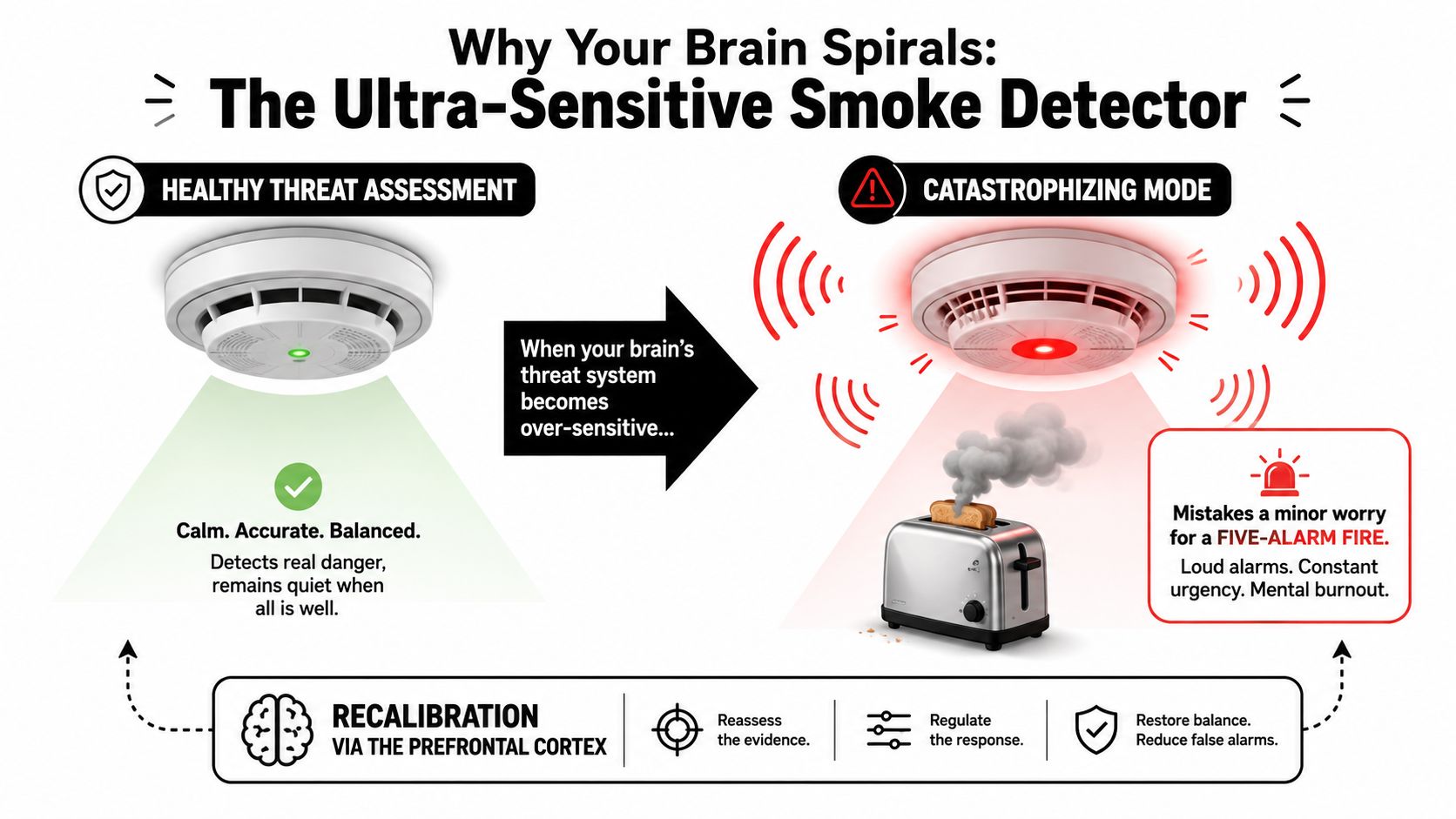
When uncertainty appears, the brain's alarm circuits can assign it a threatening meaning before the more reflective parts of the brain have reviewed the evidence. Under stress, the prefrontal systems involved in perspective-taking and deliberate reasoning may have a harder time interrupting that alarm. Attention then locks onto signs that support danger while neutral details receive less notice.
The body becomes part of the feedback loop. A racing heart, tight chest, dizziness, or shallow breathing may be interpreted as confirmation that something is seriously wrong. That interpretation increases fear, which intensifies the sensations, making the original interpretation feel even more convincing.
The thought is learned, not chosen
Catastrophizing is also connected with intolerance of uncertainty. The mind keeps rehearsing possible disasters in an attempt to achieve certainty, but each imagined scenario creates another question. Reassurance may calm you briefly, yet the brain can learn that checking was necessary, which keeps the cycle active.
Research has treated catastrophic misinterpretation as a measurable process rather than a vague form of negativity. Early cognitive models formalized this process in 1986, describing how people may misread bodily sensations as signs of imminent catastrophe. A longitudinal CBT study later found that changes in catastrophic misinterpretations predicted later reductions in panic severity, panic attack frequency, distress and apprehension, and avoidance behavior. These findings are summarized in the PubMed discussion of catastrophic misinterpretations and panic treatment.
The distinction matters. Your brain isn't trying to ruin your life. It's using an overlearned safety strategy that has become too sensitive. Understanding that mechanism doesn't remove the fear instantly, but it gives you a practical target. You can work with the prediction, the body alarm, the avoidance, or the uncertainty instead of treating the whole experience as one overwhelming problem.
For a broader map of thinking patterns, use The Anxiety Checklist thought distortion guide as a reference. Naming the process is often the first step toward changing what happens next.
Common Signs and Hidden Triggers
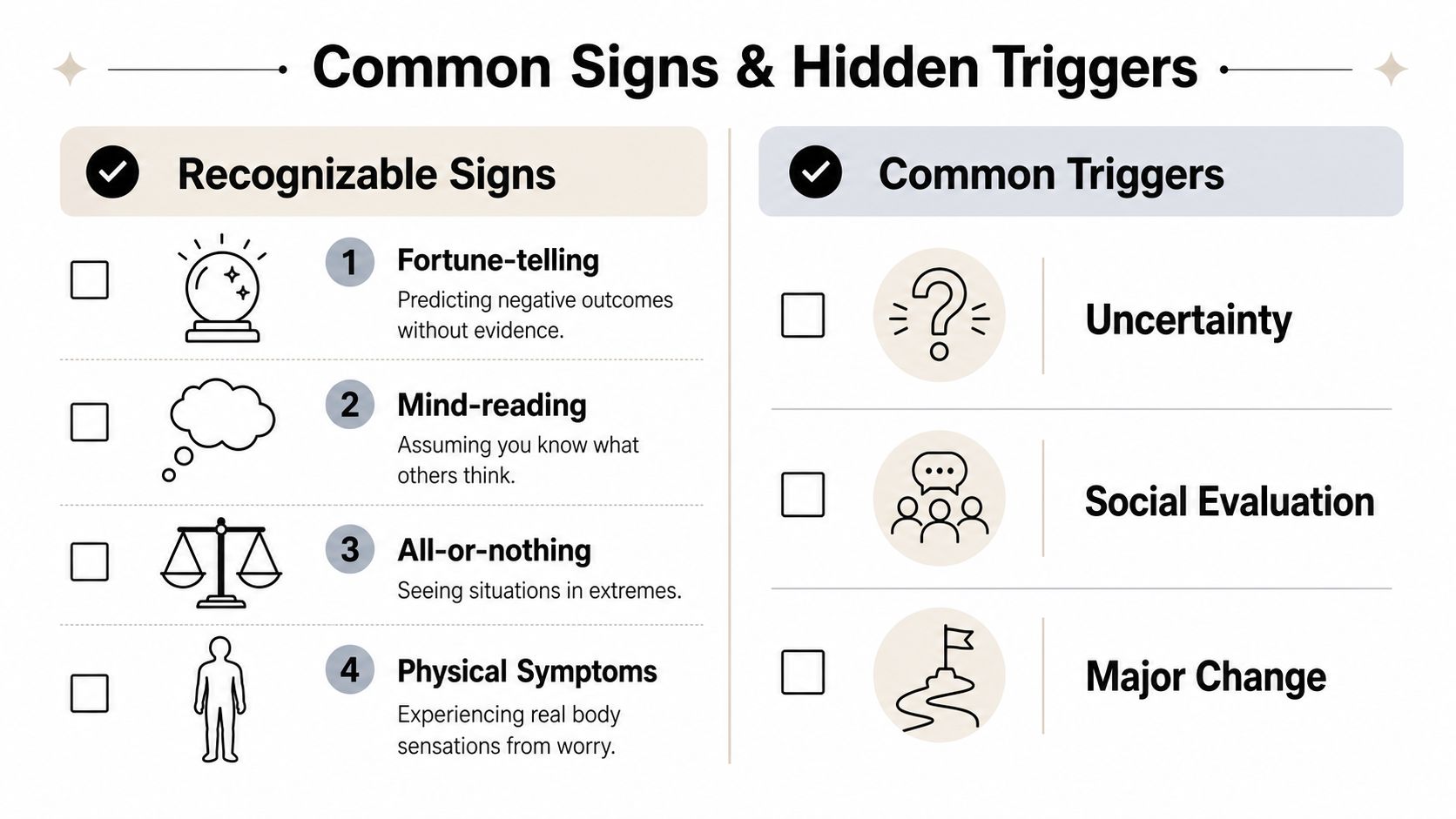
Catastrophizing can look different depending on the topic, but the underlying move remains similar. The mind takes incomplete information, adds a threatening interpretation, and removes realistic alternatives.
Consider these everyday versions:
- Fortune-telling: Your supervisor schedules a meeting, and you decide you're about to be dismissed.
- Mind-reading: A friend responds with a short message, and you assume they're offended or preparing to leave.
- All-or-nothing thinking: You make one mistake and conclude that you're incompetent at everything.
- Physical conclusions: You notice a headache and immediately connect it to the most frightening diagnosis.
- Past-as-proof thinking: You remember a previous failure and use it as evidence that every future attempt will end badly.
These are patterns to observe, not labels you have to adopt. You might catastrophize about work while feeling balanced about health, or worry intensely about bodily sensations while handling social uncertainty well. Research on catastrophizing suggests that it can be threat-specific, operating differently across pain, health worry, panic, PTSD, and everyday stress. A computational psychiatry paper distinguishes objective and subjective catastrophes and links greater catastrophizing with lower risk-taking on an experimental task, while a cross-sectional whiplash study linked pain-related anxiety with disability-related outcomes. The broader point is that the trigger matters, as described in this research on threat-specific catastrophizing.
What makes the alarm louder
Some triggers are easy to miss because they occur before the worry begins:
- Poor sleep or exhaustion can reduce your capacity to evaluate uncertainty calmly.
- Caffeine may make normal arousal feel more alarming.
- News and social media exposure can keep attention trained on threats.
- Hormonal shifts may change how intensely you experience emotions and body sensations.
- Conflict avoidance can leave ambiguous situations unresolved.
- Perfectionism can turn an ordinary error into a verdict about your worth.
- Unclear messages or unfamiliar environments provide gaps that anxiety fills with frightening explanations.
A short check-in can help you identify your anxiety triggers before you challenge the thought itself. Ask what happened immediately beforehand, what your body was already experiencing, and whether the concern is about danger, judgment, health, loss of control, or uncertainty. Once the pattern becomes visible, you can choose a tool that matches the point where the cycle is strongest.
Evidence-Based Strategies That Interrupt the Spiral
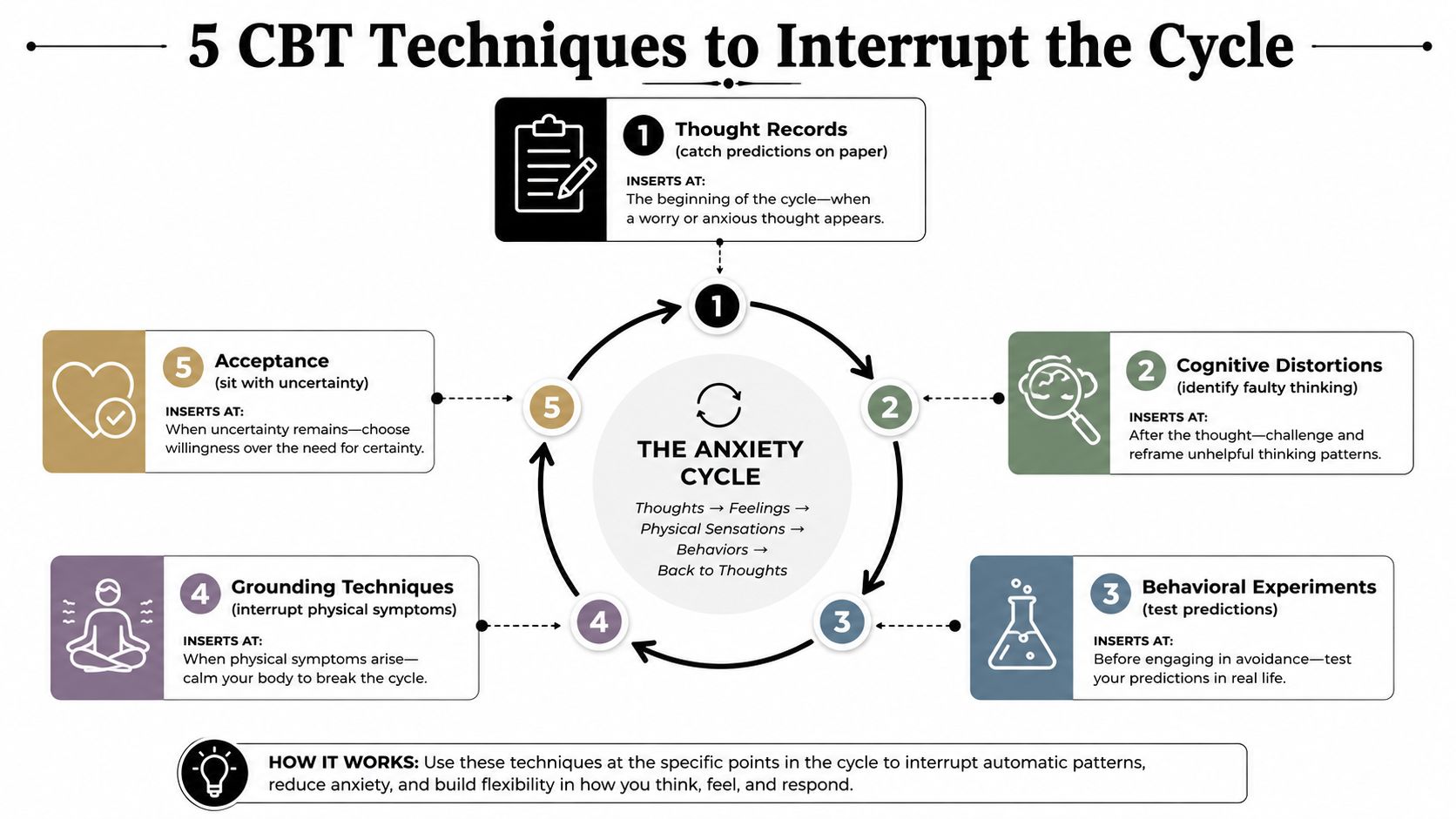
Different CBT tools interrupt different parts of the anxiety cycle. Trying to reason with a thought while your body is in high alarm may be difficult, while grounding alone may not change a prediction that keeps returning. Match the tool to the moment.
Thought records for racing predictions
Use a thought record when the worry is still forming but hasn't yet become a long chain. Write the situation, the automatic thought, the emotion, the body sensations, and the action your mind wants you to take.
Example: “My manager sent a brief email” becomes “I'm going to be fired.” Writing the sentence down makes the prediction visible. You're no longer responding only to a feeling; you're examining a specific claim.
Cognitive restructuring for certainty
Use cognitive restructuring when the thought feels like a fact. Separate evidence from interpretation:
- What facts support the feared outcome?
- What facts don't support it?
- What other explanations fit the same information?
- What would you say to a friend in this situation?
- What would you do if the difficult outcome occurred?
A balanced alternative isn't forced positivity. “I know for certain that nothing bad will happen” may feel false. “The email is ambiguous, and I'll learn more when we speak” is more credible and leaves room for action.
A 2024 systematic review of CBT-related interventions found a standardized mean difference of -0.44 for reductions in catastrophic thinking over six months compared with usual care, alongside a -0.23 reduction in anxiety symptoms. The review also found greater reductions when mental health professionals delivered CBT, emphasizing the value of treatment fidelity. See the systematic review of CBT-related interventions for those findings.
Grounding for panic symptoms
Grounding is most useful when physical sensations are driving the interpretation. Name five things you can see, four you can feel, three you can hear, two you can smell, and one you can taste. You can also slow your breathing by making the exhale gentle and longer than the inhale.
The purpose isn't to prove that the sensation is harmless through force. It's to redirect attention toward the present and give your nervous system a chance to settle before you evaluate the thought. If you have new or severe physical symptoms, seek appropriate medical care rather than assuming they're anxiety.
Behavioral experiments for avoidance
Use a behavioral experiment when you keep acting as though a prediction is already true. Make a low-risk, observable prediction, then test it.
If you believe, “If I send this ordinary email, the recipient will think I'm incompetent,” send it without rereading it repeatedly. Record what happens. The result may not be perfect, but it supplies information that reassurance and imagination can't provide.
Graduated exposure for long-term dread
Exposure targets the avoidance that keeps fear powerful. Build a gradual hierarchy, starting with a manageable encounter and repeating it until you can remain present without relying on escape or excessive safety behaviors. Then move toward a harder step.
For panic, exposure might involve noticing bodily sensations without immediately treating them as emergencies. For social fear, it might involve sending a message without checking it over and over. For health anxiety, it may involve delaying reassurance-seeking while following a sensible medical plan.
Structured treatment can produce substantial improvement. In one randomized clinical trial, 72% to 79% of patients receiving an intensive four-day panic treatment were in remission after treatment, compared with 51% receiving standard CBT, and follow-up remission remained 72% to 83% versus 52%. The results are reported in this randomized clinical trial of intensive panic treatment.
The following video offers another way to reinforce these ideas:
Real Examples of Catastrophic Thinking in Daily Life
At work, a missed email may become a complete threat story. You notice that a colleague hasn't replied, decide they're unhappy, assume your manager has heard about a mistake, and predict dismissal, humiliation, and financial instability. A thought record interrupts the first interpretation. Cognitive restructuring examines the actual evidence, while a behavioral experiment might involve sending one clear follow-up instead of repeatedly checking the inbox.
The health-related spiral follows a similar structure but needs a different response. A mild headache becomes a feared diagnosis, then an imagined emergency visit, then a frightening picture of how your family would cope. Grounding can reduce the immediate body alarm, while a planned medical consultation addresses appropriate health questions without turning repeated reassurance-seeking into the main coping strategy.
The subjects differ, but the threat mechanism is similar:
| Trigger | Catastrophic interpretation | Useful first move |
|---|---|---|
| Brief work message | “My career is ending” | Record facts separately from assumptions |
| Ordinary body sensation | “I'm facing a medical disaster” | Ground, then follow proportionate medical guidance |
| Delayed reply | “The relationship is over” | Test the prediction instead of mind-reading |
Catastrophizing isn't defined by whether the topic is work, health, relationships, or travel. It's defined by the leap from uncertainty to disaster and the belief that you couldn't cope. Research also suggests that catastrophizing may operate as a distinct construct rather than being identical to anxiety, depression, rumination, or worry, while pain catastrophizing can independently relate to anxiety and depression symptoms. This nuance is discussed in the psychometric research on catastrophizing.
Recognizing the same pattern across different domains is a recovery skill. You learn that the topic changes, but the sequence can be observed, recorded, and interrupted.
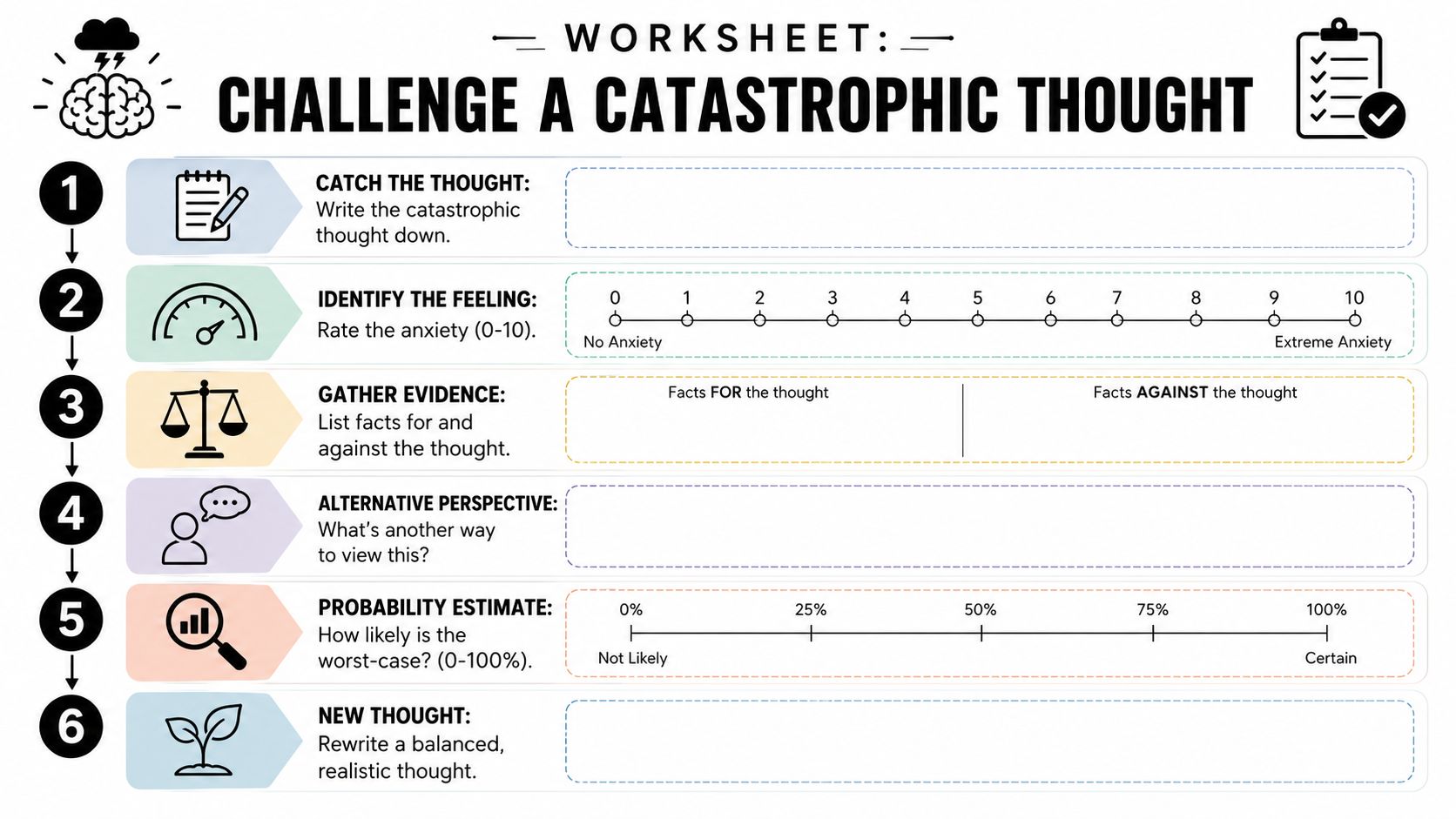
A Short Worksheet to Challenge a Catastrophic Thought
Start with a small example. Situation: “My manager sent a short message.” Automatic thought: “I'm being fired.” Worst-case image: losing income and disappointing everyone. Evidence against it: the message contains no information about dismissal, and previous brief messages had ordinary explanations. Balanced thought: “I don't know what the meeting is about yet. I can attend, listen, and respond to what is said.”
Use the following prompts for a current worry. Write in your own words, and avoid trying to sound rational or polished.
- Triggering situation: What happened that set off the alarm? Describe only what a camera could record.
- Automatic thought: What did your mind say would happen? Write the sentence exactly as it appeared.
- Worst-case image and intensity: What outcome are you imagining, and how intense is the anxiety right now?
- Evidence for and against: Which observable facts support the prediction, and which facts point to other explanations?
- Balanced alternative: What is a realistic thought that acknowledges uncertainty without declaring disaster?
- New intensity rating: After completing the exercise, how strong is the anxiety now?
The worksheet isn't meant to eliminate every uncomfortable thought. It teaches you to slow the jump from event to conclusion and to include your coping ability in the picture. If the feared outcome did occur, ask what your next practical action would be. A specific next step is different from endless mental rehearsal.
You can explore CBT belief experiments when you're ready to move from written analysis to testing predictions in daily life. Repetition builds fluency. The same structure can help with a minor ambiguous message or a fear that has shaped your choices for a long time.
When Self-Help Isn't Enough and Professional Help Matters
Self-help can be useful, but it shouldn't require you to manage severe anxiety alone. Professional support becomes especially important when panic attacks occur more than once weekly, avoidance spreads into work or relationships, sleep disruption continues for over a month, physical symptoms resemble a cardiac event, or intrusive catastrophic thoughts no longer respond to journaling. New or concerning physical symptoms deserve medical evaluation, even when anxiety is also present.
A clinician can distinguish situational worry from conditions such as generalized anxiety disorder, panic disorder, or health anxiety. That distinction guides treatment. CBT may focus on interpretations, safety behaviors, and exposure. ACT may help you stop organizing your life around thoughts that cannot be eliminated. A prescriber can discuss medication when that's appropriate, while primary care can help coordinate assessment and referrals.
Evidence supports a hopeful view of treatment. A meta-analysis of CBT for adult anxiety disorders found an overall mean remission rate of 51.0%, meaning about half of treated patients no longer met diagnostic criteria after treatment across the included studies, as reported in this CBT remission meta-analysis. A separate follow-up found that among people with panic disorder who hadn't responded to medication, nearly two-thirds met remission criteria after CBT, with sustained benefit at one year, according to this study of CBT after medication nonresponse.
Long-term recovery is also possible. A 10-year follow-up study reported remission of all diagnoses for 58% of participants and remission of all anxiety diagnoses for 63%, with relapse rates ranging from 25% to 31%. Those findings appear in this long-term CBT follow-up study.
Cost, stigma, and access can make the first step difficult. Ask a primary-care office about referrals, look for telehealth clinicians, and search for sliding-scale community clinics. Support groups and practical guidance can also reduce isolation, including the Kindness Community Foundation mental wellness resources. Seeking unwelcome thoughts mental health support isn't failure. It's a decisive way to stop letting fear set the limits of your life.
A Hopeful Path Forward With Anxiety Checklist
Recovery becomes easier to practice when each tool has a clear place in the sequence.
During an acute spiral, SOS mode can provide immediate prompts for grounding, affirmations, and calming steps when panic makes it hard to think. Use it to create enough space for the alarm to lower before you decide what the thought means.
For daily thought practice, the thought journal can serve as a repeatable record. Capture the trigger, prediction, body sensations, evidence, and balanced response. Over time, this makes the pattern easier to recognize earlier, before catastrophizing anxiety gathers momentum.
For avoidance, the exposure library can help you organize feared situations into a gradual hierarchy. The point isn't to force yourself into the hardest situation immediately. It's to practice staying present through manageable encounters, then build from there.
Turning insight into a routine
A structured masterclass can supply education about panic and CBT concepts, while a daily practice library can reinforce cognitive restructuring between therapy sessions or alongside self-guided work. Anxiety Checklist also includes tools such as guided meditations, sleep audios, walking sessions, hypnosis sessions, and affirmations for ongoing nervous-system support. The app provides an always-free SOS mode, requires no login to get started, and offers a 7-day free trial for premium content, as described by the publisher.
Use one tool at a time. During a body-sensation spiral, begin with grounding. After the alarm settles, record the interpretation. Later, test one prediction or take a small exposure step. This sequence respects how anxiety works instead of demanding that you solve every layer at once.
Catastrophizing is a learned threat pattern, not a permanent identity. Each time you catch a prediction, challenge its evidence, and choose an action that fits your values rather than your fear, you practice a different response. Panic-free living doesn't mean you'll never notice uncertainty or uncomfortable sensations. It means those experiences no longer control every decision.
The Anxiety Checklist offers SOS support for acute panic, thought journaling for catastrophic predictions, exposure tools for avoidance, and structured CBT education for longer-term practice. Visit The Anxiety Checklist and choose one small exercise today, then repeat it often enough for confidence to grow.