

Are you afraid of the next panic attack, avoiding ordinary activities, or trapped in thoughts that keep predicting disaster? The conventional question is often, “Which treatment stops anxiety?” A more useful question is, “Which tools help with this part of my anxiety cycle, and how can I practice them consistently?”
Non medication anxiety treatment can address immediate distress while also changing the thoughts, fear responses, body sensations, and avoidance patterns that keep anxiety active. The ten options below include rapid tools for panic, daily practices that support nervous-system regulation, and structured approaches for deeper recovery. Progress usually takes repetition, and no technique works perfectly every time. Still, anxiety doesn't have to define your relationships, work, travel, or sense of safety.
Self-help tools can support recovery, but they aren't a substitute for professional assessment when symptoms are severe, persistent, or disabling. New, intense, or concerning physical symptoms deserve medical evaluation, especially if you're unsure whether they're caused by anxiety. If work pressure is feeding the cycle, these ideas may also complement practical strategies for dealing with work overwhelm.
Table of Contents
- 1. Cognitive Behavioral Therapy CBT
- 2. Exposure Therapy Systematic Desensitization
- 3. Deep Breathing and Breathwork Techniques
- 4. Grounding Techniques 5-4-3-2-1 Method and Variants
- 5. Mindfulness and Meditation
- 6. Progressive Muscle Relaxation PMR
- 7. Exercise and Physical Activity
- 8. Journaling and Written Cognitive Processing
- 9. Social Connection and Peer Support
- 10. Sleep Optimization and Sleep Hygiene
- 10-Point Comparison: Non-Medication Anxiety Treatments
- Build Your Personal Path to Feeling Safe Again
1. Cognitive Behavioral Therapy CBT
CBT treats anxiety as a pattern involving thoughts, feelings, physical sensations, and behavior. A person with social anxiety might think, “Everyone is judging me,” feel a surge of shame, notice a racing heart, and avoid speaking. CBT helps them examine the thought, test it against evidence, and gradually behave differently.
A person with panic disorder might use a behavioral experiment to learn that a pounding heart feels frightening but doesn't automatically mean collapse. Someone with generalized anxiety may learn to separate productive worry, which leads to a practical action, from rumination, which repeats the same threat without solving it.
CBT has been studied as a core non-medication anxiety treatment for decades. A 2025 meta-analysis found a mean effect size versus controls of Hedges' g = 0.51, with a 95% confidence interval of 0.40 to 0.62, across randomized controlled trials. Uncontrolled pre-post analyses showed g = 1.18, with a 95% confidence interval of 1.01 to 1.34. The analysis also found no significant increase in CBT effect sizes over the last 30 years, with B = -0.008 and p = 0.24, suggesting stable core efficacy across modern treatment eras (2025 CBT meta-analysis summary).
A practical CBT starting point
- Record the pattern: Write the situation, automatic thought, emotion, and evidence for and against the thought.
- Test predictions: Approach a manageable situation you usually avoid and observe what happens.
- Track change: Review entries over time so small improvements become visible.
A CBT-trained therapist can guide this work, while validated self-help materials can provide a starting structure. CBT tools for anxiety relief may help you practice thought records and related exercises between appointments.
2. Exposure Therapy Systematic Desensitization
Avoidance brings short-term relief, but it teaches the brain that the avoided situation was dangerous. Exposure therapy reverses that lesson through gradual, repeated contact with feared situations, thoughts, or body sensations in a controlled way.
Someone afraid of driving might begin by sitting in a parked car, then drive on a quiet street, and later approach busier roads. A person with social anxiety could progress from ordering coffee to speaking with a small group and eventually giving a presentation. For agoraphobia, steps might move from leaving a safe room to walking through a hallway, visiting a store, and entering a crowded public place.
Build a fear ladder
List feared situations from least to most difficult and give each a subjective anxiety rating from 0 to 100. Begin with a manageable step. Stay with it long enough to learn that anxiety can rise and fall without escape becoming the only solution.
You don't need to force the hardest exposure immediately. Repetition matters more than dramatic effort. Leaving as soon as anxiety rises can strengthen avoidance, while remaining safely engaged gives your brain new evidence.
Practical rule: Exposure isn't about proving that you'll never feel anxious. It's about learning that anxiety can be present without controlling your choices.
Interoceptive exposure can be useful for panic. Under professional guidance, a person may deliberately create sensations such as dizziness or a faster heartbeat, then observe that the sensations are uncomfortable rather than dangerous. A therapist should guide major exposures, especially when trauma, medical conditions, or severe panic symptoms are involved. A structured tool can help you overcome fears with an anxiety ladder.
3. Deep Breathing and Breathwork Techniques
During panic, breathing can become fast, shallow, or irregular. That change may intensify dizziness, chest tightness, and the feeling that something is terribly wrong. Slow, comfortable breathing gives you a concrete action while your body begins moving away from high alert.
Try box breathing by inhaling for four counts, holding for four, exhaling for four, and holding again for four. Repeat the pattern several times without forcing deep breaths. Another option is diaphragmatic breathing, where your abdomen expands gently as you inhale rather than your chest doing most of the movement.
Use breathwork before panic peaks
Practice while calm, not only during emergencies. Rehearsal makes the sequence easier to remember when your mind goes blank. You can place one hand on your abdomen, soften your shoulders, and make the exhale comfortable and unhurried.
Some people prefer a four-count inhale, a seven-count hold, and an eight-count exhale. Others become more uncomfortable when counting or holding their breath, so the best pattern is the one that feels safe and sustainable. Stop if you feel faint, and seek medical advice for unexplained breathing symptoms.
Breathwork can help you recognize the body's alarm response rather than treating every sensation as proof of danger. This guide to understanding the fight or flight response can add context to that experience.
You can also follow a guided breathing demonstration here:
4. Grounding Techniques 5-4-3-2-1 Method and Variants
Grounding shifts attention from catastrophic predictions to what's happening in the room right now. The 5-4-3-2-1 method uses the senses in a simple sequence: notice five things you see, four you can touch, three you hear, two you smell, and one you taste.
A person in a panic attack might name the color of a wall, the feeling of their shoes, traffic sounds outside, the scent of soap, and the taste of a mint. The exercise doesn't need to erase anxiety. Its first job is to interrupt the mental spiral and restore contact with the present.
Make grounding easy to reach
- Use physical sensation: Press your feet into the floor, hold a textured object, or place your palms together.
- Shorten the sequence: Use five sights, four sounds, three physical sensations, two smells, and one taste when time is limited.
- Prepare a kit: Keep mints, fabric with an interesting texture, or another safe sensory object nearby.
- Pair methods: Name sensory details while breathing slowly, so your attention has both an external and physical anchor.
Grounding can also help when you feel detached or unreal. If intense cold, strong scents, or other sensory tools worsen symptoms, choose gentler options. The aim is orientation, not punishment.

Keep the steps somewhere accessible until they become familiar. A free SOS mode grounding option can offer prompts during a moment when recalling the sequence feels difficult.
5. Mindfulness and Meditation
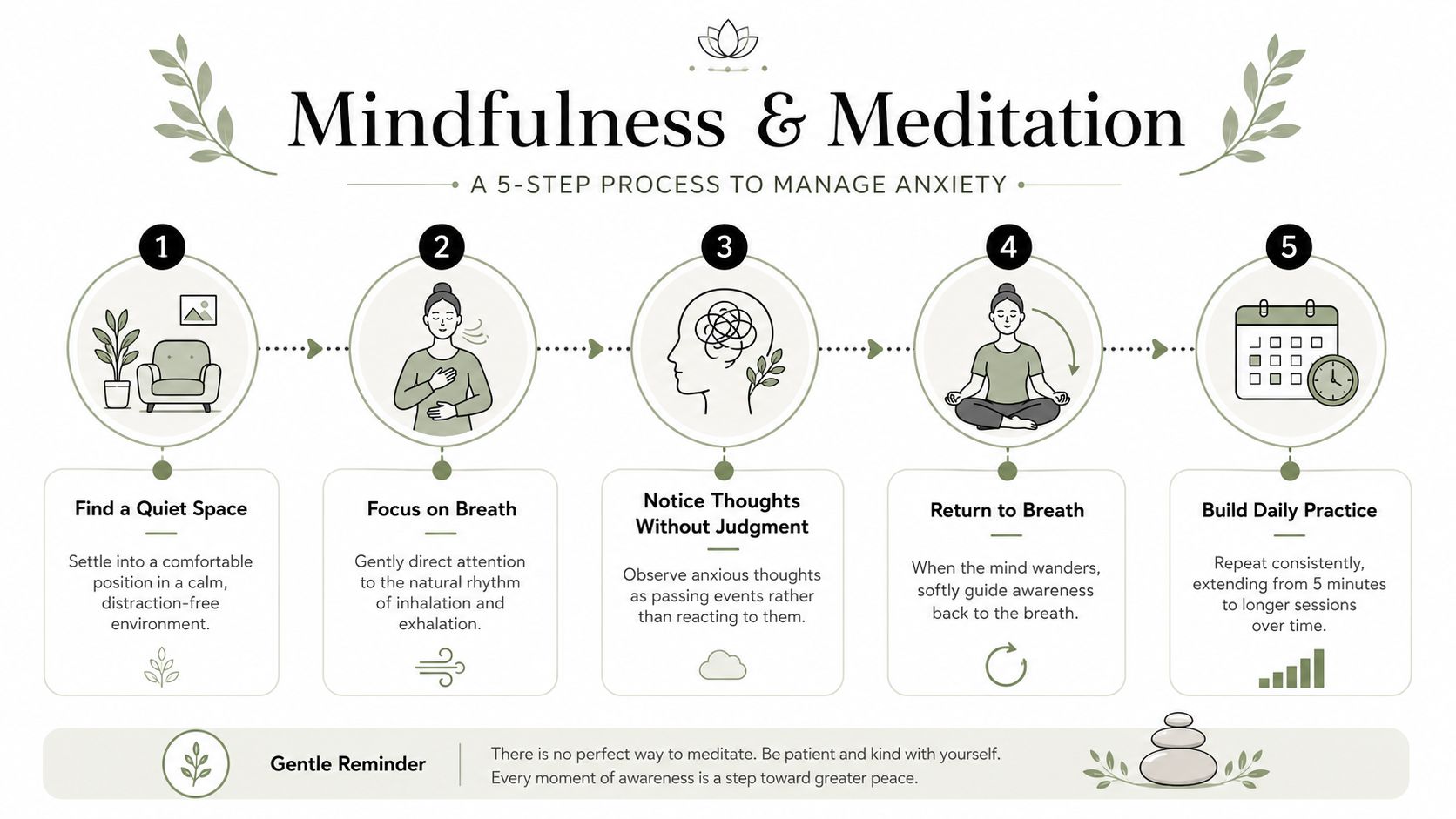
Mindfulness teaches you to notice thoughts, feelings, and sensations without immediately obeying them. Anxiety says, “This threat is happening now,” even when the threat belongs to a feared future. Mindfulness creates a small pause between the thought and the reaction.
Start with a short daily practice. Sit comfortably, notice the breath, and return attention whenever the mind wanders. The return is the practice, not a sign that you've failed. A body scan can help you observe tightness in the jaw, shoulders, chest, or abdomen without trying to force each sensation away.
Let thoughts be events, not commands
During an anxiety spike, try the STOP sequence:
- Stop: Pause before reacting.
- Take a breath: Allow one steady breath.
- Observe: Notice thoughts, feelings, and sensations.
- Proceed: Choose the next action deliberately.
Mindfulness isn't the same as suppressing anxious thoughts or demanding calm. You may still feel fear while becoming less entangled with it. Remote mindfulness-based stress reduction has been found comparable to in-person delivery overall in a 2025 trial, although social anxiety improved more with in-person care (trial data table). That distinction matters. A convenient format can improve access, but delivery style may matter for particular symptoms.
A Scripture meditation practice may suit readers who prefer spiritually framed reflection. Choose an approach you can repeat without turning meditation into another performance test.
6. Progressive Muscle Relaxation PMR
Anxiety often leaves the body braced. You may clench your hands, raise your shoulders, tighten your abdomen, or press your tongue against your teeth without noticing. Progressive muscle relaxation makes that tension visible by deliberately tightening and releasing muscle groups in sequence.
Begin with your hands and forearms, then move through the upper arms, shoulders, face, chest, abdomen, legs, and feet. Tense gently for about five seconds and relax for about ten, focusing on the contrast. If you have pain, an injury, or a condition affected by muscle contraction, ask a clinician how to adapt the exercise.
Turn body awareness into an early warning system
PMR works best as regular practice rather than a last-minute rescue technique. A session before bed can help you identify where you store tension and give your body a repeatable transition into rest. Once you know the full sequence, you can use a shortened version by releasing the shoulders, jaw, hands, abdomen, and legs.
Slow breathing can accompany each release. Instead of judging tension as evidence that anxiety is winning, treat it as information. Tight shoulders may be an early signal to pause, unclench, and choose a coping response before the cycle grows stronger.
Audio guidance can help at first, especially if you rush through the releases. Keep the practice gentle. The purpose is to teach your nervous system what relaxation feels like, not to create more strain.
7. Exercise and Physical Activity
Movement gives anxious energy somewhere to go. Walking, running, cycling, swimming, dancing, and strength training can all become part of a non medication anxiety treatment plan when they're safe for your health and realistic for your schedule.
A person with generalized anxiety might begin with regular walks and notice that sleep and restlessness improve together. Someone with social anxiety could choose a small group class, gaining both movement and low-pressure contact with other people. If exercise sensations resemble panic, start slowly and learn to distinguish normal exertion from danger with appropriate medical guidance.
Choose consistency over punishment
- Start enjoyably: Pick an activity you're willing to repeat, rather than the most demanding option.
- Use small steps: A brief walk can be a valid beginning if you've been sedentary.
- Schedule movement: Put it on your calendar as a health appointment.
- Notice the effect: Record how your body and mood feel before and after, without demanding instant relief.
Exercise isn't a replacement for therapy when anxiety is severe. It's a foundation that can support sleep, confidence, and tolerance of physical sensations. Outdoor movement may also give you daylight and a change of environment, while group activities can reduce isolation.

Aim for a routine that fits your life. A modest practice you maintain is more useful than an ambitious plan you abandon.
8. Journaling and Written Cognitive Processing
Writing takes anxiety out of the blur of mental repetition and puts it somewhere you can examine. A thought record can reveal that a feared outcome is a prediction rather than a fact. It can also show patterns, such as anxiety rising before a weekly meeting, after conflict, or late at night.
Use this structure:
- Situation: What happened?
- Automatic thought: What did your mind predict?
- Feeling: What emotion and body sensations appeared?
- Evidence for: What supports the prediction?
- Evidence against: What facts don't fit it?
- Balanced thought: What would be a fairer conclusion?
Keep the practice contained
Five or ten minutes may be enough. Writing for too long can become another form of rumination if you keep searching for certainty. End with one practical action, such as sending an email, postponing a decision until morning, or returning to a grounding exercise.
You can also write freely about fear, shame, anger, or grief without editing yourself. Follow that with a balanced perspective or a small expression of gratitude, so the journal doesn't become a permanent record of threats.
Review earlier entries occasionally. Look for recurring triggers, safety behaviors, and moments when your prediction didn't come true. Shadow work journaling prompts for anxiety can provide structure when you know you're distressed but can't identify the underlying concern.
Journaling won't solve every anxiety disorder, and it shouldn't replace care for severe symptoms. Its value lies in making patterns easier to see and giving CBT or therapy conversations clearer material to work with.
9. Social Connection and Peer Support
Anxiety grows louder in isolation. A trusted person can't remove every symptom, but honest connection can reduce shame and challenge the belief that you're uniquely broken or unsafe.
Start with one person who responds with patience. You might say, “I've been having panic symptoms, and I don't need you to fix them. It would help if you stayed with me while I breathe.” Clear requests make support easier to provide.
Choose support that encourages recovery
A structured support group can help you hear experiences that resemble your own and learn how others handle avoidance. Online communities may feel more accessible when leaving home or speaking face to face feels too difficult. They're most helpful when members encourage coping, boundaries, and professional care rather than exchanging frightening stories or reinforcing reassurance-seeking.
- Share gradually: You don't need to disclose everything at once.
- Set boundaries: Step away from conversations that intensify fear.
- Match the group: Look for support related to panic, social anxiety, or generalized anxiety when relevant.
- Combine resources: Peer support can sit alongside therapy, CBT practice, and medical evaluation.
Connection also creates opportunities to practice the behaviors anxiety has narrowed. A short phone call, shared walk, or regular meal can become a gentle exposure to closeness and ordinary life.
If a loved one has panic attacks, listen without dismissing the fear. Offer calm company, ask what helps, and avoid making avoidance the only plan.
10. Sleep Optimization and Sleep Hygiene
Poor sleep and anxiety can reinforce each other. Worry makes it difficult to settle, and fatigue can make ordinary sensations feel threatening. Improving sleep won't eliminate every cause of anxiety, but it can give your nervous system a more stable foundation for therapy, exposure, movement, and daily problem-solving.
Keep your bedtime and wake time as consistent as practical. Build a quiet wind-down routine with reading, gentle stretching, meditation, or calming audio. Reduce evening stimulation and notice whether caffeine, alcohol, late work, or phone use keeps your body alert.
Treat sleep as part of treatment
A dark, quiet, comfortable bedroom may help, but don't turn sleep hygiene into another rigid test. If you lie awake monitoring the clock and becoming more alarmed, a clinician trained in insomnia treatment can help you change that pattern.
Persistent snoring, gasping, restless legs, or severe daytime sleepiness deserves medical evaluation. Untreated sleep problems can make anxiety harder to manage, and self-help routines won't address every sleep disorder. A practical bedtime anxiety protocol for CEOs can offer ideas for creating a calmer transition from work to rest, whatever your job title.
The most useful routine is one you can repeat. Start with a stable wake time or a brief screen-free wind-down, then build from there.
10-Point Comparison: Non-Medication Anxiety Treatments
| Method | Implementation complexity 🔄 | Resource requirements ⚡ | Expected outcomes 📊 | Effectiveness ⭐ | Ideal use cases 💡 |
|---|---|---|---|---|---|
| Cognitive Behavioral Therapy (CBT) | Moderate, structured protocol, homework required | Moderate, CBT-trained therapist or validated programs; ~12–20 sessions | Durable symptom reduction, relapse prevention; measurable gains in 4–8 weeks | ⭐⭐⭐⭐⭐ | GAD, panic disorder, social anxiety; long-term skill building |
| Exposure Therapy (Systematic Desensitization) | High, requires hierarchy, repeated planned exposures | Moderate–High, therapist guidance recommended for complex cases | Strong, lasting reduction in avoidance and fear responses over weeks–months | ⭐⭐⭐⭐⭐ | Specific phobias, panic with avoidance, social anxiety, OCD adjuncts |
| Deep Breathing / Breathwork | Low, simple techniques to learn and practice | Minimal, no equipment; apps or audio optional | Immediate physiological calming within minutes; baseline benefits with consistent practice (2–3+ weeks) | ⭐⭐⭐⭐ | Acute panic attacks, situational anxiety, early-stage escalation |
| Grounding Techniques (5-4-3-2-1 etc.) | Low, easy to learn; practice improves speed | Minimal, no equipment; optional grounding kit items | Very rapid short-term reduction (2–5 minutes); best for dissociation/panic | ⭐⭐⭐⭐ | Panic attacks, dissociation, acute overwhelm in public settings |
| Mindfulness & Meditation | Low–Moderate, easy to start, requires regular practice | Minimal–Moderate, guided apps, classes, or self-practice | Reduced frequency/intensity of anxiety; improved emotional regulation over weeks | ⭐⭐⭐⭐ | Chronic anxiety, stress resilience, maintenance alongside therapy |
| Progressive Muscle Relaxation (PMR) | Low–Moderate, guided 10–30 min sessions; systematic practice | Minimal, audio guides helpful; time commitment for full sessions | Decreases muscle tension, improves sleep and baseline anxiety with regular use | ⭐⭐⭐⭐ | Tension-related anxiety, insomnia, somatic symptoms |
| Exercise & Physical Activity | Moderate, scheduling and adherence required | Minimal–Moderate, can be free (walking) or require classes/equipment | Long-term baseline anxiety reduction, better sleep and mood within weeks | ⭐⭐⭐⭐⭐ | GAD, comorbid depression, lifestyle-based treatment and prevention |
| Journaling & Written Processing | Low, simple to implement but needs honesty and routine | Minimal, pen/app; structured templates boost effectiveness | Improves insight, reduces rumination, supports cognitive change over weeks | ⭐⭐⭐ | Thought restructuring, pattern identification, adjunct to therapy |
| Social Connection & Peer Support | Low–Moderate, requires vulnerability and time | Minimal–Moderate, support groups, online communities, friends/family | Reduces isolation and shame; ongoing practical and emotional support | ⭐⭐⭐⭐ | Loneliness-driven anxiety, recovery maintenance, motivation for treatment |
| Sleep Optimization & Hygiene | Moderate, lifestyle changes and consistency required | Minimal–Moderate, environment adjustments; possible medical/CBT‑I referral | Large impact on anxiety (often 30–50% reduction); enhances all other treatments in 2–4 weeks | ⭐⭐⭐⭐⭐ | Insomnia-related anxiety, foundational treatment to improve other interventions |
Build Your Personal Path to Feeling Safe Again
No single technique has to carry your entire recovery. Breathing may help you get through the first minutes of panic, but it may not change the belief that the next sensation is dangerous. Journaling may reveal the belief, while CBT or exposure can help you test it. Sleep, movement, mindfulness, muscle relaxation, and connection can make that deeper work more manageable.
A practical sequence can look simple:
- Choose one rapid tool: Use breathing or grounding when panic begins.
- Add one daily foundation: Pick sleep consistency, movement, mindfulness, or journaling.
- Address the maintaining pattern: Consider CBT or guided exposure for recurring avoidance and fearful interpretations.
- Review your results: Note what helped, what made symptoms worse, and what you want to adjust.
This approach keeps recovery concrete. You're not required to master ten methods at once. One practiced tool can become a bridge to the next step.
The evidence also calls for honest expectations. A 2026 scoping review of non-pharmacological anxiety treatment in general practice found only seven relevant studies after screening 3,425 articles, showing that real-world evidence remains limited (general practice scoping review). The same source describes strong trial efficacy for CBT alongside routine-care challenges, including dropout and non-response that vary by person and disorder. That doesn't mean treatment is hopeless. It means the right question is personal and practical: what works for you, with the support and setting you can realistically sustain?
For panic disorder, CBT is widely described as a first-line treatment, with short-term programs typically lasting 12 to 15 sessions in individual or group formats (CBT for panic disorder). A controlled group CBT study found 85% of treated participants were panic-free after treatment compared with 30% of controls, while 64% met conservative recovery criteria compared with 9% of controls, and 63% still met recovery criteria at six months (controlled group CBT study). A separate review of 69 randomized clinical trials involving 4,118 patients found better CBT outcomes than controls within 12 months after treatment, with reported relapse rates for panic disorder ranging from 0% to 14% at three to 12 months (panic disorder CBT meta-analysis).
Real-world care can help, too. One general-practice study reported recovery in 57% of the intervention group versus 38% of a waitlist control group, with 2.17 times greater odds of recovery (general-practice anxiety treatment study). These findings don't promise a fixed outcome for any individual, but they support a hopeful conclusion: living with fewer panic-driven limitations is a realistic direction.
Anxiety Checklist can be one optional source of support. Its always-free SOS mode offers grounding, affirmations, and quick prompts, while its broader resources include hypnosis sessions, sleep audios, guided meditations, walking sessions, CBT self-therapy tools, exposure exercises, and educational material. You can use it alongside qualified professional care, not as a replacement for assessment when anxiety is severe or persistent.
Recovery may happen gradually. Each time you respond to fear with a practiced skill, remain present through a sensation, question a prediction, or choose connection instead of avoidance, you're building evidence that anxiety can be managed and that your life can become larger than panic.
The Anxiety Checklist offers an always-free SOS mode for grounding and quick support, plus daily tools such as sleep audios, guided meditations, walking sessions, affirmations, hypnosis, and CBT self-therapy exercises. Visit The Anxiety Checklist to explore practical non medication anxiety treatment support for panic moments and long-term recovery.