


You're sitting still, yet your chest feels banded tight. Your breaths have become quick and shallow, your heart is demanding attention, and one frightening thought keeps returning: What if something is seriously wrong? You may reach for your phone and start searching symptoms, only to feel more alarmed by every result.
Chest tightness can be frightening, but panic-related relief is a learnable skill. The practical approach has two tracks: calm the body during the episode, then retrain the nervous system so the sensation stops feeling like an emergency. This guide will help you make that distinction while keeping safety first. If anxiety also keeps your thoughts looping, these tools for overthinking and anxiety can support the longer recovery process.
Table of Contents
- When Your Chest Feels Tight and Your Mind Spirals
- Red Flags That Mean Stop and Get Help Now
- What Is Actually Causing the Tightness
- Your In-the-Moment Relief Protocol
- Tools That Help You Heal for the Long Run
- Your First Week Toward Living Panic Free
When Your Chest Feels Tight and Your Mind Spirals
A panic episode often begins with a small body sensation. Maybe your chest feels slightly restricted after a stressful message, a poor night's sleep, or an unexpected rush of fear. You notice the sensation, check your breathing, and then brace your chest and shoulders. The extra tension makes breathing feel stranger, which convinces your mind that danger is increasing.
That spiral feels convincing because the body is reacting as if it needs to escape. You might keep taking bigger breaths, scan your pulse, or ask someone to confirm that you look okay. None of that means you're weak or imagining the experience. The sensation is real, even when panic is the driver.
Practical rule: Treat the alarm as a body response first, not as proof that the feared explanation is true.
Chest tightness relief is not a mystery reserved for unusually calm people. You can practice it, improve at it, and eventually teach your nervous system that a tight chest can pass without catastrophe. The immediate track uses posture, slower breathing, grounding, and a clear safety check. The long-term track addresses fear of bodily sensations, avoidance, health anxiety, and the habits that keep panic ready to fire.
If you've been looking for compassionate medical support for anxiety alongside mental-health care, house call depression therapy from Life Primary Care may be a useful resource to discuss with a qualified professional. Medical evaluation matters, especially when symptoms are new or recurring.
For now, loosen your jaw, lower your shoulders, and let your next breath be ordinary rather than forceful. You're in the right place. Move through this at your own pace.
Red Flags That Mean Stop and Get Help Now
Before trying breathing exercises, make one calm decision: does this feel like a familiar panic pattern, or is there a warning sign that needs urgent assessment? Chest tightness can come from anxiety, but it can also signal a heart or lung problem. You can't safely diagnose the cause from sensation alone.
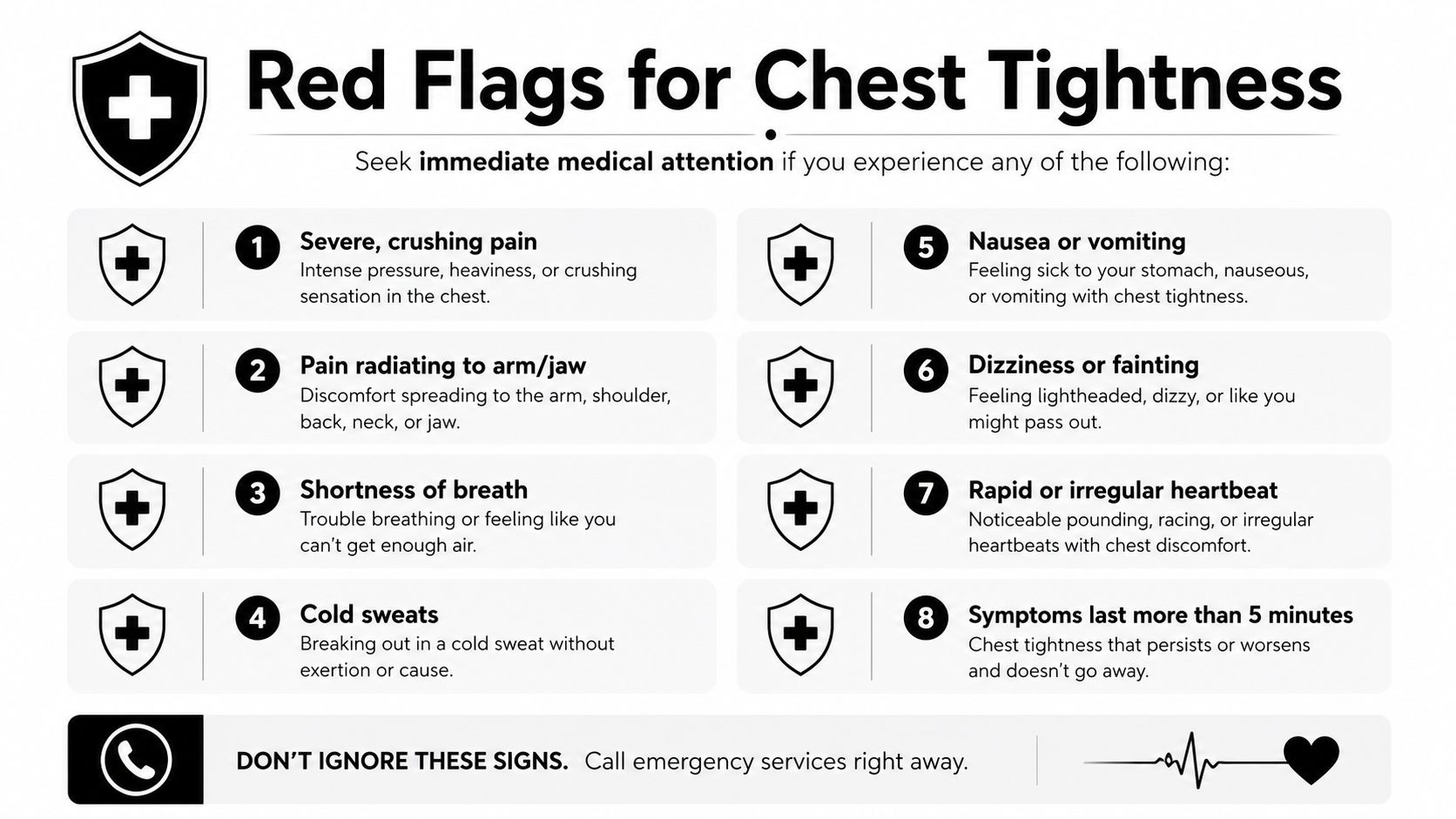
Get emergency help immediately if you have:
- Crushing or pressure-like pain: Especially if it feels severe, unusual, or overwhelming.
- Pain that spreads: Discomfort moving into the arm, jaw, neck, shoulder, or back needs urgent attention.
- Exertion-related pain: Stop activity if tightness worsens while walking, exercising, or climbing stairs.
- Shortness of breath at rest: Don't assume this is panic when breathing remains difficult while you're still.
- Cold sweat, dizziness, or fainting: These symptoms raise the urgency, particularly when they appear with chest discomfort.
- Sudden sharp pain with coughing or breathing: This can point to a lung-related problem and needs assessment.
- Chest tightness after an injury: Trauma can affect muscles, ribs, or the lungs.
- Rapid change in severity: A symptom that suddenly becomes intense or unlike your usual episodes deserves immediate care.
The gethelpnow anxiety resource can help you organize support information, but it isn't a substitute for emergency services. If any red flag is present, call emergency services or go to the ER now. Skip breathing exercises until a doctor has cleared you. If this is an anxiety episode without warning signs, the rest of this article will still be here when you return.
What Is Actually Causing the Tightness
The right relief depends on the cause. Anxiety techniques can help when panic is tightening your breathing pattern, but they won't treat asthma, reflux, an injury, or a cardiac problem. A useful first step is to notice the pattern without turning that observation into self-diagnosis.
Match the pattern to the next action
Anxiety and panic often create a band-like squeeze. You may breathe rapidly, over-breathe, or hold tension in the chest, ribs, neck, and upper back. The sensation may shift as your breathing and attention change. The matching direction is to reduce over-breathing, relax braced muscles, and address the fear attached to the sensation. The Anxiety Checklist panic guide offers additional panic-focused explanations and exercises.
Stress-related muscle tension commonly feels sore, tight, or tender across the chest wall, intercostal muscles between the ribs, or upper back. It may change when you twist, stretch, press the area, or alter your posture. Gentle movement, heat, rest, and professional assessment can be more useful than repeated reassurance.
Asthma or bronchospasm can bring chest tightness with wheezing or difficulty moving air. Cleveland Clinic explains that short-acting bronchodilators widen narrowed airways within minutes, with relief typically felt in 10 to 15 minutes and lasting roughly 4 to 6 hours (Cleveland Clinic's bronchospasm guidance). These medicines provide rescue relief, but they don't treat the underlying airway inflammation. Use prescribed medication as directed, and seek urgent care when symptoms are new, severe, or persistent.
Acid reflux tends to burn behind the breastbone and may worsen after eating, bending, or lying down. The relief direction is reflux evaluation and management, not repeated panic drills.
Costochondritis, inflammation where the ribs meet the breastbone, can cause localized pain that changes with movement, coughing, or deep breathing. A clinician should confirm the cause before you treat recurring symptoms at home.
If understanding the heart's structure would make medical conversations less abstract, you can explore 3D cardiac anatomy as an educational visual. It won't determine why your chest feels tight, but it may help you understand what your clinician is evaluating.
| Likely Cause | Signature Clue | Best Relief Direction |
|---|---|---|
| Anxiety or panic | Tightness shifts with breathing, fear, and attention | Slow breathing, grounding, therapy, and nervous-system retraining |
| Muscle tension | Soreness changes with posture, movement, or touch | Gentle movement, rest, and medical guidance |
| Bronchospasm | Wheeze or difficulty moving air | Prescribed rescue inhaler and urgent assessment when needed |
| Acid reflux | Burning that worsens after meals or lying down | Reflux-focused medical care |
| Costochondritis | Localized pain affected by movement or deep breaths | Clinical assessment and appropriate pain care |
Recurring chest tightness deserves a medical check, even when panic seems likely. Rule out cardiac and respiratory causes first, then work confidently on anxiety rather than repeatedly wondering whether you missed something.
Your In-the-Moment Relief Protocol
Use this five-minute sequence when a clinician has ruled out urgent causes and the episode matches your familiar panic pattern. The aim isn't to force the sensation away. The aim is to stop adding fuel while your body completes the alarm response.
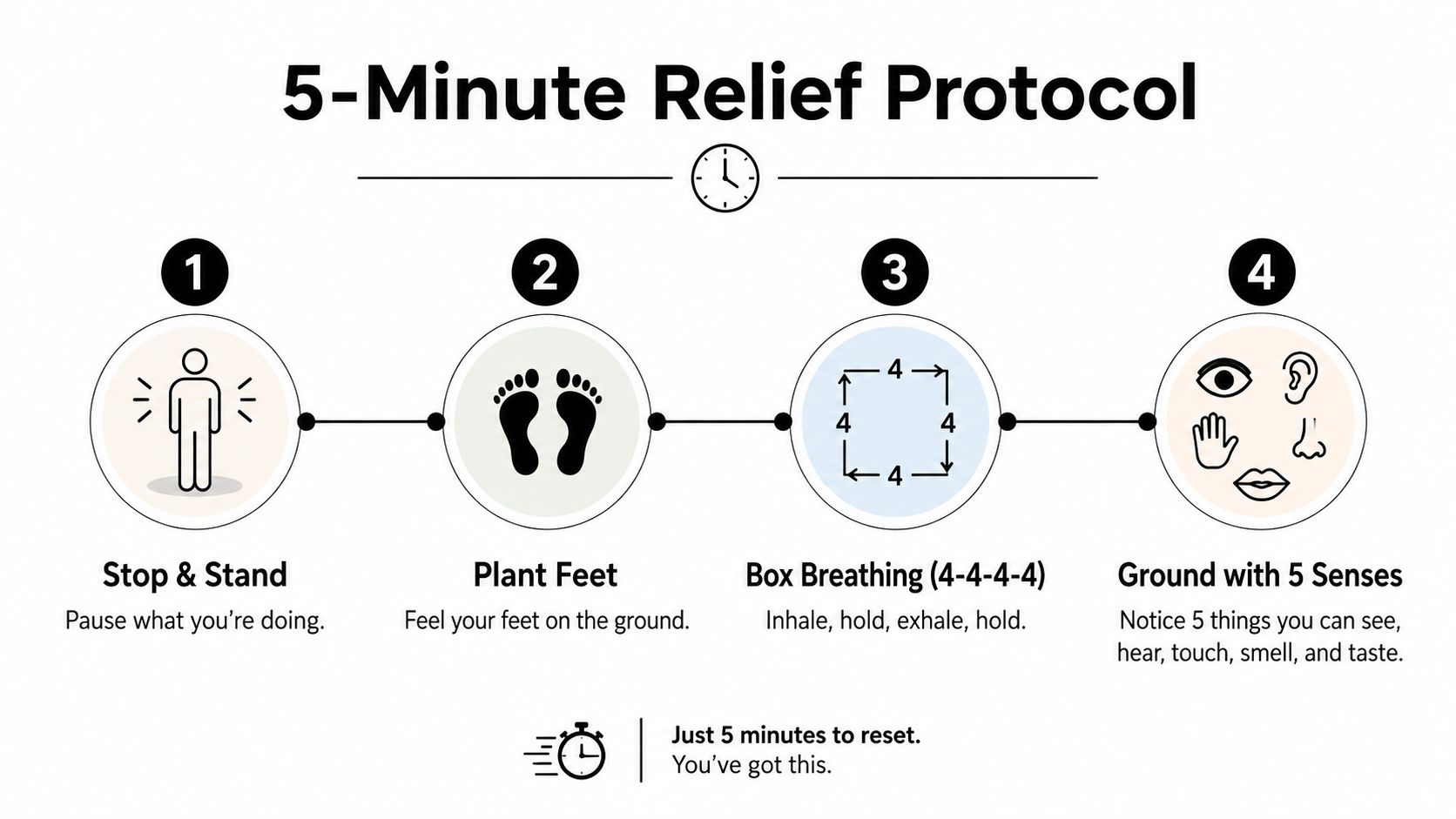
Minute one, stop and plant yourself
Stop walking, working, or checking symptoms. Sit upright or stand with your feet supported, then let your arms rest. Unclench your hands, drop your shoulders, and soften your stomach. A posture reset tells your body that you aren't preparing to fight or flee.
Say, “This is uncomfortable, and I have a plan.” Don't argue with every frightening thought. A short, repeatable statement works better than an internal debate.
Minutes two and three, slow the cycle
Use box breathing:
- Inhale gently for 4 counts.
- Hold for 4 counts.
- Exhale slowly for 4 counts.
- Hold for 4 counts.
- Repeat for several minutes.
Breathing-training research in panic disorder found increased pCO2, meaning carbon dioxide in the blood, and reduced respiratory rate after intervention. The reported effects were SMD = 0.338 for pCO2 and SMD = 0.342 for respiratory rate, indicating measurable physiological correction rather than only subjective comfort (systematic review and meta-analysis of breathing training).
The common mistake is trying to pull in more air, faster. Deep, rapid breathing can worsen the carbon-dioxide drop associated with hypocapnia, which can prolong tingling, dizziness, and tightness. Keep the inhale quiet and comfortable. If holding your breath makes you feel worse, stop the pattern and breathe gently without forcing counts.
Minute four, reconnect with the room
Use the 5-4-3-2-1 scan:
- 5 things you can see
- 4 things you can feel
- 3 things you can hear
- 2 things you can smell
- 1 thing you can taste
Name ordinary details, such as the edge of a table, fabric under your fingertips, or traffic outside. Grounding moves attention from internal threat monitoring toward the present environment.
Minute five, add a sensory anchor
If breathwork feels too difficult, press your fingertips together and notice the pressure. Hold a textured object, run cool water over your hands, or place an ice cube against your wrist. Some people also find a cool-water face dip helpful. These sensations give the brain a clear, neutral signal to process while the surge settles.
A short practice video can guide you through the pacing, but stop if symptoms feel medically unusual or worsen. You can also keep a set of anxiety breathing techniques available for practice outside an episode.
Run this protocol when calm, not only when desperate. Rehearsal teaches your body the sequence before panic makes concentration difficult. Relief may arrive gradually. That still counts as progress.
Tools That Help You Heal for the Long Run
A rescue technique can carry you through a surge, yet lasting relief requires a second track. You must calm the body during an episode and retrain the nervous system between episodes. Repeatedly noticing sensations, allowing them, and choosing a measured response teaches your brain that chest tightness is not automatically danger.
Choose tools that build skill
Use a guided breathing library to practise a slower, comfortable rhythm. Some apps pair prompts with biofeedback, showing a visible signal as your body changes. Open these tools during neutral moments first. That connection turns the app into a practice aid instead of another emergency search.
Structured CBT programs can address health anxiety directly. CBT, or cognitive behavioural therapy, teaches you to identify a frightening interpretation, examine the evidence, and test a more balanced response. Thought journaling helps when the recurring belief is, “Chest tightness means I'm in immediate danger.” Anxiety self-help guides can give you more evidence-based strategies to explore at your own pace.
Exposure work reduces avoidance. Interoceptive exposure means practising safe body sensations in small, planned doses, so your brain learns that a sensation itself is not proof of catastrophe. A therapist can help you design an appropriate hierarchy. Do not deliberately provoke symptoms that could be unsafe for you, and do not use exposure as a substitute for medical evaluation.
Mindfulness builds tolerance for internal sensations without constant checking. A walking session, guided meditation, or short body scan lets you notice pressure, breathing, and heartbeat without immediately seeking reassurance.

Pair digital practice with human support
Choose one digital tool and one weekly human practice. The human option might be therapy, a peer-support meeting, or a conversation with someone who stays calm without repeatedly checking your symptoms. This pairing keeps your phone from becoming another reassurance device.
The Anxiety Checklist is one option. Its always-free SOS mode provides grounding prompts, affirmations, and immediate support without a login. Its broader library includes guided meditations, sleep audios, walking sessions, hypnosis sessions, affirmations, and CBT self-therapy tools such as thought journaling, belief experiments, and exposure therapy. Educational material includes a CBT introduction by Dr. Joshua Shifrin, PhD, a PanicFree Masterclass by Michael Norman, and 65+ articles in Anxiety University. Premium content has a 7-day free trial, according to the publisher's product information.
For sleep and evening wind-down, calming surroundings can support your routine without replacing anxiety treatment. If candles fit your routine, The Candledust bedtime picks may offer ideas for a consistent bedtime setting.
Avoid tools that promise instant cures, demand constant symptom checking, or provide endless reassurance. Reassurance may soothe you briefly while teaching your brain that safety depends on certainty. Ask, “What skill am I practising right now?”
Research supports this two-track approach. A 2025 study reported that abdominal breathing training reduced anxiety with Cohen's d = 0.61, with effects lasting 4 weeks (the 2025 breathing intervention research). That result does not make every breathing technique suitable for every person. It supports addressing the anxiety pattern itself through approaches such as CBT and medication, rather than relying only on repeated testing or short-term calming.
Practise safety instead of organising your life around avoidance. Over time, panic loses authority because your body has learned a different response.
Your First Week Toward Living Panic Free
Your first week doesn't need to be dramatic. It needs to be repeatable. Use the immediate protocol when symptoms rise, then spend a small amount of time each day teaching your nervous system that normal sensations are survivable.
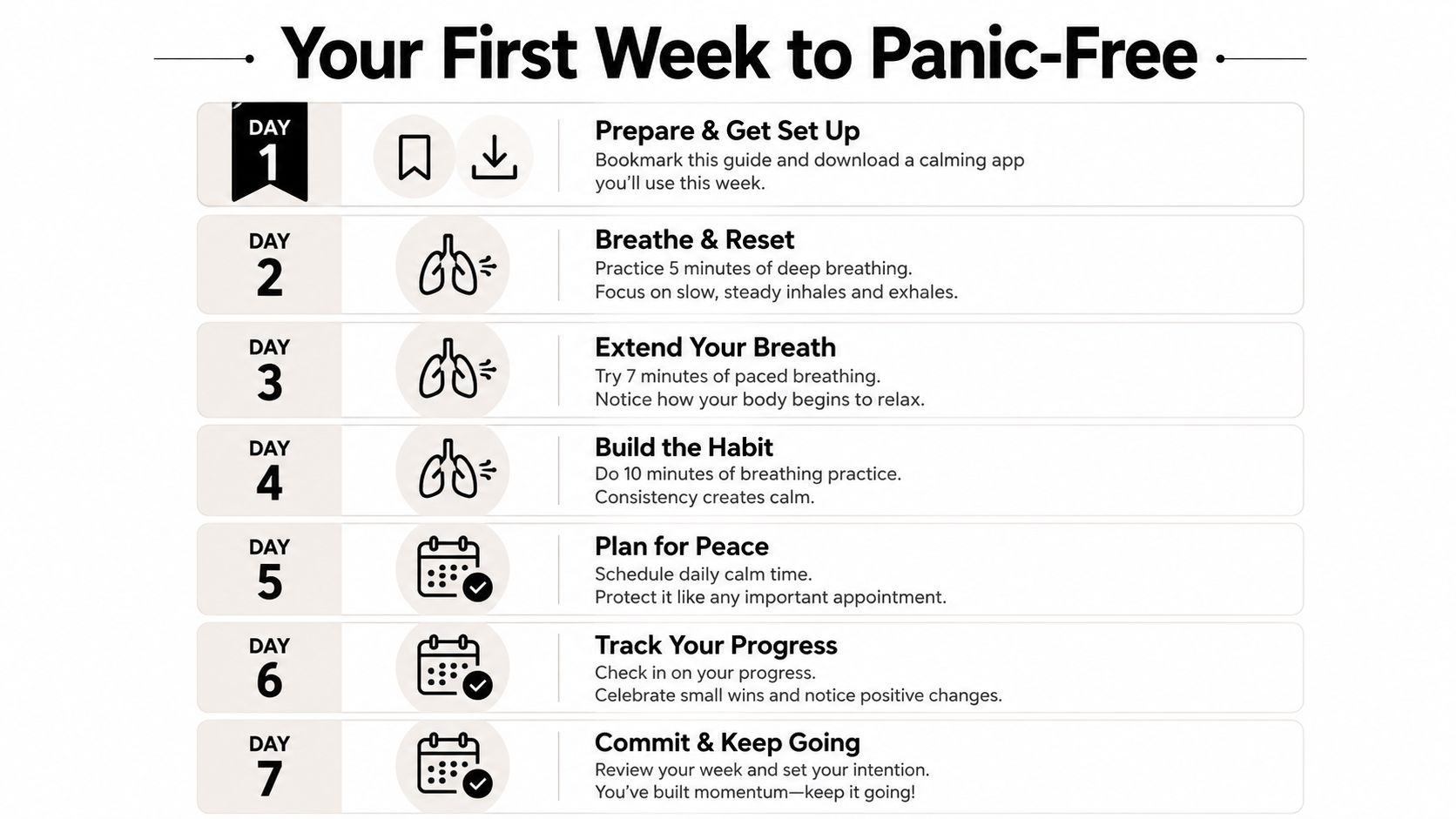
Days one through four, create the foundation
Day 1: Bookmark the red-flag rules. Choose one breathing or CBT app, and download it before you need it. Tell one trusted person what kind of support helps, such as sitting nearby without repeatedly asking whether you're okay.
Days 2 through 4: Run the box-breathing protocol twice daily when you're relatively calm. Keep a brief log with three entries: what the tightness felt like, what happened just before it, and what helped. Write observations rather than verdicts. “Tightness began after an argument and eased while I stood and slowed my exhale” is more useful than “My heart is failing.”
Days five through seven, add confidence
Day 5: Schedule a medical check-in to discuss recurring chest tightness and rule out cardiac or respiratory causes. This isn't a failure of anxiety work. It gives you a safer foundation for it.
Days 6 and 7: If a clinician has confirmed that the activity is safe, complete one brief interoceptive exercise in a controlled setting, such as a short breath-hold or light exertion. Stop for concerning symptoms, and work with a therapist if you're unsure how to choose or pace the exercise. Review your log at the end of the week and look for patterns, not perfection.
Keep the two tracks separate but connected. The rescue plan helps you respond during a surge. Daily practice changes what your brain predicts the next time your chest feels unusual. Hope becomes more believable when you collect your own evidence that sensations rise, peak, and pass.
When tightness returns, repeat this commitment anchor:
“I have a plan, I have tools, and this will pass.”
The Anxiety Checklist offers an always-free SOS mode for grounding and panic support, plus guided breathing, meditations, sleep audios, and CBT self-therapy tools for longer-term practice. Visit The Anxiety Checklist to start building your personal chest tightness relief plan today, with no login required and a 7-day free trial for premium content.