


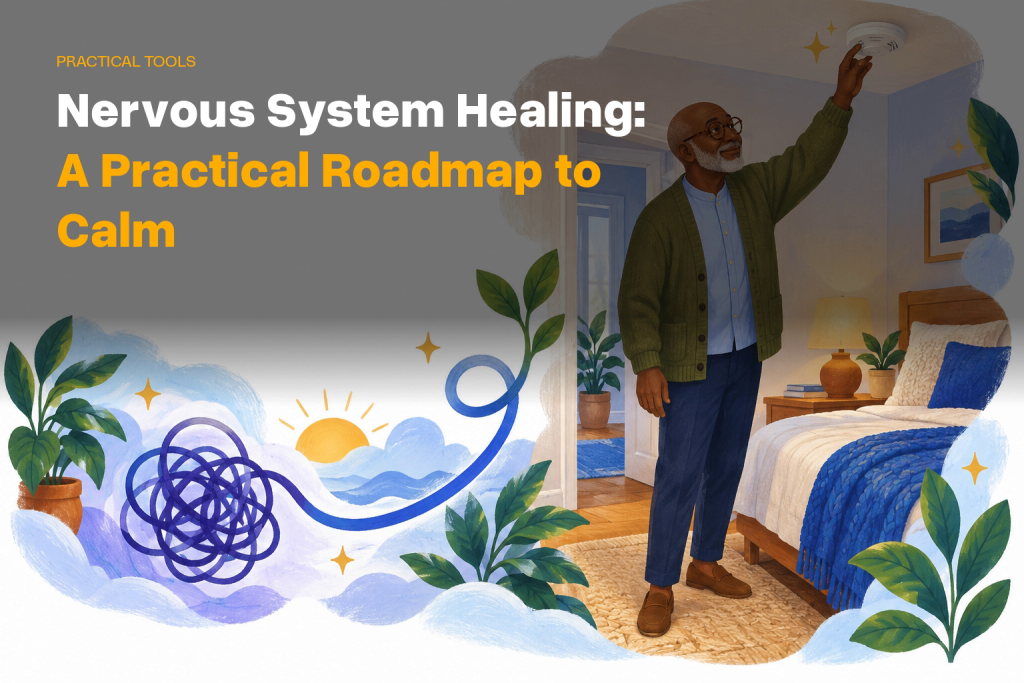
At 3 a.m., your heart suddenly starts racing. You scan the dark room for danger, but nothing is there. By morning, your shoulders are tight, your breathing is shallow, and a low hum of dread follows you through work, meals, conversations, and bedtime.
This pattern can feel like a personal failure, especially when other people seem able to relax. It isn't. Your body may be running a learned protection program that once made sense but no longer matches your surroundings. The hopeful truth is that nervous system healing is possible. Anxiety can become quieter, panic can stop controlling your choices, and calm can become familiar again.
Healing doesn't mean you'll never feel stress. It means your body learns to recognize safety, respond to genuine threats, and return to balance after activation. The path is gradual, practical, and supported by what we know about neuroplasticity, anxiety treatment, autonomic regulation, and trauma-informed care.
Table of Contents
- The Quiet Truth About Living in Survival Mode
- How the Nervous System Actually Works
- Why Your System Gets Stuck and What It Feels Like
- Evidence-Based Tools That Actually Rewire Calm
- Your Step-by-Step Plan to Retrain Your Nervous System
- When Self-Help Is Not Enough and Professional Help Matters
- Building Lasting Resilience and Calm for the Long Run
The Quiet Truth About Living in Survival Mode
A woman wakes before dawn with her pulse pounding. She checks the clock, listens for sounds in the house, and searches her thoughts for an explanation. There isn't an immediate threat, yet her body acts as if one is close.
She gets up exhausted. Her jaw aches from clenching, her chest feels tight, and she takes shallow breaths without noticing. During the day, she answers messages while scanning for bad news, apologizes when nobody is upset, and stays busy because quiet moments make the dread more noticeable. At night, she tells herself she should be grateful, then wonders why gratitude doesn't switch off the alarm.
This is what chronic sympathetic activation can look like in ordinary life. It doesn't always resemble a dramatic trauma response. Sometimes it appears as irritability, overthinking, poor sleep, digestive discomfort, emotional distance, or an inability to enjoy a safe moment. The nervous system keeps preparing for danger after the original pressure has passed.
Your body is adapting, not betraying you
The nervous system changes in response to experience. Neuroplasticity describes the adaptive structural and functional changes that occur with experience, injury, and therapy, and modern clinical references place it at the center of recovery in the central and peripheral nervous systems (NCBI Bookshelf). That adaptability gives you a reason to hope. A system that learned alarm can also learn recovery.
Nervous system healing isn't about deleting every anxious thought. It involves repeated experiences of noticing activation, responding skillfully, and discovering that the body can settle without escape, reassurance, or avoidance.
The aim isn't permanent calm. It's a faster, kinder return to calm.
A simple guide to the body's alarm pattern can help you identify what happens during activation. The Anxiety Checklist's response guide can support that first act of recognition. Naming the response doesn't make symptoms imaginary. It helps separate a protective body signal from proof that catastrophe is happening.
The rest of this roadmap focuses on retraining rather than forcing. You'll learn how the autonomic nervous system works, why it can remain alert, which tools fit different symptoms, and when professional care should become part of the plan.
How the Nervous System Actually Works
Your autonomic nervous system is the body's automatic pilot. It helps regulate functions such as heart rate, digestion, breathing patterns, and shifts in alertness without requiring conscious instructions. You don't need to remember to increase alertness when a car swerves or encourage digestion after a meal. Your body coordinates those changes continuously.
The sympathetic branch acts like a gas pedal. It mobilizes energy for action, increasing vigilance and preparing muscles to respond. The parasympathetic branch acts more like a brake, supporting restoration, digestion, and recovery. These branches aren't enemies. A healthy nervous system uses both, moving toward activation when needed and settling afterward.
A house with three safety settings
The vagus nerve is a major communication pathway linking the brain with the heart and gut. It participates in parasympathetic regulation, but it's more useful to think of the whole system as a responsive network rather than a single switch.
Polyvagal theory offers a practical map with three broad states:
- Ventral vagal safety: You feel connected, present, curious, and able to use social support.
- Sympathetic mobilization: You feel keyed up, restless, frightened, angry, or driven to act.
- Dorsal vagal shutdown: You feel numb, collapsed, detached, foggy, or unable to respond.
A house can make this easier to understand. The smoke detector represents threat detection. A dimmer switch represents changing levels of arousal rather than a simple on-or-off reaction. A three-speed thermostat represents the body's broad movement between connection, mobilization, and shutdown.
These states are adaptive. A racing heart can help you move away from danger, while temporary withdrawal can conserve energy when a situation feels overwhelming. The problem arises when the alarm remains sensitive, the dimmer stays bright, or the thermostat shifts too quickly.
You can study brain-based feedback approaches, including using neurofeedback to reduce anxiety, as one possible part of a broader treatment plan. No single technique replaces assessment, especially when symptoms are severe or medically unexplained.
Retraining begins with targeted input. Breathing, movement, social connection, attention, therapy, and predictable routines can all provide information that differs from danger. Repetition matters because the nervous system learns from patterns, not from one reassuring thought.
Why Your System Gets Stuck and What It Feels Like
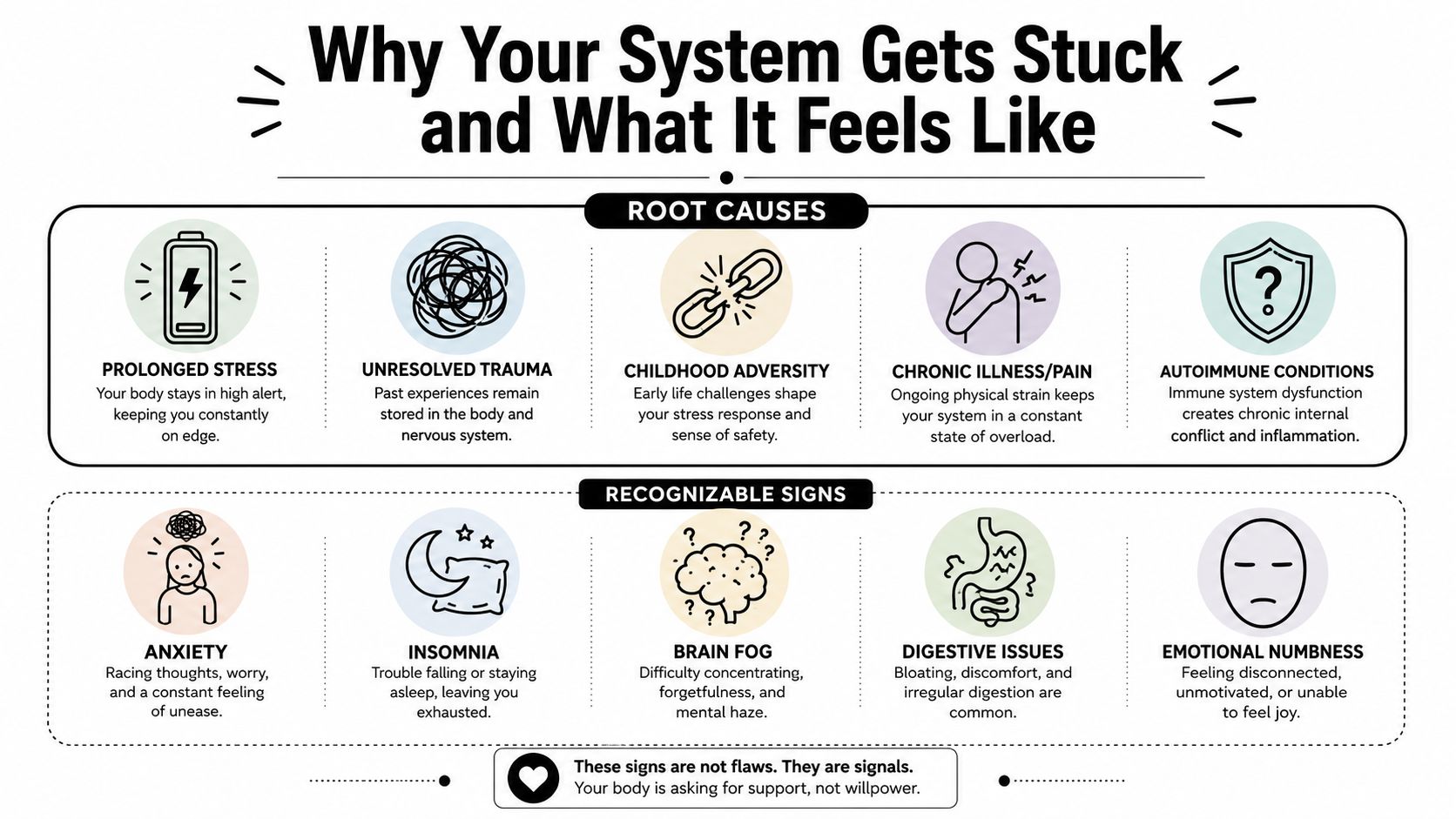
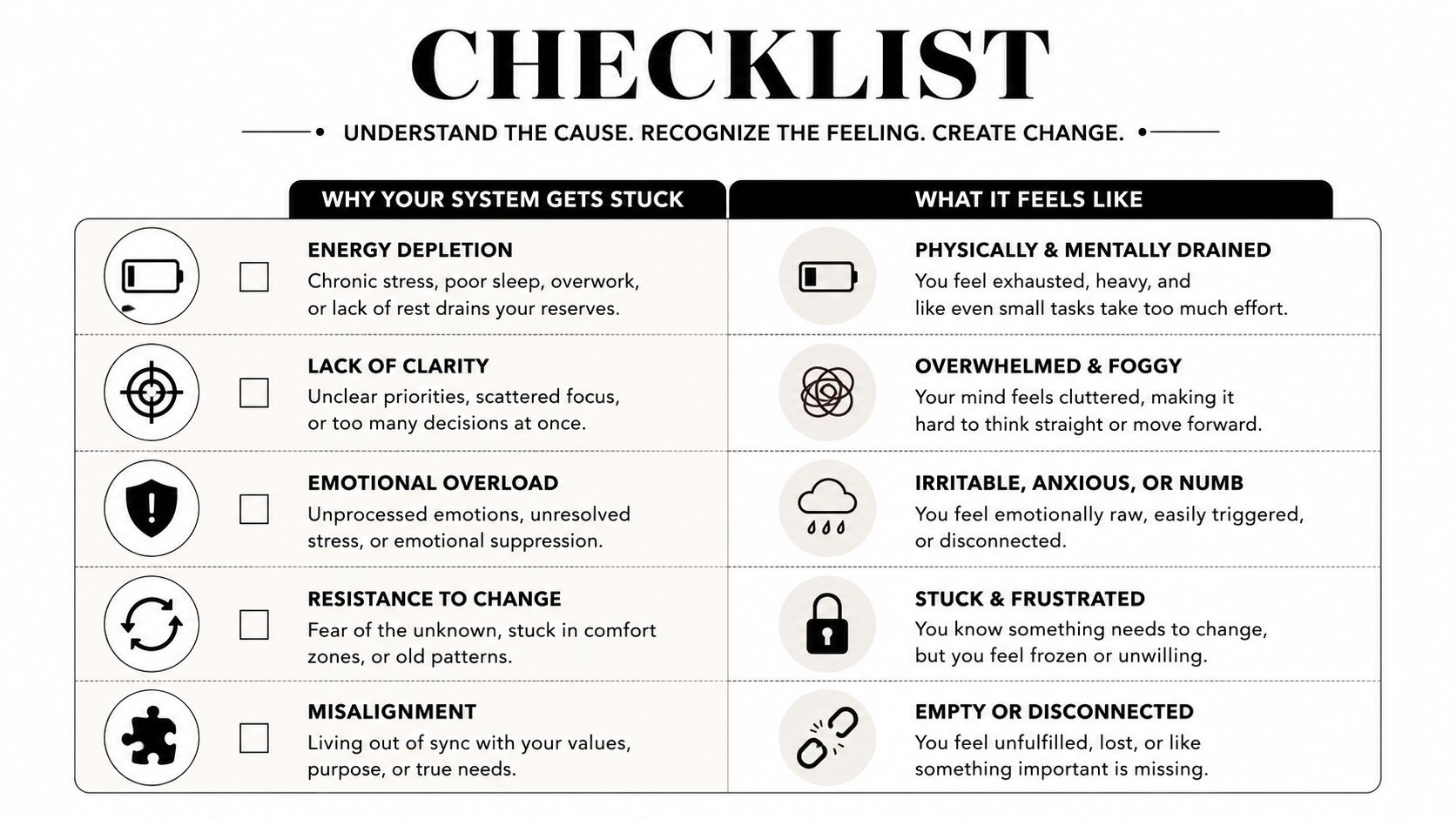
A nervous system can remain prepared for danger when stress arrives without enough recovery. Prolonged work pressure, unresolved trauma, childhood adversity, chronic illness, pain, autoimmune conditions, gut dysfunction, poor sleep, stimulant overuse, and constant digital stimulation can all add load. None of these automatically explains a person's symptoms, but each can make it harder for the body to return to baseline.
The threat-detection system doesn't need a conscious decision to stay alert. Repeated discomfort, unpredictable sensations, frightening memories, or ongoing uncertainty can keep attention turned outward for signs of trouble. Over time, the body may respond to ordinary cues, such as a heartbeat, a notification, a crowded room, or a tired morning, as if they require urgent protection.
The signs are signals, not character flaws
Symptoms often appear in combinations:
- Physical: Racing heart, chest tightness, muscle bracing, digestive issues, headaches, fatigue, and sleep disturbance.
- Mental: Brain fog, racing thoughts, indecision, catastrophizing, and difficulty concentrating.
- Emotional: Irritability, dread, numbness, shame, or feeling disconnected from other people.
- Behavioral: People-pleasing, avoidance, compulsive checking, staying constantly busy, or freezing when action feels impossible.
The same person may move between high activation and shutdown. Someone can spend the morning overworking and the afternoon feeling emotionally numb. Someone else may look calm while internally monitoring every sensation.
For a compassionate description of these patterns and their meaning in recovery, Be Your Best Self Thrive on nervous offers another accessible perspective from Be Your Best Self & Thrive Counseling, PLLC.
Peripheral nerve healing shows why biology often requires patience. Clinical reviews commonly describe regenerating axons growing at about 1 to 2 millimeters per day, often simplified to roughly 1 millimeter per day or 1 inch per month (clinical review). That physical regeneration is different from anxiety recovery, but both illustrate an important principle: nervous system change can be measurable while still unfolding gradually.
If mental loops are keeping the alarm active, learning how to stop overthinking and worrying can give you a cognitive entry point. The goal isn't to argue with every thought. It's to notice the loop, reduce the behaviors that reinforce it, and practice a different response.
Evidence-Based Tools That Actually Rewire Calm
Different symptoms call for different tools. Breathing may help someone who feels physiologically activated, while CBT may better address catastrophic interpretations. Trauma-focused treatment may be necessary when ordinary relaxation brings up flashbacks or dissociation.
| Tool | Targets | Time to Effect | Evidence Strength | Best For |
|---|---|---|---|---|
| Diaphragmatic or paced breathing | Arousal and breath-driven panic | Often immediate, with practice | Clinically established regulation skill | Acute anxiety and shallow breathing |
| CBT | Worry, catastrophic beliefs, avoidance | Builds across treatment | Strong clinical evidence | Anxiety disorders and cognitive loops |
| Graded exposure | Fear generalization and avoidance | Gradual | Strong within appropriate treatment | Panic and situation-based fear |
| EMDR | Trauma-linked memories and triggers | Gradual, supervised | Established trauma-focused approach | Trauma-related symptoms |
| Somatic or sensorimotor therapy | Body-based threat responses | Variable | Promising, practitioner-dependent | Trauma and chronic bracing |
| Yoga, TRE, and gentle movement | Bracing and arousal | Short-term shifts with repetition | Variable by method and population | Bodily tension and regulation practice |
| Walking and strength training | Mood, stress load, and physical activation | Gradual | Supportive adjunct | General resilience |
| Sleep, light, and nutrition routines | Circadian and physiological stability | Gradual | Foundational support | Poor sleep and inconsistent energy |
A 2025 meta-analysis of 74 studies with 8,277 participants found mindfulness-based body-focused treatments and CBT were similarly effective for somatic symptoms, while body-focused approaches were more effective for anxiety immediately after treatment and at follow-up (meta-analysis). That doesn't mean one approach is universally superior. It suggests that symptom pattern should guide the choice.
For anxiety disorders, CBT has substantial support. One meta-analysis found an overall mean remission rate of 51.0% for adults receiving CBT (CBT meta-analysis). Panic-focused CBT can also have lasting effects. A long-term study reported relapse rates of 0% to 14% over 3 to 12 months in predominantly panic-disorder samples (long-term CBT study).
Match the tool to the symptom, then layer rather than chase a single cure.
Try gentle belly breathing when you need a simple way to place attention in the body. Belly breathing for focus and calm can provide a practical starting point. Humming, a comfortable vocal tone, and a cool splash to the face may also feel settling, but stop if they increase distress.
Trauma exposure requires care. Breathwork should be adapted or avoided when medically inappropriate, including situations such as pregnancy without professional guidance. Cold exposure can be unsafe for some heart or circulation conditions. Active PTSD, severe dissociation, or flooding trauma memories are reasons to work with a trained clinician rather than intensify exercises alone.
You can explore additional evidence-based anxiety resources while deciding which practices fit your needs.
Your Step-by-Step Plan to Retrain Your Nervous System
Start with stability before intensity. A nervous system that's sleep-deprived, underfed, overstimulated, or flooded by caffeine has fewer resources for learning calm.
Phase one builds predictable safety
Keep wake and sleep times consistent enough to create a recognizable rhythm. Get morning light, eat three regular meals, drink water throughout the day, and reduce stimulants that make internal sensations harder to interpret. These steps aren't glamorous, but predictability gives the body fewer reasons to remain on guard.
Phase two adds daily regulation
Choose a small routine you can repeat:
- Practice five minutes of diaphragmatic breathing.
- Hum, gargle, or use a comfortable cold splash if those sensations feel safe.
- Walk at a low, sustainable intensity for twenty minutes.
- Complete a two-minute body scan before sleep, noticing contact with the bed, jaw tension, shoulders, and breath.
Don't treat discomfort as proof that the practice is working. If a technique raises panic, shorten it, soften it, or replace it. Titration means giving the system a manageable dose of change.
Phase three prepares you for spikes
During an anxiety surge, orient to the room before trying to reason with the fear. Name what you see, feel your feet, and identify sounds that tell you you're in the present. You might try 4-7-8 breathing or a physiological sigh, but use a gentler pattern if breath holds make you dizzy or frightened.
A five-senses script can be simple: name five things you see, four things you can touch, three things you hear, two things you smell, and one thing you taste. The exercise shifts attention from imagined danger toward immediate sensory information.
Phase four brings in deeper work
Somatic therapy, EMDR, or supervised breathwork can address patterns that daily exercises can't reach. Keep a weekly record of your window of tolerance, sleep quality, and how long it takes to recover after a trigger. The record isn't a test. It helps you notice progress that anxiety may otherwise hide.
Use proven anxiety recovery techniques as prompts, not demands. Repetition over weeks matters more than performing a perfect routine once.
When Self-Help Is Not Enough and Professional Help Matters
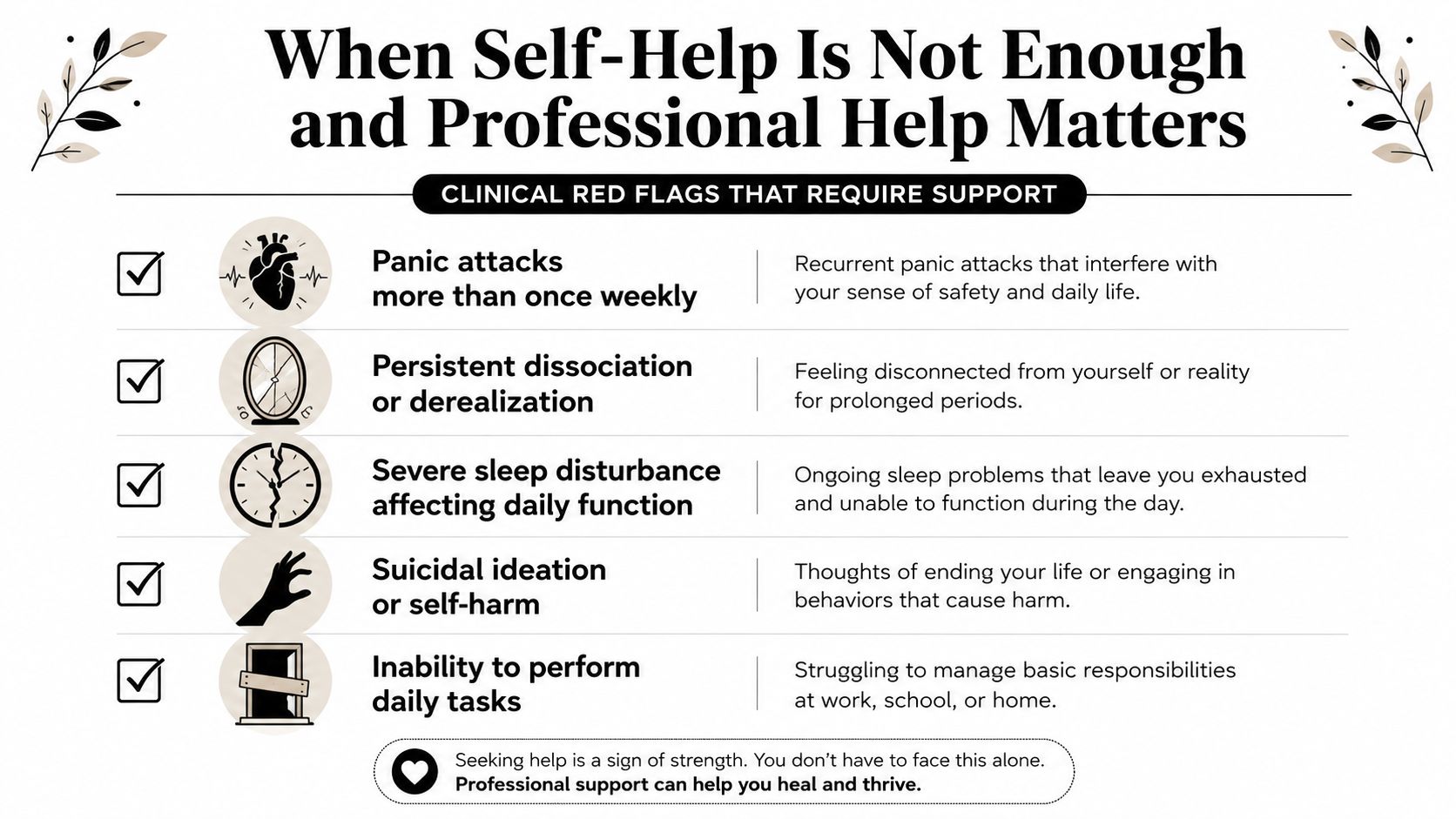
Self-help is useful when symptoms are manageable and practices leave you more present. Professional support becomes important when panic attacks happen more than once weekly, dissociation or derealization persists, sleep disruption severely affects daily function, or trauma memories flood you during body-based work.
Seek urgent help for suicidal thoughts, self-harm risk, or an inability to perform essential daily tasks. If symptoms worsen after two months of consistent practice, that isn't a reason for self-blame. It signals that the plan needs assessment, adjustment, or a different level of care.
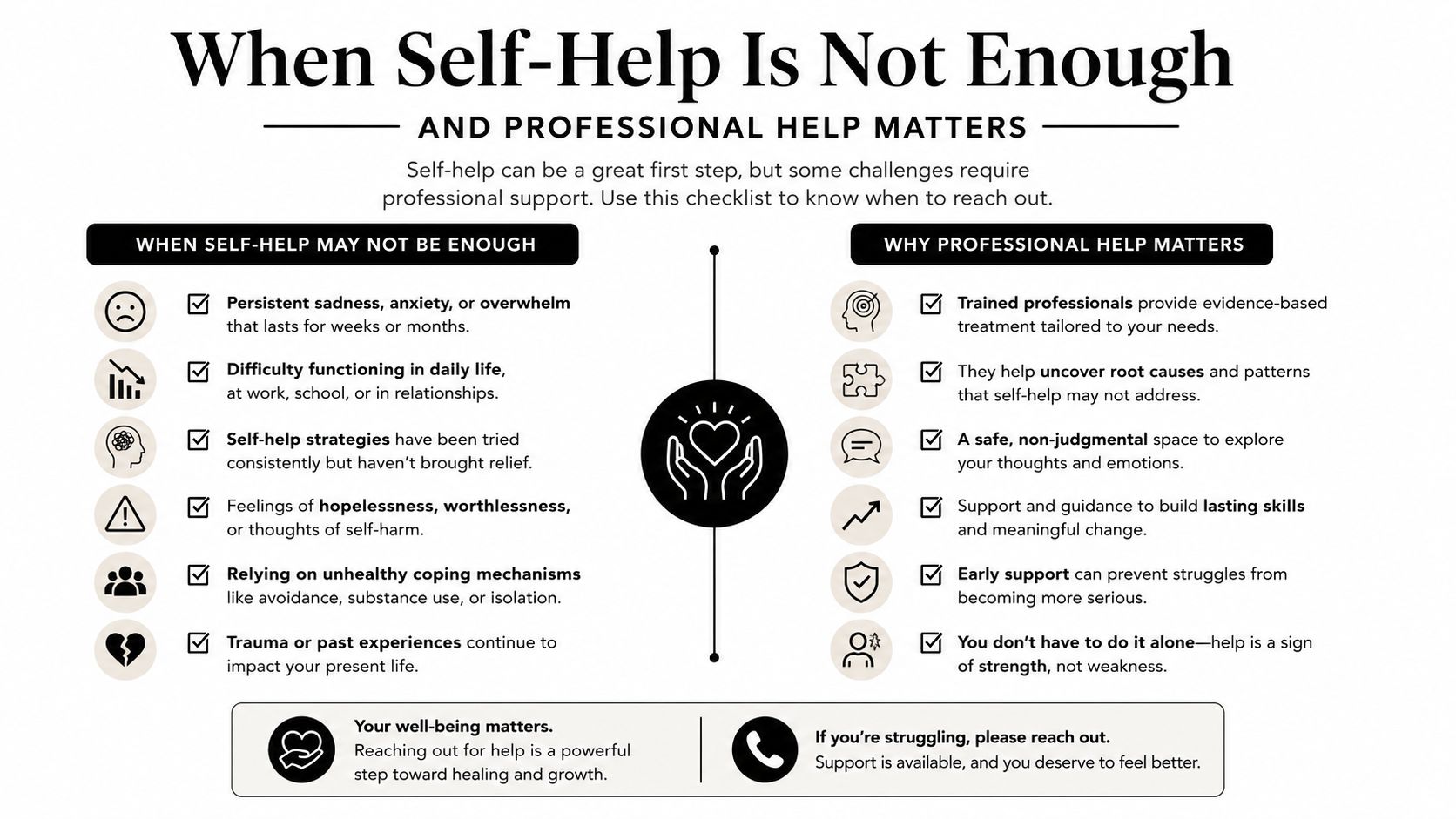
A primary care clinician can help rule out medical contributors, including thyroid, cardiac, or hormonal conditions. A psychologist trained in CBT, EMDR, or somatic approaches can address anxiety and trauma patterns. A psychiatrist can assess whether medication may be appropriate, while a qualified somatic experiencing practitioner may help with body-based trauma responses.
When contacting a provider, ask about credentials, trauma-informed practice, polyvagal or somatic training, and how they involve you in goal setting. You can also look for local support, such as Kelowna counselling for trauma from Interactive Counselling, if that location and approach fit your needs.
NICE guidance for generalized anxiety disorder and panic disorder describes remission, or complete relief of symptoms, as a treatment aim linked with better functioning and a lower likelihood of relapse. It lists CBT, medication, and self-help among evidence-based options (NICE guidance). Combining professional care with daily regulation isn't failure. It's often the most responsible way to build lasting change.
Building Lasting Resilience and Calm for the Long Run
Nervous system healing is better understood as a capacity you keep strengthening than as a finish line. A morning routine can include light, food, hydration, and a brief orienting pause. An evening routine can include reduced stimulation, a body scan, and a consistent transition toward sleep.
Leave room for rest days. Regulation isn't another productivity project, and a nervous system that's always being optimized can feel pressured rather than safe. Notice early cues, such as jaw tension, faster speech, shallow breathing, withdrawal, or compulsive checking, then respond before activation becomes overwhelming.
Community matters because people often regulate in relationship. Supportive friends, meaningful relationships, time in nature, and ordinary shared activities can remind the body that it doesn't have to manage every threat alone. These experiences complement therapy and individual practices without replacing them.
Tracking turns vague impressions into useful information. Record a trigger, the body sensation that followed, the tool you tried, and how your recovery changed. A resource such as The Anxiety Checklist can fit into that process by offering an always-free SOS mode with grounding prompts, affirmations, and quick support, alongside daily options such as guided meditations, sleep audios, walking sessions, and CBT self-therapy tools.
The most encouraging progress may look small at first. You notice the racing heart sooner. You stay in a conversation instead of escaping. You recover after a trigger and sleep more peacefully afterward. Each regulated breath, completed exercise, and recorded insight gives your brain another experience of safety and strengthens your ability to engage fully with life.
The Anxiety Checklist offers real-time SOS support for panic, grounding prompts, affirmations, and daily tools for longer-term anxiety work, including CBT journaling and exposure exercises. Visit The Anxiety Checklist to add practical support to your nervous system healing routine and begin with tools you can use today.