



If you’re reading this, you probably know the feeling all too well—a mind that just won't shut off. It’s a relentless storm of worries, what-ifs, and racing thoughts that feels impossible to escape. The noise can be deafening, leaving you drained, overwhelmed, and feeling utterly powerless.
Let’s start with the most important thing you need to hear right now: You are not broken. The state you're in is not a permanent sentence. A life free from the constant grip of panic and anxiety is absolutely possible. Believing that—even just a little—is the real first step.
Finding Hope When Your Mind Won't Stop Racing
To truly clear your mind, you first have to believe that it's even possible. It all starts with hope—a quiet conviction that you can find calm in the middle of a mental storm. It's the belief that a life without constant panic isn't just a fantasy, but an attainable reality. This guide is designed to be your map on that hopeful path.
It was created by someone who has been there, who has navigated the turbulent waters of anxiety and made it to the other side. We’re going to explore practical, real-world techniques that go far beyond generic advice. You'll learn actionable strategies to not only quiet the noise in the moment but to fundamentally change your long-term relationship with your thoughts.
Hope isn't just a passive feeling; it's an active strategy. It's the decision to take the first step, even when the path ahead isn't perfectly clear. This is about reclaiming your peace, one manageable action at a time.
Your Path to a Clearer Mind
The journey to a clearer mind isn’t about finding a single, magical fix. It's about building a personalized toolkit of strategies that empower you to regain control when your thoughts start to spiral. Think of it like learning any new skill. It might feel clunky and unnatural at first, but with consistent practice, it starts to become second nature.
Your journey will involve:
- Interrupting the panic cycle with immediate, sensory-based grounding techniques.
- Challenging the negative thoughts that fuel your anxiety by learning to question their validity.
- Building resilient habits through simple, daily routines that create lasting mental clarity.
This isn't about fighting a war against your mind, but learning to work with it. It’s about discovering you have far more power over your thoughts and feelings than you currently believe. To begin, it helps to understand the core principles of recovery. If you're ready, you can learn more about the essential anxiety recovery steps that form the foundation of this approach. It all starts right here, with this first step toward a more hopeful future.
Ground Yourself When Panic Starts to Build
You know the feeling. Your heart starts pounding, the walls feel like they’re closing in, and your thoughts are pulled into a terrifying spiral. When panic hits, trying to "just calm down" is like yelling over a hurricane. The noise in your head is just too loud.
What you need is an anchor. Something practical to pull you out of the mental chaos and back into the present moment. That’s where grounding comes in.
Grounding techniques are your emergency toolkit. They work by forcing your focus away from the freight train of frightening thoughts and onto the physical world around you. This simple shift interrupts the brain's panic loop, giving your nervous system a chance to catch its breath and giving you back a sense of control.
Think of it as a simple, three-step flow to get from panic back to peace.
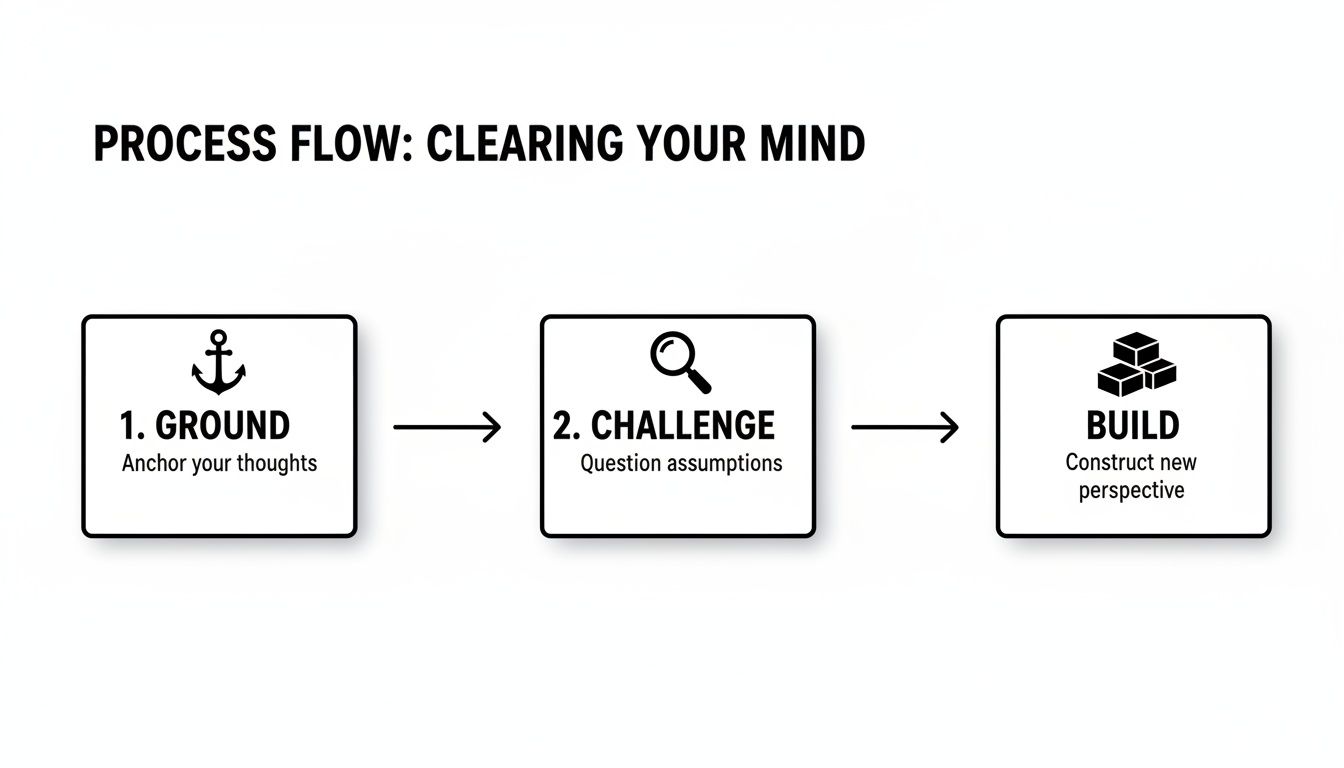
It all starts with grounding yourself. From there, you can challenge the thoughts that sparked the panic and, over time, build lasting resilience.
Use Your Senses to Reconnect
One of the most reliable ways to ground yourself is the 5-4-3-2-1 technique. It’s not just about listing things; it’s about engaging your senses with intention. Don't just see five things—notice the specific shade of blue on a book cover or the way light reflects off your water glass.
- 5 Things You Can See: Look for tiny details. The texture of the wood on your desk, a small crack in the ceiling, a bird outside your window.
- 4 Things You Can Touch: Really feel the soft fabric of your shirt, the cool smoothness of the tabletop, or the solid weight of your feet on the floor.
- 3 Things You Can Hear: Listen past the noise in your head. Can you hear the low hum of a computer, distant traffic, or the sound of your own breathing?
- 2 Things You Can Smell: Try to pick out a scent in the air. Maybe it’s the faint aroma of coffee or the clean scent of soap on your hands.
- 1 Thing You Can Taste: Focus on the lingering taste of your last meal or drink, or even just the neutral taste inside your mouth.
This sensory exercise forces your brain to reconnect with your immediate environment, proving to your amped-up nervous system that you are safe, right here and right now. You can find more powerful grounding techniques for anxiety to build out your personal toolkit.
Remember, the goal isn’t to fight the panic but to shift your attention away from it. Grounding creates a safe distance between you and the overwhelming feeling, giving you the space to breathe and think again.
If you’ve ever felt this way, you're not alone. The feeling of being overwhelmed is incredibly common—anxiety affects 301 million people globally, making it a leading cause of disability.
These numbers don't show that people are stuck; they show that countless individuals are on the same journey as you, seeking and finding their way back to calm. Simple practices like grounding provide a vital lifeline, helping you reclaim control when it matters most.
Challenge the Thoughts That Fuel Your Anxiety

Once you've anchored yourself in the present, it's time to tackle the root of the problem: the thoughts that feed your fear. An anxious mind is often a breeding ground for automatic negative thoughts (ANTs)—those intrusive worries that pop up out of nowhere, feel completely true, and send you spiraling.
But here’s a truth that can change everything: A thought is just a thought, not a fact.
Learning to see the space between your thoughts and reality is a game-changing skill. This practice, known as cognitive reframing, is a cornerstone of Cognitive Behavioral Therapy (CBT). It’s not about pretending everything is fine or forcing positivity. It's about putting on your detective hat and getting curious about your own mind. By investigating your anxious thoughts and questioning their power, you can fundamentally change your relationship with anxiety.
Become a Detective of Your Own Mind
Think of your anxious thought as a suspect on trial. Your job isn’t to accept its story at face value (“I’m going to fail this”), but to investigate it like a detective, gathering evidence for and against its claims. Let’s put a common anxious thought on the stand.
The Anxious Thought: “I’m going to completely mess up this conversation, and everyone will think I’m awkward and incompetent.”
That thought feels heavy, final, and absolute. But is it really true? Let’s dig a little deeper.
Here’s a practical way to question these thoughts. Use this framework to systematically challenge the automatic negative thoughts that cloud your mind.
Challenging Anxious Thoughts: A Practical Framework
| Automatic Thought | Cognitive Distortion | Evidence Against It | A Balanced Thought |
|---|---|---|---|
| "I'm going to mess up this conversation and everyone will think I'm awkward." | Mind Reading & Fortune-Telling | I've had many successful conversations before. People are usually focused on their own lives, not scrutinizing me. | "I'm nervous, but I'm capable of having a good conversation. Even if I feel awkward, it's unlikely to be the disaster my anxiety predicts." |
| "If I don't get this promotion, my career is over." | All-or-Nothing Thinking | One promotion doesn't define my entire career path. There are other opportunities for growth, both inside and outside this company. | "I really want this promotion, and I'll be disappointed if I don't get it. But my career isn't over. I can learn from this and find other ways to advance." |
| "My heart is racing. I must be having a heart attack." | Catastrophizing | My doctor has confirmed I am healthy. A racing heart is a common symptom of anxiety. I've felt this before, and it always passes. | "My heart is beating fast because I'm anxious. I know this feeling. I can use my breathing exercises to help my body calm down." |
By walking through this process, you’re not trying to bully yourself into positive thinking. You're just aiming to shift from a place of panicked certainty to a more realistic and balanced perspective.
The goal is to loosen the thought's grip, not to eliminate it entirely. This simple shift from 100% belief to even 90% can diffuse its power almost instantly.
The need for these skills has never been more urgent. In 2021, 22.8% of adults in the US—nearly 57 million people—were living with a mental illness. Tragically, suicide deaths reached a high of 49,000 in 2022. On a global scale, the gap in care is staggering; fewer than 10% of people in low-income countries receive any form of mental health support. These are not just numbers; they are a powerful reminder of why finding hope and effective tools is so vital. You can learn more about these critical mental health statistics and their impact.
Spot Common Cognitive Traps
Anxious thoughts aren't very creative. They tend to fall into the same predictable, irrational patterns called cognitive distortions. Think of them as mental glitches. Once you learn to spot them, you can see them for what they are—and rob them of their power.
Here are a few of the most common culprits:
- Catastrophizing: Your mind fast-forwards to the absolute worst-case scenario. (e.g., "If I get stuck in traffic, I'll be late, get fired, and my life will be ruined.")
- All-or-Nothing Thinking: You see things in black-and-white terms, with no room for nuance. (e.g., "If I don’t get a perfect score, I'm a total failure.")
- Mind Reading: You assume you know what others are thinking, and it’s always negative. (e.g., "They haven’t texted back. They must be angry with me.")
Identifying these patterns is like seeing behind the curtain of your anxiety. When you can name the trap—"Ah, that's catastrophizing again"—you can begin to dismantle the faulty logic that keeps you stuck. For a full breakdown of these mental traps, you can learn more about common cognitive distortions and get a practical roadmap for countering each one.
Build Mental Clarity with Simple Daily Routines

While grounding techniques offer a lifeline in the moment and cognitive reframing helps you dismantle anxious thoughts, the real path to a panic-free life is paved with consistency. True mental clarity isn't something you achieve in a single, grand gesture. It's built day by day, through small, sustainable habits that signal to your brain that you are safe and in control.
Think of it as your proactive defense against mental clutter. Instead of waiting for the storm of anxiety to hit, you're building a fortress of calm, one brick at a time. The secret is to start so small that it feels almost effortless. That's how you make these practices stick.
Weave Calm into Your Existing Day
One of the most powerful ways to form new habits is a technique called habit stacking. The idea is simple: you attach a new behavior you want to adopt to an existing one you already do automatically. This completely removes the friction of trying to remember something new and just makes it part of your natural flow.
Your current schedule is already full of established routines you don't even think about. Let's use them.
- Your Morning Coffee: As your coffee is brewing, grab a notebook for a five-minute "brain dump." Just get everything that's rattling around in your head—worries, to-do lists, random ideas—out and onto the page. No judgment. This simple act can instantly clear your mind.
- The End of Your Workday: The second you log off your computer, do a two-minute breathing exercise. This small ritual creates a clean break between your work life and personal time, stopping stress from following you home.
- Brushing Your Teeth at Night: While you're brushing, think of one small thing that went well during the day. It doesn't have to be monumental. This quick gratitude practice helps retrain your brain to look for what went right, not just what went wrong.
When you link these new actions to old habits, consistency starts to feel natural, not like another chore. This is how you start to build a life where peace is your default setting, not a rare exception.
Schedule Time for Your Worries
This might sound completely counterintuitive, but one of the most effective ways to manage anxiety is to give it a designated time and place. It’s a technique known as scheduling a "worry window." You set aside a short, predetermined period—say, 15 minutes every day at 5:00 PM—where you have full permission to worry about anything and everything.
When an anxious thought pops up outside of this window, you don't fight it. You simply acknowledge it and tell yourself, "I'll think about that during my worry time." This practice teaches your brain that you are in control, not the anxiety.
This technique is so powerful because it contains the anxiety instead of letting it spill over and contaminate your entire day. You stop being reactive to every worry that pops into your head and become proactive about managing your mental space. Over time, you might even find you don't need the full 15 minutes.
Building these habits is an act of profound self-compassion. It's a declaration that you deserve peace and that a life free from panic is absolutely within your reach.
For more practical guidance, explore resources on how to practice mindfulness for daily calm and weave it into your routines. These small, daily actions compound, creating an upward spiral toward lasting mental well-being. Additionally, structured practices like meditation are incredibly effective; you can explore our guide on meditation for anxiety to find a style that works for you.
Your Path Forward From Anxiety to a Hopeful Future
You’ve made it this far, and that’s a huge step. The goal of this journey isn't just to cope with anxiety, but to reclaim your life from it. Let’s bring everything together and look at what comes next.
Think of the strategies you’ve learned—grounding yourself, questioning anxious thoughts, and building mindful routines—as your personal toolkit. They’re here for you whenever the mental noise starts to get too loud. Escaping the cycle of worry isn't a far-off dream; it's something you build, one small, practical action at a time.
Embracing the Journey with Hope
Remember, you are not alone in this. Feeling overwhelmed is a part of being human, but so is our incredible capacity for resilience and healing. The path forward starts with small, manageable steps.
Be kind to yourself, especially on the hard days. Progress is never a straight line. There will be bumps, doubts, and setbacks along the way. The real key isn’t aiming for perfection—it’s celebrating every bit of forward movement, no matter how small it feels.
You now have the tools and the knowledge to clear your mind and take the first brave step towards a more hopeful, peaceful life. The control you've been seeking is not outside of you—it is within reach.
Embracing this path means recognizing your own strength. It's about shifting from a life run by fear to one guided by what truly matters to you.
Your Next Steps to a Panic-Free Life
The most powerful strategies are the ones that become a natural part of your daily rhythm. Take exercise, for example. Research shows that even small, consistent amounts can have a massive impact.
A 2019 Harvard study found that just 15 minutes of running a day can lower the risk of major depression by 26%. That's because physical activity is a powerhouse for your brain, releasing feel-good endorphins and promoting neural growth that helps create a sense of calm. It’s one of the best ways to physically break the loop of negative thoughts that fuels anxiety.
Of course, there will be times when you need more than just self-help strategies. Professional guidance can be a game-changer, giving you a structured, supportive space to build on these skills. If you’re curious, you can learn more about psychotherapy for anxiety and see how it might fit into your journey.
The most important thing? Start today. Pick just one small thing. Maybe it’s a five-minute walk around the block. Maybe it’s a single "brain dump" entry in a journal. Or maybe it’s just challenging one anxious thought. Each step is a victory.
Frequently Asked Questions About Clearing Your Mind
Starting the journey toward a calmer, more hopeful life is bound to bring up some questions. It's completely natural to wonder about the process, what you should expect, and how to handle the inevitable bumps in the road.
Let's walk through some of the most common questions. My goal here is to give you the clarity and confidence you need to trust these techniques and, more importantly, to trust yourself.
How Long Does It Take for These Techniques to Work?
This is probably the most common question I hear, and the honest answer has two parts. Some techniques are built for speed, while others are about the long game.
Grounding techniques, like the 5-4-3-2-1 method, are designed for immediate relief. Their entire purpose is to pull you out of a spiral of panic and anchor you in the present. You should feel a sense of calm returning within just a few minutes.
On the other hand, practices like cognitive reframing and building new daily habits are about deep, long-term change. You’ll likely notice small, encouraging shifts in your thinking and mood within a few weeks. But the kind of significant, lasting change that reshapes your life? That typically builds over several months of consistent, compassionate effort. It’s a journey of gradual progress, not an overnight fix.
What if I Try a Technique and It Doesn’t Work for Me?
First off, that’s completely normal—and even expected. Think of this whole process as an experiment in getting to know yourself better.
Not every strategy will click with every person. A technique that feels like a lifesaver one day might not land the same way the next. This doesn't mean you've failed; it just means you've gathered more valuable information about what your nervous system needs in that moment.
The goal isn't to find one perfect, magic-bullet solution. It’s to build a personalized toolkit. If one grounding exercise feels awkward or ineffective, just try another one. The key is to have several different options you can turn to, empowering you to adapt to whatever life throws your way.
Can I Really Stop All Anxious Thoughts?
The goal here isn't to achieve a perfectly empty mind or to somehow banish anxious thoughts forever. Frankly, that would be impossible. Anxiety is a natural human emotion, and it’s a vital part of our internal alarm system.
Instead, the real goal is to fundamentally change your relationship with your thoughts.
You’ll learn to notice an anxious thought without letting it hijack your entire day. You’ll practice acknowledging its presence without automatically accepting it as the absolute truth. And then, you'll learn to gently redirect your focus.
This is how you truly clear your mind—not by forcing silence, but by learning to turn down the volume on the noise and take back the controls. It’s about finding peace amidst the chatter, proving to yourself that a hopeful future, free from the grip of panic, is absolutely possible.
If you are ready to take a structured, step-by-step approach to reclaim your life from anxiety, The Anxiety Checklist provides a complete system to guide you. It combines a 10,000-word eBook with interactive tools to help you build a personalized toolkit for lasting calm and fearless living. Learn more about The Anxiety Checklist.