



The ABC model is one of the core tools in Cognitive Behavioral Therapy (CBT). It’s a simple way of looking at how our beliefs about something—not the event itself—are what actually cause our emotional and behavioral consequences. Most importantly, it's a proven roadmap that gives you a clear, structured way to heal from the thought patterns that fire up anxiety and lead you toward a panic-free life.
Your Path to a Life Without Panic Starts Here

If you've ever felt trapped by the relentless cycle of anxiety or completely sideswiped by a panic attack, I want you to know something: what you're feeling is real. And more importantly, there's a clear, hopeful way forward to lasting healing. Feeling cornered by your own fear is exhausting, but this is exactly where your new beginning can take root.
This isn't about wading through dense psychological theories. It's about giving you a genuine source of hope—a practical tool you can start using today to reclaim your life from the grip of panic and prove to yourself that a calm, anxiety-free life is absolutely possible.
A New Way to Understand Anxiety
The journey to a panic-free life begins with understanding what’s really going on in your mind. For years, you might have believed that things happening around you—like a crowded room or a sudden work deadline—were the direct cause of your fear. The ABC model of CBT flips that idea on its head, putting the power to heal right back where it belongs: with you.
Think of it as a simple but powerful decoder for your own mind:
- A – Activating Event: This is the trigger—the thing that happens.
- B – Belief: This is your automatic thought or interpretation of that event.
- C – Consequence: This is your emotional and physical reaction (the anxiety or panic).
This framework shines a light on the fact that it’s the "B"—your belief—that truly drives the "C"—the consequence. Your feelings aren’t random flaws; they are the logical result of your thoughts. Just realizing this connection is the first real step toward lasting change and a life free from panic. You can see how this insight fits into a bigger picture by exploring these anxiety recovery steps.
The most empowering truth is this: while you can't always control the events in your life (A), you absolutely have the power to change how you interpret and respond to them (B), which in turn transforms your emotional reality (C).
This isn't just about putting a band-aid on your symptoms. It's about fundamentally reshaping the automatic reactions that have been fueling your anxiety, allowing you to heal from the inside out. Your journey toward living a calmer, more fearless life starts right now, with this single, powerful idea.
Understanding the ABC Model for Anxiety
Ever feel like a wave of anxiety hits you out of the blue, leaving you feeling completely powerless? If you've ever thought your panic just happens, the ABC model is about to offer you a new—and much more hopeful—way of looking at it. This is your first step toward true healing.
At its heart, the ABC model is a simple but powerful tool from Cognitive Behavioral Therapy (CBT) that pulls back the curtain on why you feel the way you do. It’s built on one core idea: it’s not the event itself that triggers panic, but the meaning you give it. This insight alone can put you back in the driver's seat of your life.
This whole approach was pioneered by psychologist Albert Ellis back in the 1950s. It was a core part of his work on Rational Emotive Behavior Therapy (REBT), which paved the way for the CBT we know today. It was a game-changer because it shifted the focus from just looking at external events to understanding our internal thought processes, giving people a real method to heal.
The Three Core Components
To really get a handle on how to stop a panic cycle, you first need to see the pieces of the puzzle. The ABC model breaks it down into three simple steps. Once you see them laid out, you're already on your way to solving it and finding lasting relief.
A is for Activating Event: This is the trigger. It can be anything—an unexpected email from your boss, walking into a crowded store, or even just a random memory popping into your head. It's the situation that kicks everything off.
B is for Belief: This is your immediate, automatic thought about the Activating Event. It’s your brain's split-second interpretation. Think, "I'm going to fail this presentation," or "Everyone is staring at me."
C is for Consequence: This is the emotional and physical fallout from your belief. It’s the intense fear, the racing heart, the shortness of breath, and that overwhelming urge to escape—the panic attack itself.
To make this even clearer, let's break it down in a table.
The ABC Model at a Glance
This table gives you a quick snapshot of how the three components work together, turning an ordinary situation into a moment of panic.
| Component | What It Means | Simple Example |
|---|---|---|
| (A) Activating Event | The external or internal trigger that starts the sequence. | Your phone rings with an unknown number. |
| (B) Belief | Your immediate, automatic interpretation of the event. | "It's bad news. Something terrible has happened." |
| (C) Consequence | The emotional and physical reaction to your belief. | Heart pounds, you feel sick, and your mind races with fear. |
Seeing it laid out like this makes it obvious that the phone call didn't make you panic—the thought about the phone call did. This is a moment of immense hope.
The most life-changing insight you can take from the ABC model is that ‘A’ does not directly cause ‘C’. The trigger isn't what makes your heart pound. Your 'Belief' about that trigger is the real culprit. You can learn more about the mechanics behind this when you're understanding CBT for anxiety in our detailed guide.
Think of your 'Belief' as a pair of glasses. If the lenses are smudged with fear, everything you look at will appear threatening. The ABC model teaches you how to clean those lenses, giving you a clear and hopeful view of the world.
By learning to spot and question your automatic beliefs, you can fundamentally change your emotional and physical reactions. This isn't just about coping; it's a skill that builds real, lasting freedom from panic.
While you can make incredible progress on your own, sometimes a little expert guidance can accelerate your healing. Working with a qualified CBT therapist can help you apply these principles in a way that’s tailored to your life. This is the foundation of taking your power back and proving to yourself that a life without panic is truly within your reach.
How to Apply the ABC Model to Panic Attacks
So, you’ve got the basics of the ABC model down. But how do you take that knowledge and turn it into a real-world tool for stopping panic in its tracks? This is where the work—and the hope—truly begins. You're about to shift from just understanding your anxiety to actively dismantling it and healing for good.
The real power comes when we expand the model just a bit. After A (Activating Event), B (Belief), and C (Consequence), we’re adding two more letters. These are the steps that give you the power to create lasting change and build a panic-free life.
Introducing D and E to the ABC Model
This is where you stop being a passive observer of your anxiety and become an active participant in your own recovery and healing. These next steps transform the ABC model from a simple observation tool into a powerful method for intervention.
- D is for Disputation: Think of this as becoming a compassionate detective for your own thoughts. You’re no longer taking your automatic beliefs at face value. Instead, you're challenging them, questioning them, and looking for evidence of a more balanced truth.
- E is for Effective New Belief: This is the goal. After you’ve successfully disputed the initial, unhelpful thought, you replace it with one that's more balanced, rational, and hopeful.
This five-step process gives you a clear, repeatable framework for rewiring how you respond to your triggers. It’s the hands-on work that builds a life free from the constant fear of panic.
The diagram below shows that initial chain reaction—from the event to your feelings—and highlights just how critical your belief is in the whole process.
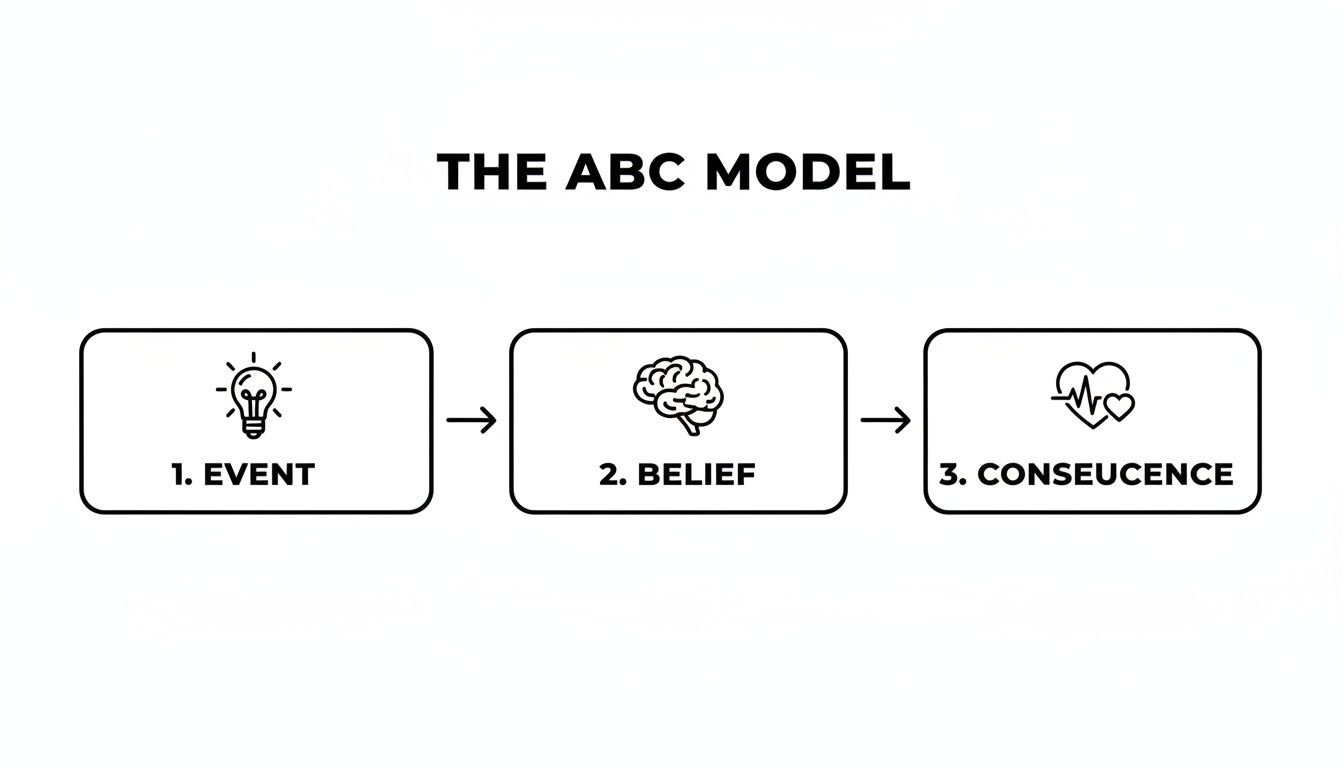
As you can see, that belief is the bridge between what happens and how you react. That makes it the perfect place to step in and make a change toward healing.
Putting It All Together: A Real-World Example
Let’s walk through a common scenario to see exactly how this works. Imagine you’re at your desk, and an email from your boss lands in your inbox. The subject line just says: "Urgent Meeting."
1. (A) Activating Event: You get the email. Simple enough.
2. (B) Belief: Your mind immediately leaps to the worst-case scenario. "I’m in huge trouble. I must have screwed something up, and now I'm going to get fired."
3. (C) Consequence: Your heart starts to pound. Your palms get sweaty, you can't seem to catch your breath, and a wave of pure dread washes over you. You're right on the edge of a full-blown panic attack.
This is the point where you could easily get trapped in a cycle of fear. But with the full ABCDE model, you have a clear, hopeful path forward.
4. (D) Disputation of the Belief: You consciously hit the pause button. It's time to challenge that automatic, catastrophic thought by asking some grounding questions:
* "What actual evidence do I have that I'm about to be fired?" (None. All I have is an email subject line.)
* "Has my boss ever fired someone this way before?" (No, that’s not how they operate.)
* "What are some other, more likely and less scary reasons for this meeting?" (It could be about a new project, a last-minute team update, or a simple question about my work.)
* "What's a more balanced and hopeful way to look at this?" (The word "urgent" probably just means it's time-sensitive, not that it's a disaster.)
5. (E) Effective New Belief: After poking holes in the first thought, you create a new one. "This email is probably about a time-sensitive issue my boss needs my help with. I’ll go to the meeting ready to listen and contribute."
What’s the new consequence? Your heart rate slows down. Your breathing evens out. That feeling of dread is replaced with a sense of calm readiness. You didn’t change the event, but you completely changed its power over you.
This isn't just a mind game; it’s a proven method for healing. By the 1980s, research showed that this CBT-based approach had 75-80% efficacy rates for treating anxiety and panic. This model is so powerful that it helped 70% of patients reframe their catastrophic thoughts, cutting panic attacks by half in some studies. This track record isn't just data—it's a testament to the very real possibility of living a panic-free life.
Using a Personal ABC Worksheet to Stop Panic
Understanding the theory behind anxiety is a great start, but true healing happens when you put that knowledge into practice. Action is the single most powerful antidote to the helplessness that panic and anxiety feed on. This is where you go from just knowing about the abc model cbt to actually using it—turning an abstract idea into a concrete habit that builds real, lasting hope.
To get started, we're going to use a simple but incredibly effective tool: a personal ABC worksheet. Think of it as your private "Hope Log." This isn't just another busywork exercise. It's a way to get your thoughts out of your head and onto paper, giving you the clarity you need to step in and stop a panic spiral before it gains momentum.
By consistently logging these moments, you’ll start to see undeniable proof that you have the power to change how you feel and to heal.
Turning Theory into a Tangible Habit
This worksheet expands on the basic ABC framework by adding two crucial action steps: D (Disputation) and E (Effective New Belief). This guided approach walks you through the entire process of cognitive restructuring, from identifying the initial trigger to creating a new, calmer, and more hopeful perspective.
Here’s how you can start using it right away, either in the middle of an anxious moment or by reflecting on one that recently passed:
- A – Activating Event: Write down exactly what happened. Be specific and objective. Example: "My friend canceled our plans last minute."
- B – Beliefs: Jot down your immediate, automatic thoughts. Don’t filter or judge them; just get them out. Example: "They don't really want to see me. I must have done something wrong. Nobody actually likes me."
- C – Consequences: Note the emotional and physical fallout from those beliefs. Example: "Felt a pit in my stomach, heart started racing, felt intensely sad and lonely."
- D – Disputation: This is where you become a compassionate detective. Challenge your beliefs from step B by asking tough, fair questions. Example: "Is there any other possible reason they canceled? What solid evidence do I have that they don't like me? Haven't they been a good friend in the past?"
- E – Effective New Belief: Craft a more balanced, rational, and hopeful thought to replace the old one. Example: "Life gets busy, and things come up unexpectedly. A single canceled plan doesn't define our entire friendship. This is a chance for me to make a new plan when things calm down."
This process isn't about pretending everything is perfect. It's about seeing the situation for what it truly is, free from the distortions that anxiety loves to create, and finding the hope within it.
A Practical Worksheet Example for Social Anxiety
Let's walk through how this works in a common real-life scenario. For many, social events can trigger intense anxiety. This completed worksheet shows how you can use the abc model cbt to find immediate relief and start building the confidence for a panic-free social life.
Here’s a sample entry to guide you.
Sample ABCDE Worksheet Entry for Social Anxiety
| Step | Your Entry |
|---|---|
| (A) Activating Event | Received an invitation to a large party where I won't know many people. |
| (B) Beliefs | "I'll be so awkward. Everyone will notice I'm alone and think I'm a loser. I'll have nothing to say, and I'll just stand in a corner all night." |
| (C) Consequences | Immediate dread, tight chest, urge to decline the invitation, stomach churning with anxiety. |
| (D) Disputation | "Is it true everyone will be watching me? Most people are focused on their own conversations. What's the worst that could actually happen? Can I think of a time I went to a party and it was okay?" |
| (E) Effective New Belief | "It's normal to feel a little nervous. I can aim to have just one or two short conversations. I don't have to be the life of the party; just showing up is a win on my healing journey." |
Filling out a worksheet like this helps you see the truth in black and white.
Seeing this on paper provides a powerful realization: the initial panic wasn't caused by the party invitation itself, but by the story you told yourself about it. By rewriting that story with hope, you reclaim your emotional freedom.
This worksheet is so much more than a piece of paper; it’s a tool for liberation. It empowers you to step out of the cycle of fear and actively build a life where you are in control. Every time you fill it out, you are taking a definitive step toward a panic-free future.
Common Roadblocks and Advanced Strategies
Starting your journey with the ABC model is a huge step. It’s a moment filled with hope and the promise of a life where you're back in the driver's seat, not your panic. But just like learning any new skill, it's completely normal to hit a few bumps along the way.
The trick is to see these bumps not as failures, but as learning opportunities on your path to healing. They are the moments that sharpen your skills and build real, lasting confidence in your ability to live panic-free.
One of the first hurdles many people face is mistaking feelings for beliefs. When you’re filling out your worksheet, it’s easy to write "I felt anxious" in the 'Belief' column. But remember, your feelings are the Consequence (C). The Belief (B) is the specific thought that triggered that feeling—the "I'm going to mess this up" or "Everyone is staring at me." Getting this right is a key step toward healing.
Another common challenge is feeling discouraged when you don’t see massive changes overnight. Healing isn't a one-and-done event; it's a process of taking hopeful steps, one after another. Every single time you practice, you're building resilience and literally carving out new, calmer pathways in your brain.
Digging Deeper with Advanced Tactics
Once you get comfortable spotting those surface-level thoughts, you can start digging deeper. This is where you can truly accelerate your journey toward living panic-free by targeting the roots of your anxiety. The key tactic here is identifying your core beliefs.
Core beliefs are the deep, fundamental rules you hold about yourself, others, and the world. They often run silently in the background, acting as the fuel for your automatic anxious thoughts.
Here are a few common examples that feed anxiety:
- "I am not good enough."
- "The world is a dangerous place."
- "I must be perfect to be accepted."
When you start to question these deep-seated assumptions, you can dismantle the very foundation your anxiety is built on. It's a powerful step toward lasting freedom and true healing.
For those of us juggling panic while also raising a family, sometimes an 'advanced strategy' means reducing the chaos in our daily lives. Finding effective strategies for managing family chaos can create the calmer external environment you need to do this important internal work.
It's also worth noting that the ABC model has continued to evolve. Later revisions by Albert Ellis himself helped boost the model’s efficacy to between 70-85% in modern CBT—a truly hopeful statistic for anyone seeking to heal.
A message of hope: Don't just challenge your thoughts—learn to accept them with compassion. Acceptance isn't about giving up; it's about reducing the struggle. When an anxious thought appears, you can acknowledge it ("There's that 'I'm not safe' thought again") without letting it take over. This is an act of self-love on your healing journey.
This compassionate approach, when paired with cognitive challenging, creates a well-rounded and powerful toolkit for a panic-free life. You might also find that practicing specific grounding techniques for anxiety can help you create the mental space you need to apply these strategies when you feel overwhelmed.
Every small step you take is a victory, leading you toward a future where you are in control and living freely.
Making the ABC Model a Lifelong Habit for Freedom
The real magic of the abc model cbt doesn’t happen on a single worksheet. It happens when you start weaving this practice into the fabric of your daily life. This is where the work pays off, where practice truly becomes progress, and progress finally feels like the freedom you've been hoping for.
The goal isn’t to fill out forms forever. It's to make this mental check-in feel so automatic and natural that it becomes a source of inner strength and peace.
Think about it this way: just five minutes each evening is all it takes to get started. Use that quiet time to look back on any moments that felt tough and run them through the ABC lens. This small, consistent action is what builds unstoppable momentum toward real, lasting healing.
Rewiring Your Brain for Calm
Every single time you hit pause to notice and question an anxious belief, you're doing so much more than just putting out a temporary fire. You are actively rewiring the neural pathways in your brain for long-term healing.
Each time you successfully challenge a fear-based thought, you weaken the old, automatic fear response. At the same time, you're strengthening a new, more resilient and hopeful one.
This consistent practice is an act of profound self-empowerment. You are not just managing anxiety; you are fundamentally teaching your brain a new way to feel safe, proving that healing is possible.
Anxiety doesn’t have to be a life sentence. It’s a pattern of thought and reaction, and you have the absolute power to change that pattern. By committing to this process, you're laying the foundation for a life that is no longer dictated by fear, but filled with hope and freedom.
To keep that momentum going, it also helps to set clear, achievable SMART goals for your anxiety recovery.
With every small victory, you’re not just coping—you’re moving closer to a genuinely fulfilling, fearless life. You can heal, and this is how you start.
Frequently Asked Questions About the ABC Model
Is the ABC Model Effective for Severe Anxiety?
Yes, it's incredibly effective and offers tremendous hope. The ABC model is a core component of Cognitive Behavioral Therapy (CBT), which has shown up to 75% efficacy in treating anxiety disorders. Think of it this way: instead of just managing the symptoms of panic, you’re getting to the root of the problem to heal it for good.
This tool works because it helps you dismantle the panic piece by piece, targeting the beliefs that fuel the fire. It gives you a sense of control and hope precisely when anxiety tries to convince you that you have none.
What if I Have Trouble Identifying My Beliefs?
That’s completely normal, and it's a common part of the healing process. Automatic thoughts can be so fast and deeply ingrained that they feel almost invisible. It’s a common hurdle, so please don't get discouraged.
Start by working backward from the Consequence (C)—your feeling or physical reaction. When you feel that wave of anxiety, pause and compassionately ask yourself, "What was going through my mind right before this feeling hit?"
Remember, this is a skill, and you are capable of learning it. The more you practice, the better you'll get at catching these thoughts. Each time you try, you’re building the muscle of self-awareness and taking a step toward a panic-free life.
How Quickly Can I Expect to See Results?
There's no set timeline, but many people feel a spark of hope the very first time they use an ABC worksheet. Just taking concrete, structured action can be a powerful antidote to the helplessness that anxiety breeds.
Real, lasting healing comes from consistency. Every time you challenge an unhelpful belief, you are actively rewiring your brain's response to stress. Your journey to a panic-free life is built on these small, repeated victories, and with this model, you are on the right path to get there.
At The Anxiety Checklist, we believe everyone deserves a life free from the grip of panic. Our complete system gives you the tools and structured guidance to turn this practice into lasting freedom. Start your journey to fearless living today at https://anxietychecklist.com.