



If you’ve ever felt hijacked by anxiety, you know the script. Your heart races, your chest tightens, and a flood of "what if" thoughts takes over. It’s exhausting, and it can leave you feeling powerless, as if you're forced to endure a storm you can't control.
But what if that storm isn't some random force of nature? What if you could learn to navigate it—and ultimately calm the winds yourself? This is the profound hope offered by Rational Emotive Therapy, or REBT.
Developed back in 1955 by psychologist Dr. Albert Ellis, this approach is built on a simple, life-changing idea: it’s not the events in our lives that cause our distress, but what we tell ourselves about them. This is the key to unlocking a future free from the grip of panic.
Your Beliefs, Not Events, Are the Real Culprit
This guide is your practical toolkit for taking back control. The core principle—that you have immense power over your anxiety—is where true healing begins. This isn't just a theory; it's a proven path to living a calmer, more confident life.
When you're stuck in a cycle of chronic anxiety, it’s easy to feel like you're just reacting to the world around you. An upcoming presentation, a crowded grocery store, a weird text message—these feel like the direct cause of your panic.
REBT empowers you by flipping that script. It reveals that the true source of your emotional turmoil isn't the event itself, but the rigid, demanding beliefs you hold about it. It’s the meaning you’ve assigned to that presentation (e.g., "I must be perfect or I'm a failure") that's actually fueling the dread.
"We are not disturbed by events themselves but by our opinion of them.” – Epictetus
This idea, borrowed from ancient Stoic philosophy, is the key to unlocking a life that isn't dictated by constant worry. Once you learn to spot, challenge, and change these underlying thought patterns, you can begin to heal your emotional responses from the ground up.
Moving From Victim to Active Participant in Your Healing
Instead of just white-knuckling your way through anxiety, REBT gives you the tools to actively dismantle the mental habits that keep it alive. It’s a hands-on approach that puts you in the driver's seat of your own recovery.
You’ll discover how to:
- Recognize the specific irrational beliefs that trigger your anxiety spiral. These are often "shoulds," "musts," and "oughts."
- Challenge these beliefs by asking for evidence. Is it really true that you'll be a total failure if you stumble over a few words?
- Replace those rigid demands with more flexible, rational alternatives. Think "I'd prefer to do well, but if I don't, it's not the end of the world."
This is how you shift from feeling like a victim of your anxiety to becoming an empowered agent in your own healing. A life where you feel calm, confident, and in control isn’t some far-off fantasy. With the principles of Albert Ellis Rational Emotive Therapy, it's an achievable reality, and your journey toward a panic-free life can start right now.
If you're caught in the grip of anxiety, it often feels like the world is pulling your strings. A looming work deadline, an unexpected bill, or a critical comment from a friend can feel like a direct cause for a wave of panic. Living this way is powerless and completely exhausting.
But here's where Albert Ellis's Rational Emotive Therapy (REBT) offers a profound and hopeful shift in perspective—one that gives you back the controls.
This shift starts with a simple but powerful framework called the ABC model. It’s the key to seeing how your own mind creates the anxiety you feel, and more importantly, how you can start to dismantle it for good. The model breaks down our emotional experiences into three simple parts:
- A is for the Activating Event. This is the situation itself—the trigger.
- B is for your Beliefs. These are the thoughts, interpretations, and rules you apply to that event.
- C is for the Consequences. These are your emotional and behavioral reactions.
Most of us assume that A directly causes C. We think, "That presentation made me panic," or "The party gave me anxiety." But REBT shows us there's a crucial middle step we almost always miss: our beliefs. It isn't the event, but our interpretation of the event, that actually determines our emotional response.
The Belief Is Where Your Power Lies
This is the most hopeful part of the entire process. You often can't control the activating events in your life—deadlines will still loom, and social situations will still come up. But you have absolute authority over your beliefs. They act like a filter, processing the event and ultimately shaping the outcome. This is your pathway to healing.
To see this in action, let's look at the simple example below. The table shows how different beliefs about the exact same event can create wildly different emotional and behavioral results, highlighting just how much power your thoughts hold to create either panic or peace.
Applying the ABC Model to Common Anxiety Scenarios
| Activating Event (A) | Irrational Belief (iB) | Emotional Consequence (C) | Rational Belief (rB) | New Healthy Consequence (C) |
|---|---|---|---|---|
| A friend doesn't text back for several hours. | "They must be angry with me. I must have done something wrong. This is terrible." | Intense anxiety, worry, obsessive checking of the phone. | "They're probably just busy. People have lives outside of texting. I can handle not getting an immediate response." | Mild concern that fades, ability to focus on other tasks. |
| You make a small mistake in a work report. | "I'm a complete failure. I can't do anything right. I'm going to get fired over this." | Panic, shame, desire to hide the mistake or avoid the boss. | "It's a mistake, and that's frustrating, but it's not the end of the world. I'll fix it and learn from it." | Annoyance, but also a proactive desire to correct the error and move on. |
| You receive a last-minute party invitation. | "I must be charming and entertaining, but I'll probably say something stupid and everyone will judge me. I can't stand that feeling." | Overwhelming social anxiety, declining the invitation. | "It would be nice to go, but if I feel awkward, that's okay. I can leave if I'm not enjoying myself. It's not a performance." | Healthy nervousness or excitement, attending the party with an exit plan. |
As you can see, the activating event is neutral. It’s the belief that gives it meaning and dictates whether you feel manageable concern or debilitating anxiety. This simple distinction is life-changing. It moves you from being a victim of circumstance to being the architect of your own emotional state. The problem isn't the party; it's the rigid, demanding belief that you must perform perfectly.
This diagram shows the direct flow from your thoughts to your feelings and, ultimately, to your actions.
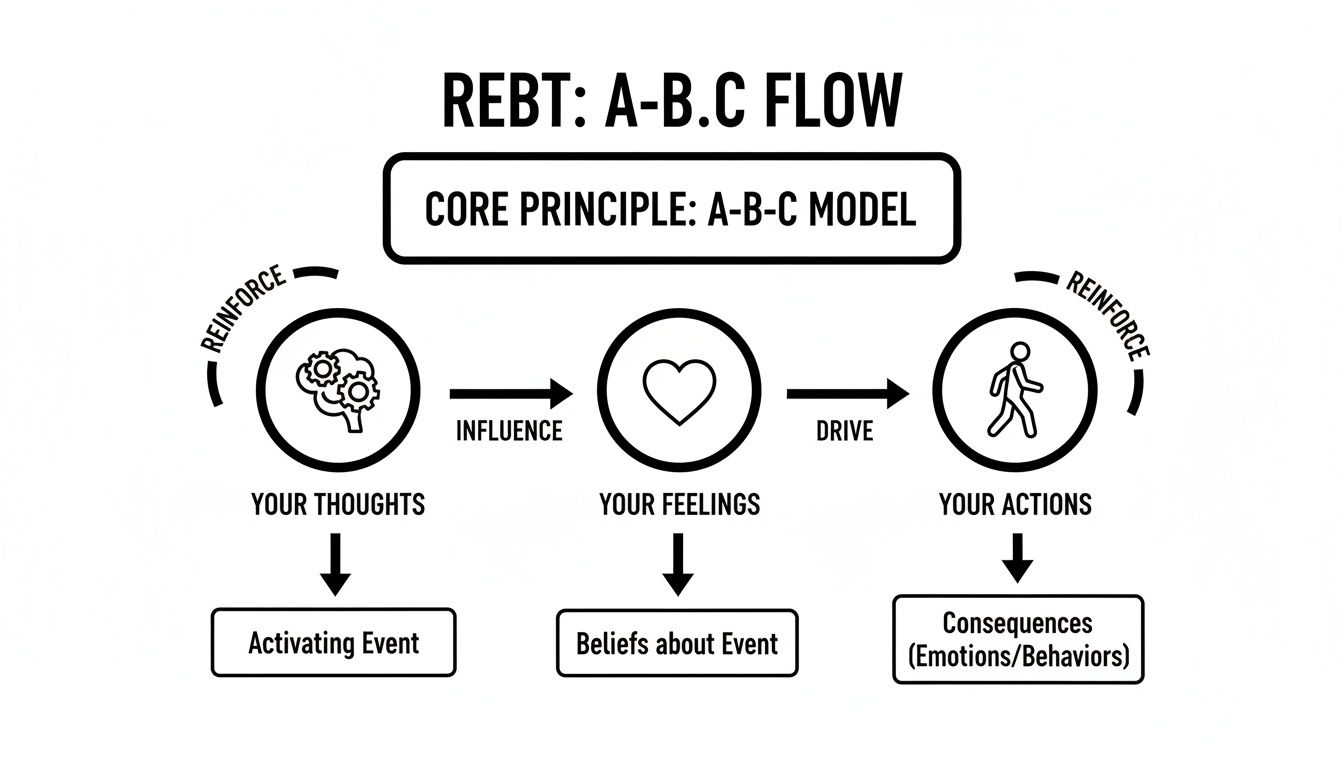
This visual makes it clear: our beliefs are the central processing unit, determining whether an event results in a healthy, appropriate emotion or a destructive one like anxiety. By changing the belief, you can change your life.
Your Mind as an Operating System
Think of your mind as a computer’s operating system and your beliefs as the software running on it. An activating event is just incoming data. If the software is programmed with irrational code—like "I must be perfect," "Life must always be fair," or "I can't handle discomfort"—it processes that data and produces an error message: anxiety, panic, or depression.
The goal of Rational Emotive Therapy isn’t to avoid the data (the events) but to update the software (your beliefs). By identifying and rewriting this faulty code, you can fundamentally change the output. You learn to install more flexible, rational programs based on preferences instead of rigid demands—for example, shifting from "I must succeed" to "I prefer to succeed, but failure doesn't define my worth."
This process involves getting good at spotting the thinking traps that make up our irrational beliefs. If you're ready to take a closer look at your own thought patterns, check out our guide on how to identify and challenge common cognitive distortions that fuel anxiety.
Understanding the ABC model is the first concrete step toward a life with less panic. It gives you a clear map showing you exactly where to intervene. Instead of trying to change the world around you, you can focus your energy where it truly matters: on changing the thoughts within you. This is the foundation of hope and the beginning of your healing journey.
Identifying the Irrational Beliefs That Fuel Your Panic
So, you’ve got the ABC model down. You know where the anxiety cycle can be interrupted. The next step is figuring out what you’re actually looking for—those specific, sticky thoughts that act as the kindling for your panic. This is where real hope blossoms, because once you can name these thought patterns, you can start to dismantle them.

This is the power of Albert Ellis Rational Emotive Therapy. It shines a light on the unconscious drivers of our anxiety, tracing that overwhelming, vague feeling of dread back to a few core, rigid demands we place on ourselves, others, and the world. This is where you begin to take back control and start your path to a panic-free life.
The Three Core Musts That Drive Anxiety
At the very heart of most of our emotional pain, Albert Ellis found three inflexible, absolute demands he called the "Three Core Musts." Think of these not as gentle wishes but as strict, non-negotiable rules. When reality inevitably breaks these rules, anxiety, anger, and despair rush in to fill the space.
Demands on Yourself: "I must do well and win the approval of others for my performances, or else I am no good." This belief hooks your entire self-worth to your performance and what other people think. It’s the hidden engine behind performance anxiety, perfectionism, and a crushing fear of failure.
Demands on Others: "Other people must treat me considerately and kindly, in precisely the way I want them to." This sets an impossible standard for literally everyone in your life. When people act according to their own needs—not your unwritten rulebook—this belief triggers anger, resentment, and social anxiety.
Demands on the World: "Life must be easy, without discomfort or struggle." This is a demand for a life without problems. When life throws its unavoidable curveballs—frustrations, losses, and unfairness—this belief leads to feeling overwhelmed, self-pity, and the sense that it's all "unbearable."
Just seeing these "musts" in your own thinking is a huge breakthrough. They often operate silently, driving your emotional reactions without you even noticing. If you want to dig deeper into how these beliefs take shape, you can explore these 18 Core Belief Examples that influence our reality.
Secondary Beliefs That Amplify Panic
Spinning off from these core musts are secondary beliefs that are like throwing gasoline on the fire. These are the thought habits that take a minor frustration and blow it up into a full-scale catastrophe.
"You largely feel the way you think." – Albert Ellis
This simple quote is the soul of REBT. If you change these toxic thinking habits, you change how you feel. Ellis flagged two particularly destructive patterns that are almost always present in anxiety and panic.
Awfulizing (or Catastrophizing)
This is the habit of turning a negative event into the worst-possible-case scenario. It’s taking a small slip-up and declaring it an absolute disaster.
- Setback: You stumble over a few words during a work presentation.
- Awfulizing Belief: "That was a complete catastrophe! I've tanked my career, everyone thinks I'm an idiot, and I'll never live this down."
- Result: Waves of intense shame, anxiety, and panic.
"I-Can't-Stand-It-Itis" (Low Frustration Tolerance)
This is the deep-seated belief that you simply cannot handle discomfort, frustration, or emotional pain. It makes you fear your own feelings and drastically underestimates your own resilience. Tackling the constant churn of overthinking and anxiety is directly tied to building your tolerance for these uncomfortable feelings.
- Situation: You feel your heart start to race before a social event.
- I-Can't-Stand-It-Itis Belief: "I can't stand this feeling! It's completely unbearable. I have to get out of here right now."
- Result: A full-blown panic attack fueled by the desperate urge to escape the feeling itself.
These beliefs feel like facts, but they aren't. They are learned mental habits. The incredible hope baked into Albert Ellis Rational Emotive Therapy is that any habit that was learned can be unlearned. By seeing these patterns laid out clearly, you’ve already taken the first step toward swapping them out for something better. This isn't about blaming yourself for having these thoughts; it's about empowering yourself with the knowledge that you can finally change them.
How to Actively Dispute and Dismantle Anxious Thoughts
You’ve done the hard work of pinpointing the irrational beliefs that have been hijacking your peace. That’s a huge step. But just knowing they're there isn't enough to stop them.
This is where you learn to fight back. We're moving from passive awareness to an active, life-changing practice. The hope of living without the constant threat of panic solidifies right here—in the work of tearing down the mental scaffolding that has kept you feeling trapped.
Think of this as your workshop for healing. We’re officially adding the “D” to our ABC model: Disputation. This is the core engine of Albert Ellis Rational Emotive Therapy, and it’s all about actively cross-examining your anxious thoughts. It’s not about getting into a pointless argument with yourself. It’s about becoming a fair but firm detective, demanding hard evidence from the thoughts that claim to be true.
This process gives you a concrete method to stop the anxiety spiral in its tracks. It's the tangible proof that you really can change your thinking and, as a result, change how you feel and live. You're about to learn the language of liberation from anxiety.
The Three Pillars of Disputation
Disputation isn't some vague command to "just think positively." It's a structured inquiry with specific questions designed to show your irrational beliefs for the flimsy constructs they are.
Think of these three methods as different lenses you can use to scrutinize any anxious thought that pops up.
- Reality-Testing (Empirical Disputing): This questions whether your belief has any basis in fact.
- Logical Disputing: This checks if your belief even makes sense.
- Pragmatic Disputing: This examines whether holding onto the belief is actually helping you in any way.
Each one gives you a powerful line of questioning to pull out the moment anxiety strikes. Let’s break down the exact scripts you can use.
Reality-Testing Your Fears
This is your first line of defense. It forces you to put on your scientist hat and demand proof. Anxious thoughts often feel true, but they rarely have solid evidence to back them up.
When a fear pops up, hit it with these questions:
- "Where is the absolute, 100% proof that this catastrophe will happen?"
- "What is the actual evidence that this thought is true, versus just a feeling I’m having?"
- "Have I been in a similar spot before? What actually happened then?"
- "What are some other, more realistic outcomes for this situation?"
Example in Action:
- Activating Event: You have a big presentation coming up at work.
- Irrational Belief: "I'm going to completely freeze up. Everyone will think I'm an idiot, and my career will be ruined. It's going to be a total disaster."
- Disputation: "Where is the evidence that I'll definitely freeze? I've given talks before, and even though I was nervous, I got through them. Is it really a fact that my entire career depends on this one presentation? No, that's a massive exaggeration. It’s far more likely I’ll be nervous but that it won't be a 'disaster'."
This technique pulls you out of the hypothetical nightmare your anxiety cooked up and grounds you back in reality. It’s a powerful tool, and it shares some DNA with the structured thinking found in other cognitive therapies. If you're curious about how these methods connect, our article on understanding CBT for anxiety offers a deeper dive.
Using Logic to Unravel Anxiety
Let's be honest: anxious beliefs are almost never logical. They’re born from emotion, not reason. This line of questioning is all about exposing the faulty connections and extreme conclusions that define anxious thinking.
Challenge the internal logic with these questions:
- "Does it logically follow that because I want something, it must happen?"
- "Just because this feels awful, does that really mean I can't stand it?"
- "Is it reasonable to condemn my entire self-worth over one mistake or flaw?"
- "Where is the universal rulebook that says life has to be easy and fair?"
"The best years of your life are the ones in which you decide your problems are your own. You do not blame them on your mother, the ecology, or the president. You realize that you control your own destiny." – Albert Ellis
This quote gets to the heart of it. When you dispute the logic of your demands on the world and on yourself, you start to take your power back.
The Final Question: Is It Helping?
This is Pragmatic Disputing, and frankly, it’s often the most powerful question of all. It cuts through every other argument and gets right to the bottom line: Is this belief actually serving you?
Ask yourself, with brutal honesty:
- "How is holding onto this belief helping me? Is it getting me closer to my goals or pushing me further away?"
- "What are the consequences of thinking this way—emotionally, behaviorally, and even physically?"
- "Would letting go of this belief lead to a better outcome, even if it feels scary at first?"
- "If I keep believing this, where will I be in a month? In a year?"
Successfully taking apart your old, rigid beliefs paves the way for the final, crucial step: "E" for an Effective New Philosophy. This isn't just swapping one thought for another; it's about building a whole new way of looking at the world.
It’s the flexible, rational, and profoundly healthier mindset that emerges when you do this work. This new philosophy—rooted in preference over demands, acceptance over intolerance, and resilience over fragility—is the true foundation for lasting emotional peace and a life free from panic.
Daily Exercises to Build Lasting Emotional Resilience
Knowing how to challenge your anxious thoughts is a game-changer. But real, lasting change? That comes from putting that knowledge into practice, every single day. This is where you move from theory to action, building the emotional muscle you need to stop living under the constant threat of panic and start living a life of freedom.
Think of it less like coping and more like proactively rewiring your brain. The exercises from Albert Ellis Rational Emotive Therapy are meant to be woven into your daily life. This transforms your new, rational beliefs from intellectual concepts into your default way of thinking. Just like physical fitness, emotional resilience is built through repetition. These techniques are your personal training program for a calmer, more confident mind.
Build Your Mental Fitness with REBT Journaling
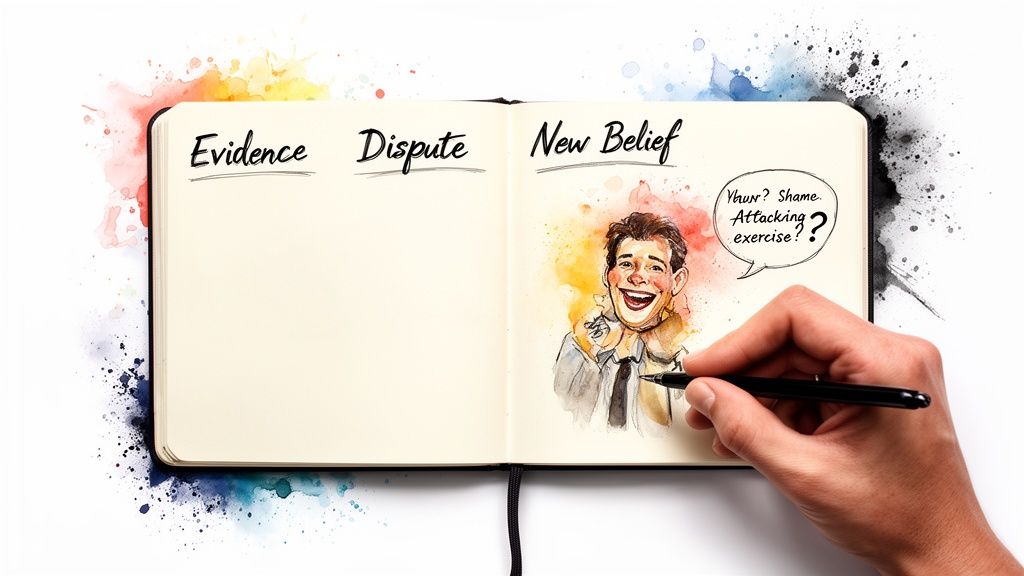
One of the most powerful ways to see your progress in black and white is through a specific kind of journaling. An REBT journal isn’t for venting or spiraling—it’s a structured workout for your mind. By consistently documenting your experiences using the ABCDE model, you create a tangible record of your own healing journey.
This simple practice turns you into a researcher of your own mind. It gives you clear, undeniable data on what triggers your anxiety and, more importantly, how your new beliefs are actively changing your reactions over time. This is concrete proof that healing is possible.
How to Structure Your Journal Entry:
- Activating Event (A): Describe what happened, just the facts. Example: "My boss sent a one-word email: 'Tomorrow.'"
- Irrational Belief (iB): Write down the hot, immediate thought that popped into your head. Example: "I'm definitely getting fired. I must have done something awful, and this is terrible."
- Consequences (C): Note the emotional and physical fallout. Example: "Instant knot in my stomach, heart started pounding, felt a wave of panic wash over me."
- Disputation (D): This is where you fight back. Challenge that belief. Example: "Where is the actual evidence I'm in trouble? Is it possible he was just busy? Is believing this helping me or just making me miserable before I even know what's happening?"
- Effective New Philosophy (E): Write out a more balanced, rational thought to replace the old one. Example: "I don't know what this is about, which feels uncertain, but I can handle uncertainty. It’s likely about a project. If it is criticism, I can listen and handle it constructively."
Making this a regular habit builds incredible momentum. It proves to you, in your own handwriting, that you have the power to shift your emotional state. It’s a foundational tool for a panic-free life because it makes your healing process visible and intentional.
"You largely feel the way you think." – Albert Ellis
This simple truth is the core of your practice. By consistently guiding your thoughts toward flexibility and logic, you are actively choosing how you want to feel. This is what taking back control from anxiety looks like.
Prove Your Fears Wrong with Behavioral Experiments
While journaling rewires your thoughts, behavioral exercises are where you prove those new beliefs to yourself out in the real world. One of the most effective techniques in Rational Emotive Therapy is the shame-attacking exercise. The idea is to intentionally do something harmless that you’re afraid will bring judgment or embarrassment.
Why? To prove to yourself that you can survive the discomfort. This builds a powerful immunity to the fear of what other people think—a massive driver of social anxiety and panic. You aren't just thinking your way out of fear; you're acting your way out of it. This is how you build unshakable confidence in your own resilience.
Examples of Shame-Attacking Exercises:
- Wear your t-shirt inside out for an hour while running errands.
- Ask for a 10% discount on a coffee you’ve already paid for.
- In a quiet library, drop a book and say "oops!" a little too loudly.
- Go into a hardware store and ask an employee where you can find a "skyhook."
The goal is to trigger that cringey feeling of shame and then notice that the catastrophe you feared never happens. Most people are too wrapped up in their own lives to even notice. This direct, real-world evidence is far more potent than any thought alone. It cements your new rational belief: "It might be unpleasant if others judge me, but it's not awful, and I can definitely stand it."
If you feel your body tensing up during these experiments, pairing them with some simple breathing exercises for anxiety can be a huge help.
These daily practices are your path forward. They are the concrete actions that turn the hope of a panic-free life into your lived reality. You are no longer just surviving anxiety—you are building a resilient mind, one rational thought and one brave action at a time.
Your Path Forward to a Life Unchained from Fear
We've covered a lot of ground together. You've been building a lifelong skill set, not just looking for a temporary patch. Now, it’s time to pull all the pieces together and see what your future can look like. The principles of Albert Ellis Rational Emotive Therapy offer more than a way to cope with anxiety—they give you a clear, actionable path to heal your relationship with it for good.
Think of it like learning to navigate your own mind. Before, you might have felt like you were on a flimsy raft, getting tossed around by every storm of anxious thought. Now, you’ve learned how to read the weather, understand your own ship, and steer toward calmer waters. The storms will still show up on the horizon, but they no longer have the power to shipwreck you.
From Vicious Cycle to Virtuous Upward Spiral
Anxiety loves to trap you in a vicious cycle where perfectionism feeds fear, and that fear fuels even more perfectionism. You feel anxious about a big task, so you convince yourself you must do it perfectly to make the anxiety go away. Of course, that rigid demand just cranks up the pressure, making you even more anxious.
REBT gives you the tools to break that loop and start a new, hopeful one. By actively challenging those rigid demands and shifting your focus to unconditional self-acceptance, you start swapping out the "musts" for simple preferences. This is where real freedom begins.
- Before: "I must not feel anxious before this meeting, or it will be a complete disaster." (This all but guarantees you'll feel anxious about your anxiety).
- After: "I'd prefer not to feel anxious, but if I do, I know I can handle it. My performance is not a reflection of my entire worth."
This simple shift creates a virtuous upward spiral. As you prove to yourself, again and again, that you can tolerate discomfort, your fear of it starts to shrink. This frees up an incredible amount of mental energy that was once wasted on worry, allowing you to actually live your life with joy and confidence.
A Map and a Compass for Your New Life
You came to this guide looking for a way out of the relentless cycle of anxiety and panic. You were searching for hope that a different kind of life—one not ruled by fear—was even possible. Now, you have more than just hope. You have a map (the ABCDE model) and a compass (disputation techniques). You have a proven strategy for healing.
The only thing left to do is to start walking.
Your next step isn't to master everything overnight. It's to choose one single principle and apply it. Your new life—one that’s open to possibility and unchained from fear—begins with that one intentional act.
Lasting change isn’t built on some massive, one-time transformation. It’s built one small, brave choice at a time. For a deeper dive into how to foster this kind of profound personal growth, exploring the ideas behind transformational coaching can provide valuable insights that pair well with your REBT journey.
Your path forward is all about application. It's about choosing to challenge a single "should" statement today. It's about trying one behavioral experiment, or simply forgiving yourself for a mistake. Each time you do this, you strengthen your new, rational beliefs and chip away at anxiety's hold. To get a clearer picture of what comes next, you can learn more about the crucial anxiety recovery steps you can start taking today.
Frequently Asked Questions About REBT for Anxiety
It's completely normal to have questions as you start digging into something new, especially when it’s as personal as your own mental health. Getting clear on what to expect with Albert Ellis rational emotive therapy can give you the confidence you need to really commit to the process of healing.
Here are some of the most common questions we hear from people just starting out.
How Quickly Can I Expect to See Results with REBT?
This is a hopeful question, because everyone's path is a little different. Some people feel a shift almost immediately—that "aha!" moment when the ABC model clicks and they realize they have more power over their reactions than they ever thought possible. That sense of hope can be a huge first step toward healing.
For many, real, noticeable changes in day-to-day anxiety start to show up after a few weeks of consistent practice. But think of REBT less like a quick fix and more like learning a new language for your mind. Progress often comes in waves, not a straight line. Every time you question a belief or try a new behavior, you're building a stronger, more resilient foundation for a panic-free life.
The most powerful changes don't happen overnight. They come from patient and persistent work. True healing is when these rational principles become your new default way of thinking, and that builds incredible momentum over time.
Is It Necessary to Work with a Therapist?
While Albert Ellis rational emotive therapy was designed to be practical enough for self-help, there’s no doubt that working with a trained REBT therapist can fast-track your progress and deepen your healing. A good therapist can:
- Offer an outside perspective on your irrational beliefs, which are often blind spots we can't see on our own.
- Walk you through exercises like disputation in a supportive, safe space where you can be vulnerable.
- Help you stay on track and keep you motivated, especially when you hit the inevitable roadblocks on your recovery journey.
That said, self-help is a fantastic place to start. Many people find incredible relief and make huge strides using structured resources, workbooks, and a genuine commitment to daily practice. The most important thing is that you start.
This guide has given you a map and a compass to navigate your way out of anxiety. The next step is yours to take. With The Anxiety Checklist, you get a complete system to turn these principles into daily habits. Our 93-point interactive spreadsheet and in-depth eBook give you the structure and tools to dismantle anxious thoughts, build resilience, and finally live the fearless life you deserve. Start your journey today at https://anxietychecklist.com.