

Some readers arrive here in the middle of a hard moment. Your chest is tight. Your thoughts are racing. Part of you wants help, and another part is too overwhelmed to even choose what to try first.
That experience is common in anxiety. When distress spikes, people often can't think clearly enough to use longer, more demanding strategies, which is one reason digital CBT tools can fall short in the exact moment they're needed most, as noted in this implementation review on digital CBT barriers during high distress.
The encouraging part is that healing from anxiety usually doesn't depend on one perfect technique. It often comes from learning which tool fits which moment. Some tools help you get through the next ten minutes. Others help you change the patterns that keep panic alive. If you want to learn about anxiety and panic attacks, that understanding can make everything feel less mysterious and more manageable.
Table of Contents
- Your First Step Towards a Panic-Free Life
- What Are CBT Tools? Understanding Your Mind's Toolkit
- SOS Tools for Immediate Relief When Panic Hits
- Core Tools for Rewiring Anxious Thought Patterns
- Action Tools for Facing Fears and Building Confidence
- Safety, Limitations, and When to See a Therapist
- Building Your Personal Anxiety-Relief Plan
Your First Step Towards a Panic-Free Life
A lot of people with anxiety live in a strange split screen. On the outside, they answer emails, drive to work, make dinner, and smile at the right times. On the inside, they're scanning for danger all day. A skipped heartbeat feels ominous. A quiet text thread feels like rejection. A crowded store starts to feel like a trap.
Then panic joins the picture. You feel a rush of heat, a pounding heart, shaky hands, dizziness, and the terrifying thought that something is very wrong. After that, it's easy to start organizing your whole life around prevention. You sit near exits. You avoid long lines. You keep checking your body. You try to think your way to safety.
Anxiety often shrinks life gradually. Healing often rebuilds it gradually too.
That's where cognitive behavioral therapy tools can offer real hope. Instead of asking you to “calm down,” CBT gives you practical ways to understand what's happening and respond differently. It's a structured, goal-oriented approach rather than open-ended discussion, and major clinical sources describe it as focused on changing thoughts and behaviors through practical techniques and homework over time, as summarized by the Mayo Clinic overview of CBT.
The shift that changes everything
The first shift is simple but powerful. You stop measuring success only by whether anxiety shows up. You start measuring success by what you do when it does.
That matters because a panic-free life usually doesn't begin with never feeling anxious again. It begins when anxiety stops being the boss. You learn how to ride out a wave, how to question a catastrophic thought, and how to take a small brave step instead of retreating.
Two kinds of tools, two kinds of healing
It helps to sort CBT tools into two groups:
- SOS tools help during high distress. They lower chaos and help you regain enough footing to function.
- Rewiring tools help between panic spikes. They target the habits that keep anxiety stuck, like avoidance, catastrophic predictions, and constant self-monitoring.
Both matter. One helps you survive the moment. The other helps you build a life that no longer revolves around fear.
What Are CBT Tools? Understanding Your Mind's Toolkit
CBT can sound clinical, but the basic idea is very human. Your mind and body learn patterns. Some patterns help you. Some accidentally train you to feel more afraid. CBT gives you exercises to notice those patterns and practice new ones.
Why CBT feels practical
A useful analogy is physical therapy for the mind. If your ankle is weak, you don't heal it by staring at it and hoping. You use specific exercises that strengthen, stretch, and retrain. CBT works in a similar way. It uses repeatable skills to help you respond to thoughts, feelings, and situations in healthier ways.
CBT is also one of the most widely studied tools-based therapies. A major review found strong support for its use in anxiety disorders, showing these methods are backed by extensive clinical research in this review of CBT evidence across disorders.
The loop CBT targets
Most cognitive behavioral therapy tools are built around a simple loop:
| Part of the loop | What it means | Example |
|---|---|---|
| Thought | What your mind says | “My heart is racing. I'm not safe.” |
| Feeling | The emotion that follows | Fear, dread, helplessness |
| Behavior | What you do next | Leave the store, sit down, check your pulse |
That loop can happen in seconds. The thought feels true, the feeling gets louder, and the behavior seems necessary. Then the brain learns, “Avoidance kept me safe.” Next time, the alarm fires even faster.
Practical rule: CBT tools don't try to erase every anxious thought. They help you change your relationship to the thought and the action that follows it.
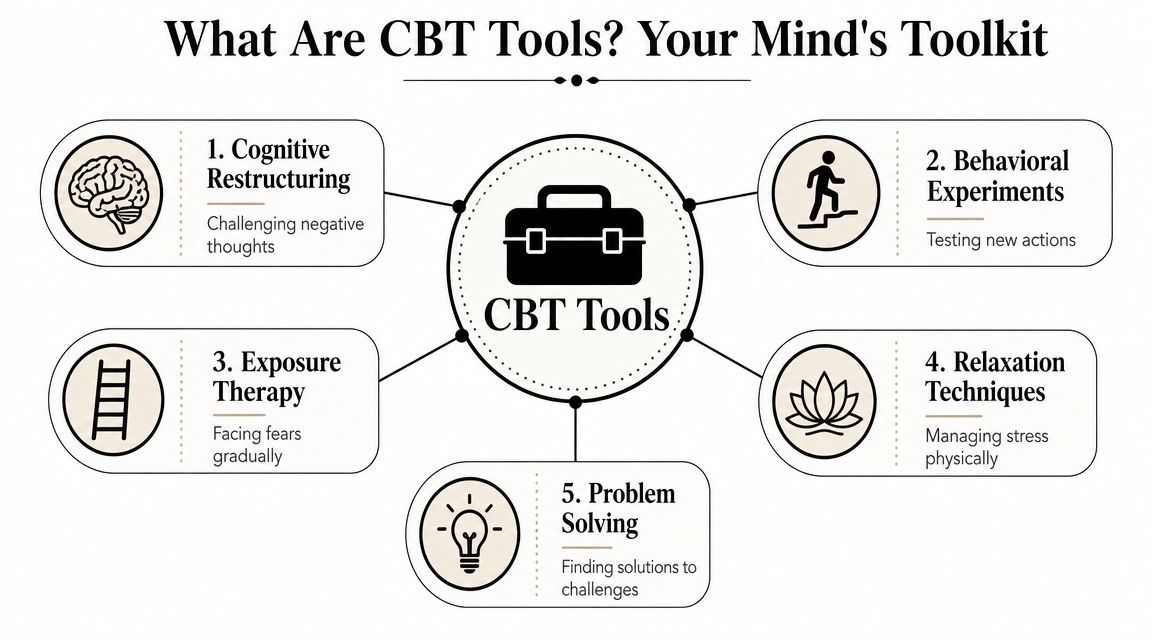
Here are some common tools people use:
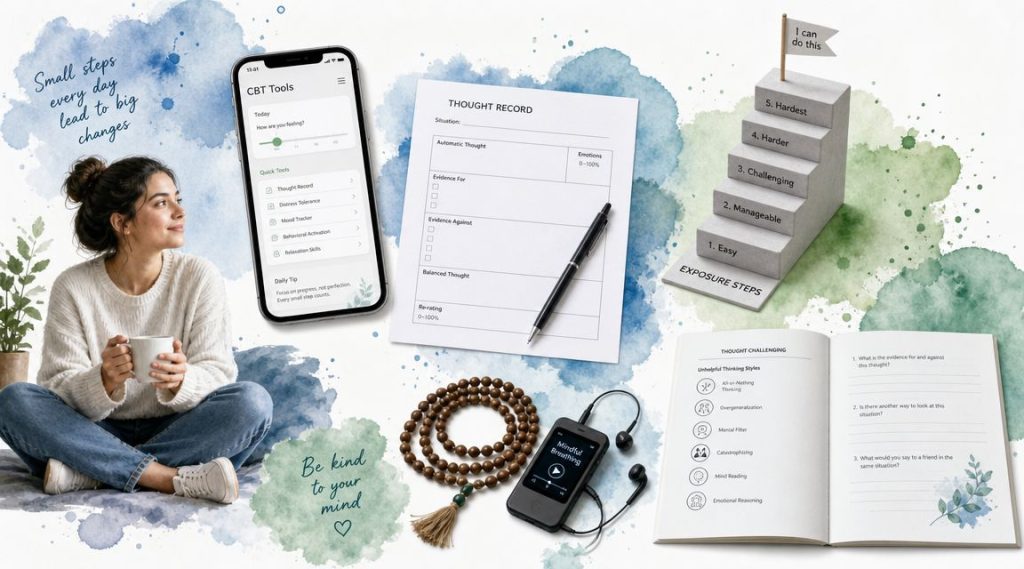
- Thought records help you catch and examine anxious thinking.
- Behavioral experiments help you test whether your feared prediction occurs.
- Exposure exercises help you face feared situations gradually instead of escaping them.
- Relaxation skills help your body come down from high activation.
- Problem solving helps when the issue is practical and solvable, not just hypothetical fear.
The key idea is that these are not random self-help tips. They're parts of a structured toolkit. When you understand what each one is for, anxiety starts to feel less like a mysterious force and more like a pattern you can work with.
SOS Tools for Immediate Relief When Panic Hits
When panic surges, you don't need a long worksheet first. You need something simple enough to use while your heart is pounding and your thoughts are scattered.

Some immediate tools work because they interrupt spiraling and reduce frantic avoidance. Clinical guidance describes CBT as focused on changing thoughts and behaviors, with techniques such as relaxation, coping skills, self-monitoring, and learning to approach situations that have been avoided in this Cleveland Clinic guide to CBT. If you want more guided support, some people also use panic and anxiety relief tools to make these steps easier to follow when they're overwhelmed.
What helps when your mind goes blank
During acute anxiety, keep your goal modest. You are not trying to solve your whole life. You're trying to get your footing back.
A good SOS tool usually does one of three things:
- Grounds attention so your mind stops sprinting into worst-case scenarios.
- Slows your body so the alarm system has less fuel.
- Reduces escape behavior so panic doesn't keep teaching your brain that ordinary discomfort is dangerous.
Three tools to use right away
1. Grounding with five senses
This is helpful when you feel unreal, dizzy, or mentally flooded.
Try this slowly:
- Name five things you can see. Look for details, like color, shape, or light.
- Name four things you can feel. Your feet in shoes, your back on the chair, cool air on your skin.
- Name three things you can hear. A fan, traffic, a distant voice.
- Name two things you can smell. If nothing is obvious, notice neutral smells.
- Name one thing you can taste. Even a sip of water counts.
This works because it pulls attention out of imagined danger and back into the present environment.
2. Box breathing
This is useful when your breathing gets fast and shallow.
Follow a steady pattern:
- Inhale gently.
- Pause.
- Exhale gently.
- Pause again.
Keep the rhythm even and unforced. The purpose isn't to “win” against panic. It's to stop accidentally feeding it with frantic breathing.
A short guided practice can help when reading instructions feels like too much:
3. A coping card
Write one or two sentences on your phone or a card before panic strikes. Keep it plain and believable.
Examples:
- “This feels intense, but feelings rise and fall.”
- “My body is sounding an alarm. I can stay with it.”
- “I don't need certainty right now. I need one steady next step.”
Panic becomes more manageable when you stop demanding instant peace and start practicing steady response.
What not to expect from SOS tools
SOS tools are first aid, not the whole treatment. If grounding helps you stay in the grocery store for three more minutes, that's useful. If breathing helps you get through a meeting without bolting, that counts.
But if you only use emergency tools and never address the deeper cycle, anxiety often keeps returning. Relief matters. So does rewiring.
Core Tools for Rewiring Anxious Thought Patterns
Long-term healing often begins when you stop treating every anxious thought like a fact. That's where the deeper cognitive tools come in.
The most important cognitive behavioral therapy tools are designed to target the thought-feeling-behavior loop directly. Self-monitoring through thought records and cognitive restructuring helps you test whether anxious thoughts are evidence-based or distorted, as explained in this clinical review of mechanism-specific CBT tools.
A thought record in plain language
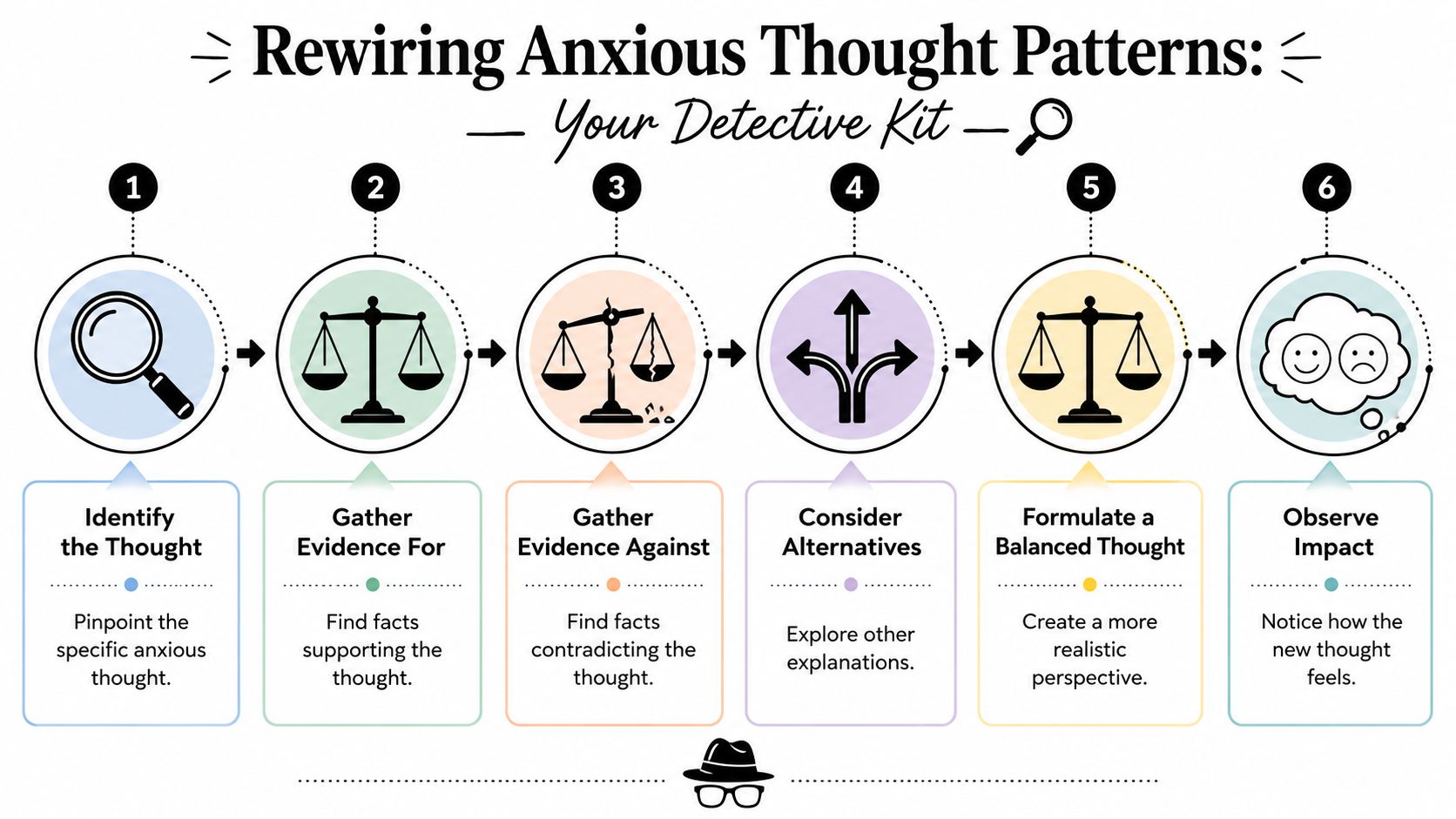
A thought record is just a structured way to slow down and investigate what your mind is telling you.
Use this simple template:
| Step | Question to ask |
|---|---|
| Situation | What happened? |
| Automatic thought | What flashed through my mind? |
| Emotion | What did I feel? |
| Evidence for | What supports this thought? |
| Evidence against | What doesn't fit this thought? |
| Balanced thought | What's a fairer, more realistic view? |
This can feel awkward at first. That's normal. You're building a new skill, not trying to sound wise on paper.
A real example of cognitive restructuring
Say your boss sends a short email: “Can we talk later?”
Your anxious brain says, “I messed something up. I'm in trouble.”
Your emotion is fear. Maybe your stomach drops. Maybe you start replaying every recent mistake. Maybe you lose the rest of your afternoon to spiraling.
Now you become a detective instead of a fortune teller.
Evidence for the thought:
You did send one project late last week.
Evidence against the thought:
Your boss didn't say anything negative. You've also gotten positive feedback. “Can we talk later?” could mean many things.
Balanced thought:
“I'm worried I made a mistake, but I don't have enough information yet. There are several possible reasons for this email.”
That new thought may not make you feel calm instantly. That's okay. The point is not forced positivity. The point is accuracy.
The best balanced thought is usually not “Everything is fine.” It's “I don't know yet, and I can handle knowing more.”
If overthinking is one of your biggest struggles, it can help to learn more about how to stop overthinking in a way that connects directly to these CBT skills.
Common thinking traps to watch for
Many anxious thoughts fall into familiar patterns:
- Catastrophizing means jumping straight to the worst outcome.
- Mind reading means assuming you know what other people think.
- Fortune telling means treating a fear like a prediction.
- All-or-nothing thinking means seeing only total success or total failure.
Once you can label the pattern, you often feel a little less fused with it. The thought becomes something you're noticing, not something you must obey.
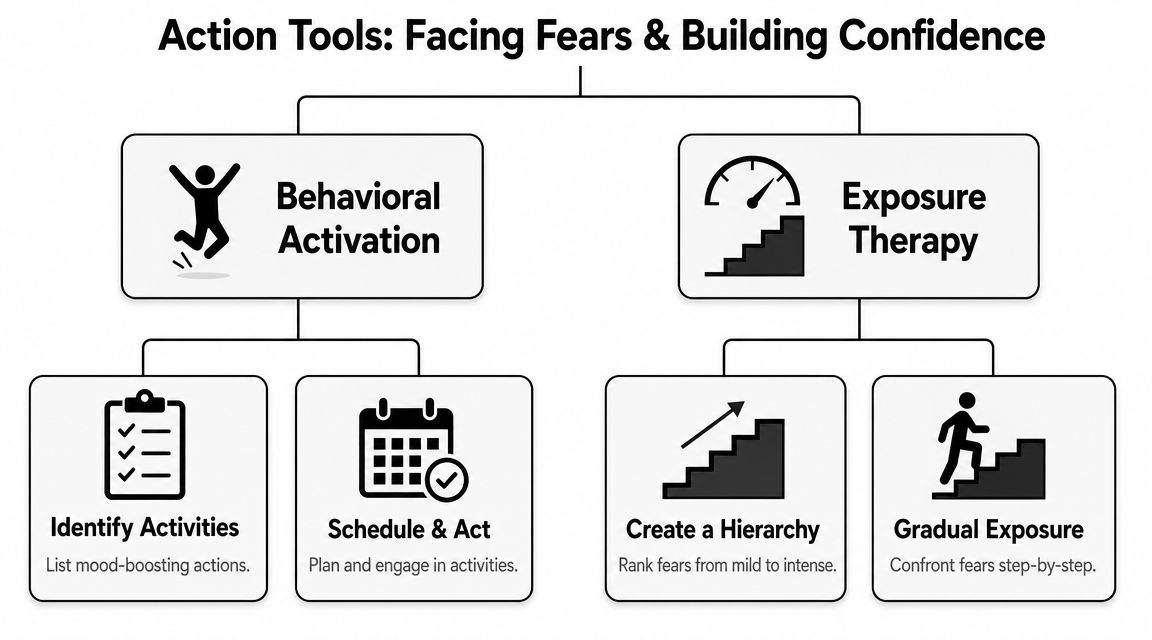
Action Tools for Facing Fears and Building Confidence
Anxiety doesn't only live in thoughts. It also lives in habits. If you avoid enough situations, your world starts shrinking, and your brain never gets a chance to learn that you can handle discomfort.
That's why behavioral CBT tools matter so much. CBT is a structured, goal-oriented therapy that emphasizes practical techniques and homework assignments over time, which is why tools like journaling and behavioral experiments are core parts of the framework, according to the earlier Mayo Clinic reference.
Behavioral experiments
A behavioral experiment is a small test of an anxious prediction.
Suppose social anxiety tells you, “If I speak up in the meeting, everyone will think I sound stupid.” Instead of arguing with that thought all day, you design an experiment.
Try this structure:
- Prediction: “If I say one thing, people will judge me.”
- Experiment: Share one short comment or question.
- Observation: What happened?
- Learning: Was the prediction fully accurate, partly accurate, or inaccurate?
What makes this powerful is that it moves anxiety out of the courtroom and into the lab. You're not trying to win a debate with fear. You're collecting data from real life.
Exposure works like a staircase
Exposure sounds intimidating, but the most useful version is gradual. Picture it as a staircase, not a cliff.
If public speaking scares you, your ladder might look like this:
- Read a paragraph out loud when alone.
- Record yourself speaking for one minute.
- Practice in front of one trusted person.
- Speak briefly in a small group.
- Give a longer presentation.
The point is repetition with willingness. You enter the feared situation in a manageable way and stay long enough to learn something new.
A tool like this fear ladder anxiety tool can help you break a large fear into smaller, clearer steps.
Key insight: Confidence usually doesn't come before action. It grows because of repeated action.
What to remember while doing exposure
People often get confused here and think success means “I felt calm.” That's not the best measure. Better questions are:
- Did I stay longer than I usually would?
- Did I reduce safety behaviors, even a little?
- Did I learn that anxiety can rise and fall without controlling me?
You don't need dramatic bravery. You need repeatable bravery.
A few examples of safety behaviors to watch for:
- Over-preparing so heavily that you never test your actual ability.
- Constant reassurance-seeking before, during, or after the feared event.
- Escaping early the moment discomfort rises.
- Checking your body to see whether symptoms are getting worse.
Reducing these behaviors often matters as much as entering the situation itself. That's how people start building confidence they can feel in daily life.
Safety, Limitations, and When to See a Therapist
Self-help can be powerful, but it has limits. If anxiety is severely disrupting work, school, relationships, sleep, or basic daily functioning, it's wise to get professional support. The same is true if panic feels relentless, if trauma is part of the picture, or if trying these tools leaves you feeling more stuck instead of clearer.
When self-help isn't enough
A therapist can do more than teach skills. They can spot patterns you can't easily see from the inside, help tailor tools to your exact triggers, and guide exposure work at a pace that feels challenging but safe.
Think of therapy like hiring a skilled coach. You're still doing the work, but you don't have to do it alone. If you want a practical overview of care options, local considerations, and insights on Vancouver CBT strategies and costs can help you ask better questions before starting.
You might want extra support if any of these sound familiar:
- Your world is shrinking. You're avoiding more and more places, sensations, or responsibilities.
- You can't practice consistently. Every tool feels impossible to use without guidance.
- The distress feels layered. Panic, trauma, depression, or intrusive thoughts are overlapping.
- You're unsure what's safe to do alone. Exposure and self-directed exercises feel confusing or destabilizing.
If you're on the fence, this guide to understanding when to talk to a therapist can help you think it through gently.
Seeking help isn't failure. It's a strong, informed decision to give yourself better support.
Building Your Personal Anxiety-Relief Plan
The most useful plan is usually simple. Pick one SOS tool for high-distress moments and one rewiring tool for regular practice.
For example, your plan might look like this:
- When panic rises: Use grounding with five senses.
- Once a day or a few times a week: Fill out one short thought record.
- Once this week: Take one step on an exposure ladder.
That's enough to begin. Healing doesn't require doing everything at once. It asks for repetition, honesty, and small acts of courage that add up over time.
Some people also like pairing CBT work with calming routines that make practice easier, such as sleep habits, walks, or sensory cues. If that interests you, this article on using essential oils to calm your day can be one gentle complement to the more structured tools in this guide.
The main thing to remember is this. A panic-free life usually isn't built in one leap. It's built when you stop seeing anxiety as proof that you're broken and start treating it as a pattern you can learn to change. You have more room to heal than anxiety tells you.
If you want a practical place to put these ideas into action, The Anxiety Checklist offers support for both sides of recovery. You can use its free SOS features when panic hits and your mind goes blank, then practice longer-term CBT tools like thought journaling, belief experiments, and exposure work when you're ready to rewire the deeper pattern.