



You jolt awake with your heart pounding. Your chest feels tight. The room is dark, quiet, and suddenly unreal. For a few frightening moments, it can feel like something is terribly wrong, even if you were asleep only seconds ago.
If that's happening to you, I want to start with the most important truth. Nocturnal panic attacks are treatable. They are not a sign that you're losing your mind, and they are not a life sentence. They are a pattern your nervous system has learned, and learned patterns can be changed.
Many people get stuck in a second layer of fear after the attack itself. They start dreading bedtime, scanning their body for danger, or wondering whether sleep will ever feel safe again. That fear makes sense. It's also reversible. With the right support, immediate coping tools, and longer-term treatment, people do get better. They sleep again. They stop fearing the night.
Table of Contents
- Waking Up to Hope Not Horror
- What to Do When Panic Wakes You Up
- Create a Panic-Proof Evening Routine
- Long-Term Treatments for Lasting Relief
- Finding Your Support System for Healing
- Your Toolkit for Reclaiming Calm Nights
Waking Up to Hope Not Horror
You fall asleep expecting rest, then bolt awake with a pounding heart, a jolt of fear, and the awful sense that something is very wrong. In that moment, night can start to feel like enemy territory.
That reaction makes sense. The brain is trying to explain a sudden burst of alarm in the dark, while you are still half asleep and disoriented. Many people quickly conclude, “If panic can happen in my sleep, I am not safe anywhere.” That conclusion is understandable. It is also inaccurate.
Nocturnal panic is a panic pattern, not a life sentence. Your nervous system has learned to set off an alarm at the wrong time. Alarms can be retrained.
That is the hopeful shift. The goal is not to force yourself to love nighttime right away. The goal is to understand what is happening well enough that fear stops writing the whole story. Once you see these episodes as false alarms instead of proof of danger, recovery starts to feel practical.
You do not need more evidence that you are suffering. You need a clear path back to safety, and that path exists.
It also helps to know that the aftermath can linger. After a nighttime panic episode, some people feel shaky, foggy, drained, or emotionally tender the next day. That does not mean the episode harmed you. It usually means your body spent a lot of energy in survival mode and now needs time to settle. If that next-day crash has been scaring you too, Anxiety Checklist support for recovery can help you make sense of it.
What readers often get wrong
| Common fear | More accurate view |
|---|---|
| “This means something is deeply wrong with me.” | This is a known form of panic, and it responds to treatment. |
| “If it happens during sleep, I have no way to change it.” | You can lower nighttime fear in the moment and train your nervous system over time. |
| “Bed will always feel unsafe now.” | Beds can become neutral and calming again as your body relearns that night is not an emergency. |
Many people get stuck because they ask the wrong question. “Why did my body betray me?” keeps you in shock and self-doubt. A better question is, “How do I help my body trust the night again?” That question leads to skills, repetition, and healing.
And healing is the expectation here, not a rare outcome for a lucky few.
What to Do When Panic Wakes You Up
When panic wakes you up, your first job is not to solve your whole anxiety history. Your first job is to lower alarm and regain orientation.
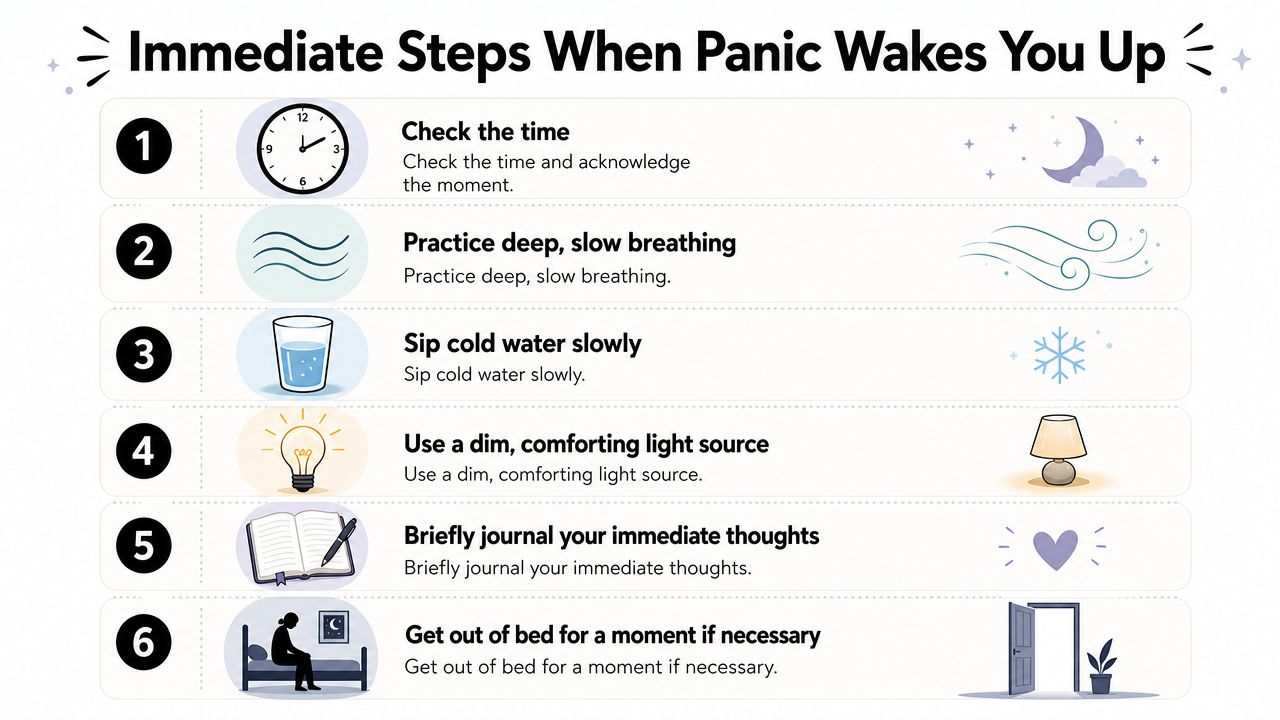
Start with orientation not analysis
At night, the mind loves catastrophic explanations. Heart attack. Suffocating. Losing control. Going crazy. Don't argue with each thought one by one. Start simpler.
Look at a clock. Name where you are. Say your age out loud. Put your hand on the mattress and notice its texture. Listen for a familiar sound, such as a fan, distant traffic, or your own breath. Orientation tells the brain, “I am awake, I know where I am, and this moment is real.”
Practical rule: If your mind is racing, use your senses before your thoughts.
A grounding sequence that works well in the dark is a modified 5-4-3-2-1 exercise:
- Notice five physical points of contact. Feet on floor, back on headboard, blanket on legs, pillow behind you, hands touching.
- Identify four things you can feel. Cool air, soft sheet, solid bed frame, your shirt against your skin.
- Name three sounds. Your breathing, a vent, silence itself.
- Notice two things you can see. A doorway, a curtain, a dim light.
- Say one true sentence. “This is panic. It will pass.”
Use a simple sequence you can remember
You don't need a perfect technique. You need a repeatable one.
Try this order:
- Slow the exhale: Breathe in gently, then breathe out longer than you breathe in. Keep it comfortable, not forced. If you want a guided version, these effective breathing to calm panic exercises can help you practice before the next rough night.
- Sip water slowly: A few slow sips can interrupt the spiral and cue your body to downshift.
- Turn on a dim light: Bright overhead light can feel jarring. A soft bedside light is enough to help your brain reorient.
- Loosen the body: Drop your shoulders. Unclench your jaw. Uncurl your hands.
- Leave the bed briefly if needed: If you're escalating while lying there, sit in a chair or stand nearby for a moment. The point isn't to flee. It's to reset.
Build a bedside rescue setup
Prepare for nighttime panic when you're calm, not while you're in it. Keep a small “SOS kit” by the bed.
- A grounding object: A smooth stone, soft fabric, or anything with a familiar texture.
- A calming scent: Lavender roll-on, unscented lotion you associate with rest, or another gentle smell.
- A written reminder: One card with short sentences like “This is panic,” “My body is safe,” and “I don't need to solve this right now.”
- A saved audio: A short breathing track, body scan, or grounding audio on your phone.
Some people also keep a tiny notebook by the bed. If your mind keeps shouting the same fear, write one sentence only: “I am having panic sensations, and I'll revisit this in daylight.” That keeps you from entering a 3 a.m. courtroom with your thoughts as hostile witnesses.
Create a Panic-Proof Evening Routine
What helps at 2 a.m. matters. What you do at 9 p.m. matters too. A steady evening routine lowers the chance that your body goes to sleep already braced for danger.

Clinical guidance repeatedly recommends slow deep breathing, progressive muscle relaxation, guided imagery, sleep hygiene, and eliminating stimulants as practical ways to reduce nocturnal symptoms and help prevent recurrence (clinical overview in PMC).
Make the hour before bed feel predictable
Your brain loves cues. If the hour before bed is chaotic, stimulating, or emotionally loaded, your body doesn't get a clean signal that rest is safe.
A strong wind-down hour often includes:
- Lower light levels: Lamps instead of bright ceiling lights.
- A quiet activity: Reading, gentle stretching, knitting, or a simple puzzle.
- One calming sound: White noise, non-vocal music, or a sleep audio.
- A fixed order: Wash face, change clothes, tea or water, journal, bed.
Predictability helps because it reduces the nervous system's need to stay on guard.
Trim stimulation that keeps the alarm system ready
Blue light and endless scrolling don't just delay sleep. They can also keep your thoughts activated and your body alert. Late caffeine, nicotine, and other stimulants can do the same. If you're working on nocturnal panic attacks treatment, evening inputs matter more than many people realize.
You can also borrow a few essential sleep hygiene insights to make your room feel more supportive. Think comfort, darkness, and fewer distractions, not perfection.
If food and drink habits tend to stir up your anxiety, these dietary adjustments to reduce anxiety can be useful to review earlier in the day rather than obsess over right before bed.
Give your mind a place to put the day
Night panic often feeds on unfinished stress. That's why a brief “mental closing routine” can help.
Try one of these:
- A worry page: Write down what's bothering you and one next step for tomorrow.
- A gratitude list: Keep it plain and real. Clean sheets, your dog, one decent conversation, getting through a hard day.
- Progressive muscle relaxation: Tense and release each muscle group slowly.
- Guided imagery: Picture one safe, boring, familiar scene in detail.
A short guided practice can help you rehearse calm before bed:
You do not need a beautiful nighttime routine. You need one your body recognizes as safe.
Long-Term Treatments for Lasting Relief
Real relief usually comes in two layers. The first layer helps you get through a bad night. The second teaches your brain and body to stop sounding the alarm so often in the first place.
That second layer is where recovery becomes steady.
Why treatment works
Nocturnal panic can feel mysterious because it wakes you out of sleep, often without an obvious trigger. But the pattern itself is understandable. A sensitive nervous system notices a body sensation, the mind reads it as danger, fear surges, and the body responds with even more intensity. Once that loop is learned, nights can start to feel unsafe before your head even hits the pillow.
The hopeful part is simple. Learned alarm patterns can be unlearned.
Treatment works by helping your system make a new association. Instead of "night equals danger" or "a racing heart means something is terribly wrong," your brain slowly learns, "this is uncomfortable, but not harmful, and I know what to do." Recovery is not about becoming perfectly calm every night. It is about building enough understanding, repetition, and self-trust that panic stops running the show.
How CBT changes the fear cycle
Cognitive Behavioral Therapy, or CBT, is often the clearest treatment path for panic because it addresses the cycle directly. It teaches you what panic is, how your thoughts can intensify it, and how your behaviors can accidentally keep it going.
A structured CBT plan for panic often includes:
| CBT element | What it does |
|---|---|
| Psychoeducation | Explains panic symptoms so they feel less mysterious and threatening |
| Symptom monitoring | Helps you spot patterns in sensations, thoughts, and timing |
| Cognitive restructuring | Teaches you to question catastrophic interpretations such as “I'm dying” or “I'm losing control” |
| Interoceptive exposure | Helps you practice feeling body sensations without treating them like an emergency |
| Relapse prevention | Prepares you for future stress spikes so one rough night does not become a full setback |
Interoceptive exposure confuses many people at first. The goal is not to make you miserable. The goal is to teach your nervous system that sensations like a pounding heart, dizziness, or shortness of breath are frightening but survivable. It works like fire drills for the body. Rehearsal lowers alarm.
That is why CBT can feel so different from reassurance alone. Reassurance says, "you are probably okay." CBT helps you learn, through practice, "I can feel this and still be okay."
If you want a stronger foundation before starting therapy, these anxiety learning resources can help you understand the language and logic of panic treatment.
What medication can and cannot do
Medication can help lower the volume of panic, especially if episodes are frequent, sleep is badly disrupted, or anxiety is spilling into daytime life. It can create breathing room. It does not usually teach the brain how to interpret fear differently on its own.
As noted earlier, some medications used for nocturnal panic can take several weeks to reach full effect, while others may work faster but require careful medical oversight because of dependence and tolerance concerns. That timeline matters. It helps explain why people sometimes feel discouraged too early and why therapy remains so useful during the first phase of treatment.
A simple way to think about medication is this:
- SSRIs or SNRIs: Often used to reduce the overall panic tendency over time.
- Benzodiazepines: Sometimes used for severe short-term relief under medical guidance.
- CBT plus medication: Often helpful when symptoms are intense, persistent, or making daily life hard to manage.
If sleep itself has become part of the fear pattern, practical bedroom changes can still support treatment. Some people find it helpful to pair therapy work with local, plain-language sleep education such as this sleep guidance for Southern Oregon residents that explains common insomnia contributors in simple language.
Helpful supports alongside formal treatment
Formal treatment does the heavy lifting. A few steady practices can make that treatment easier for your nervous system to absorb.
- Breathing practice during calm hours: This helps your body learn the rhythm before you need it at 2 a.m.
- Progressive muscle relaxation: Useful if panic shows up with clenching, bracing, or chest tightness.
- Guided imagery: Gives a threat-focused mind something neutral and familiar to return to.
- Gentle sleep hygiene: Supports better rest without turning bedtime into a performance test.
- Reviewing stimulant use: Helpful if caffeine, nicotine, or other activating substances are keeping your system on alert.
One rough night does not erase progress.
Healing from nocturnal panic is usually a process of repetition. Each time you respond with understanding instead of terror, your nervous system gets a new lesson. Over time, those lessons add up. That is how people move from fearing bedtime to trusting themselves in the dark again.
Finding Your Support System for Healing
A hard part of nocturnal panic is what happens the next day. You are tired, unsettled, and unsure who will understand. The right support system changes that. It gives you people who can help you sort out what is happening, respond well in the moment, and stay with you long enough for your nervous system to relearn safety.
Recovery gets stronger when support is clear.
Who to call first
If nighttime panic keeps returning, start with a medical professional you trust, such as your primary care doctor. Their job is to look at the full picture. They can help rule out medical conditions, review medications or substances that may be adding fuel to the fire, and point you toward the right kind of mental health care.
Then build your team based on the kind of help each person provides. A therapist trained in CBT for panic helps you work with the fear cycle itself. A psychiatrist or other prescribing clinician can assess whether medication makes sense for your situation. These roles work like different parts of the same repair plan. One helps retrain the alarm system. The other may help lower its intensity so that retraining is easier.
Medication usually asks for patience, as noted earlier. That is one reason steady support matters so much in the early phase of treatment.
If finding care feels abstract or intimidating, looking at real-world examples can help. Reviewing local services such as counselling options in Vernon can make the process feel more familiar and easier to start.
How to explain it to people you trust
Loved ones often want to help, but they may confuse nocturnal panic with a nightmare or assume it is “just stress.” A short explanation usually works better than a long defense, especially when you are already worn out.
Try this:
“I sometimes wake up in a panic state with strong physical symptoms. It is a real anxiety response. What helps most is calm support and simple reminders that I am safe.”
That script does two useful things at once. It explains the problem without asking you to prove it. It also tells the other person how to be helpful.
You can make their role even clearer with a few specific requests:
- Stay calm with me: Sit nearby or speak softly.
- Keep questions simple: Too many questions can make the alarm system spike again.
- Remind me what is happening: “You are safe. This is panic. It will pass.”
- Help me follow my plan: Water, dim light, breathing, grounding, then back to rest.
If you are unsure whether a prescribing clinician should be part of your care team, The Anxiety Checklist's psychiatrist resource explains what that role can look like.
Support also includes the way you talk to yourself. If you wake up panicked and then shame yourself for needing help, the nervous system hears more danger. If you respond the way a skilled coach would, with calm, repetition, and patience, the message changes. You are learning a solvable skill, not serving a life sentence.
Needing support means you are giving recovery the conditions it needs. That is how people rebuild self-trust, night by night.
Your Toolkit for Reclaiming Calm Nights
The path out of nighttime panic is rarely one magic fix. It's a toolkit. You calm the moment. You prepare the evening. You treat the pattern. You let other people help.
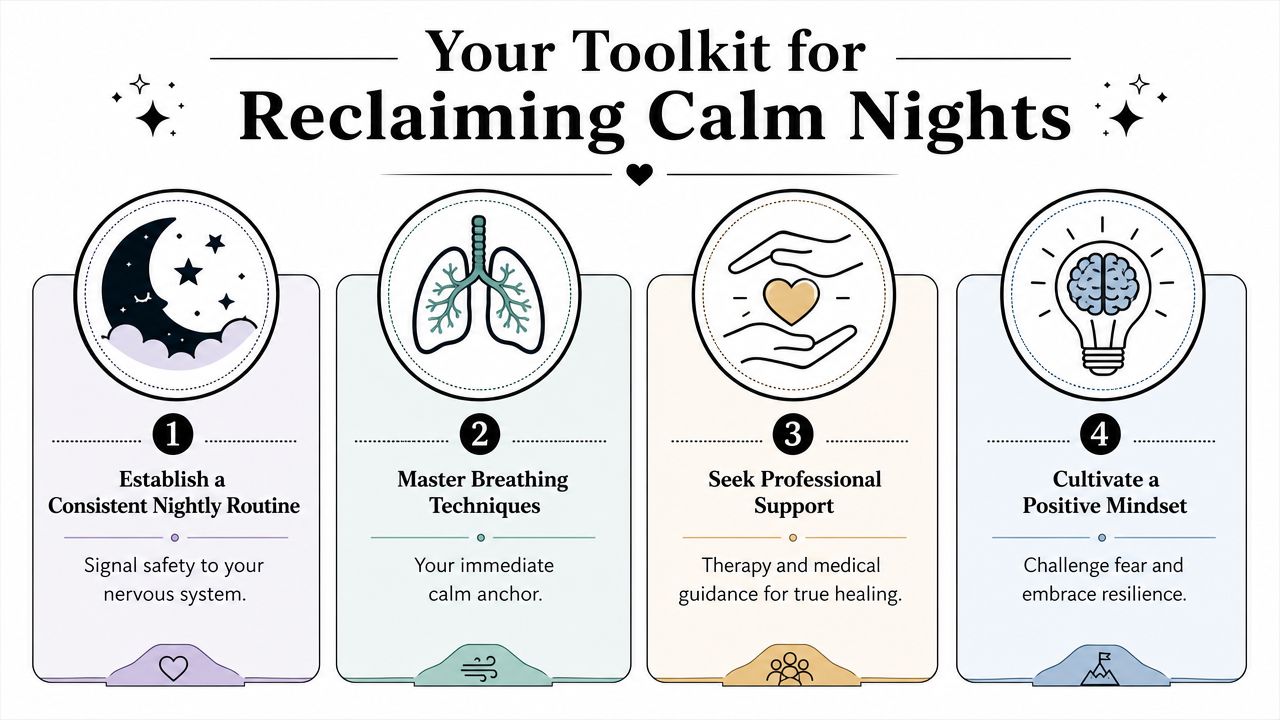
Here's what belongs in that toolkit:
- An immediate calming plan: A short script, slow exhale breathing, water, dim light, grounding.
- A steady evening rhythm: Less stimulation, more predictability, and a real wind-down.
- Evidence-based treatment: CBT first, with medication when appropriate and professionally guided.
- A support network: People who understand the difference between panic and danger.
- A new mindset: Not “What if this happens again?” but “If it happens again, I know what to do.”
That last shift is powerful. Fear shrinks when you trust yourself. Not because you can prevent every sensation, but because you know sensations don't get the final word.
Recovery doesn't usually look like one dramatic night where panic disappears forever. It looks like growing confidence. Shorter spirals. Less fear of bedtime. More nights where your body settles faster. Then, one day, you notice sleep feels ordinary again.
That ordinary peace is not out of reach. It's what treatment is for.
If you want practical support between therapy sessions or need help in the middle of a panic spike, The Anxiety Checklist offers science-based tools for real-time relief and long-term recovery, including grounding help, breathing support, guided meditations, sleep audios, and CBT-based self-therapy resources. It's a gentle next step if you're ready to rebuild trust with your mind, your body, and the night.