


Do you ever reach for anxiety advice and notice the gap right away? Most guidance tells you to calm down, breathe, or think positive, but it doesn't always tell you what to do in the exact moment your mind is spiraling and your body feels like it's sounding an alarm. When panic is rising, you need something concrete. You need a way to interrupt the loop.
There is a way out, and it often starts with simple distraction techniques for anxiety that help you regain control fast. These aren't about avoiding your feelings forever. They're about giving your nervous system enough stability to come back online, so you can respond instead of react. In practice, that matters. A person on a crowded train, a student before an exam, or a professional outside a meeting room can all use the same basic principles to get grounded again.
The deeper hope is this. Every time you use a skill that helps you move through anxiety without being consumed by it, you teach yourself that panic isn't the end of the story. Relief is possible. Confidence can be rebuilt. Many people who once felt trapped by anxiety do reach a place where panic no longer runs their lives.
This guide gives you practical tools you can use right away, with scripts, trade-offs, and honest notes about what helps and what usually doesn't. These are first steps toward something bigger than short-term relief. They're part of a path toward healing and living panic free.
Table of Contents
- 1. 5-4-3-2-1 Grounding Technique
- 2. Progressive Muscle Relaxation
- 3. Engaging Creative or Hobby-Based Distraction
- 4. Physical Movement and Exercise
- 5. Guided Meditation and Mindfulness
- 6. Cognitive Reframing Through Structured Thought Work
- 7. Immersive Storytelling, Audiobooks, and Podcasts
- 8. Cold Water Exposure and Vagal Stimulation Techniques
- 8-Method Comparison: Anxiety Distraction Techniques
- From Distraction to Lasting Change Your Next Steps
1. 5-4-3-2-1 Grounding Technique
When anxiety pulls your attention inward, grounding brings it back to what is present. That shift sounds simple, but it can be powerful. Instead of arguing with a panic thought, you redirect your senses toward the room, the train, the office, or the classroom in front of you.
The classic version is straightforward. Name five things you can see, four things you can touch, three things you can hear, two things you can smell, and one thing you can taste. If you're on public transportation, that might be five seats, four clothing textures, three sounds in the carriage, two scents in the air, and the taste of gum.
Use it when your mind won't stop scanning for danger
Specificity helps. “A blue office chair with wheels” works better than “a chair,” because your brain has to engage with reality in more detail. That's part of why this technique can interrupt spiraling. It gives your mind a job that competes with fear.
Try this script: “I'm anxious, but I'm here. I can see the window, the lamp, the notebook, the plant, the door. I can feel my shoes, my sleeve, the chair, the floor.” Keep going even if you don't feel calmer right away. The first win is redirection, not instant peace.
Practical rule: Practice grounding when you're relatively calm. Under stress, your brain uses what it already knows well.
Some people prefer to go in reverse order. Others pair the exercise with slower breathing or hold a smooth stone, ring, or fidget tool for the touch portion. If one version feels awkward, adjust it. Flexible use tends to work better than rigid perfection.
If your mind goes blank in panic, guided mental health tools for anxiety can help prompt each sensory step in real time. That matters because during a panic surge, remembering the method can be harder than the method itself.
What usually doesn't help is rushing through the list mechanically. If you fire off answers without really noticing anything, you miss the grounding effect. Slow it down enough for your nervous system to register, “I'm here, and this moment is survivable.”
2. Progressive Muscle Relaxation
Anxiety often lives in the body before you fully name it in words. The jaw tightens. Shoulders creep upward. Hands clench. Progressive Muscle Relaxation, often called PMR, works by helping you notice that tension directly, then release it on purpose.
You tense one muscle group, hold briefly, then release and pay attention to the difference. Hands, arms, shoulders, face, chest, stomach, legs, feet. The contrast teaches your body what “letting go” feels like.
A short script that works in real life
You don't need a perfect setup. If you're lying in bed, sitting at your desk, or parked before work, an abbreviated version can still help. Start with hands, shoulders, and jaw. Those areas often carry anxiety heavily.
Try this: inhale and tighten your fists. Notice the effort. Exhale and release. Lift your shoulders toward your ears. Exhale and drop them. Press your jaw gently together, then let it soften. After each release, say to yourself, “That's tension leaving.”
A lot of people expect PMR to feel dramatic. Sometimes it does. Sometimes it feels subtle at first, then you notice your breathing deepen and your thoughts lose some intensity. That quieter response is still useful.
For people who like guidance, a recorded practice can make the pacing easier and more consistent. This guided option can help you settle into the rhythm:
What doesn't work well is over-tensing, especially if you already live with pain, migraines, or a very activated body. Gentle effort is enough. If full-body PMR feels too long during a stressful day, use mini-rounds on your jaw, shoulders, hands, and stomach. Short practice still counts.
Some clients discover their anxiety isn't only in their thoughts. It's in a clenched mouth, raised shoulders, and a hard belly. Once they notice that, they can interrupt it much earlier.
3. Engaging Creative or Hobby-Based Distraction
Not every distraction technique for anxiety needs to look clinical. Sometimes the best interruption is a hobby that captures enough of your attention that worry loses its grip. Drawing, knitting, gardening, journaling, watercolor, baking, playing guitar, and pottery all work for the same reason. They ask your brain to focus, sense, decide, and create.
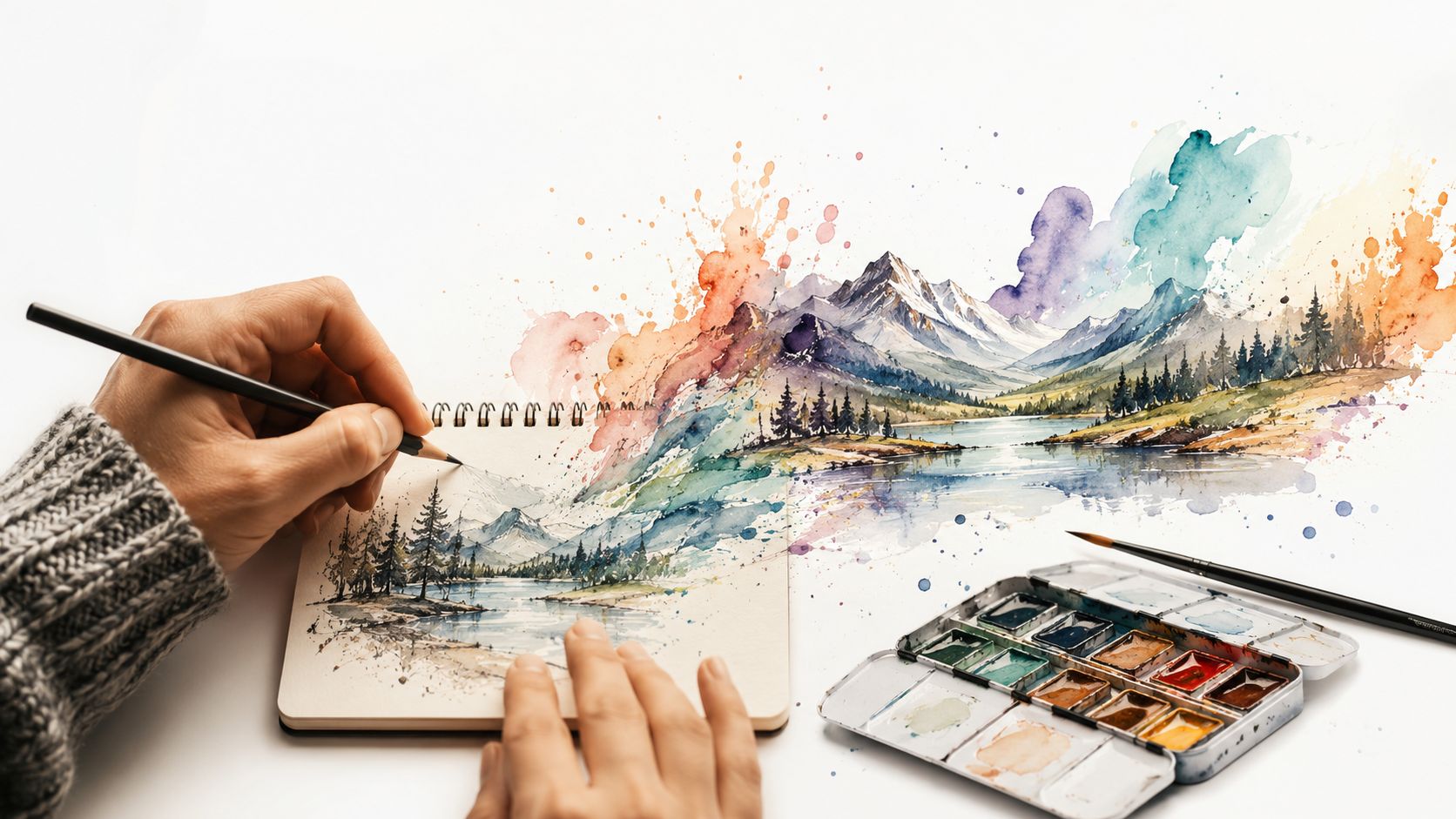
A person who spends part of an anxious evening mixing paint colors or shaping clay often experiences something important. Their attention starts moving toward process instead of threat. That shift can bring relief, but it also rebuilds confidence. You remember that your mind can do more than panic.
Choose absorption, not performance
The right hobby isn't the one you think you should enjoy. It's the one that holds you. If journaling helps, use it. If journaling turns into rumination, try collage, embroidery, LEGO, cooking, or an instrument instead.
A useful script is: “For the next few minutes, I'm not solving my whole life. I'm just choosing colors, shaping this page, or finishing this row.” That keeps the task small enough for an anxious brain to accept.
- Keep it visible: Store your sketchbook, yarn, puzzle, or instrument where you can reach it fast. Friction matters when anxiety spikes.
- Start tiny: Give yourself a few minutes, not a big commitment. Starting is often the hardest part.
- Track your best fits: Notice which hobbies calm you, which energize you, and which accidentally increase pressure.
Writing can be especially effective when you need both distraction and expression. If you want more structure, these shadow work journaling prompts anxiety can help shift journaling away from spiraling and toward insight.
What tends not to help is turning a coping tool into another performance standard. If you sit down to paint and immediately judge the result, anxiety may just move into a new costume. Aim for absorption, not excellence.
4. Physical Movement and Exercise
Anxiety creates energy. If that energy has nowhere to go, it can build into restlessness, shakiness, and a sense that you might explode from the inside. Movement gives the body an outlet. It also shifts attention toward muscles, rhythm, breath, and the environment around you.
For some people, a brisk walk is enough to break the loop. Others do better with stretching, yoga, dancing in the kitchen, a short strength circuit, or a guided walk with calming audio. The best form is the one you'll use when your system is activated.
What helps when exercise itself feels activating
One common fear is, “If my heart rate rises, I'll panic more.” That's understandable. Panic and exercise can share body sensations, and many anxious people become sensitive to those cues. Start gentler if that's true for you. Walking, mobility work, or slow yoga can rebuild trust in your body without overwhelming it.
A script that works well during an anxious walk is: “This is movement, not danger. My legs are working. My feet are hitting the ground. My body knows how to do this.” Keep your attention on concrete sensations, not on checking whether you're fully calm yet.
Moving your body doesn't mean forcing intensity. It means helping stress complete a cycle instead of circling inside you.
Regular movement also supports long-term healing because it teaches your nervous system that physical sensations can be safe and manageable. That lesson matters for people who fear dizziness, breath changes, or a pounding heart. Gentle repetition builds tolerance.
If you want a supportive movement practice that fits a demanding schedule, this guide to yoga for professionals offers practical ideas for stress relief and anxiety. What usually doesn't help is choosing exercise based on punishment, guilt, or all-or-nothing thinking. Sustainable movement calms more effectively than a plan you dread and quit.
5. Guided Meditation and Mindfulness
Meditation gets oversimplified. People hear “just sit with your thoughts,” then feel like they've failed when their mind gets louder. In anxiety treatment, guided meditation and mindfulness work better when they're used as skills, not tests. The job isn't to have a blank mind. The job is to notice what's happening without getting pulled under by it.
A guided voice can be especially helpful because it gives your attention somewhere to land. Instead of wrestling with every thought, you follow instructions back to the breath, the body, or an image of safety. That structure makes the practice more accessible when you're tired, overstimulated, or on edge.
A gentler way to meditate when anxiety is loud
If standard breath meditation makes you too aware of your body, switch formats. Body scans, visualizations, walking meditations, and sleep meditations can feel less intense. Some people do better with eyes open, looking softly at one spot in the room.
Try this script: “A thought is here. I don't need to solve it right now. I'm returning to the sound of the guide's voice, the feeling of the chair, and the air moving in and out.” That sequence creates space between you and the anxious thought.
Meditation tends to work best when you practice in calmer moments too. Then it's familiar when anxiety rises. If you only try it during a panic peak, it may feel frustrating or impossible, which makes sense.
- Use short sessions: A brief practice is often more effective than forcing a long one.
- Expect wandering: Returning attention is the practice. It's not a mistake.
- Match the style to the state: Sleepy minds may like body scans. Agitated minds may prefer guided walks or visual focus.
What doesn't usually help is using mindfulness to monitor yourself too closely. If you keep asking, “Am I calm yet,” you stay trapped in evaluation. A better aim is steadiness. Calm often follows.
6. Cognitive Reframing Through Structured Thought Work
Some distraction techniques for anxiety work through the senses. This one works through the thinking brain. When anxiety says, “This symptom means something terrible,” or “Everyone will judge me,” structured thought work slows the story down and examines it.
This isn't positive thinking. It's not telling yourself everything is fine when it doesn't feel fine. It's closer to investigative journalism. You gather evidence, identify distortions, and build a more balanced view.
A script for challenging a catastrophic thought
Start by writing the thought exactly as it appears. “I'm going to embarrass myself in this meeting.” “This headache means something is seriously wrong.” Then ask a few questions: What facts support this? What facts don't? Is anxiety filling in blanks? What would I tell a friend in this situation?
The replacement thought should be believable. “I might feel nervous in the meeting, but nervous isn't dangerous, and I can still speak clearly.” Or, “My body is stressed right now, and I don't need to jump to the worst conclusion.” Realistic reframing lowers panic more reliably than forced positivity.
A lot of people find that writing works better than trying to do this mentally. Once the thought is outside your head, it's easier to inspect. If overthinking is a major part of your pattern, this guide on how to stop overthinking can support the process.
Clinical note: Reframing is most effective when it is gentle and credible. An anxious mind rarely trusts extreme reassurance.
What often doesn't help is debating with panic in a frantic way. If your body is highly activated, ground first, then reframe. Thought work usually lands better after your nervous system has come down a notch.
7. Immersive Storytelling, Audiobooks, and Podcasts
Some anxious minds calm when they have something compelling to follow. A strong narrator, a familiar podcast host, or a well-paced story can pull attention out of rumination and into a different track. That's not trivial. Audio can create structure, companionship, and a sense of forward motion when your thoughts feel stuck.
This is especially useful during commutes, chores, pacing, or nights when silence makes your mind louder. A person listening to an engaging audiobook on the train often arrives less entangled in anxious prediction. Someone folding laundry while a trusted podcast plays may notice that the task and the voice together reduce mental space for spiraling.
Build an audio rescue kit before you need it
Preparation helps here. Save a small set of reliable options in advance. Not the most ambitious content. The most regulating content. For one person, that's a mystery novel with a calm narrator. For another, it's a gentle interview show, familiar comedy, or nature storytelling.
A useful script is: “I'm borrowing this voice and this story until my mind settles.” That simple framing can reduce the pressure to fix yourself immediately.
- Choose wisely: Avoid topics that trigger health fears, doom spirals, or overstimulation.
- Pair it with action: Walking, tidying, coloring, or commuting while listening creates a double anchor.
- Use familiar content for sleep: New and suspenseful stories can keep some people alert.
Audio can also include soothing sound-based content. For people who respond well to whispers, tapping, or soft repetitive sounds, ASMR for anxiety relief may be worth exploring.
What doesn't work as well is scrolling for the perfect thing while already panicking. Decision fatigue can make anxiety worse. Build the playlist first, then use it when needed.
8. Cold Water Exposure and Vagal Stimulation Techniques
Sometimes anxiety is too intense for reasoning alone. Your body is surging, your heart is racing, and you need a fast physiological interruption. Cold water and other vagal stimulation techniques can help shift the state of your nervous system quickly.

The simplest version is splashing cool or cold water on your face. Some people hold an ice pack to the cheeks or briefly place their hands in cold water. Others use humming, gargling, or long exhalations when cold exposure isn't practical. These methods can interrupt the panic cycle by changing what the body is doing in that moment.
Use body-based interruption with care
This technique is best used as a tool, not a dare. Start gently so you know how your body responds. A cool splash may be enough. You don't need extreme exposure to benefit from the shift in attention and sensation.
Try this script: “My body is activated. I'm going to give it a new signal.” Splash the face, then exhale slowly and longer than you inhaled. If water isn't available, hum steadily for several breaths or gargle for a short period. The vibration itself can be grounding.
Understanding why your body reacts so strongly can also reduce fear. If panic makes more sense to you when you know the mechanics, this article on understanding the fight or flight response can be helpful.
What usually doesn't help is using cold as a way to punish yourself for being anxious. This should feel regulating, not harsh. If intense cold is triggering or you have medical concerns about sudden cold exposure, use milder methods such as cool water, humming, or slow exhalations instead.
8-Method Comparison: Anxiety Distraction Techniques
| Technique | 🔄 Implementation Complexity | Resource Requirements | ⚡ Speed / Immediate Relief | 📊 Expected Outcomes & Effectiveness ⭐ | Ideal Use Cases / Key Advantages 💡 |
|---|---|---|---|---|---|
| 5-4-3-2-1 Grounding Technique | Low, simple sensory sequence, easy to learn | None, fully portable | ⚡ Fast, often interrupts panic within minutes | ⭐ Effective short-term for acute panic; temporary relief | Public spaces, on-the-go panic interruption; practice during calm to automate |
| Progressive Muscle Relaxation (PMR) | Moderate, learns a sequence; 10–20 min for full effect | Minimal, quiet space, optional audio guide | ⚡ Moderate, abbreviated versions work faster (5–10 min) | ⭐ High for reducing physical tension and improving sleep with regular practice | Evening routines, tension-related anxiety, sleep aid; target areas that hold stress |
| Engaging Creative / Hobby-Based Distraction | Variable, depends on activity skill level | Materials/tools vary (art supplies, instrument) | ⚡ Variable, 5 min to hours; not ideal for immediate panic | ⭐ Strong long-term mood, reward and skill benefits; variable acute effect | Builds mastery and identity, processes emotions, enjoyable sustained distraction |
| Physical Movement and Exercise | Low–Moderate, scalable from short walks to workouts | Low-cost, comfortable clothes, space; optional equipment | ⚡ Fast, relief often within minutes of movement | ⭐ Very high, immediate and long-term anxiety reduction supported by research | Acute and chronic anxiety management, improves sleep and resilience; choose enjoyable movement |
| Guided Meditation and Mindfulness | Moderate, requires practice and focused attention | Minimal, quiet space and/or guided audio/apps | ⚡ Moderate, short practices help, may be hard in severe panic | ⭐ High long-term benefits (emotion regulation, neural change) with consistency | Reduces rumination, builds resilience; start short and use guided sessions |
| Cognitive Reframing (Structured Thought Work) | Moderate–High, structured practice and analytic effort | Minimal, pen/paper or digital tools, CBT guidance | ⚡ Moderate, can be used immediately but needs cognitive capacity | ⭐ High for addressing root thought patterns and lasting change | Best for chronic worry, journaling, therapy; practice when calm to access during stress |
| Immersive Storytelling, Audiobooks & Podcasts | Low, passive listening, easy to start | Audio device and content (phone/headphones) | ⚡ Fast, quickly captures attention | ⭐ Good for sustained distraction and companionship; variable clinical effect | Commuting, multitasking, sleep support; curate non-triggering content |
| Cold Water Exposure & Vagal Stimulation | Low, simple techniques but can feel intense | Access to cold water/ice (or humming/gargling) | ⚡ Very fast, physiological shift within seconds | ⭐ Very effective for immediate panic interruption; contraindications exist | Emergency panic tool, physiological reset; practice safely and avoid if medical risks apply |
From Distraction to Lasting Change Your Next Steps
Distraction techniques are valuable because they can help you get through the moment that feels unmanageable. They interrupt panic, redirect attention, and give your system a chance to settle. For many people, that immediate relief is the first proof that anxiety can be influenced. You are not powerless inside it.
But lasting healing usually asks for more than interruption alone. If you only distract without learning your patterns, anxiety often comes back wearing the same mask. Real recovery tends to happen when in-the-moment tools are paired with deeper work that changes how you relate to fear, body sensations, uncertainty, and catastrophic thinking. That's where approaches like Cognitive Behavioral Therapy can be so useful. They help you identify the loops that keep anxiety alive and practice new responses until they become more natural.
This is also why a good support tool matters. In daily life, people don't always have a therapist in their pocket, a perfect memory for coping skills, or the mental bandwidth to remember what to do when panic hits. A structured app can bridge that gap. The Anxiety Checklist is designed for exactly that kind of real-world support. Its always-free SOS mode can guide you through immediate relief when your mind goes blank, while its broader library supports longer-term change through grounding tools, thought journaling, guided meditations, walking sessions, affirmations, sleep support, and deeper CBT-based exercises.
That combination matters because recovery is rarely one dramatic breakthrough. More often, it's a series of repeated moments in which you respond differently. You ground instead of spiraling. You walk instead of freezing. You reframe instead of catastrophizing. You learn that an anxious body can settle. You learn that panic can rise and pass. Over time, those experiences build trust.
If you've been living in fear of the next panic attack, hold onto this. Healing is possible, and many people do reach a place where anxiety no longer controls their choices. Progress may feel uneven, but uneven progress is still progress. Every skill you practice is evidence that your nervous system can learn safety again.
Sleep and physical recovery also matter more than many anxious people realize. If your body feels exhausted but still keyed up, this article on addressing tired but wired feelings offers another angle on calming an overactivated system. Keep going gently. You do not need to do every technique perfectly. You only need to keep building a path back to yourself, one workable step at a time.
If you want support that helps both in the middle of panic and over the long term, The Anxiety Checklist is a strong place to start. It offers an always-free SOS mode for those moments when you can't think clearly, plus guided tools for grounding, meditation, walking, sleep, affirmations, and CBT-based self-therapy. If your goal is not just to cope but to heal and live panic free, it gives you practical help you can use right away.