

Your phone is probably already full of promises. Sleep better. Meditate daily. Build better habits. Become calmer, sharper, more productive.
But anxiety changes the experience of all of that.
You open an app because your chest is tight, your thoughts are racing, and you need help right now. Instead, you get a streak counter, a cheerful reminder, or a long lesson you can't absorb because your nervous system is already in alarm mode. That gap can feel crushing. It can also make you wonder whether personal growth tools are built for people like you at all.
They can be. The right personal development app isn't just another self-help product. It can be a quiet support system in your pocket. It can help you get through a hard moment, notice patterns you've never been able to name, and practice small skills that slowly make panic feel less powerful. If you've been looking for mental health tools for anxiety, there's good reason to keep going.
Most of all, there is hope here. Anxiety can feel permanent when it keeps interrupting your days, shrinking your world, and making ordinary tasks feel unsafe. But panic isn't a life sentence, and healing doesn't require perfection. With the right support, many people learn to calm their bodies, challenge anxious thinking, and move toward a life that feels open again.
Table of Contents
- Your Path to a Calmer Mind Starts Here
- What Are Personal Development Apps
- Key Features That Drive Real Change
- How to Choose an App That Truly Helps
- Healing Anxiety One Step at a Time
- Making Your New Habits Stick for Lasting Relief
Your Path to a Calmer Mind Starts Here
Maybe it happens in the grocery store. Maybe it starts in bed at 2 a.m. Your mind catches on one sensation, then another. Your heart feels too loud. You try to reason with yourself, but the fear keeps building. After a while, even reaching for help can feel hard because anxiety steals language, focus, and trust in your own body.
That's the moment many people turn to their phones, not because they want a grand transformation, but because they need one steady next step. A well-designed personal development app can meet that moment with structure instead of pressure. It can offer grounding, guided breathing, journaling prompts, or a short exercise that helps your mind stop spiraling long enough to feel your feet on the floor again.
Panic can make ordinary life feel far away
Anxiety is exhausting partly because it's so disruptive. It doesn't just create fear. It can make routines fragile. A missed meal, a stressful email, a crowded room, or one bad night of sleep can make everything feel harder than it should.
That's why “just be more disciplined” advice often lands badly. You're not failing because you don't care enough. You're trying to build stability while your nervous system keeps hitting the fire alarm.
Practical rule: If an app makes you feel scolded when you miss a day, it's probably not built for anxiety.
Support should feel reachable
A good app won't replace emergency care or a qualified therapist when those are needed. What it can do is make support more available between appointments, during difficult evenings, or in the small windows where change usually starts. It can give shape to recovery when your thoughts feel messy and your energy is low.
That matters because healing often looks less dramatic than people expect. It may begin with one calming exercise, one thought written down, one feared situation approached gently instead of avoided. Small moments count. Repeated often enough, they become evidence that your body can learn safety again.
What Are Personal Development Apps
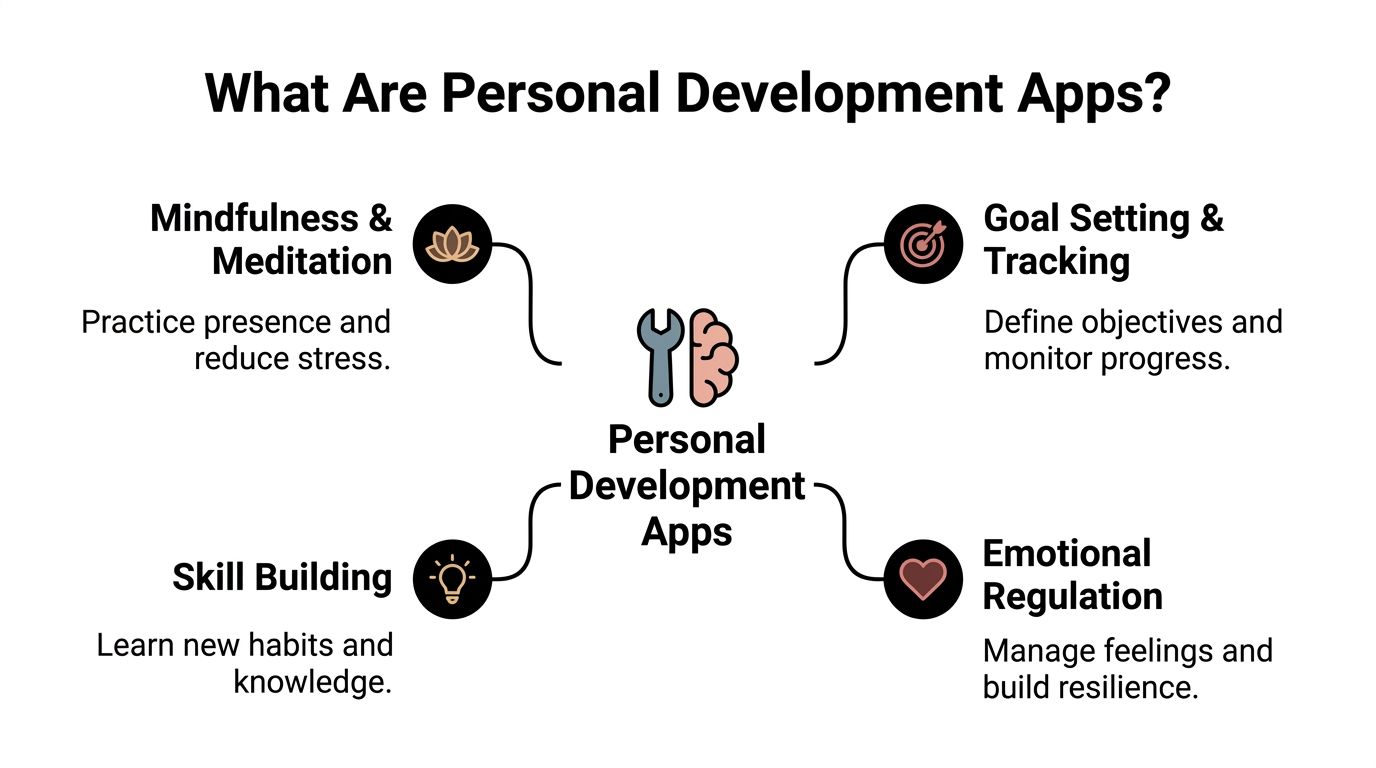
A personal development app is easiest to understand as a digital toolkit for your mind. Instead of holding physical tools like a notebook, timer, workbook, and audio guide in separate places, the app brings them together on your phone. Some tools help you reflect. Some help you calm down. Others help you learn, plan, or practice new habits.
This category is broad, which is why people often feel confused when they search for one. The term can include meditation apps, goal trackers, self-reflection journals, learning apps, and platforms that combine several methods in one place. The market is also expanding. The global personal development market was valued at USD 51.47 billion in 2023 and is forecast to grow to USD 115.9 billion by 2035, with the app segment growing quickly as people seek convenient mobile support for mental health and self-improvement, according to Market Research Future's personal development market analysis.
If you've spent time reading evidence-based anxiety resources, you've probably already noticed that not every tool serves the same purpose. That's important. An app that helps with motivation may not help much in a panic wave.
A digital toolkit for your mind
Picture this. If your inner life were a home workshop, different tools would solve different problems.
| Type of tool | What it helps with | Example of use |
|---|---|---|
| Mindfulness tools | Slowing your body and attention | A short breathing session before bed |
| Habit tools | Repeating a small action | A reminder to journal after breakfast |
| Journaling tools | Spotting thought patterns | Writing down a fear and testing it |
| Learning tools | Understanding anxiety or behavior change | A brief lesson on panic symptoms |
That's why one person loves a meditation app while another bounces off it. They may need completely different tools.
The main types you'll see
Some apps are very simple. They track habits, count streaks, and send reminders. These can be useful if your main problem is forgetting or staying organized.
Others focus on mindfulness and meditation. They usually offer breathing exercises, sleep audios, or guided sessions to help you slow down. These can support stress reduction, especially when you're overstimulated.
A third group centers on journaling and emotional regulation. These apps help you log moods, write about distressing thoughts, or notice triggers over time.
Then there are multi-method platforms. They combine journaling, guided exercises, educational content, and behavior tools in one place. For anxiety, this integrated approach is often easier because you don't have to patch together support from five different apps.
A helpful app doesn't just ask, “What goal do you want to reach?” It also asks, “What happens in your body and mind when fear gets in the way?”
Key Features That Drive Real Change
Some app features look impressive but don't do much when anxiety is the primary barrier. A streak badge can't coach you through spiraling thoughts. A generic reminder can't help much when your body is bracing for danger. Real change usually comes from tools that match how anxiety works.
Why generic tracking often falls short
Habit tracking has value. It makes progress visible and gives your day some structure. But tracking alone often assumes you're already calm enough to act. Anxiety often breaks that assumption.
That's one reason integrated tools matter. Personal development apps that combine evidence-based CBT frameworks with AI-driven journaling showed a 34% higher user retention rate than apps that relied only on generic habit tracking, because personalized feedback strengthens self-awareness, according to this analysis of personal growth apps.
That finding makes intuitive sense. Anxiety is slippery. People often know they feel bad but can't tell what set it off, what thought intensified it, or what response kept the fear going. Journaling with guided prompts can slow that blur into something visible.
Features that help anxious minds
The strongest features usually do one of two jobs. They either help in the moment, or they build skill over time.
Here are the ones worth looking for:
- CBT thought tools help you notice a fear, examine the prediction inside it, and test whether it's accurate. That matters because anxious thoughts often feel like facts.
- Guided journaling gives structure when your mind feels tangled. Instead of “write about your feelings,” it may ask what happened, what you feared, and what happened next.
- Grounding or SOS tools are built for moments when you can't think clearly. They should be fast, simple, and easy to follow under stress.
- Education in plain language helps you understand symptoms without getting overwhelmed. Knowing why panic feels physical can reduce secondary fear.
- Reflection prompts tied to behavior help you move from insight to action. That's where breaking the overthinking cycle becomes possible.
When an app helps you name a thought, calm your body, and take one small action, it stops being a tracker and starts acting like a recovery tool.
One more point trips people up. Meditation and journaling aren't competing approaches. They solve different problems. Meditation can lower arousal. CBT-style journaling can challenge the story driving the arousal. Used together, they often support both relief and learning.
How to Choose an App That Truly Helps
Most app reviews reward polish, not fit. They praise clean design, long feature lists, and motivational language. For someone with anxiety, that can be misleading. The question isn't whether an app looks modern. The question is whether you can still use it when your brain goes blank, your body feels unsafe, and your motivation disappears.
Why anxiety-first design matters
Many popular self-improvement apps treat anxiety as a side topic. You might get a breathing exercise tucked inside a productivity platform, or a meditation tab added to a habit app. But if fear is what keeps interrupting your day, that structure is backward.
Anxiety-first design starts with the blocker, not the ambition. It asks what a person needs during a panic surge, after a bad night, or in the hour before a feared event. That gap matters because 70% of users report that anxiety prevents consistent use of apps that don't offer structured, real-time grounding tools that enable action, according to Hex Digital's analysis of self-improvement apps.
If you want one practical example, a supportive app for mental wellness should let you get help quickly, not make you work through five setup screens before you can breathe.
A simple way to evaluate your options
Use these questions before you download anything or before you commit to a subscription.
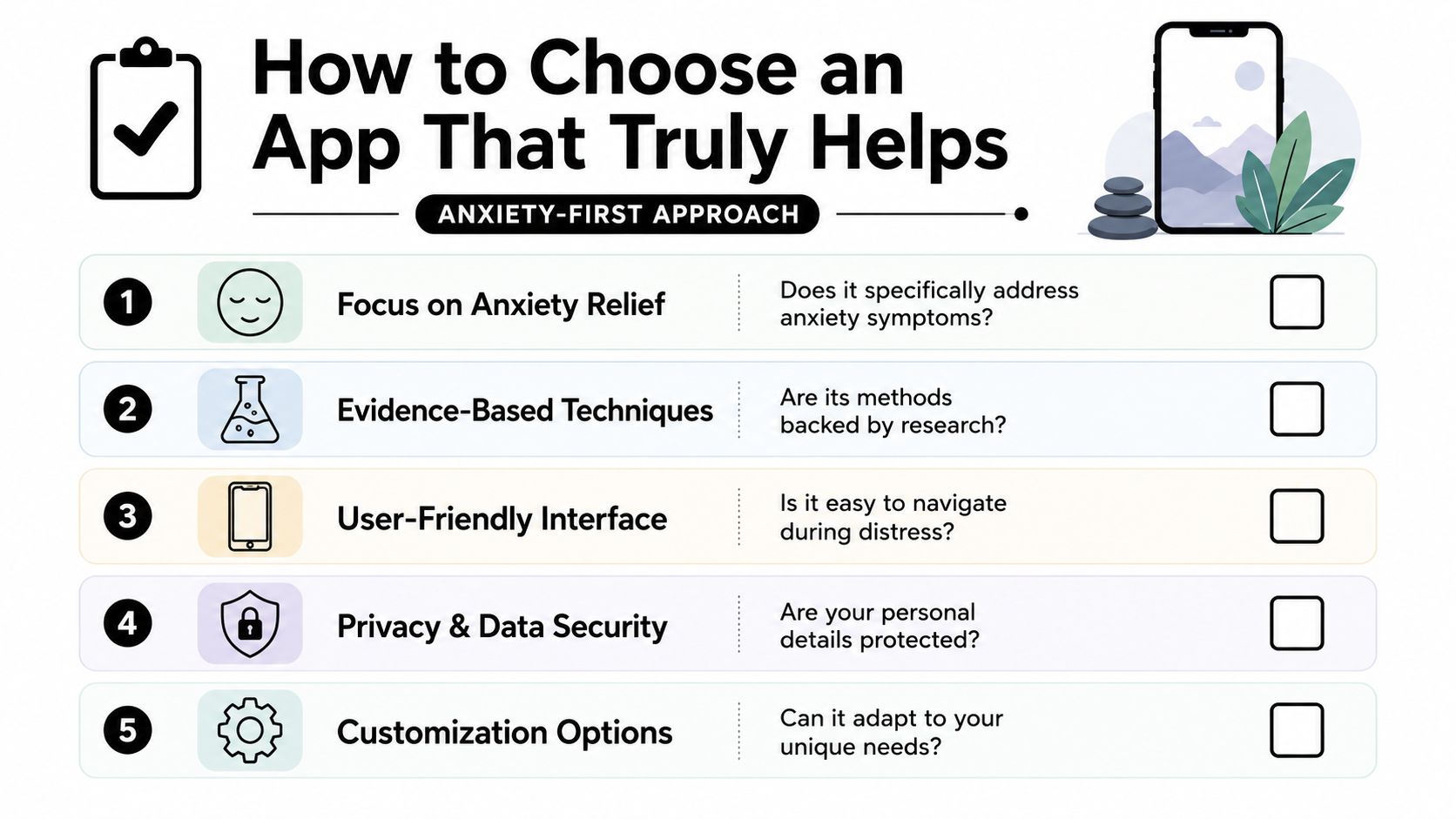
- Does it offer immediate relief? If panic hits, can you reach a grounding tool within seconds? Anxious users often need an SOS path, not a dashboard.
- Are the methods evidence-based? Look for CBT-informed journaling, structured reflection, or other established approaches. Vague “mindset coaching” may feel supportive but not necessarily therapeutic.
- Is the interface calm under pressure? Small text, cluttered menus, and too many choices can make distress worse.
- How does it treat privacy? This matters if you're logging fears, moods, or personal thoughts. Look for clear controls around login, data storage, and what gets shared.
- Can you try it without pressure? A gentle trial period lets you test whether the app feels regulating or activating.
A quick comparison helps:
| Good fit for anxiety | Poor fit for anxiety |
|---|---|
| Fast access to calming tools | Buried support features |
| Clear, guided steps | Open-ended prompts only |
| Privacy-conscious setup | Heavy data collection upfront |
| Flexible pacing | Streak pressure and guilt messaging |
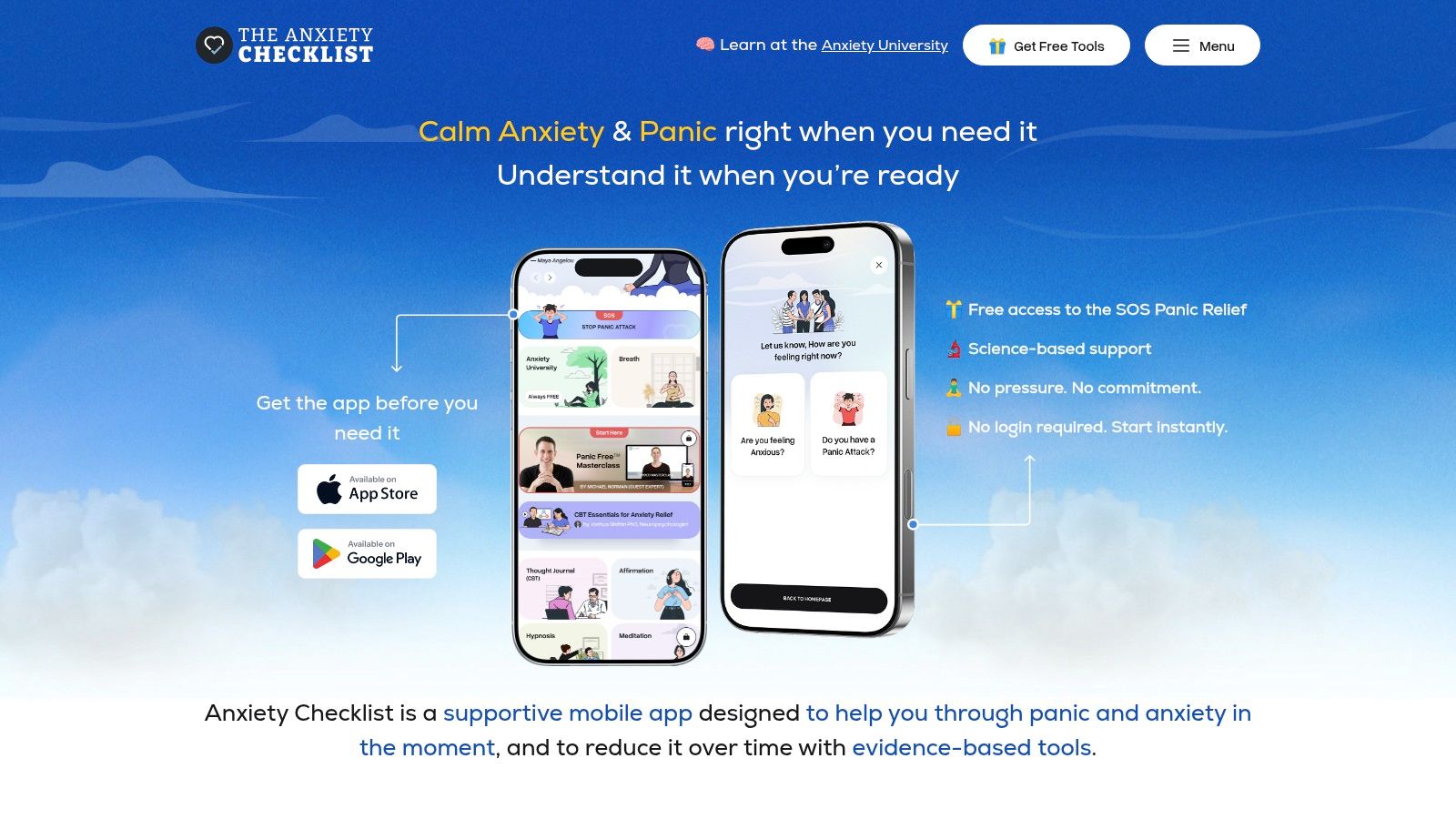
Some people also need one app that covers both crisis moments and longer-term work. One factual example is The Anxiety Checklist, which offers an always-free SOS mode, stress-reduction tools, CBT self-therapy exercises, and educational content without requiring login to get started. That mix won't fit everyone, but it shows what anxiety-first design can look like in practice.
Healing Anxiety One Step at a Time
Relief and healing aren't the same thing, but they can work together. A calming tool can help you get through tonight. A structured practice can help next month feel different from this month. That's the path many people need. Not one miracle feature, but a sequence of small supports that keep building on each other.
What immediate relief can look like
A panic spike usually narrows your world fast. Thoughts race. Sensations feel dangerous. The mind starts scanning for escape. In that state, long explanations often don't help.
A well-designed SOS feature does less, not more. It might guide your breathing, help you orient to the room, ask you to name what you can see, or give you a short grounding phrase to repeat. Those steps sound simple, but simple is exactly what helps when your thinking brain is overloaded.
Sometimes people feel discouraged because grounding doesn't make anxiety vanish instantly. That doesn't mean it failed. It may have interrupted escalation, helped you stay present, or reduced the urge to flee. Those are meaningful wins.
A panic episode doesn't have to end with fear in charge. Even one grounded minute can change what happens next.
For many people, it also helps to build calming routines outside crisis moments. If you want practical ideas, this guide can help you learn to build calm habits in ways that feel manageable.
How long-term healing builds
Long-term change usually comes from repeated experiences that teach your brain a new lesson. CBT is especially important here because it helps people identify anxious thoughts, test feared predictions, and reduce avoidance. For panic disorder, CBT achieves success rates of 70 to 90%, with 90% of patients remaining panic attack-free 18 months after treatment, according to this Psychological Medicine report on focused CBT for panic disorder.
That number matters because it offers something many anxious people haven't felt in a while. Real hope. Not vague encouragement. Evidence that a panic-free life is possible.
In an app, this often looks ordinary on the surface. You write down a fear. You notice the catastrophic prediction inside it. You compare what you feared with what happened. You slowly face situations you've been avoiding, sometimes with structured tools for anxiety management that break a big fear into smaller steps.
Healing often feels repetitive. That's normal. Your nervous system learned fear through repetition too. It can learn safety the same way.
Making Your New Habits Stick for Lasting Relief
The hardest part of using a personal development app isn't starting. It's using it in a way that doesn't become one more thing to fail at. Anxiety already creates enough pressure. Your routine needs to lower that pressure, not add to it.
Make the goal smaller than your anxiety
Small goals work better because they ask less from a stressed brain. When a goal is specific and realistic, your mind doesn't have to wrestle with ambiguity. That's one reason SMART goal frameworks matter. In personal development apps, using SMART goals correlates with a 47% increase in weekly goal adherence, according to this review of personal development tools.
Instead of “I'll work on my anxiety every day,” try something tighter:
- Specific: Open the app after breakfast.
- Measurable: Complete one grounding exercise.
- Achievable: Keep it under five minutes on hard days.
- Relevant: Choose a tool that helps with panic or overthinking.
- Time-bound: Do it for one week, then reassess.
That kind of goal is easier to trust because it has edges.
Consistency grows through kindness
Progress with anxiety is rarely linear. One day you'll feel steady. The next day your body may react strongly to something that seems minor. That doesn't erase your work.
Try this rhythm instead of chasing perfect use:
- Pick one anchor moment like morning coffee, the commute, or getting into bed.
- Use one feature consistently before adding others.
- Review without judgment at the end of the week. Ask what helped, what felt hard, and what needs to get smaller.
- Count returns as success. Reopening the app after a rough patch is progress.
Gentle reminder: A supportive routine should feel like a handrail, not a test.
Healing from anxiety often begins this way. Repeatedly. A few minutes at a time. If panic has convinced you that your future will always be this small, hold onto the evidence that change is possible. Your nervous system can learn new patterns. Your habits can support recovery instead of fear. And you don't have to do all of it at once.
If you want a calm, structured place to start, The Anxiety Checklist offers tools for immediate panic relief and longer-term anxiety work in one app. You can use it to ground yourself in hard moments, explore CBT-based exercises, and build a steadier routine without needing to have everything figured out first.