



You open a travel tab because part of you wants to go. Then your chest tightens. You start checking flight times, hotel reviews, weather, maps, airport layouts, cancellation policies, and whether you can still back out. A simple trip begins to feel like a trap.
If that sounds familiar, you're not weak, dramatic, or broken. The fear of traveling can be intense, confusing, and isolating. It can make you want freedom and fear it at the same time.
The hopeful truth is that this fear is both understandable and treatable. Fear of flying alone is often estimated at 3% to 8% of people, and some travel-anxiety sources report much higher figures in certain regions, including reports of aviophobia in up to 40% of populations in Western Europe, Northern Europe, and North America, with about 6% to 7% experiencing severe symptoms, according to Psych Central's overview of travel anxiety. That range tells us something important. You are far from alone.
Relief usually doesn't come from forcing yourself to “just relax.” It comes from understanding what your fear is made of, learning how panic works, and building a plan that helps your mind and body feel safe again. If you want more guided support while you work on that, these anxiety coping guides and tools can help you keep learning between trips.
Table of Contents
- Your Journey to Freedom Starts Here
- Understanding the Fear of Traveling and Its Forms
- How Travel Anxiety Shows Up and When to Seek Help
- Proven Techniques to Reclaim Your Freedom to Travel
- A Step-by-Step Plan to Prepare for Your Next Trip
- Your Hopeful Journey to Panic-Free Adventures
Your Journey to Freedom Starts Here
Many people with the fear of traveling live in a painful in-between place. They want the wedding, the vacation, the visit with family, the work opportunity, the weekend away. But the moment a trip becomes real, their nervous system acts like danger is near.
That reaction can feel acutely discouraging. You may have told yourself, “I should be able to do this.” You may have canceled, postponed, or gone on trips while panicking internally. You may even look calm on the outside while your mind is racing through every possible disaster.
You do not need to be fearless to travel again. You need a path that is gentle, clear, and repeatable.
Healing often starts when you stop treating the fear as a character flaw and start treating it as an anxiety pattern. Anxiety is persuasive. It takes uncertainty and translates it into threat. Travel happens to contain many things anxious brains dislike: unfamiliar places, changing plans, limited control, bodily sensations, and lots of “what if” questions.
A more compassionate view changes everything. Instead of asking, “Why am I like this?” you can ask, “What exactly is my brain trying to protect me from?” That question opens the door to useful answers.
Here's what recovery tends to look like in real life:
- First comes clarity: You identify whether your fear centers on flying, being trapped, getting lost, being alone, panic symptoms, or disruptions.
- Then comes skill-building: You learn how to slow the spiral before it takes over.
- Then comes practice: You take small, planned steps that teach your body a new lesson. Travel is uncomfortable, not unsafe.
- Finally comes freedom: Not perfect calm every time, but growing confidence and less avoidance.
That's how panic-free travel becomes realistic. Not by overnight transformation, but by steady retraining.
Understanding the Fear of Traveling and Its Forms
Travel fear often becomes easier to work with once it has shape. The fear of traveling is often described as hodophobia, a term for fear of travel or traveling. Some people feel relief when they learn there is a name for what they have been experiencing. Others prefer plainer language. Either response is fine. What helps most is recognizing that this fear usually follows patterns, and patterns can be understood and changed.
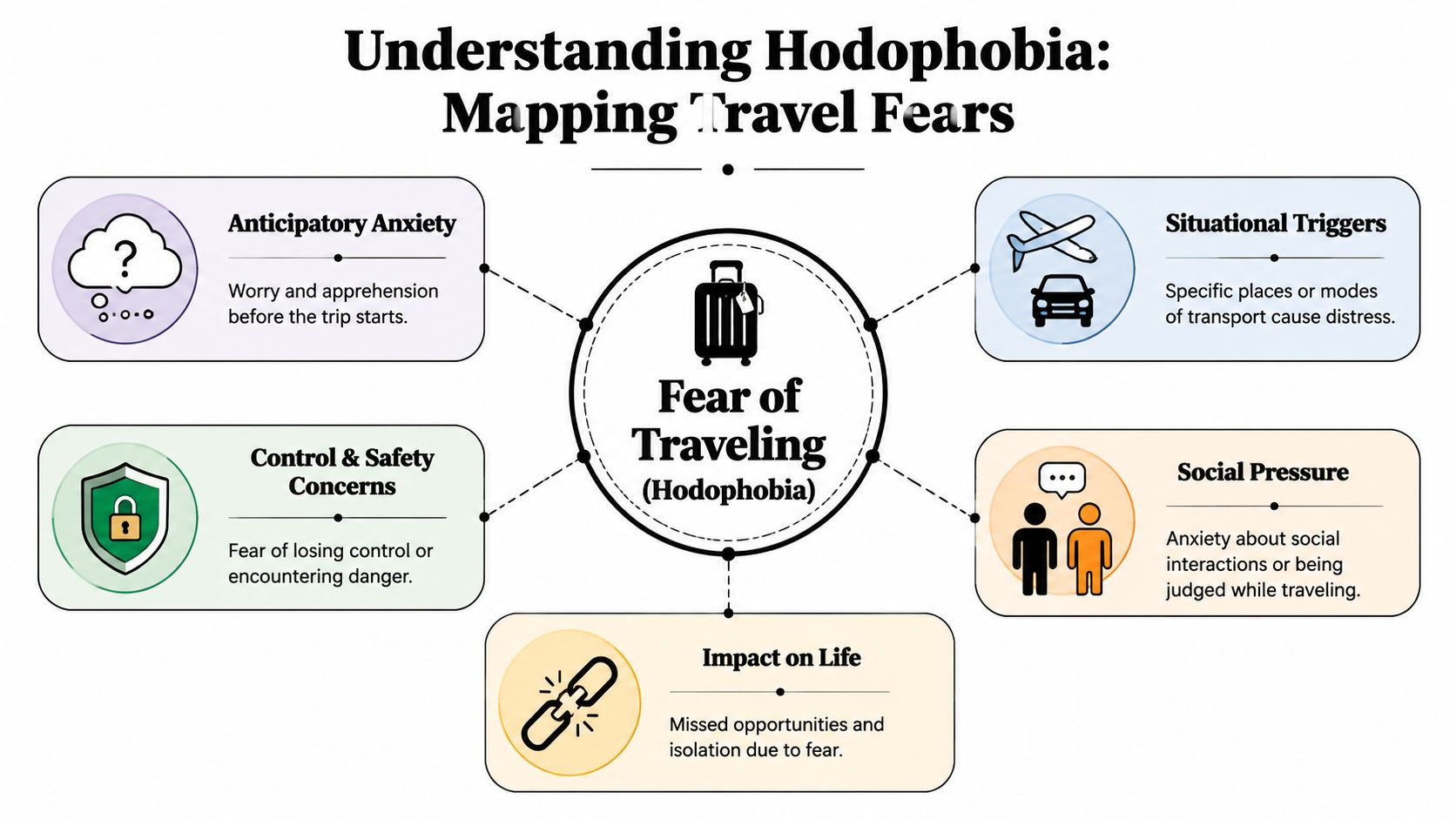
Mental health professionals often view hodophobia through the lens of specific phobias and anxiety learning. In plain terms, your brain starts linking travel with danger, even if the danger is unlikely or comes more from panic itself than from the trip. The hopeful truth is that this fear is both understandable and treatable.
Travel anxiety works like an over-sensitive smoke alarm. Its job is protection. But after enough stress, uncertainty, or one bad experience, it can start reacting to ordinary travel cues as if they signal an emergency. A boarding gate, a traffic jam, a hotel check-in desk, or even a packed suitcase can set it off.
That is why “fear of traveling” is often too broad to be useful on its own.
For one person, the main fear is the method of travel. A plane may feel trapping. A train may feel hard to leave. A highway may feel too far from help. If flying is your strongest trigger, understanding aerophobia can help you sort out whether the fear is about the aircraft, the loss of control, or the possibility of panicking while in the air.
For another person, the vehicle is only part of the story. The fear may center on being far from home, not knowing the language, missing a connection, getting lost, being alone, or feeling exposed in unfamiliar places. In that case, the trip becomes a container for several smaller fears that stack on top of each other.
A helpful way to make sense of your own pattern is to get specific:
| Travel fear pattern | What it often sounds like |
|---|---|
| Anticipatory fear | “I start spiraling days before I leave.” |
| Panic fear | “I'm afraid my body will panic and I won't be able to get out.” |
| Control fear | “I can't relax if someone else is in charge of the route, timing, or outcome.” |
| Social exposure fear | “What if I need help and can't explain what's wrong?” |
| Safety fear | “What if something goes wrong and I'm by myself?” |
Specificity matters because each fear pattern responds to a slightly different kind of preparation. Fear of crashing, fear of fainting, fear of being trapped, and fear of being alone may all show up under the label of travel anxiety, but they do not all need the same response.
A therapist might call this case formulation. A traveler might call it figuring out what spooks you. Both mean the same thing. You stop treating the fear like one giant wall and start seeing the separate bricks.
That shift creates hope. “I'm scared of travel” can feel enormous and permanent. “I'm scared of being delayed in an unfamiliar place while panic symptoms rise” is still painful, but it is clear enough to work on. Clarity is where a travel-readiness plan begins.
How Travel Anxiety Shows Up and When to Seek Help
Travel anxiety doesn't only live in thoughts. It usually appears in three places at once: the body, the mind, and behavior. Recognizing all three can help you stop blaming yourself for “overreacting.” Your whole system is responding.
What happens in the body mind and behavior
In the body, travel anxiety can feel like a false alarm with full volume. Your heart races. Your stomach churns. You feel shaky, lightheaded, hot, cold, tense, or unreal. Some people notice the symptoms most when packing. Others feel them in transit, at the airport gate, on the highway, or in the hotel room at night.
In the mind, the classic pattern is the “what if” spiral. What if I panic on the plane? What if I faint? What if I get stuck in traffic? What if I can't find the exit? What if I embarrass myself? These thoughts can arrive so fast that they feel like facts.
Behavior completes the cycle. People start avoiding. They cancel trips, over-prepare, seek repeated reassurance, travel only with a “safe” person, or leave situations early. Those behaviors make sense in the short term because they lower anxiety quickly. But they also teach the brain, “Good thing we escaped. That really was dangerous.”
A quick self-check can help:
- Physical signs: racing heart, nausea, dizziness, tight chest, sweating, tingling
- Mental signs: catastrophic predictions, scanning for danger, replaying worst-case scenarios
- Behavioral signs: avoiding booking, delaying departure, needing repeated checking, escaping early
Signs it may be time for extra support
Occasional nerves before a trip are common. The line usually gets crossed when fear starts shrinking your life. Maybe you turn down visits, jobs, reunions, or rest because travel feels impossible. Maybe every trip becomes a battle of endurance rather than something manageable.
If panic is part of your travel fear, it can help to learn about support for panic episodes so the sensations themselves feel less frightening. Professional help may also be worth considering if your anxiety leads to repeated avoidance, significant distress, or intense suffering before, during, or after travel.
Seeking help is not surrender. It is training.
A therapist can help you sort out whether your main driver is panic, a specific phobia, trauma, generalized anxiety, or a mix. That distinction matters because the most effective strategy depends on the pattern underneath.
Proven Techniques to Reclaim Your Freedom to Travel
Travel anxiety responds best to methods that do two things at once. They reduce uncertainty before the trip, and they help your nervous system settle during the trip. Hospital guidance on travel stress recommends structured planning and paced breathing, and notes that CBT works well for anxiety because it directly addresses the “what if” thinking that drives avoidance in this practical Kaiser Permanente guide.
CBT helps you become a thought detective
CBT, or cognitive behavioral therapy, asks you to examine anxious thoughts instead of obeying them. Not every fear thought is wrong. But anxious thoughts are often incomplete, exaggerated, or built around worst-case assumptions.
Think of CBT as thought-detective work. A detective doesn't arrest the first suspect. They gather evidence.
If your mind says, “If I panic on the plane, I won't cope,” a CBT-style response might be:
- What am I predicting?
- What evidence supports it?
- What evidence doesn't?
- If the feared moment happened, how would I respond?
That last question is powerful. Anxiety says, “You can't handle it.” Recovery says, “If it happens, I have a plan.”
Exposure works like wading into water
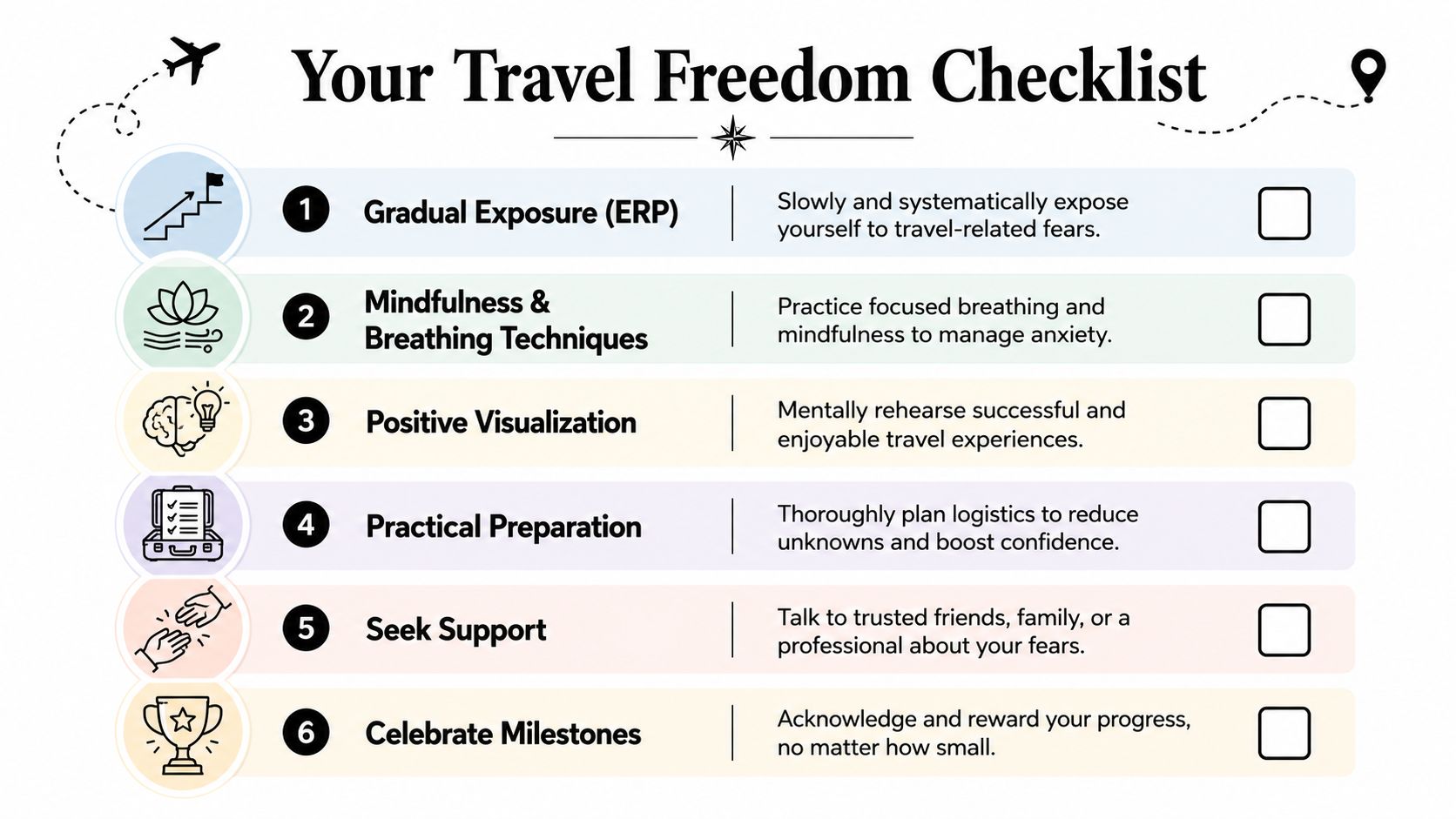
Exposure therapy sounds intimidating until its process is likened to entering cold water. You don't need to dive into the deep end on day one. You start where your feet can touch. Then you stay long enough for your body to learn that the water is uncomfortable but tolerable.
For fear of traveling, exposure might look like this:
- Start with travel cues: look at train schedules, airport maps, or hotel bookings without escaping.
- Move to mini-practice: take a short drive, ride one stop on a train, sit at a station, visit an airport without flying.
- Build duration: increase time, distance, or complexity in small steps.
- Repeat on purpose: the brain learns through repetition, not one heroic attempt.
The goal of exposure isn't to feel zero anxiety. The goal is to discover that anxiety rises, peaks, and falls without needing to control everything.
Calming the nervous system in real time
When anxiety spikes, logic alone often isn't enough. Your body needs a signal of safety. Slow, paced breathing helps because it gives your nervous system a rhythm to follow.
A few simple tools can work well together:
- Paced breathing: Use slow, steady breaths. If you're not sure where to begin, these calming breathing techniques can give you a concrete structure.
- Grounding: Name what you can see, feel, and hear right now. This pulls attention out of future catastrophe and back into the present.
- Practical preparation: Print your itinerary, save offline maps, and write down key contacts. These aren't “safety crutches” when used wisely. They're ways of reducing unnecessary uncertainty.
Used together, these methods help in two directions. CBT changes the story. Exposure changes the learning. Breathing and grounding change the physical alarm state. That combination is often where hope becomes momentum.
A Step-by-Step Plan to Prepare for Your Next Trip
A good travel-readiness plan doesn't ask you to be brave in a vague way. It gives your anxious brain a job. That job is preparation with limits, not endless checking.
Fear often grows fastest around disruption. Delays, cancellations, missed connections, and sudden changes can trigger the sense that everything is unraveling. Travel-anxiety guidance increasingly points to backup planning like printed itineraries and contact lists because uncertainty and logistics are central triggers, as described in this Road Scholar article on traveling anxiety.
Prepare for the parts that trigger loss of control
Preparation works best when it's concrete. Instead of trying to “feel ready,” build readiness on paper.
Try this checklist:
- Map the route: Know your departure time, transit steps, arrival details, and backup options.
- Print key details: Bring your itinerary, booking confirmations, medication list, and emergency contacts.
- Plan airport timing: If airports are a trigger, a practical resource like Max's Luxury Rides airport timeline can help you choose a calmer arrival window.
- Reduce decision load: Lay out clothes, chargers, documents, and snacks the night before.
- Name the likely wobble point: Is it security, boarding, being stuck in traffic, or sleeping away from home? Plan for that point specifically.
A short written plan often works better than mental rehearsing. The anxious mind keeps moving the goalposts. Paper stays still.
Practice before the real trip
You don't need your next trip to be the first test. Practice in smaller doses first.
One person might rehearse by packing a bag and driving to the airport, then returning home. Another might book a short train ride. Someone with panic in crowded terminals might sit in a busy café with luggage for a while and practice staying through the sensations.
If you want a guided way to build these steps, structured exposure therapy tools can help you create a fear ladder and work upward gradually. This is also one place where The Anxiety Checklist can be useful as one option among many. It includes an always-free SOS mode for grounding and quick prompts during acute anxiety, along with CBT and exposure tools for longer-term practice.
Keep the practice principle simple:
| Level | Example practice |
|---|---|
| Low | Read travel emails without reassurance-seeking |
| Moderate | Take a short local trip and stay with the sensations |
| Higher | Complete a brief real journey with a clear coping plan |
A visual walk-through can also make the process feel more doable:
Pack an SOS kit for your mind
Your SOS kit isn't superstition. It's a support plan for moments when your brain goes blank.
Include a few items in one note on your phone or one index card in your bag:
- A grounding script: “This is anxiety. It feels strong, but it will pass.”
- A breath cue: “Slow exhale. Loosen shoulders. Unclench jaw.”
- Your coping sequence: drink water, sit down, breathe, name five things you see, text one support person
- Practical backups: gate number, hotel address, local transport option, medication details
Build for the version of you that feels overwhelmed, not the version of you that feels calm at home.
That one shift can change a trip. You stop demanding perfect confidence before you go. You start traveling with support, skill, and self-trust.
Your Hopeful Journey to Panic-Free Adventures

You are at the airport gate, coffee in hand, ticket on your phone, and your body reacts as if danger is everywhere. Your chest tightens. Your thoughts race ahead to missed flights, closed doors, and public panic. Nothing around you has changed, yet your nervous system is sounding a false alarm.
That experience can make your world feel smaller. Trips get postponed. Invitations become stressful instead of exciting. Rest starts to feel out of reach. Still, fear is learned, and learned patterns can be retrained.
A hopeful path usually starts when you treat travel anxiety less like a personal flaw and more like an overprotective smoke alarm. It goes off loudly, even when the toast is only a little burnt. The goal is not to rip the alarm out of the ceiling. The goal is to teach your brain the difference between discomfort and danger, then build enough practice that travel no longer feels like an emergency.
That is how lasting change tends to happen. You understand your fear clearly. You notice how it moves through your body and thoughts. You practice responding instead of reacting. You take small, repeatable trips and preparations that show your nervous system, step by step, that you can cope.
A panic-free travel life grows from readiness, not perfection. You do not need to enjoy every airport, every delay, or every unfamiliar place. You need a plan that fits you, skills you can use under stress, and enough self-trust to stay with a hard moment without letting it make every decision.
Start with one action that feels challenging but still doable. Save a route to a nearby destination. Sit with a booking page without closing it right away. Take one short ride and let the sensations rise and fall. Build one note on your phone with the words you need when your mind goes blank. Small acts of courage teach the brain through experience, which is why they often work better than big promises made from the safety of home.
This is your roadmap. First comes understanding. Then comes practice. Then comes proof.
Your world can open again, one prepared and hopeful trip at a time.
The next helpful step might be exploring The Anxiety Checklist, especially if you want practical support for both the moment panic hits and the longer process of retraining anxiety. It offers an always-free SOS mode for grounding and calm prompts, plus tools for CBT, exposure practice, guided meditations, sleep audios, and education that can help you build confidence before, during, and after travel.