


You may be reading this with your shoulders up around your ears, scrolling because your mind won't settle. Maybe nights are the worst. Your body is tired, but your thoughts keep cycling through worst-case scenarios, old conversations, health fears, or the familiar dread that another panic episode could hit at any time.
When anxiety gets loud, people often assume healing has to start with a huge breakthrough. It usually doesn't. It often starts with something smaller and steadier: a place to catch your thoughts before they spiral, name what's happening in your body, and build a repeatable way back to calm. That's where journaling apps for mental health can help. Used well, they're not just digital diaries. They can become private companions for reflection, pattern-tracking, and emotional regulation.
If you want a deeper clinical overview of how journaling reduces anxiety, that resource gives useful context. If you're looking for a more structured anxiety self help platform alongside journaling, that can also support the work. The important thing is this: there is a way forward, and it can start on the phone you already have.
Table of Contents
- Your Path from Panic to Peace Begins Here
- How Journaling Apps Rewire Your Anxious Brain
- Choosing Your Digital Sanctuary Key Features to Prioritize
- Your Daily Practice and In-the-Moment Relief
- Making Your Journaling Therapy-Ready
- Staying Safe and Consistent on Your Healing Journey
Your Path from Panic to Peace Begins Here
There's a moment many anxious people know well. You're in bed, the room is quiet, and your mind starts scanning for danger anyway. A strange heartbeat. A memory you regret. A fear that tomorrow will feel exactly like today. You open your phone for relief and end up more activated than before.
A journaling app can interrupt that loop. Not because it erases anxiety on command, but because it gives your mind somewhere to put the fear. Instead of wrestling with ten thoughts at once, you place one sentence on a screen. Then another. That small act can shift you from being trapped inside the storm to observing it.

People often think journaling has to be deep, polished, or lengthy to count. It doesn't. In practice, the most healing use of journaling apps for mental health is often simple and honest: “My chest is tight.” “I'm scared I'll panic in public.” “I noticed I felt better after I walked outside.” Those short entries create traction.
You do not need the perfect app or the perfect words. You need a place to return to when anxiety tries to convince you that you're helpless.
Healing from panic usually begins when you stop waiting to feel ready and start building a reliable response. Your phone can become part of that response. A prompt, a mood check-in, a thought record, or a grounding note can help you remember that anxiety is happening, but it isn't the whole story.
How Journaling Apps Rewire Your Anxious Brain
Anxious thinking thrives on speed, repetition, and vagueness. Thoughts flash by so quickly that they feel like facts. Journaling slows that process down. Once a fear is written, it becomes easier to examine. That shift matters.
Why digital journaling can work so well
A 2019 meta-analysis in npj Digital Medicine found that journaling and related digital tools produced a statistically significant effect size of approximately g = 0.45 for anxiety compared to control groups, largely because apps improve consistency through daily prompts and reminders, as summarized in this review of digital journaling effects on anxiety. In plain terms, the practice works better when people consistently keep doing it, and phones are good at helping with that.
That consistency changes the therapeutic value of journaling. A notebook in a drawer can help. A prompt that appears when you're activated, a check-in before bed, or a guided template when your thoughts are chaotic can help more because it reduces friction. You don't have to remember a method from scratch. The structure is already there.
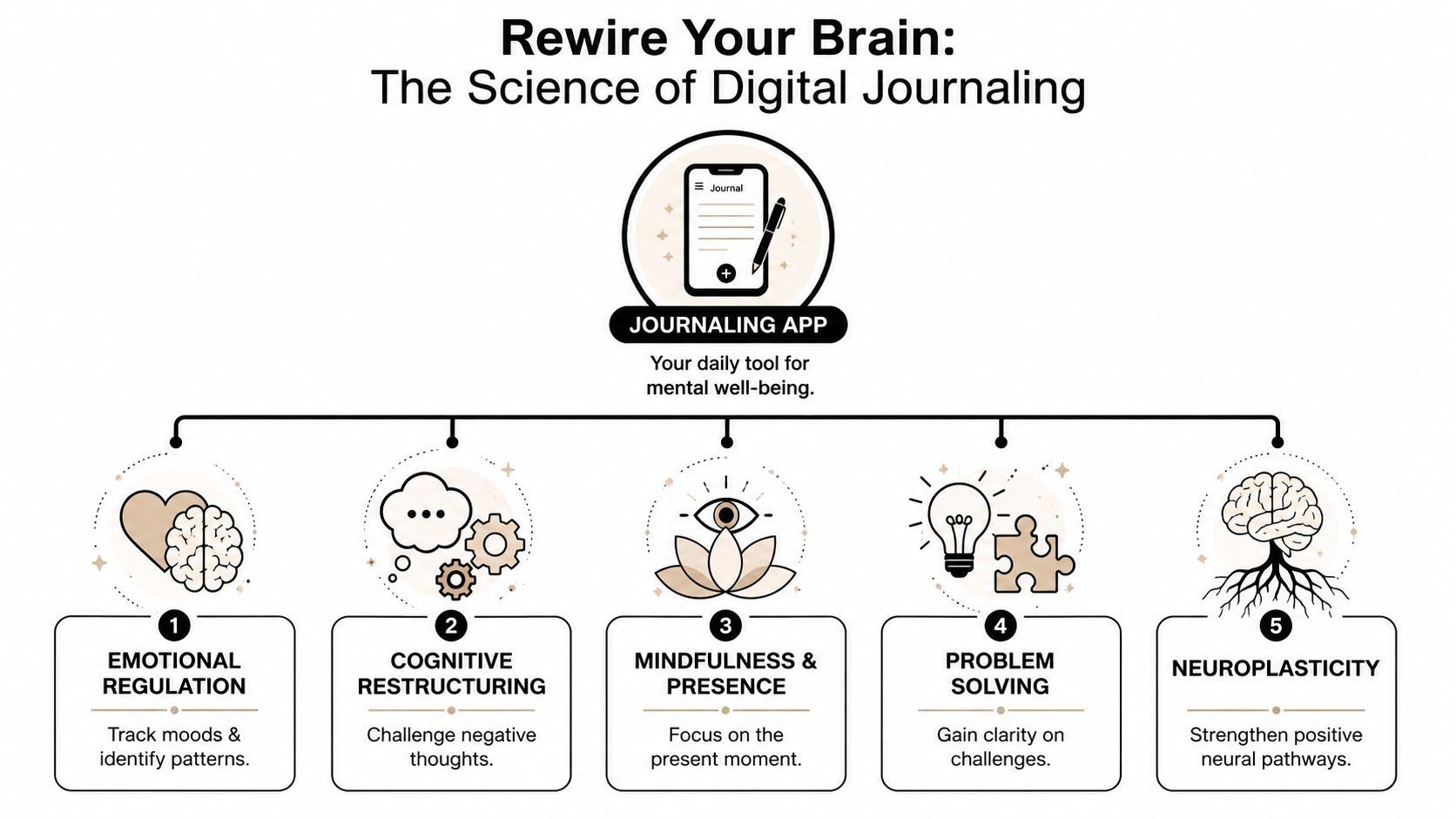
Three mechanisms tend to matter most:
- Externalizing rumination: Writing turns spinning thoughts into visible language.
- Pattern recognition: Mood and trigger tracking reveal repeat cycles.
- Cognitive restructuring: Guided prompts help you question catastrophic thinking.
What changes inside the practice
When journaling apps are designed well, they don't just collect feelings. They teach skills. A blank page is useful for reflection, but anxiety often needs more direction than that. Guided entries can help you spot all-or-nothing thinking, mind reading, fortune telling, and other distortions that make the nervous system stay on alert.
If you need a practical framework for how to challenge anxious thoughts, structured CBT-style questioning is often more helpful than free writing alone. It asks things like: What am I predicting? What evidence supports it? What's another explanation? What would I tell a friend in this situation?
Practical rule: If an entry leaves you more tangled than when you started, add structure. Anxiety usually softens when the writing moves from expression to examination.
Mood tracking adds another layer. Many people say, “I'm anxious all the time,” until they start logging context and notice that anxiety rises after poor sleep, conflict, caffeine, certain places, or unstructured afternoons. Once patterns become visible, they become workable. That's when a journaling app stops feeling like a passive record and starts functioning as a training tool for a safer, steadier brain.
Choosing Your Digital Sanctuary Key Features to Prioritize
Not every journaling app is a good fit for anxiety. Some are beautiful but shallow. Some are clever but overstimulating. Some invite endless reflection without helping you regulate. When you're choosing among journaling apps for mental health, think less about popularity and more about whether the app supports safety, clarity, and repeat use.
What to look for before you trust an app
Start with privacy. You're not just storing grocery lists. You may be writing about panic attacks, trauma triggers, relationship fears, or intrusive thoughts. Read the privacy policy in plain language if you can. Look for whether the app explains how your data is stored, whether entries are encrypted, and whether you can export or delete your data.
Then look at the writing experience itself. An anxiety-friendly app should reduce friction, not add it.
A strong app usually includes:
- Guided prompts: Helpful when your mind goes blank or you feel flooded.
- Mood and trigger logs: Useful for spotting what precedes anxious spikes.
- Fast entry options: Voice notes, quick check-ins, or short templates make consistency easier.
- Grounding support: Some people need immediate regulation before they can reflect.
- Exportable summaries: Important if you want to bring insights into therapy.
A short comparison can help:
| Feature | Why it matters for anxiety | What to avoid |
|---|---|---|
| Privacy controls | Builds trust, encourages honesty | Vague data language |
| CBT prompts | Helps challenge fearful predictions | Endless free-form chat only |
| Mood tracking | Reveals patterns across days | Logs with no insight |
| Crisis tools | Supports you during panic | Apps that assume calm attention |
| Simple interface | Lowers activation and overwhelm | Cluttered dashboards |
What helps in panic and what often doesn't
For acute anxiety, rigid CBT frameworks such as thought records often outperform open-ended AI prompts in reducing cognitive distortions, because people with panic symptoms may otherwise avoid deep processing or circle around the same fear without resolution, as noted in this discussion of structured CBT versus open AI journaling for acute anxiety. That doesn't mean AI features are useless. It means they aren't always the safest first tool when panic is high.
In practice, look for an app that can do two jobs. First, it should help you calm down when your system is activated. Second, it should help you learn from the episode later. If it only does one, it may feel supportive but not move your healing forward.
A good choice often includes guided breathing, grounding, or immediate coping support alongside reflective tools. If you want a practical tool for anxiety, look for that combination of regulation and reflection.
The best app isn't the one with the most features. It's the one you'll still trust enough to open on a hard Tuesday at 11:40 p.m.
Your Daily Practice and In-the-Moment Relief
A journaling app helps most when it becomes part of a rhythm. Anxiety doesn't heal from occasional insight alone. It softens when your nervous system gets repeated experiences of noticing, naming, and recovering. That's why daily practice matters.
Near-term change is possible. One widely shared report states that consistent use of mental health journaling apps can reduce anxiety symptoms by 64% within 30 days for users who engage daily, according to this report on daily journaling app use and anxiety reduction. Even if your progress is slower than that, the larger point still stands: repetition matters.
A short routine that builds resilience
Use your app once a day when you're relatively calm, not only when you're distressed. This teaches your brain that the app is a place for care, not just crisis.
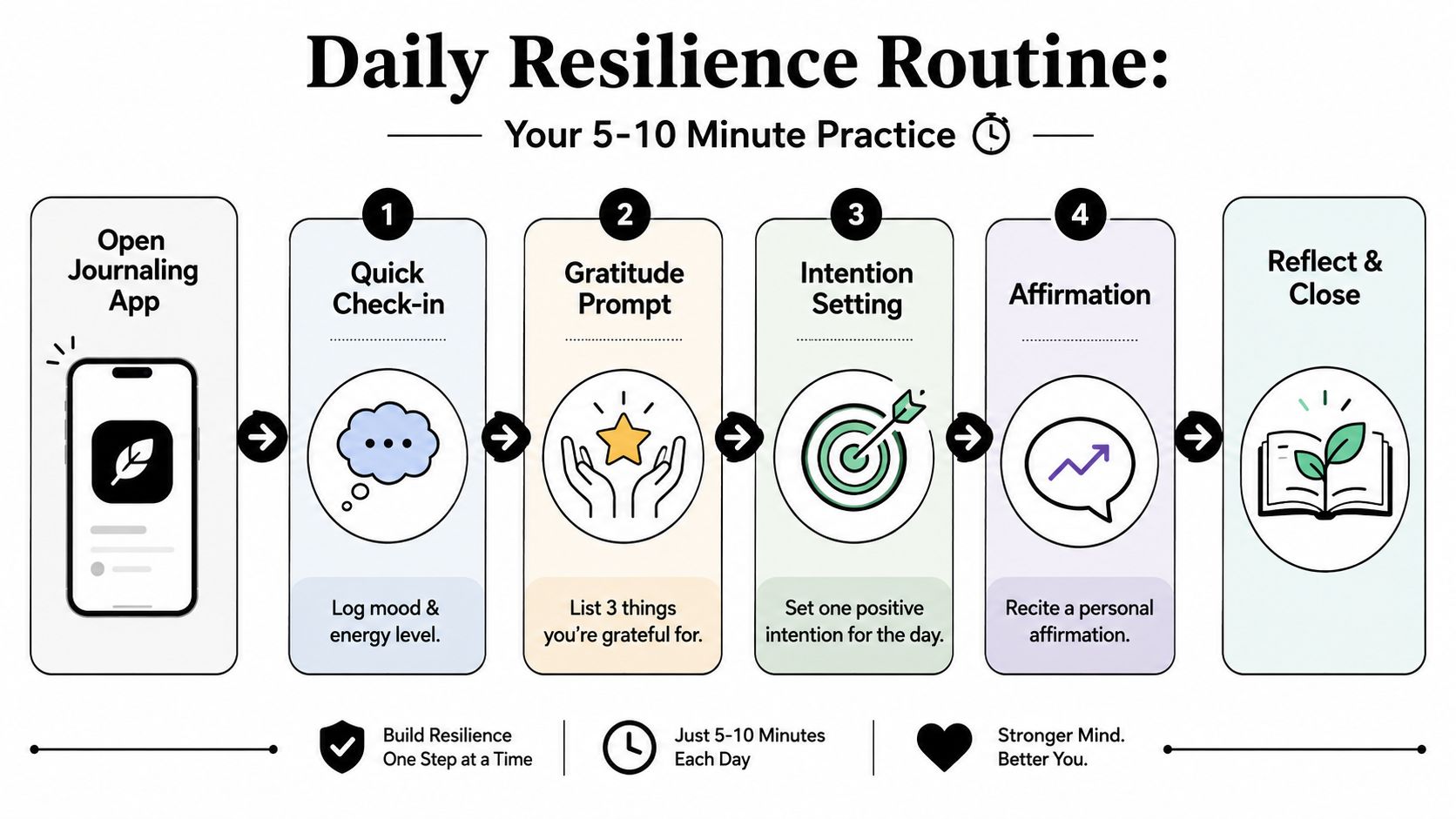
A simple practice can take just a few minutes:
- Open and check in. Rate your mood in a simple way. Name your energy level. Write one sentence about what feels most present today.
- Add one grounding observation. Notice your breath, your feet on the floor, or the temperature in the room. Keep it concrete.
- Use a focused prompt. Try “What is my mind trying to protect me from?” or “What do I need today to feel a little safer?”
- Set one intention. Keep it small. “Pause before I catastrophize.” “Step outside at lunch.” “Answer myself kindly.”
- Close with one stabilizing statement. Something like, “I can feel anxious and still move through my day.”
This video offers a calming companion practice you can pair with your journaling session:
You don't need to write pages. Short entries create continuity. Continuity creates memory. Over time, your journal becomes evidence that anxiety rises, peaks, and passes.
What to do when panic starts rising
Panic needs a different workflow. When your heart is racing and your mind is shouting danger, insight comes second. Regulation comes first.
Try this sequence inside your app or alongside it:
- Stop and orient. Look around and name what's physically present. Chair. Window. Wall. Lamp. Floor.
- Reduce the fear of the fear. Write a single sentence: “This is anxiety, not proof that I'm unsafe.”
- Use your breath on purpose. If you need a guided approach to how to use breathing for anxiety, keep it simple and paced rather than forceful.
- Catch the catastrophic thought. Write the exact prediction. “I'm going to faint.” “I'll lose control.” “This will never end.”
- Answer it briefly. Use one grounded response. “I've felt this before.” “My body is activated.” “This sensation is intense, but temporary.”
- Delay analysis. Do not force a deep journal entry in the peak of panic. Save interpretation for later.
When panic is high, your job is not to solve your whole life. Your job is to lower the alarm enough to think again.
Once the wave passes, return to the app and log what happened. Note the trigger if you know it, the body sensations you noticed, the thought that scared you most, and what helped even a little. Through this practice, healing compounds. You're teaching your brain that episodes can be met with process instead of helplessness.
How to keep the practice gentle and realistic
Many people quit because they make journaling too heavy. They assume every entry should uncover a childhood wound or produce a perfect reframe. That's too much pressure.
Instead, use a light touch:
- On busy days, do a one-line entry. “Anxiety was high after the meeting.”
- On numb days, track body cues instead of feelings. Tight jaw. Restless legs. Shallow breath.
- On better days, record what supported you. Calm moments deserve to be studied too.
Some people also benefit from positive affect journaling. In a study on online Positive Affect Journaling, a structured 12-week method focused on positive experiences and future goals showed a 5% greater reduction in patient health measure scores compared with standard care, and participants experienced reduced anxiety and mental distress after one month plus increased resilience by the second month, according to this Positive Affect Journaling study. That's useful because it reminds us that journaling does not always need to center pain. Sometimes healing comes from training attention toward safety, meaning, and hope.
Making Your Journaling Therapy-Ready
Many people walk into therapy and forget the whole week. They remember that they struggled, but not what triggered the spiral, what thoughts repeated, or what helped. That's one reason journaling can become clinically useful, not just personally comforting.
There's also a real gap here. A review of this issue notes a lack of integration between journaling apps and professional therapy workflows, and it highlights how often people want to make their journaling data “therapy-ready” without giving up privacy, as discussed in this piece on making journaling insights useful in therapy. That's a smart goal.
Share patterns, not your whole diary
You do not need to hand your therapist raw entries unless you want to. In most cases, that isn't even the most helpful move. Therapy works better when you bring patterns, summaries, and examples.
Use your app to tag or mark entries that contain:
- Common triggers: crowds, conflict, driving, health worries, silence, mornings
- Repeated thoughts: “I can't handle this,” “Something is wrong with me,” “I'll panic if I leave”
- Body patterns: chest tightness, nausea, dizziness, derealization
- Helpful responses: breathing, walking, labeling the fear, calling someone, delaying reassurance-seeking
If you want deeper reflective material between sessions, shadow work journaling prompts anxiety can help you identify themes worth discussing without dumping everything into the room at once.
Bring your therapist the map, not every mile of the trip.
A simple therapy summary to bring to session
A therapy-ready summary can fit on one screen or one note. Keep it brief and repeatable.
Try this format before your next appointment:
| What to summarize | Example of what to write |
|---|---|
| Main trigger pattern | “Anxiety rose most after being alone at night.” |
| Dominant thought | “I kept predicting I would lose control.” |
| Body signals | “Racing heart, heat, shaky hands.” |
| What helped | “Grounding and a short thought response lowered the intensity.” |
| What got in the way | “I kept checking my body for signs of danger.” |
| What I want help with | “I need a better plan for early panic symptoms.” |
This changes the quality of therapy. Instead of spending half the session reconstructing what happened, you can work directly on the mechanism. You and your therapist can identify distorted beliefs, refine exposures, strengthen coping responses, or notice progress that anxiety would otherwise hide.
A good journaling app doesn't replace treatment. It can make treatment more accurate.
Staying Safe and Consistent on Your Healing Journey
The most common problem with journaling apps isn't choosing one. It's stopping after a hopeful week. Motivation fades. Notifications blend into the background. Anxiety tells you it isn't helping fast enough, so you abandon the practice just before it starts becoming useful.
That drop-off matters. Meta-analytic data shows mental health apps have a Number Needed to Treat of 12.4 for anxiety, but effectiveness drops when people don't stay engaged, which is why habit-building and sustained use matter so much in this review of engagement and outcomes in mental health apps. In other words, the app can't help much if it becomes another icon you stop opening.
Consistency matters more than intensity
Treat journaling like physical therapy for your nervous system. Gentle repetition beats occasional intensity.
A few ways to make the habit stick:
- Attach it to something you already do. After coffee, after brushing your teeth, after parking the car, before turning off the lamp.
- Lower the bar on hard days. A single honest sentence counts.
- Use prompts that fit your state. Calm-day prompts can be reflective. High-anxiety prompts should be short and grounding.
- Review your entries weekly. Look for one thing that triggered anxiety and one thing that helped.
If you miss several days, don't restart dramatically. Open the app and begin with today. Anxiety loves all-or-nothing rules. Recovery gets stronger when you refuse them.
Privacy checks that are worth doing
Privacy concerns are reasonable. If you're going to write openly, you need to know what you're agreeing to.
Read the app's privacy language with three questions in mind:
- Can I understand what happens to my entries?
- Can I control what is stored, shared, exported, or deleted?
- Would I still feel comfortable writing here if I were discussing my hardest week?
End-to-end encryption matters because it means your writing is protected in transit and storage in a way designed to keep unauthorized people from reading it. Not every app explains this clearly. If the privacy language feels slippery or overly broad, take that discomfort seriously.
Closing reminder: Healing isn't linear, but it is learnable. A shaky week doesn't erase progress. A brief entry still counts. A panic episode met with skill is not a failure. It's practice.
There is a way to live with less fear and more freedom. For many people, journaling apps for mental health become part of that path because they offer something anxiety rarely gives on its own: a pause, a pattern, and a way back to yourself.
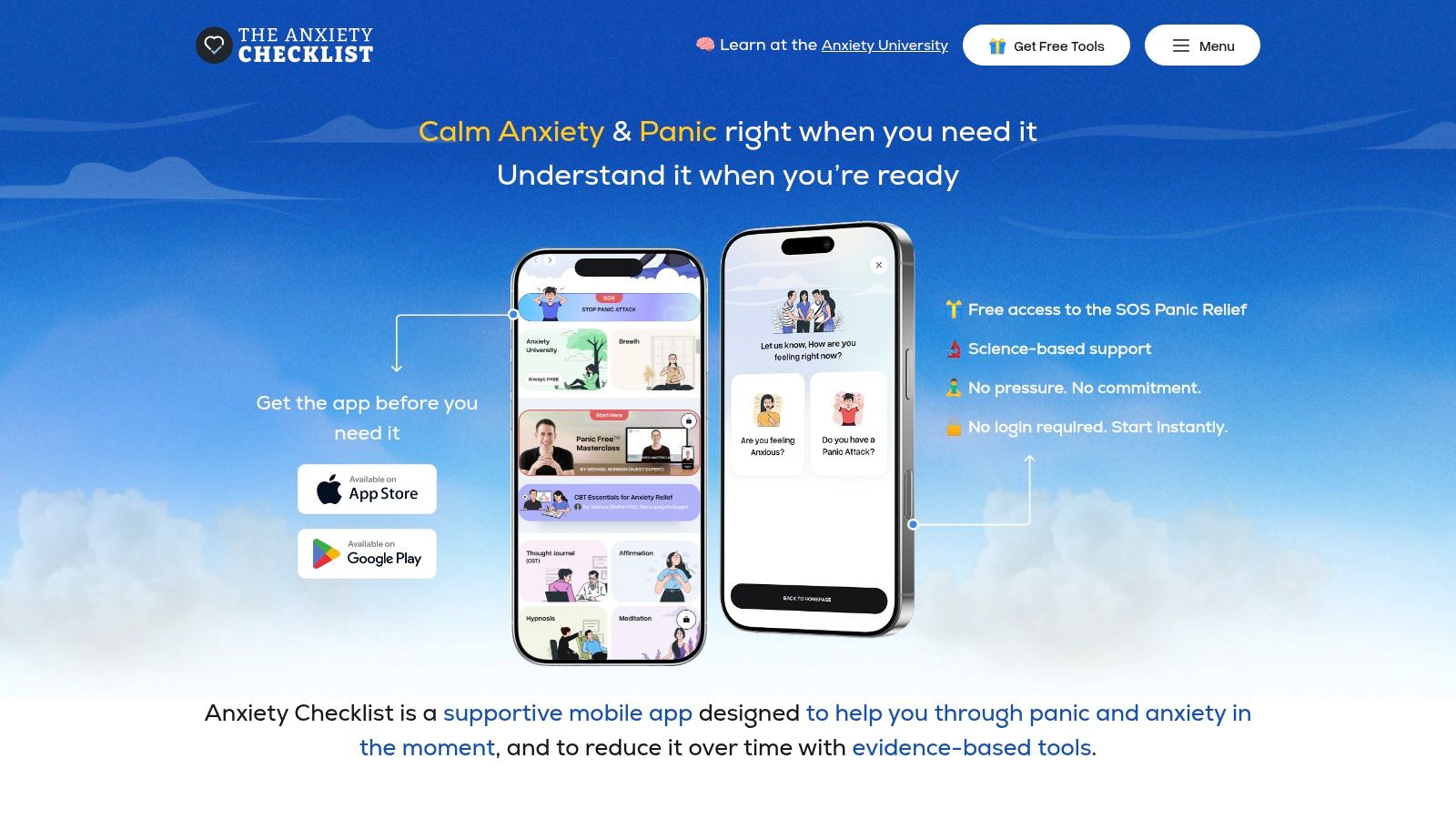
If you want one place to support both daily journaling and in-the-moment panic care, The Anxiety Checklist offers a practical starting point. It can help you calm down during acute anxiety, build a steadier routine over time, and turn self-reflection into usable progress without making the process feel overwhelming.