


You wake up all at once. Your heart is hammering. Your chest feels tight. You're gasping for air and trying to figure out what just happened.
For a few awful seconds, it can feel like something catastrophic is happening inside your body. Many people think heart attack. Others think stroke, seizure, or that they're losing their mind. Then another fear lands just as hard: what if this happens again the moment I fall back asleep?
If this sounds familiar, you're not weak, dramatic, or broken. You may be dealing with the symptoms of nocturnal panic attacks, which can feel especially terrifying because they begin out of sleep, without an obvious warning. The good news is that these episodes are understandable, treatable, and not the end of your peace. Healing from anxiety is possible, and many people do get to a place where sleep feels safe again. If you've also started fearing the panic itself, it may help to learn what is phobophobia, because the fear of fear can keep the cycle going.
Table of Contents
- Waking Up to Fear What Are Nocturnal Panic Attacks
- Recognizing the Symptoms of a Nocturnal Panic Attack
- Is It Panic or Something Else Entirely
- Understanding the Triggers Behind Nighttime Panic
- Your SOS Plan for a Middle-of-the-Night Attack
- The Path to Healing and Reclaiming Your Sleep
Waking Up to Fear What Are Nocturnal Panic Attacks
One common story goes like this. Someone falls asleep exhausted, only to bolt awake an hour or two later with a pounding heart, a wave of terror, and the certainty that something is gravely wrong. The room is familiar, there was no nightmare they can remember, and yet their body is acting like it's in mortal danger.
That experience fits nocturnal panic attacks, which are panic attacks that erupt during sleep and wake you up already in full alarm. They aren't “just bad dreams,” and they aren't a character flaw. They're a real mind-body event where the nervous system hits the panic switch while you're asleep.
Nocturnal panic is also not rare among people with panic disorder. A review in IntechOpen reports that approximately 52.1% of patients with panic disorder experience at least one lifetime nocturnal panic attack and 27.0% experienced at least one in the past month (IntechOpen chapter). That matters because it means your experience has a name, a pattern, and a treatment path.
You are not failing at sleep. Your body is sending a false alarm during sleep.
The symptoms can be so intense that people avoid bedtime, dread the dark, or start scanning their body all day for warning signs. That cycle can make nights feel even more loaded. But the cycle can be interrupted. Once you understand what these attacks are and why they happen, the fear usually starts to loosen its grip.
Recognizing the Symptoms of a Nocturnal Panic Attack
The symptoms of nocturnal panic attacks often feel chaotic in the moment. Breaking them into categories can make the experience less mysterious and less overpowering.
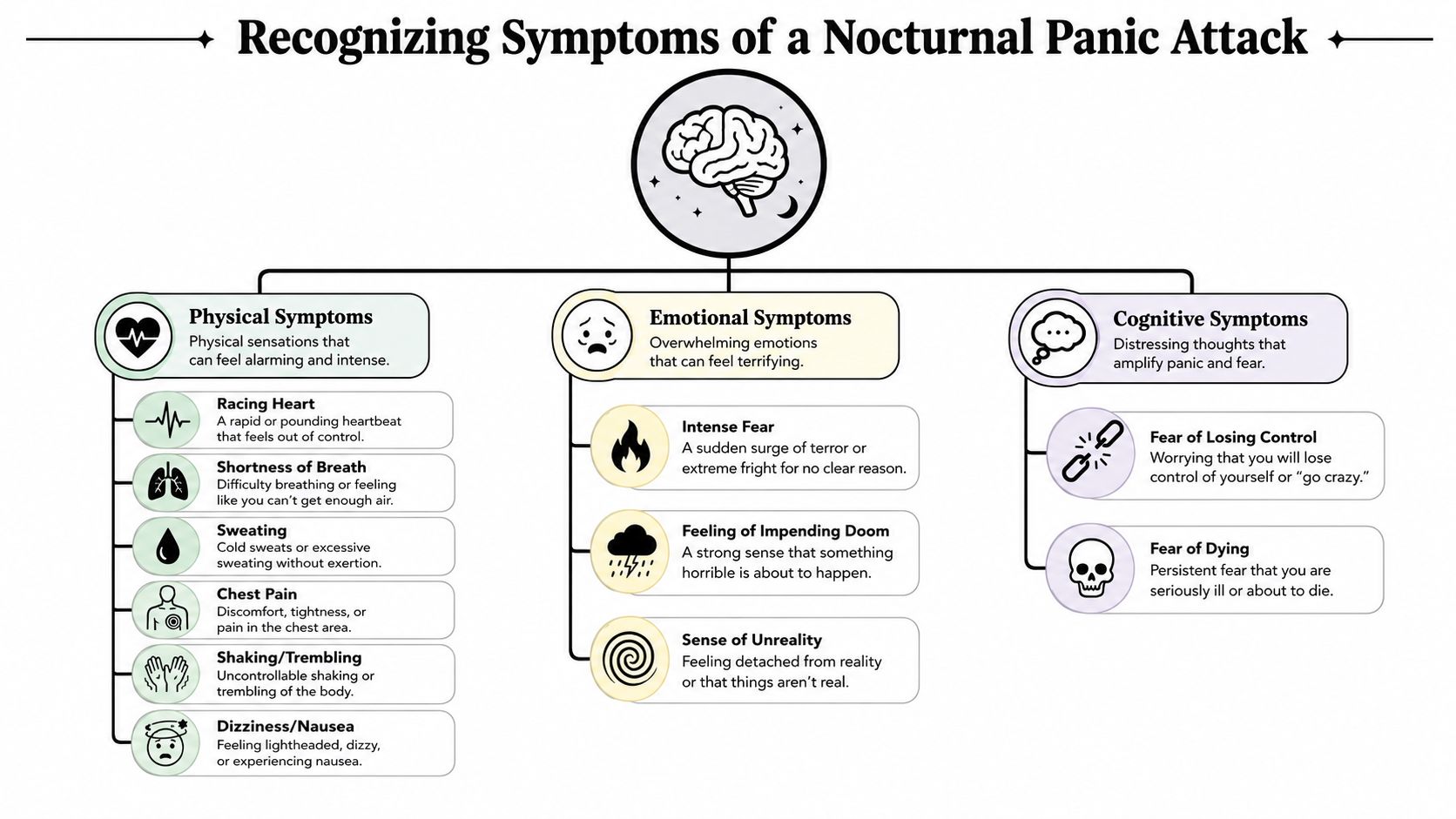
A helpful way to think about it is this: your body launches a full fight or flight response while you're asleep, then your mind wakes up and tries to explain the storm. That's why the symptoms can feel both intensely physical and profoundly psychological.
Physical symptoms your body may scream first
The physical symptoms are usually what frighten people most.
According to Panic Attack Guide, the most prominent symptoms include intense cardiovascular distress, such as a racing heart (tachycardia) or a pounding sensation, alongside respiratory symptoms like shortness of breath or choking. Neurological signs like numbness or tingling (paresthesia) and feelings of derealization are also common, all culminating in an overwhelming fear of dying or losing control.
You might notice:
- Racing heart: It can feel like your heart is pounding so hard it should not be possible.
- Shortness of breath: Many people wake up feeling they can't get enough air, or like their throat is closing.
- Chest pain or tightness: This is one reason nocturnal panic is so often mistaken for a cardiac emergency.
- Sweating: You may wake hot, clammy, or drenched.
- Dizziness or nausea: The body can feel unstable, light, or sick.
- Tingling or numbness: Fingers, toes, lips, or face may tingle.
- Feeling unreal: Some people feel disconnected from themselves or from the room around them.
Clinical guidance from Cleveland Clinic on nocturnal panic attacks also notes that these episodes can include sweating, chest pain, nausea, and paresthesia, and that they often begin abruptly without a preceding dream or nightmare.
Cognitive symptoms that make it feel like disaster
Panic rarely stops at body sensations. Your mind instantly starts making emergency interpretations.
Common thoughts include:
- “I'm dying.”
- “I'm having a heart attack.”
- “I'm going to stop breathing.”
- “I'm losing control.”
- “I'm going crazy.”
These thoughts aren't random. They're the brain trying to make sense of a body that feels under attack. If you also experience a dreamlike or detached feeling during an episode, understanding depersonalization and derealization can help put language around that strange, unreal sensation.
Practical rule: If your mind jumps to the worst-case explanation during an episode, that doesn't prove the fear is true. It shows how convincing panic can feel.
Emotional symptoms that linger after the peak
Even after the strongest physical surge eases, the emotional aftermath can hang on.
People often describe:
- Pure terror: Not mild anxiety. More like a sudden sense of catastrophe.
- Impending doom: A feeling that something awful is about to happen.
- Shame or confusion: “Why did this happen out of nowhere?”
- Fear of returning to sleep: The bed itself can start to feel unsafe.
This is why nocturnal panic can become bigger than the attack alone. The symptoms of nocturnal panic attacks don't just interrupt sleep in the moment. They can train you to fear bedtime itself. That can feed a cycle of sleep avoidance, body scanning, and heightened anxiety the next night.
A useful reframe is simple: the symptoms are real, but the emergency signal is false. When you start recognizing the pattern, the experience often becomes less bewildering and more manageable.
Is It Panic or Something Else Entirely
Uncertainty makes nighttime symptoms worse. If you don't know whether you're dealing with panic, a breathing problem, or another sleep disturbance, your mind will usually choose the scariest explanation.
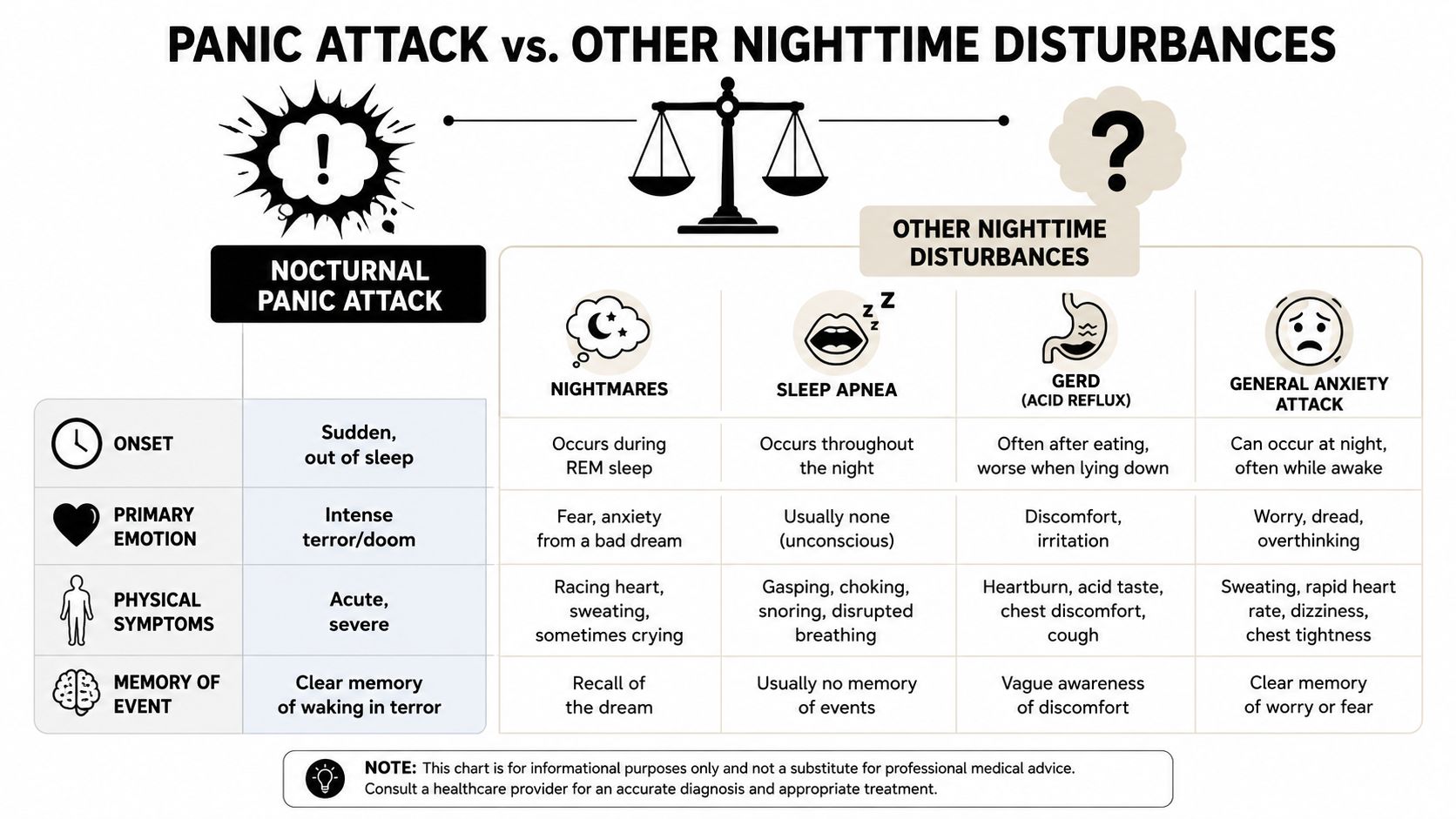
Here's the broad difference. Nocturnal panic usually means you wake up fully aware, intensely frightened, and able to remember the event clearly. Other nighttime problems can look similar from the outside, but they often feel different from the inside.
A quick side by side view
| Condition | Awakening | Memory of Event | Primary Sensation |
|---|---|---|---|
| Nocturnal Panic | Sudden awakening into full alertness | Usually clear memory | Terror, pounding heart, air hunger, doom |
| Night Terrors | Partial arousal from sleep | Often little or no memory | Confusion, agitation, intense arousal |
| Sleep Apnea | Repeated awakenings or gasping | May be limited or fragmented | Breathing interruption, choking, exhaustion |
Nightmares are different too. A nightmare usually comes with a remembered dream story. Nocturnal panic often does not. You wake into fear without a dream explanation.
GERD can also wake people with chest discomfort or a choking feeling, especially when lying down. The key sensation there is often burning, sour taste, or throat irritation rather than a sudden wave of terror.
General anxiety at night can feel like spiraling thoughts while you're awake in bed. Nocturnal panic tends to hit after you've already fallen asleep, which is part of what makes it so disorienting.
Why sleep apnea deserves real attention
One of the biggest points of confusion is sleep apnea. Both sleep apnea and nocturnal panic can involve waking abruptly with a racing heart and gasping. That overlap is more than a minor detail. A therapy review notes a critical diagnostic gap here and reports that 20-30% of adults with panic disorder also have undiagnosed sleep apnea, which is why clinicians often recommend sleep studies, or polysomnograms, to tell the difference (Therapy Group DC on nocturnal panic and sleep apnea).
If you or a partner notice loud snoring, repeated gasping, witnessed breathing pauses, or heavy daytime sleepiness, a sleep evaluation makes sense. For a plain-language overview of airway-related symptoms, this guide on sleep apnea versus snoring is a useful starting point.
If you're not sure what's waking you up, getting medically checked isn't overreacting. It's how you create clarity.
That clarity matters. When people know what they are dealing with, fear usually drops and treatment gets more focused.
Understanding the Triggers Behind Nighttime Panic
Nighttime panic can feel random. It usually isn't. There's a body-based reason it can happen during sleep.
Your brain's alarm system can misfire at night
A simple analogy helps. Think of your brain as having a smoke alarm for danger. During nocturnal panic, that alarm can go off even when there's no fire.
According to Olympic Behavioral Health on nocturnal panic attacks, nocturnal panic attacks are triggered by a spontaneous norepinephrine discharge from the locus coeruleus during non-REM sleep. This activates the sympathetic nervous system and can cause the brain's suffocation alarm to misinterpret normal CO2 fluctuations as a threat, a phenomenon known as CO2 hypersensitivity.
In plain English, your sleeping brain may briefly misread normal changes in breathing chemistry as a sign that you're not getting enough air. Then the body reacts fast. Heart pounds. Breath changes. Muscles tense. You wake up in a state of alarm.
That helps explain why breathing symptoms can feel so central at night. It's not “all in your head” in the dismissive sense. It's a real body alarm, just a false one.
Why this matters for recovery
When people don't understand this, they often blame themselves. They think they're too stressed, too sensitive, or somehow causing the whole thing through weakness. That self-blame usually makes recovery harder.
A better frame is this: your nervous system is overprotecting you. It's acting like a smoke detector that's too sensitive to steam. Once you know that, your job shifts from fighting your body to retraining it.
If you want help identifying patterns that make your nervous system more reactive overall, The Anxiety Checklist guide on triggers can help you spot what may be priming your system before bed.
Understanding the why doesn't instantly stop an episode. But it often removes one of the worst parts, the belief that the attack means something terrible and mysterious is happening to you.
Your SOS Plan for a Middle-of-the-Night Attack
When a nocturnal panic attack hits, you don't need a perfect performance. You need a short plan that works even when your thinking brain is barely online.
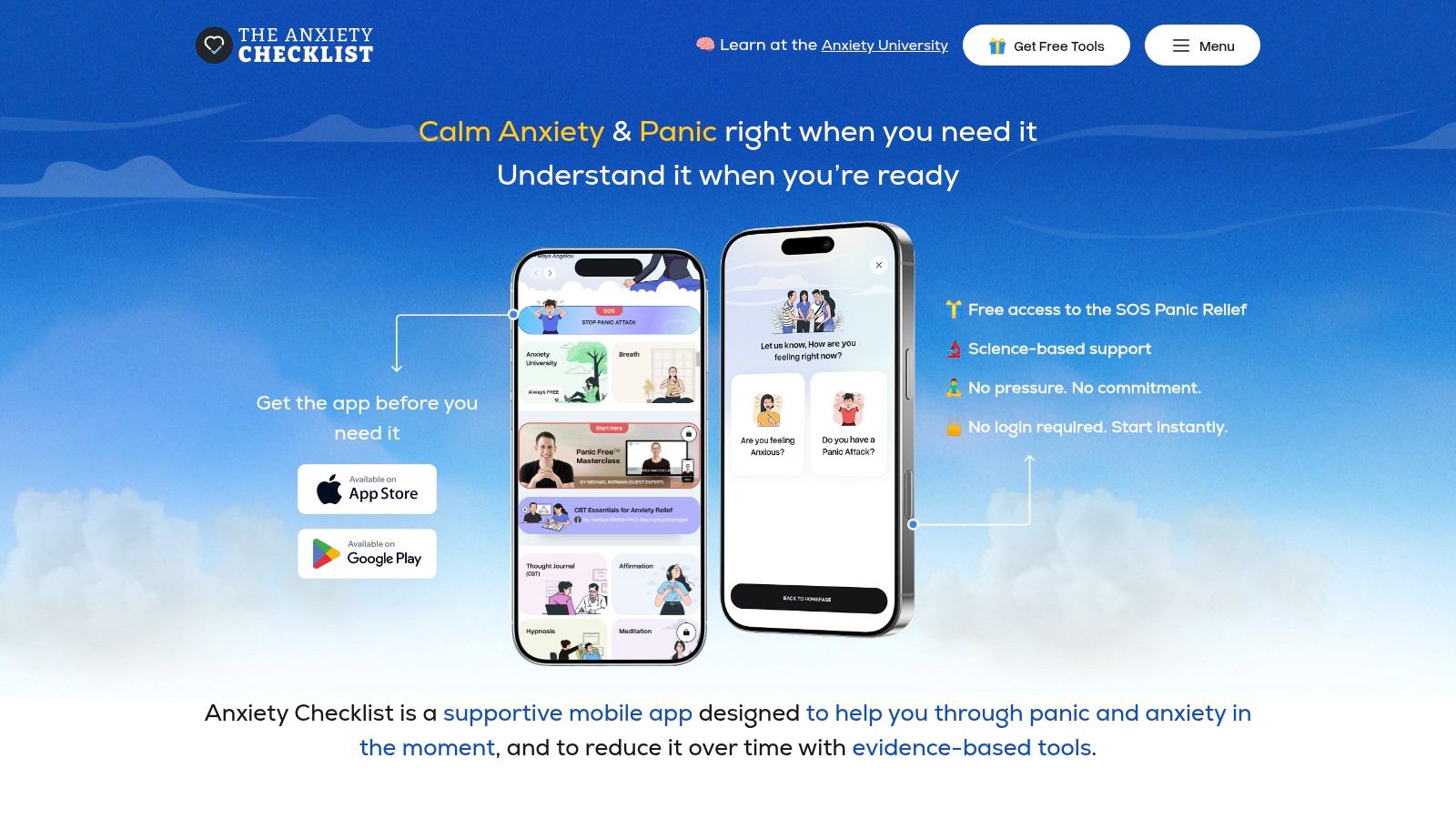
A small visual reminder can help if you keep your phone nearby for emergencies only.
What to do in the first minute
Name it clearly
Say, either out loud or in your head, “This is panic. It feels dangerous, but it will pass.” The goal is not to convince yourself with logic. The goal is to interrupt the “unknown emergency” spiral.Sit up and orient to the room
Put both feet on the floor if you can. Look for simple, neutral details. The lamp. The curtain. The edge of the dresser. This tells your brain you are awake and located in a safe place.Lengthen the exhale
Don't force giant breaths. That often makes things worse. Try a softer pattern, such as a gentle inhale and a longer, slower exhale. The long exhale helps signal that the immediate threat has passed.Use grounding
Touch the blanket. Feel the cool air. Name five things you can see, four you can feel, three you can hear. If you need a guided version when your mind goes blank, The Anxiety Checklist's grounding strategies offer concrete prompts you can follow.
“My body is having a false alarm. I don't have to solve my whole life at 2 a.m.”
How to settle your body enough to return to bed
After the first surge, the next challenge is usually the aftershock. Your body may still feel shaky, and your mind may be demanding certainty before sleep.
Try this sequence:
- Keep the light low: Bright light can fully wake your system.
- Skip checking symptoms repeatedly: Pulse-checking, searching symptoms, or scanning your chest can feed the panic loop.
- Use one calming phrase: Pick one sentence and repeat it. “This will pass.” “I am safe in this moment.” “My nervous system is settling.”
- Allow some leftover adrenaline: You do not have to feel perfectly calm before lying back down. Aim for “safe enough,” not “completely peaceful.”
If it helps to follow a paced exercise, use this after your breathing has softened a bit:
One more important point. If your symptoms are new, unusual, or you think you may be having a medical emergency, seek urgent medical care. Reassurance techniques are for recognized panic patterns, not for talking yourself out of needed evaluation.
The win in the middle of the night is not making the attack vanish on command. The win is reducing fear, shortening the spiral, and teaching your body that you can ride the wave without collapsing under it.
The Path to Healing and Reclaiming Your Sleep
Nocturnal panic can make nights feel cursed. They're not. Panic is treatable, and peaceful sleep can come back.
Treatment works and hope is realistic
This is one of the most important facts to hold onto. Approximately 52.1% of patients with panic disorder experience at least one lifetime nocturnal panic attack, and most individuals achieve significant symptom reduction or complete resolution with appropriate, evidence-based clinical care (IntechOpen chapter on nocturnal panic).
That means two things are true at once. First, this problem is common enough to be well recognized. Second, it is not something you are doomed to live with forever.
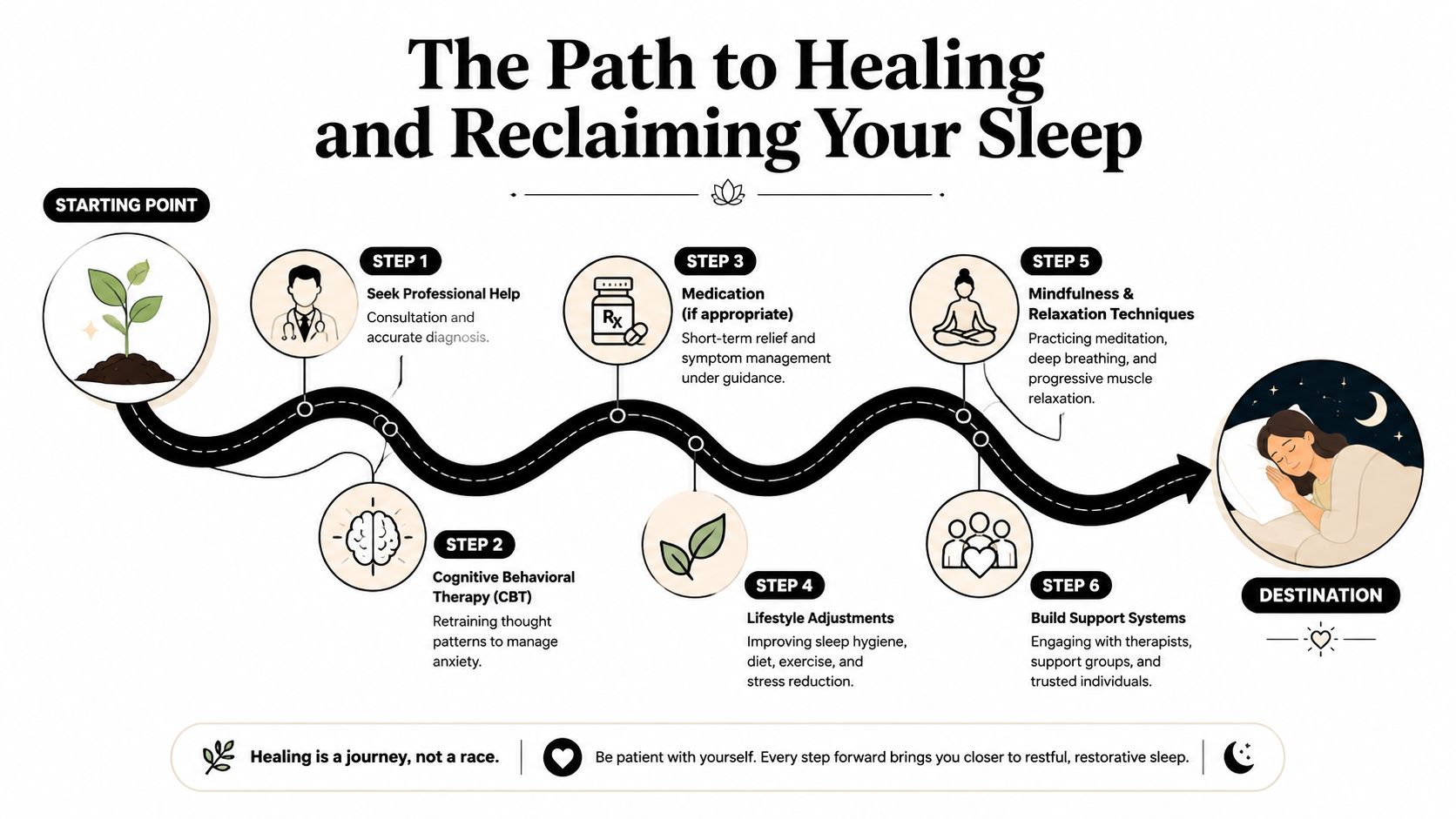
For many people, Cognitive Behavioral Therapy (CBT) is a core treatment. CBT helps you identify the thoughts, body interpretations, and avoidance patterns that keep panic alive. If your brain has learned to label a pounding heart or short breath as “danger,” CBT helps retrain that link.
A therapist may also help with:
- Interoceptive work: Learning not to fear physical sensations that resemble panic
- Sleep-related anxiety: Reducing bedtime dread and the urge to avoid sleep
- Behavior changes: Stepping out of safety habits that keep the cycle going
Medication may also be part of care for some people, under guidance from a licensed medical professional. The point is not that everyone needs the same plan. The point is that there are real options.
Daily habits that support deeper recovery
Recovery is often built during the day, not only at 2 a.m.
A steadier nervous system tends to come from repeated signals of safety. That can include:
- Consistent sleep timing: Going to bed and waking up on a regular schedule helps reduce physiological unpredictability.
- A gentler pre-sleep routine: Lower stimulation before bed. Less doom-scrolling. Less last-minute stress loading.
- Practice while calm: Breathing, grounding, muscle relaxation, and mental reframing work better at night when you've practiced them in daylight.
- Reduced body surveillance: The less you monitor every heartbeat and breath, the less fuel panic has.
- Supportive education: Learning how panic works can take away much of its mystery.
Recovery usually starts when you stop asking, “How do I make sure this never happens again tonight?” and begin asking, “How do I teach my body that nighttime is safe?”
This shift matters. Chasing absolute certainty often strengthens panic. Building tolerance, skill, and trust weakens it.
If you want a structured framework for that process, Anxiety Recovery Steps offers a practical roadmap for moving from crisis management to long-term change.
When to talk with a clinician
You do not have to wait until sleep is completely wrecked to reach out.
Consider professional help if:
- Bedtime is becoming scary: You dread sleep, stay up late to avoid it, or keep checking whether panic is coming.
- Daytime anxiety is growing: The attacks are affecting concentration, work, parenting, or relationships.
- You're unsure what you're experiencing: A clinician can help rule out medical or sleep-related causes.
- You need a plan beyond coping: SOS tools are important, but long-term healing often needs a fuller strategy.
It can help to bring notes to an appointment. Write down what happens when you wake, what symptoms show up first, whether there is snoring or gasping, and how long it takes to settle. Clear observations help a clinician sort through panic, sleep issues, and other possibilities.
Family members can help too. A calm partner who understands that the episode is terrifying but temporary can reduce shame and panic after the fact. Support does not mean trying to argue someone out of fear in the moment. It means staying steady, helping them orient, and encouraging proper evaluation when needed.
The deepest hope here is simple. You can heal from anxiety. You can teach your body that sleep is not a trap. You can stop living at the mercy of panic. Many people do, step by step, with the right support and repeated practice.
The middle of the night can feel very lonely when panic hits. The Anxiety Checklist offers support for both moments of crisis and the longer work of recovery, including an always-free SOS mode, grounding prompts, sleep audios, guided meditations, hypnosis sessions, and CBT-based tools to help you calm panic and retrain your nervous system over time. If you want practical help that meets you where you are, it's a gentle place to start.