

A brief transdiagnostic Coping Skills Workshop gave people something many anxious clients doubt is possible. Rapid relief. In a randomized study, GAD-7 anxiety scores dropped by 45%, PHQ-9 depression scores fell by 20%, and wellbeing improved by 17% immediately after treatment in the workshop group, using standardized clinical scales and a 6-week format with 68 participants overall (International Journal of Psychology & Psychological Therapy study on transdiagnostic coping skills workshop).
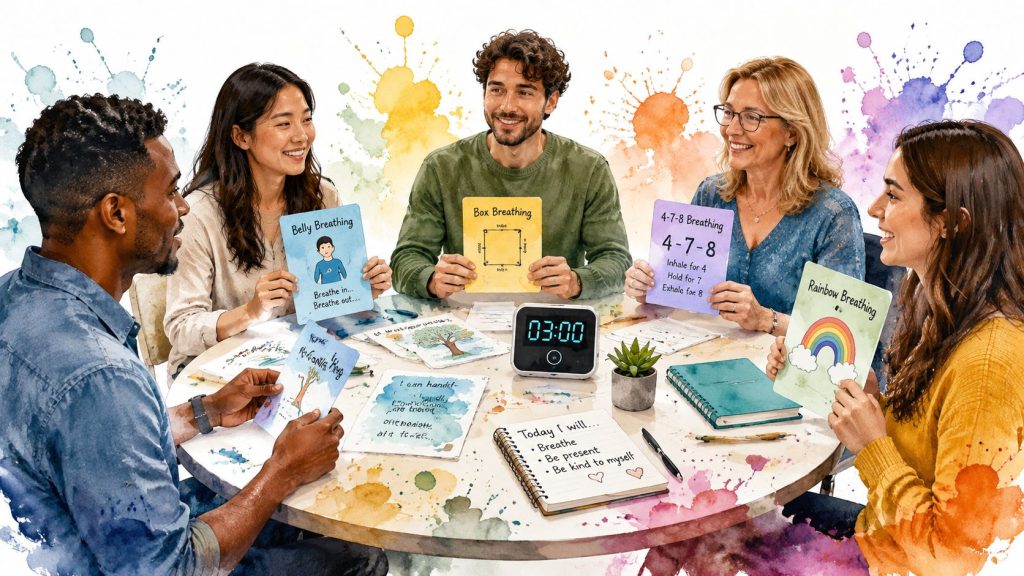
That matters because anxiety often convinces people they're stuck. They aren't. A well-run coping skills group activity can interrupt panic, teach repeatable tools, and give members the lived experience of settling their nervous system in front of other people who understand.
Group work also does something individual worksheets can't always do on their own. It normalizes symptoms. People hear someone else describe the same racing chest, tunnel vision, or fear of losing control, and shame starts to loosen. Hope returns faster when nobody has to heal alone.
Why Group Coping Transforms Anxiety into Hope. Group activities not only teach coping skills, they foster connection, normalize experiences, and ignite hope that panic can be overcome together. Below are 8 proven exercises to guide your group toward relief and resilience.
Table of Contents
- 1. Grounding Technique Circle (5-4-3-2-1 Sensory Method)
- 2. Breathing Pattern Synchronization Group
- 3. Cognitive Reframing Workshop and Thought Journaling Circles
- 4. Progressive Muscle Relaxation (PMR) Group Sessions
- 5. Exposure Hierarchy Group Practice and Behavioral Challenges
- 6. Mindfulness and Acceptance-Based Group Meditation
- 7. Peer Support and Accountability Partner Circles
- 8. Creative Expression and Art Therapy Group Activities
- Group Coping Skills: 8-Method Comparison
- Your Next Steps to Panic-Free Living
1. Grounding Technique Circle (5-4-3-2-1 Sensory Method)

When panic rises fast, this is one of the safest first-line group exercises to teach. Members name 5 things they can see, 4 they can touch, 3 they can hear, 2 they can smell, and 1 they can taste. The sequence is simple enough to remember under stress and concrete enough to pull attention away from catastrophic body scanning.
I've found this coping skills group activity works best when the facilitator reduces performance pressure. Don't ask for deep feelings first. Ask for observable details: “blue chair,” “cool floor,” “air vent hum.” People regulate faster when they don't have to be eloquent.
For clinicians who want members to practice between sessions, these practical tools for anxiety grounding pair well with printed sensory prompts or a phone-based SOS screen.
Set up the room for fast access
A grounding circle runs better when the room supports it. Mental health crisis centers often keep sensory objects in waiting areas for exactly this reason. You can borrow that logic in outpatient, school, hospital, or workplace groups.
- Place objects within reach: textured fabric, a smooth stone, mint gum, herbal scent cards, and a visual focal point help members engage senses quickly.
- Start with the easiest sense available: if the room is noisy, begin with sound. If members are visually overloaded, start with touch.
- Invite brief sharing aloud: hearing others say “I hear the heater” or “I feel my shoes” reinforces orientation and reduces the sense of isolation.
Practical rule: If someone is escalating, move from insight questions to sensory questions.
How to run it when someone starts to spike
Many resources fall short. They explain the exercise but not the in-the-moment adaptation. A future-dated 2026 teen group therapy resource highlights grounding stations for the five senses and points out the importance of safety planning when distress rises during activities (ICANotes teen group therapy activities article).
If a member starts spiraling mid-group, lower the verbal load. Sit beside, not over. Offer two choices instead of open-ended questions: “Would you rather hold the cold pack or press your feet into the floor?” Then return them to the circle only if they want to.
For trauma-informed groups, I also like ending with one round of shoulder drop, jaw release, and a brief quiet pause. Grounding interrupts the surge. The follow-through helps the body believe the danger has passed. For a deeper clinical overview, this Pennsylvania guide to PTSD grounding is a useful companion.
2. Breathing Pattern Synchronization Group
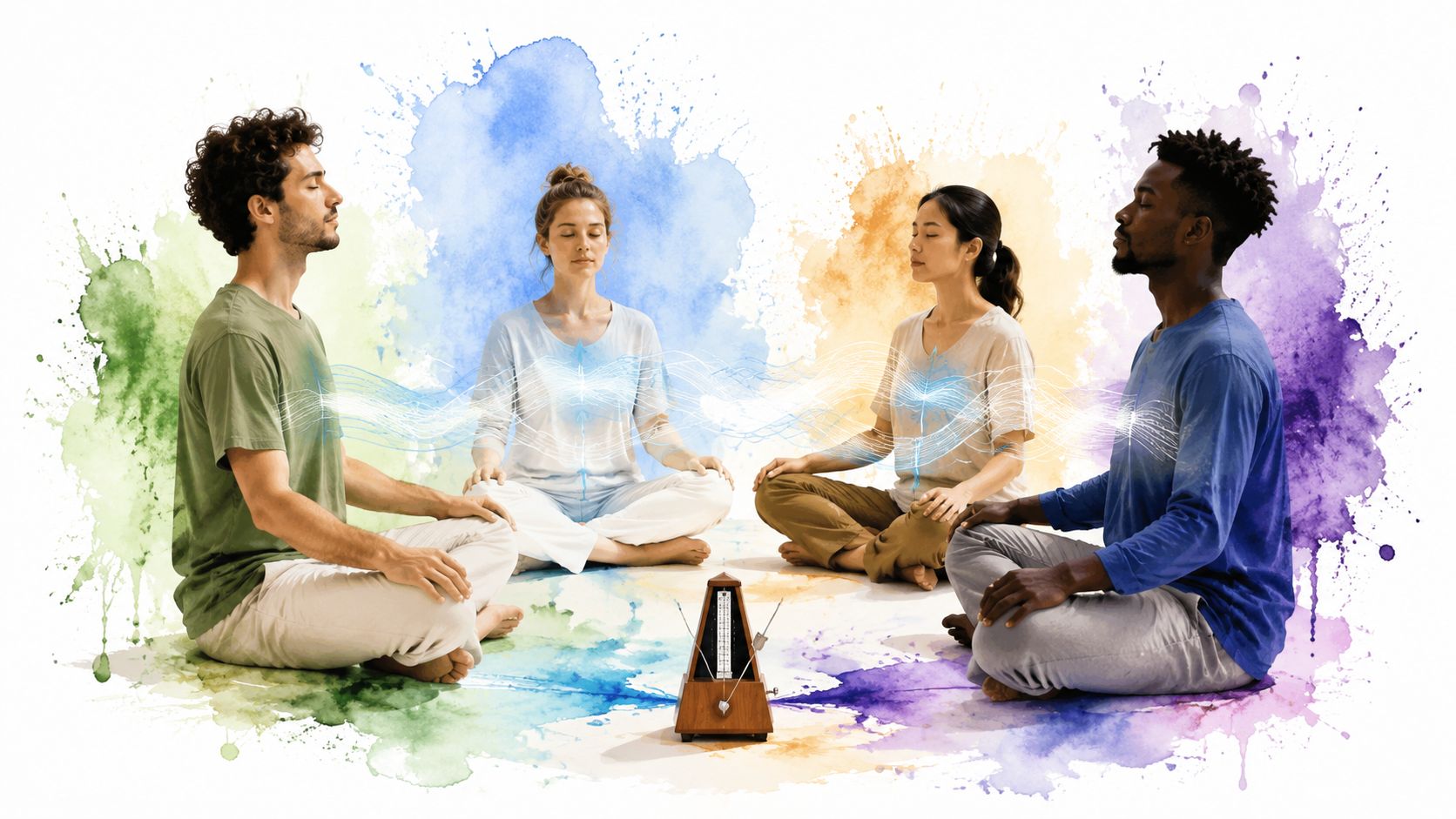
Breathing groups work because rhythm is regulating. When several people breathe together with a slow, steady pace, the room changes. Shoulders drop. Speech slows. People stop bracing for the next wave.
Keep the format plain. A longer exhale than inhale is usually easier for anxious groups than breath retention. I prefer seated posture, feet on the floor, one hand on chest or thigh, eyes open or softened. That last part matters. Asking every member to close their eyes can increase distress for trauma survivors.
Keep the breath simple
Use one rhythm for the whole round. Don't stack too many options. If you shift methods every minute, anxious members start wondering whether they're doing it wrong.
A strong sequence looks like this:
- Cue posture first: “Let the chair hold you.”
- Count out loud: a facilitator voice or a soft metronome keeps everyone together.
- Coach the exhale gently: “Let the out-breath be unforced and a little longer.”
- Stop before strain: if dizziness appears, return to natural breathing immediately.
This breathing techniques for anxiety relief guide works well as a between-session handout because members often forget pacing once panic starts.
Add a digital SOS bridge
Breathwork is most useful when members know when to use it outside group. Tie the exercise to early warning signs, not full panic only. A college counseling center might run synchronized breathing before exam season. An emergency department nurse might teach a shorter version to patients with acute anxiety. A workplace group might use two minutes before presentations.
Online coping skills training has also shown that digital, skill-focused interventions can significantly reduce stress and anxiety while increasing adaptive coping skills in young people compared with control groups (PubMed record for online coping skills training in young people). That's why I like pairing group breath practice with a simple phone prompt that says: “Name the first sign. Drop shoulders. Exhale longer than you inhale. Repeat for one minute.”
Slow breathing helps most when people start early. It's harder to access once they're already fighting the panic.
3. Cognitive Reframing Workshop and Thought Journaling Circles
Anxiety talks fast and sounds convincing. Cognitive reframing slows that process down and forces the thought into daylight. In group, one member might say, “If my heart races in the meeting, everyone will know I'm falling apart.” The facilitator writes it down. Then the group tests it, not by arguing, but by examining evidence.
That structure matters. Without it, the session turns into reassurance. Reassurance feels good for a minute and then fades. Reframing lasts longer because it teaches people how to answer panic thinking on their own.
For members who ruminate between sessions, structured journaling paired with coping with overthinking and anxiety gives them a bridge from the room to real life.
Use a shared structure, not free-for-all advice
I like a three-column format on paper or whiteboard:
- Triggering situation
- Anxious thought
- Balanced response
Reference Dr. Albert Ellis's ABC model when you want members to see that beliefs shape emotional and behavioral consequences. Reference Dr. David Clark's anxiety cycles when you want them to notice how misinterpreting sensations keeps fear alive. A hospital CBT group might begin with low-stakes worries such as sending an email. A university group might practice on fears about classroom participation before moving into deeper core beliefs.
What works and what backfires
A useful group reframe sounds like this: “My heart racing means my body is alarmed, not that I'm in danger.” An unhelpful one sounds like this: “Nothing bad will happen.” The second statement is too absolute. Anxious minds reject it.
The most effective coping skills groups also lean into skill practice, problem-solving, role-play, and psychoeducation rather than emotional expression alone. A review of coping skills group activities found that sessions focused on education, skill training, problem-solving, and role-playing involved those elements more strongly than interactional groups, and high focus on skill acquisition was linked with fewer later drinking-related problems in the relevant population (review on coping skills group activities and dose-response patterns).
That finding matches what many facilitators see in practice. Insight helps. Repetition changes behavior. If you want participants to leave with tools they can use during a panic surge, make them write the balanced thought, say it aloud, and rehearse when to deploy it.
If members need local therapy support beyond the group, this guide can help them find cognitive behavioral therapy in Vancouver.
4. Progressive Muscle Relaxation (PMR) Group Sessions
Anxiety often lives in the body before people can describe it in words. Jaw clenching, fist tightening, shallow chest breathing, curled toes. PMR gives members direct evidence that tension can rise and fall. That alone can be hopeful for people who feel trapped inside their physical symptoms.
This coping skills group activity works especially well with members who say, “I don't even notice I'm tense until I'm exhausted.” The contrast between contraction and release builds body awareness quickly.
Lead with consent and body awareness
Don't force a full-body sequence on every group. Some trauma survivors and chronic pain patients do better with a shortened version that starts with hands, forearms, and shoulders only. Give permission to skip any muscle group, reduce intensity, or visualize release rather than tighten.
A practical setup usually includes dimmer lighting, neutral music or white noise, and a script that uses plain language. Avoid telling members to “relax” repeatedly. It can sound like a command and increase pressure.
Some participants relax better when they keep their eyes open and focus on one fixed point. That's not resistance. That's good self-regulation.
A short PMR script that fits real groups
Lead members to tense one area gently, hold briefly, then release and notice the shift. Move from upper body to lower body if time allows. In a sleep-focused group, you might pair PMR with slower breathing at the end. In a physical therapy or pain management setting, you might emphasize the distinction between protective tension and intentional release.
There's also broader evidence that coping skills training can transfer beyond anxiety alone. In a clinical population of kidney failure patients, group coping skills training reduced pain perception and increased cognitive flexibility with a statistically significant result of P = 0.001 (study on coping self-efficacy and coping skills training outcomes). That's useful when you're working with members whose anxiety is tangled with pain, medical stress, or physical rigidity.
Record the PMR once if you can. Members are much more likely to practice when they have your same sequence available at home.
5. Exposure Hierarchy Group Practice and Behavioral Challenges
Avoidance is one of anxiety's favorite maintenance strategies. It offers short-term relief and long-term imprisonment. Exposure groups reverse that pattern by helping members approach feared situations gradually, predictably, and with support.
A solid exposure hierarchy might start with making eye contact, asking a store employee a question, or sitting near the exit without leaving. For social anxiety, members can practice short introductions, imperfect speaking, or asking a stranger for the time. For panic disorder, the challenge might involve entering places associated with previous attacks and staying long enough to learn that panic can crest and pass.
For people working on social fears specifically, this guide on how to overcome social anxiety can reinforce between-session steps.
Build the ladder carefully
Don't jump to the hardest item because the group feels motivated. Too much intensity too soon teaches failure, not flexibility. I usually want each member to identify a manageable step, define what staying means, and name the feared prediction in advance.
Useful prompts include:
- Name the trigger clearly: “Speak once in the meeting.”
- Rate distress before starting: use SUDS from 0 to 100.
- State the feared outcome: “They'll think I'm awkward.”
- Stay until learning happens: not until comfort is perfect, but until the urge to escape drops enough to gather new information.
The review literature also found a dose-response pattern in adolescent coping interventions, where attending at least four sessions was associated with measurable reductions in performance anxiety and fear of failure (dose-response evidence for coping skills attendance and outcomes). Exposure especially needs repetition. One brave moment helps. Repeated practice rewires expectation.
A short demonstration can help members visualize the process:
Group exposures need structure
Use observers well. While one member practices, others can track prediction versus outcome, note safety behaviors, and offer concise feedback. Don't let the room flood the person with reassurance. Better questions are, “What did you notice?” and “What happened that your anxiety didn't predict?”
Agoraphobia groups often benefit from real-world walkouts. Social anxiety groups do well with brief in-room challenges before outside practice. OCD-related groups need precision so the task targets compulsions rather than becoming another ritual. When exposure is paced well, members stop waiting to feel fearless first. They learn that healing often starts while still afraid.
6. Mindfulness and Acceptance-Based Group Meditation
Some anxious clients use coping skills as another form of control. They breathe in order to force symptoms away. They ground in order to guarantee calm. They meditate while secretly checking whether the panic is gone yet. Acceptance-based work changes that relationship.
In these groups, the instruction is simple but demanding. Notice the thought. Notice the sensation. Let it be there without adding a second layer of alarm. That's very different from passivity. It's an active choice to stop wrestling every internal cue.
Teach observation, not suppression
A useful script sounds like: “Notice the thought, ‘I can't handle this,’ and label it as a thought.” Or, “Notice tightness in the chest and make room around it.” ACT and mindfulness-based approaches work best when members learn that they can experience anxiety without obeying it.
This style also fits digital follow-up well. Guided audio in an app can support the transition from group practice to home repetition, especially for members who freeze when they try to meditate alone.
When mindfulness needs modification
Not everyone should start with silent sitting. Some people become more distressed when attention turns inward too quickly. For them, use shorter intervals, open eyes, walking meditation, or body scan with frequent orienting to the room.
Intensive outpatient coping skills training has been shown to reduce anxiety and depression symptoms, with therapeutic gains maintained at least 30 days after treatment completion (Military Medicine article on coping skills training outcomes). That's encouraging because acceptance work often feels subtle at first. People may not notice a dramatic shift in one session, but steady practice can build durable change.
I tell groups this often: the win isn't “I never felt panic.” The win is “Panic showed up, and I didn't have to disappear with it.”
7. Peer Support and Accountability Partner Circles
Healing speeds up when someone remembers your goal with you. Accountability partner circles take the energy of group connection and turn it into between-session follow-through. Each member pairs up or joins a small pod, shares one target behavior, and checks in on progress, obstacles, and what they'll try next.
This is one of the most practical formats for groups that struggle with homework adherence. Members often won't complete a worksheet for a clipboard. They will do it because another person in the group will ask how it went.
Turn support into follow-through
The pairings matter. Match members by presentation, pace, and reliability more than by personality. Two highly avoidant members can drift. Two people with very different goals may stay polite but never become useful supports.
Keep the check-in template narrow:
- What anxiety moment came up this week
- Which skill you tried
- What got in the way
- What you'll practice before the next session
Existing group materials often tell people to create situation-based coping plans, but many stop short of showing how to maintain use outside the room. A future-dated 2026 analysis on small-group coping content argues there's a knowledge-to-action gap and notes that many teens forget group-taught coping skills within two weeks without structured individualized follow-up (Counselor Chelsey coping skills small group article). Even when your population isn't teens, the principle holds. Skills fade if there's no cue, no rehearsal, and no personal plan.
How to prevent dependency
Accountability isn't rescue. That boundary needs to be explicit. Partners shouldn't become on-call crisis managers for each other. Set rules about contact frequency, privacy, missed messages, and when to use professional or emergency support instead.
A self-help lens is useful here too. For adults with social anxiety disorder, self-help interventions with support were more cost-effective than group CBT, with an 81% probability at zero willingness to pay and 89% at a willingness to pay of $3,000 per extra person responding (NCBI Bookshelf analysis of cost-effectiveness in social anxiety interventions). That doesn't mean group therapy loses value. It means supported, scalable follow-up matters. Partner circles and app-based reminders can extend the impact of a good group without requiring everyone to add more formal sessions.
8. Creative Expression and Art Therapy Group Activities
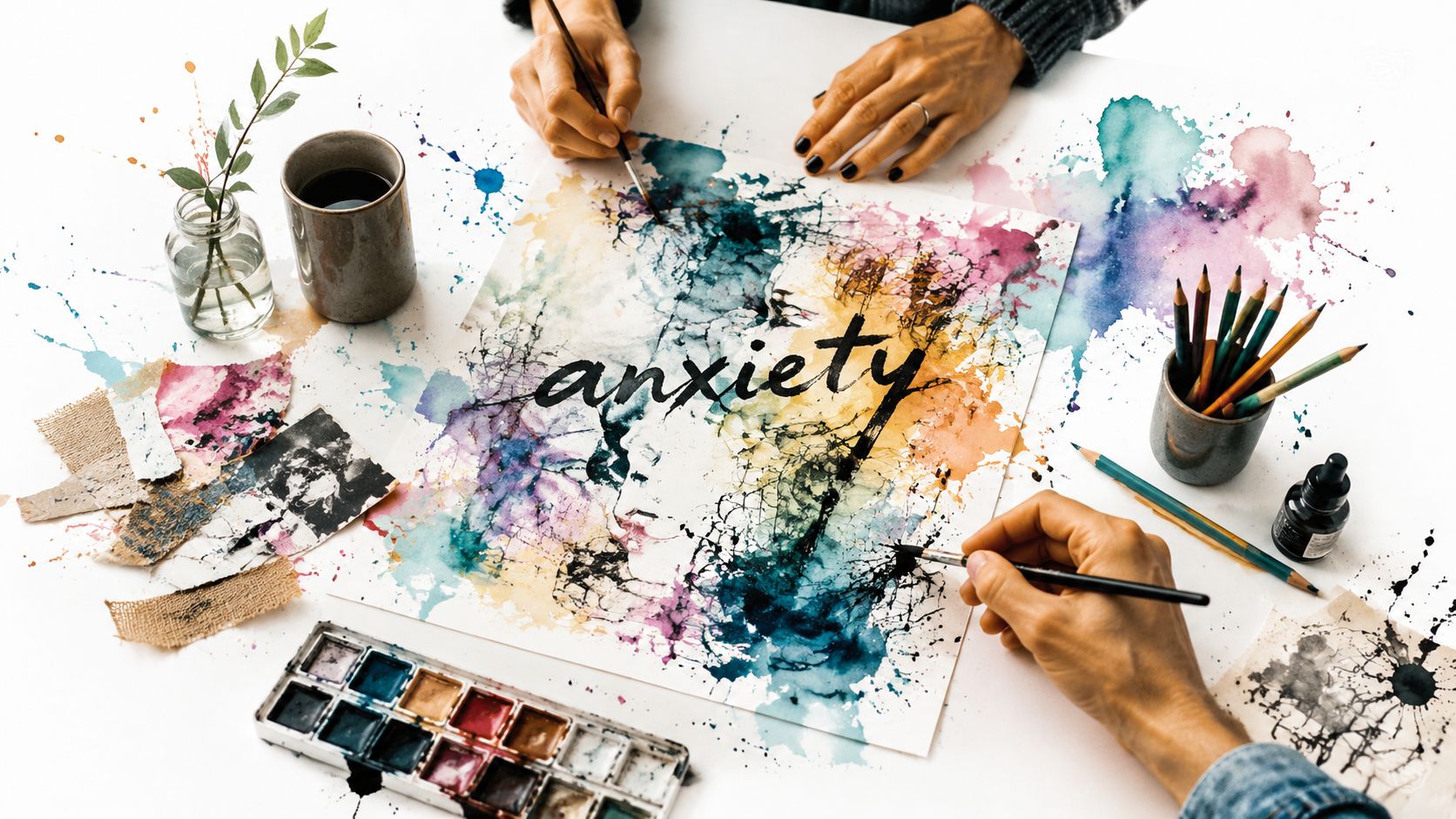
Some members can tell you every symptom of panic and still can't answer a basic question like, “What does your fear feel like?” Art helps when verbal processing gets stuck, intellectualized, or overwhelming. The work can be simple: draw anxiety as weather, map it in the body, create a collage of safety cues, or journal after painting a “before and after panic” image.
The point isn't artistic quality. It's access. Creative work can bypass the pressure to explain everything neatly and allow a member to externalize what has felt fused with identity.
For journaling-based follow-up, these shadow work journaling prompts anxiety can help members keep exploring themes that emerged in group.
Use art when words are too sharp
Art groups do well in hospitals, community centers, trauma-informed outpatient programs, and mixed-anxiety groups where not everyone is ready for direct disclosure. Good prompts include “What does anxiety look like?” “Draw your safe place,” or “Show the difference between alarm and danger.”
Offer choices in medium. Some members prefer pencils and structure. Others need color, tearing, layering, or movement. The best facilitators keep language nonjudgmental and avoid interpreting too quickly.
“There is no right way to do this” often lowers anxiety more than a full explanation of the exercise.
Processing matters more than the product
Creative expression shouldn't end with “Would anyone like to share?” Give members a few reflective prompts after the art-making. Ask what surprised them, where they noticed emotion in the body, or what title they'd give the piece now. Anonymous gallery walks can work well when the group is shy.
Group-based coping interventions can also have effects that last. In a randomized controlled trial of coping-oriented therapy for schizophrenia, participants showed greater reductions in overall symptoms and in depression and anxiety than supportive therapy, with benefits sustained for 2 years after discharge (Schizophrenia Bulletin report on group coping-oriented therapy). That's a different clinical population, but it supports a larger point. Structured group coping work can create durable change, not just a calming hour.
Group Coping Skills: 8-Method Comparison
| Technique | Implementation Complexity (🔄) | Resource Requirements (⚡) | Expected Outcomes (📊 ⭐) | Ideal Use Cases (💡) | Key Advantages (⭐) |
|---|---|---|---|---|---|
| Grounding Technique Circle (5-4-3-2-1 Sensory Method) | 🔄 Low, simple, scripted process | ⚡ Minimal, no equipment; quiet space preferred | 📊 Immediate, short-term reduction in acute anxiety; ⭐ Good for panic interruption | 💡 Acute panic, waiting rooms, brief group sessions, schools | ⭐ Quick, accessible, normalizing group validation |
| Breathing Pattern Synchronization Group | 🔄 Low–Moderate, facilitator guides timing | ⚡ Minimal, optional chime/metronome | 📊 Rapid physiological calming (HR/BP decrease); ⭐ Strong neurophysiological evidence | 💡 Yoga, ER/acute settings, corporate mindfulness, veterans | ⭐ Fast, evidence-backed, portable skill |
| Cognitive Reframing Workshop & Thought Journaling Circles | 🔄 Moderate–High, skilled facilitation and structure | ⚡ Low, worksheets, time for practice | 📊 Gradual cognitive change and reduced chronic anxiety; ⭐ High for thought-driven disorders | 💡 Chronic GAD, CBT groups, students, therapy augment | ⭐ Targets root thinking patterns; durable resilience |
| Progressive Muscle Relaxation (PMR) Group Sessions | 🔄 Low, guided sequence, moderate structure | ⚡ Low, quiet space, optional audio recording | 📊 Tangible somatic relaxation and reduced muscle tension; ⭐ Effective for somatic symptoms & sleep | 💡 Somatic anxiety, sleep clinics, meditation centers | ⭐ Direct body-based relief; strengthens mind–body awareness |
| Exposure Hierarchy Group Practice & Behavioral Challenges | 🔄 High, careful planning and skilled facilitation | ⚡ Moderate–High, logistical support, repeated sessions | 📊 Long-term fear reduction and habituation; ⭐ Most effective for lasting change | 💡 Phobias, social anxiety, OCD, agoraphobia, panic disorder | ⭐ Strongest long-term efficacy; rewires fear responses |
| Mindfulness & Acceptance-Based Group Meditation | 🔄 Moderate, facilitator experience helpful | ⚡ Low, quiet space, time commitment | 📊 Builds acceptance, reduces secondary suffering over weeks; ⭐ Sustained wellbeing gains with practice | 💡 Prevention, long-term management, any anxiety level | ⭐ Reduces reactivity; fosters lasting psychological flexibility |
| Peer Support & Accountability Partner Circles | 🔄 Low, peer-run structure | ⚡ Minimal, time and communication tools | 📊 Increases adherence, reduces isolation; ⭐ Improves real-world follow-through | 💡 Between-session support, mild–moderate anxiety, community recovery | ⭐ Highly accessible, low-cost, reciprocal social support |
| Creative Expression & Art Therapy Group Activities | 🔄 Moderate, facilitation and safety skills advised | ⚡ Low–Moderate, art materials, safe space | 📊 Nonverbal emotional processing and insight; ⭐ Effective for trauma and bypassing rumination | 💡 Trauma-informed groups, nonverbal processors, expressive needs | ⭐ Accesses deeper emotions; engages creativity and identity separation from anxiety |
Your Next Steps to Panic-Free Living
Anxiety tells people they're fragile. Good group work shows them they're trainable. That difference changes everything. Once members experience their body settling through grounding, breathing, PMR, or acceptance, panic stops feeling like an unstoppable force and starts feeling like a state they can learn to manage.
If you facilitate groups, start smaller than your ambition. Pick one or two coping skills group activity formats and teach them thoroughly instead of cramming eight techniques into one program. Repetition builds confidence. Predictability builds safety. Members are much more likely to use a skill during real panic if they've practiced it in the same sequence several times.
Trauma-informed pacing matters just as much as the activity itself. Don't force eye contact. Don't demand disclosure. Don't mistake silence for resistance. Give choices at every stage: eyes open or closed, share or pass, write or speak, stay seated or stand near the wall. When people feel agency in the room, they're more willing to stay present when anxiety spikes.
Digital support helps close the gap between insight and action. That's where SOS prompts, printable handouts, and app-based nudges become more than extras. They become retrieval cues. A member who goes blank during panic often can't remember a full worksheet or a therapist's explanation. They can follow a short prompt that says: “Look around. Name five things you see. Unclench jaw. Exhale longer.” If you want long-term healing, build those bridges on purpose.
Use the group to normalize, then individualize. Let members learn common patterns together, then create personal panic plans before they leave. A strong plan usually includes three parts: early warning signs, the first coping response, and the backup response if the first one isn't enough. For one member, that may be sensory grounding followed by a calming audio. For another, it may be stepping outside, labeling catastrophic thoughts, and texting an accountability partner.
Hope grows when people see progress they can repeat. A member who once fled the room may stay seated through a wave of anxiety. A member who avoided every social task may complete one planned exposure. A member who thought panic meant “I'm broken” may start saying, “My nervous system is activated, and I know what to do next.” That is healing.
You now have eight trauma-informed, evidence-based group activities to foster hope, connection, and skill-building. Start planning your sessions, integrate SOS prompts and worksheets from the Anxiety Checklist app, and watch your group transform panic into lasting resilience.
The Anxiety Checklist gives you support in the exact moments anxiety tends to erase your memory for coping skills. Its always-free SOS mode offers immediate prompts for grounding, affirmations, and calming steps when your mind goes blank, while the broader app includes guided meditations, sleep audios, hypnosis sessions, walking support, CBT tools, exposure exercises, and expert-led lessons for deeper recovery. If you want a practical companion for panic relief and long-term healing, it's a strong next step for both individuals and busy therapists who need structured, easy-to-use support.