

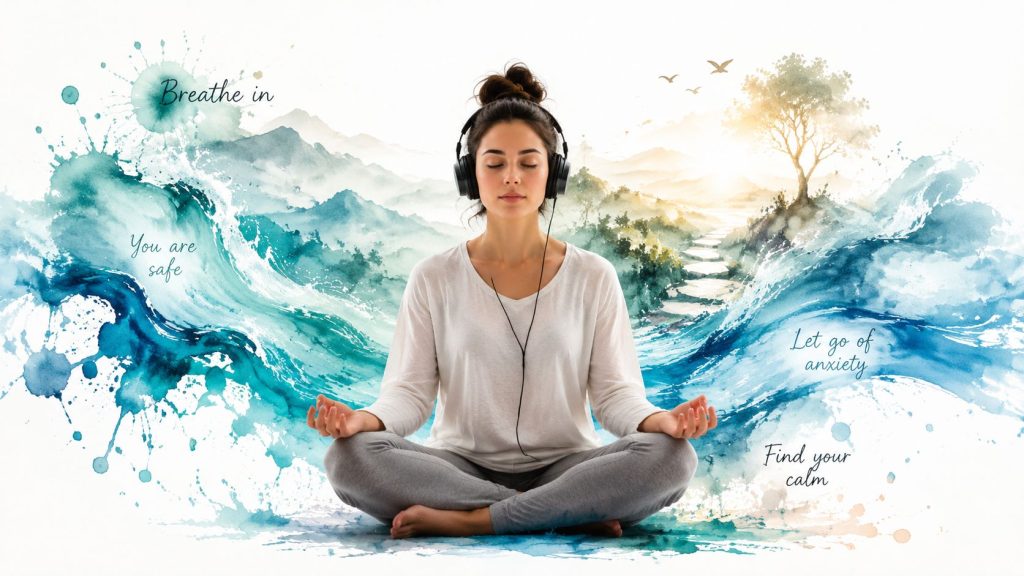
Your chest tightens. Your thoughts start sprinting. One sensation in your body turns into a full alarm: Something is wrong. I'm losing control. What if this gets worse? In moments like this, silence can feel too big. It can feel like being left alone with a fire alarm that won't turn off.
That's where guided meditation can feel different. Not magical. Not instant perfection. Just different in a very important way. A steady voice gives your mind something safe to follow when your own thoughts don't feel trustworthy.
If panic has made you afraid of your own body, there is still a way forward. Many people heal by learning how to interrupt the panic loop, calm the nervous system, and rebuild trust in themselves one guided session at a time. If you want to learn about anxiety and panic attacks, it helps to understand why this kind of practice works so well for anxious minds.
Table of Contents
- Introduction to Guided Meditation for Anxiety
- Understanding Guided Meditation
- Core Purposes and Proven Benefits for Anxiety and Panic Relief
- How Guided Meditation Differs from Unguided Practice
- Effective Use Cases Timing and Sample Scripts
- How to Evaluate and Choose the Right Guided Meditation
- Conclusion and Next Steps
Introduction to Guided Meditation for Anxiety
A guided meditation is often the first form of meditation that feels possible for someone with panic. That makes sense. When anxiety is high, your attention gets pulled into threat scanning. You notice every heartbeat, every thought, every tiny body shift. A calm voice can interrupt that pattern before it snowballs.
Think of someone waking at 2 a.m. with a pounding heart. They try to “just calm down,” but the command makes things worse. They try silence, but silence gives the panic more room to speak. Then they press play on a short guided practice and hear, “Feel your feet. Look around the room. Breathe out longer than you breathe in.” That sequence matters. It gives the brain a job.
The purpose of guided meditation isn't to force blankness. It's to create enough structure that your nervous system can stop bracing and start settling. For many anxious people, that structure is the bridge between feeling hijacked and feeling safe enough to recover.
Guided meditation can become a lifeline because it asks less of you in the moment when you have the least bandwidth.
There is hope in that. You don't need to be naturally calm. You don't need to be good at meditation. You need support that meets you where you are.
Understanding Guided Meditation
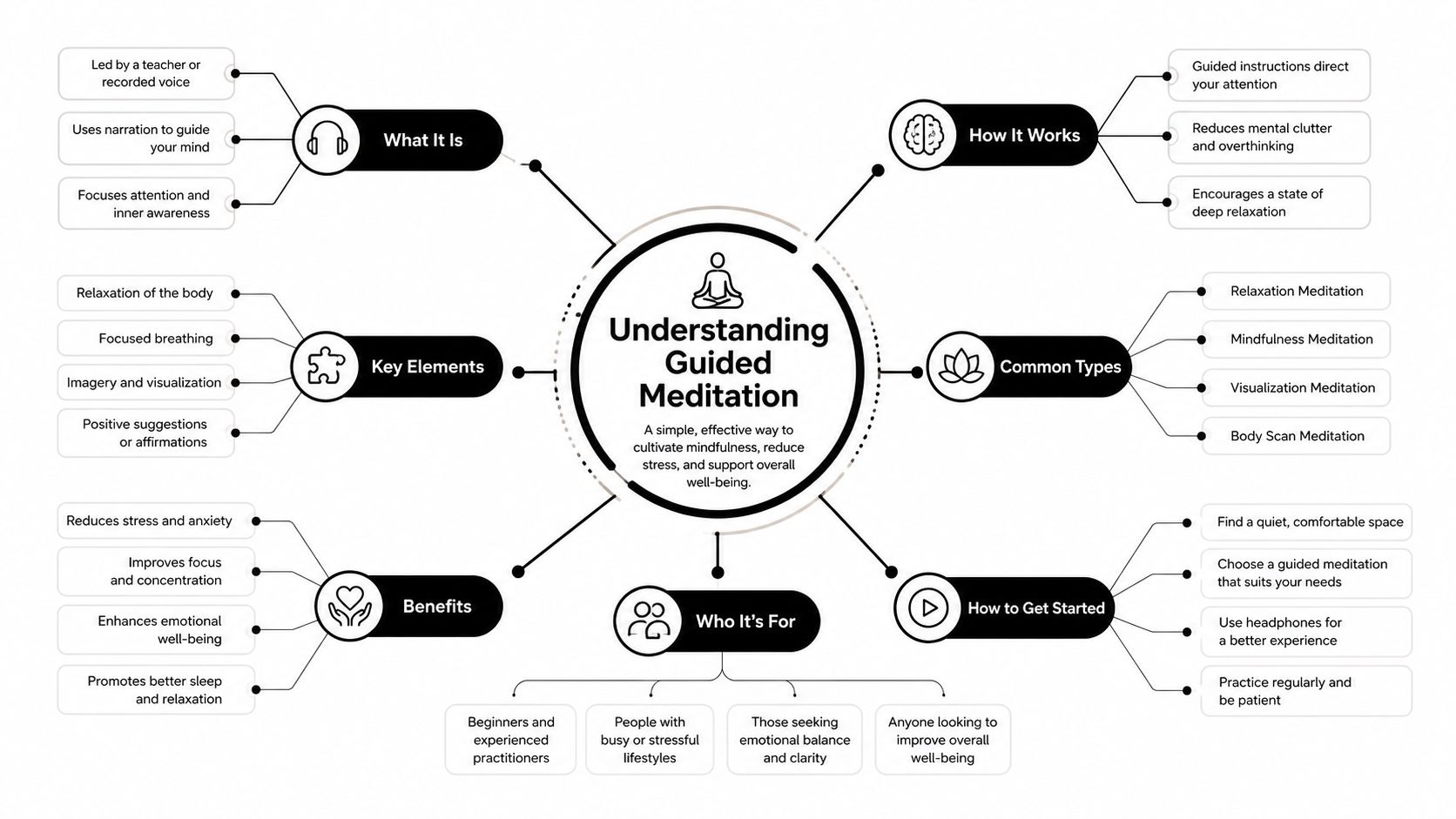
Guided meditation is meditation with direction. Instead of sitting in silence and deciding what to focus on by yourself, you listen to a teacher, therapist, or recorded voice that gives simple cues. Those cues might involve breathing, noticing sensations, relaxing muscles, using imagery, or returning attention to the present.
What the guide actually does
A good guide works like an experienced navigator on a winding road. You're still in the car. You're still doing the driving. But you're not guessing every turn alone.
Most guided sessions include three basic elements:
- Orientation to the present: The voice helps you notice where you are, what your body is doing, and what's happening right now.
- A clear anchor: This might be the breath, the feet, sounds in the room, or a phrase repeated gently.
- Pacing: The guide slows the process down so you don't flood yourself by doing too much too fast.
That pacing is one reason guided meditation feels safer to many people who struggle with anxiety during meditation.
Common formats people use
Guided meditation can happen in several forms. Some people prefer a short audio track during a panic spike. Others do better with video, live classes, or sleep meditations at night.
You might hear:
- Breath prompts that help you notice inhale and exhale without forcing either one
- Body scan cues that move attention from head to toe in small steps
- Grounding directions that bring you back to what you can feel, hear, and see
- Imagery that gives the mind a calmer scene to rest in
If you're brand new, it can help to explore simple meditation techniques for beginners from Zoe Behavioral Health before settling into a longer routine.
Why guided meditation matters for anxious minds
A foundational historical and statistical purpose of guided meditation is the treatment of psychological disorders, specifically anxiety and depression, supported by moderate evidence from major medical reviews. Studies show moderate improvements in anxiety with effect sizes of 0.38 at 8 weeks and 0.22 at 3 to 6 months, confirming its role in building psychological resilience, as summarized in this guided meditation overview.
That sentence is dense, so here's the plain version. Guided meditation isn't just for “relaxing a little.” It has a long track record as a structured support for people dealing with real emotional distress.
Practical rule: If silence makes you spiral, start with guidance. You can always reduce support later. You don't have to begin with the hardest version.
Core Purposes and Proven Benefits for Anxiety and Panic Relief
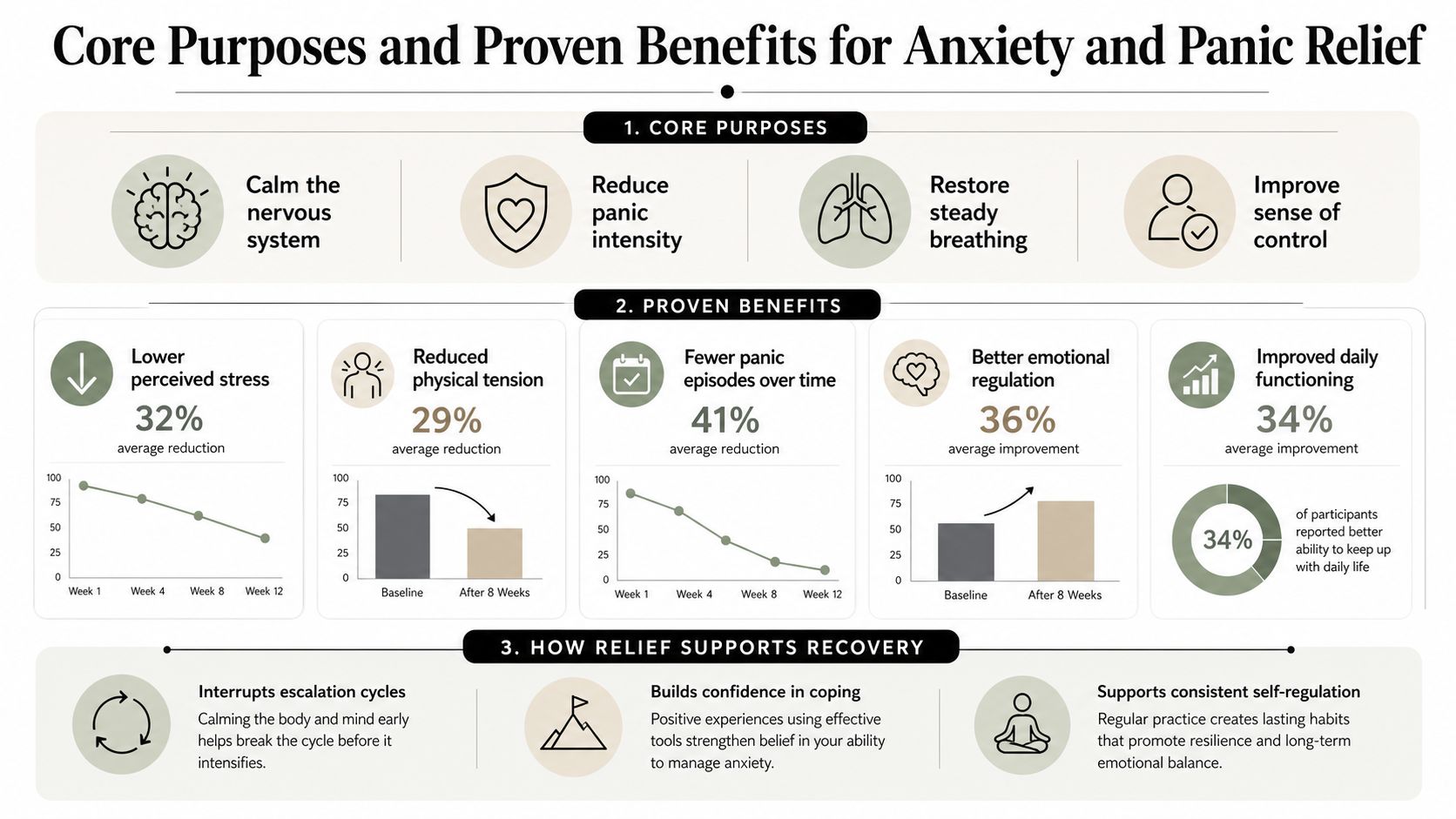
Guided meditation serves several purposes at once. It reduces stress. It helps regulate emotion. It teaches attention to come back from catastrophic thinking. And for many people with panic, it offers a repeatable way to move from alarm to steadiness.
Stress reduction is the first purpose
When people ask about the purpose of guided meditation, stress reduction is usually the clearest starting point. A large review matters here because it looked across many trials rather than one small experience. A meta-analysis of 136 randomized controlled trials with over 11,600 participants found guided meditation significantly reduced stress with a standardized mean difference of -0.45 and improved anxiety and depression symptoms, with benefits lasting 1 to 6 months after a program ended, according to this research summary on guided meditations and stress.
That matters for panic because panic doesn't only happen in isolated moments. It often grows in a stressed system. When baseline stress drops, the mind has more room before it hits overload.
Guided practice can strengthen emotional regulation
The purpose of guided meditation also goes beyond simple calming. It can help train emotional regulation. Harvard Health describes how mindfulness meditation practice changes the brain, including increased gray matter concentration in the hippocampus and broader changes in brain regions tied to self-awareness, self-regulation, executive function, and memory formation in this overview of meditation and brain change.
In everyday language, regular practice helps people notice a fear spiral earlier. Instead of getting pulled all the way into “I'm in danger,” they become more able to notice, “My alarm system is firing.” That small shift can change a lot.
Here's a useful way to think about it:
| Purpose | What it looks like in daily life |
|---|---|
| Lowering stress load | You feel less constantly braced |
| Interrupting rumination | Thoughts still show up, but they don't run the whole room |
| Building recovery speed | A bad spike doesn't ruin the whole day |
| Restoring trust in the body | Sensations feel less like proof of danger |
A guided session can also fit alongside other stress-sensitive experiences. For example, hormonal shifts can intensify panic for some people, which is why a practical guide to perimenopause panic attacks can be helpful if your anxiety seems tied to body changes.
Later in your routine, sound-based supports may also help some people settle into practice. If you're curious about that angle, you may find value in The Anxiety Checklist's binaural beats insights.
It offers hope because the effects can last
One reason guided meditation feels worth committing to is that its benefits don't have to vanish the moment the audio ends. The review above found that improvements can continue after the program is over. That tells anxious readers something important. Relief isn't limited to the exact minute you're meditating. Practice can teach the nervous system a new pattern.
For a visual reset, this short video introduces a calming guided experience many readers may find approachable:
You don't need to believe you'll be panic-free forever by tomorrow. You only need to accept that your brain and body can learn. Guided meditation gives them a safer classroom.
How Guided Meditation Differs from Unguided Practice
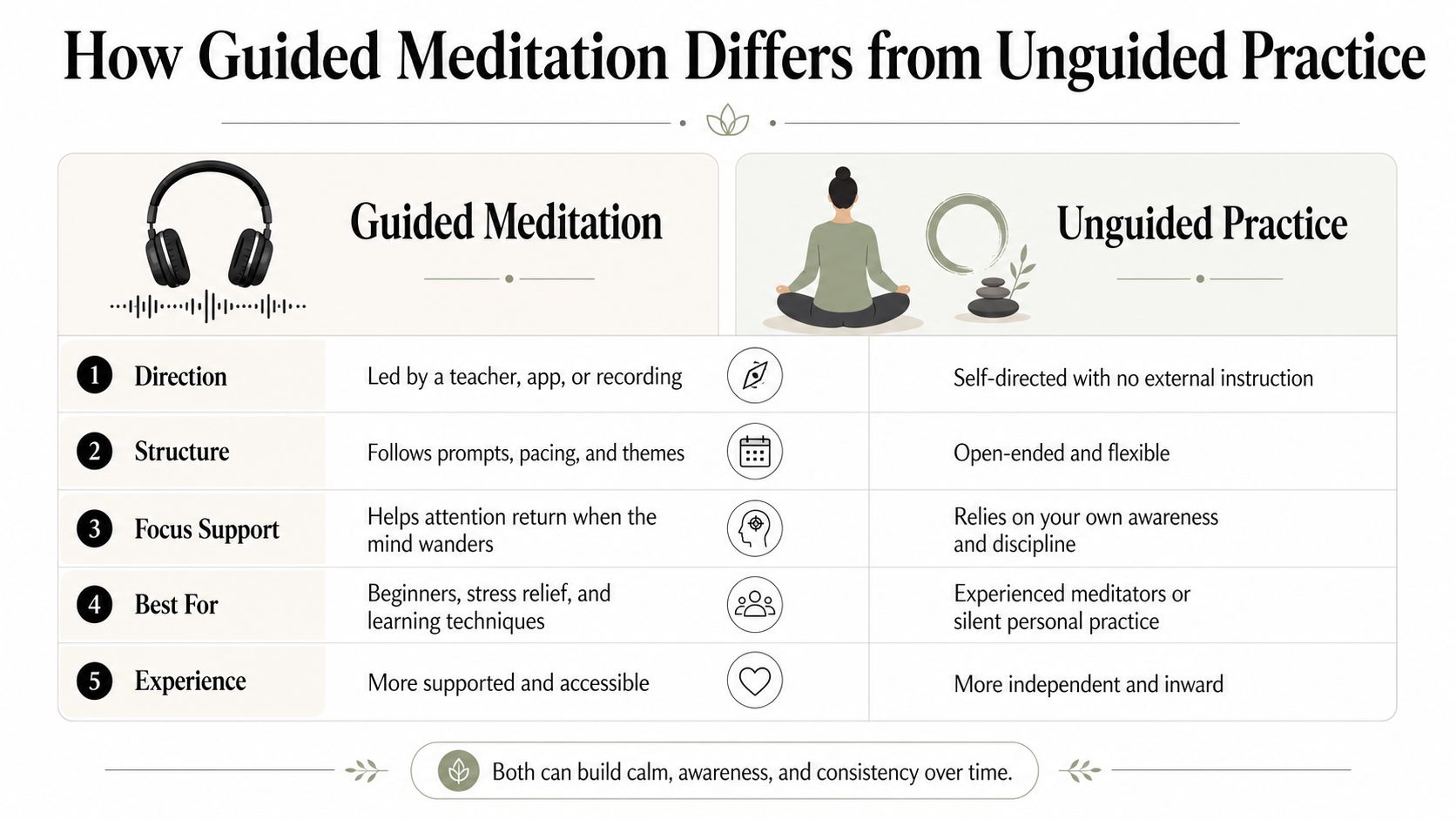
For a calm person, silent meditation may feel spacious. For a panic-prone person, it can feel like being locked in a room with every fearful thought amplified. That's the difference many guides leave out.
The external voice acts like a cognitive anchor
Recent data shows that 70% of adults use meditation for stress, but those with chronic anxiety often experience increased panic in unguided sessions without external scaffolding to ground them, underscoring the need for guided formats, as described in this discussion of guided meditation for anxiety and depression.
The key phrase here is external scaffolding. When panic rises, the thinking mind can become unreliable. A guide's voice acts as a cognitive anchor. It gives you a simple next step before the panic loop fully takes over.
Instead of this:
- Unguided spiral: “My heart is racing. Why is it racing? What if I pass out?”
- Guided interruption: “Notice the chair supporting you. Relax your jaw. Count the exhale.”
That interruption is not small. It often prevents fear from feeding on itself.
When silence can backfire
Unguided practice isn't wrong. It just isn't always the right starting point. If someone already feels flooded, silence can leave too much unstructured space. The mind starts scanning inward, finds discomfort, labels it as danger, and tightens further.
For high-anxiety people, guidance isn't a crutch. It's a safety rail.
This is similar to why some people benefit from other structured approaches, including science-backed hypnotherapy methods for anxiety. The common ingredient is support that reduces cognitive load when fear is high.
A simple comparison helps:
| Guided meditation | Unguided meditation |
|---|---|
| Provides cues | Requires self-direction |
| Interrupts spirals | Can leave spirals unchecked |
| Feels safer during panic | May feel too open during panic |
| Best for beginners with anxiety | Better once internal stability improves |
If you've tried silent meditation and felt worse, that doesn't mean you've failed at meditation. It may only mean you were trying a form that asked too much of an activated nervous system.
Effective Use Cases Timing and Sample Scripts
The best guided meditation is the one that matches the moment you're in. A panic spike needs one kind of support. A bedtime routine needs another. Daily resilience practice needs another.
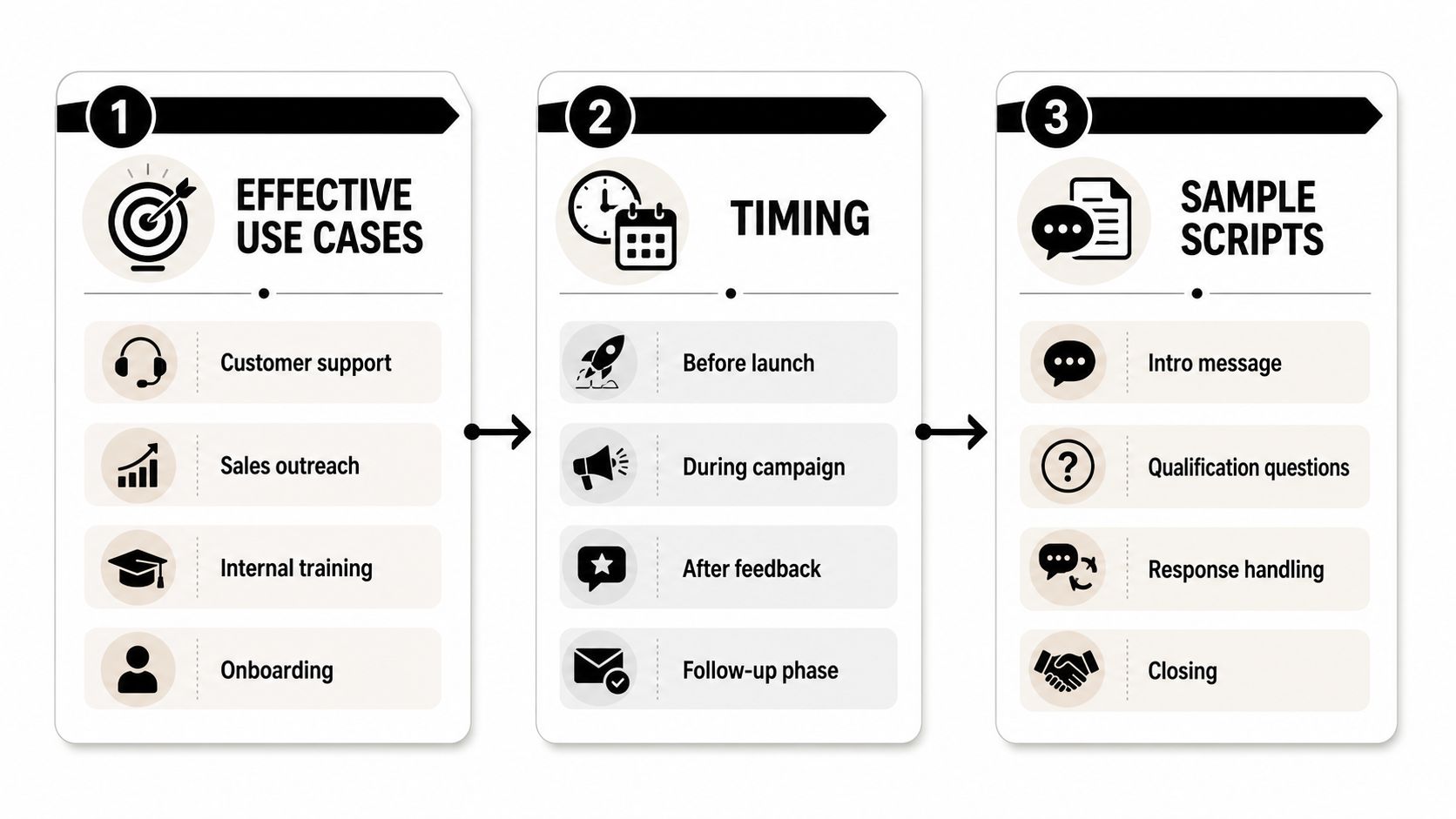
Use it differently in crisis and in maintenance
During acute anxiety, your first goal isn't deep insight. It's orientation and safety. You want a guide who talks clearly, moves slowly, and doesn't ask for too much introspection.
During calmer periods, guided meditation can help you build a stronger baseline. That's where longer sessions can work well. Over time, consistent mindfulness meditation programs show moderate evidence for improving anxiety with an effect size of 0.38 at 8 weeks, remaining significant at 0.22 over 3 to 6 months, according to this review of mindfulness meditation programs.
Plain language version: repeated practice helps. The changes may not be dramatic after one session, but regular sessions can make anxiety easier to manage over time.
A simple timing map
Different moments call for different lengths. You don't need one perfect routine. You need a few reliable options.
| Situation | Best use | What the guide should do |
|---|---|---|
| Panic spike | Very short SOS practice | Ground you in the room and slow the exhale |
| Midday tension | Brief reset | Unclench the body and interrupt racing thoughts |
| Evening decompression | Wind-down practice | Help the system shift out of vigilance |
| Pre-sleep anxiety | Sleep-focused guidance | Reduce body scanning and soften mental chatter |
| Daily resilience building | Longer seated session | Train attention, steadiness, and recovery |
What to do during a panic spike
If panic hits hard, don't aim for serenity. Aim for containment.
Try this sequence:
- Open your eyes. Panic often worsens when attention collapses inward.
- Name five neutral things around you. A wall, a lamp, a sock, a door, a shadow.
- Follow a voice, not your fear. Let the guide choose the next step.
- Lengthen the exhale gently. Don't force giant breaths. Forced breathing can make some people more dizzy.
- Stay low demand. This isn't the time for deep silence or abstract teachings.
Grounding cue: “You don't need to make the fear disappear right now. You only need to stay with one safe instruction at a time.”
That sentence alone can reduce performance pressure. Many anxious people panic about panicking. A guided practice helps break that second layer.
Sample script for immediate grounding
Here's a short example of what a panic-focused guided meditation might sound like:
“Feel both feet touching the floor. Press them down gently. Look around and name one thing that is blue, one thing that is soft, and one thing that is still. Let your shoulders drop a little. Breathe in naturally. Breathe out slowly. You are here in this room. This feeling is intense, but you are still here, and you are still safe enough to take the next breath.”
Notice what this script does. It doesn't argue with panic. It doesn't say, “Relax.” It gives concrete sensory tasks. That helps the brain shift from threat prediction to present-moment contact.
Daily resilience practice looks different
When you're not in full alarm, guided meditation can become training. You build familiarity with your body. You notice early tension. You practice coming back before the stress stack gets too high.
A resilience session often includes:
- Settling first: A minute or two of posture, breath, and orientation
- One central anchor: Breath, sounds, feet, or body sensations
- Gentle return practice: Every time the mind wanders, the guide invites you back without criticism
- A closing phrase: Something steadying, like “I can meet this moment”
Many anxious people are harsh with themselves. This self-criticism can make meditation challenging. They think every distracted session is failure. It isn't. A guided meditation teaches the opposite lesson. Return is the practice.
Sample script for daily resilience
This kind of script works well when you're reasonably calm:
“Sit in a way that feels supported. Notice the contact between your body and the chair. Bring attention to the breath at the nostrils, chest, or belly, wherever it feels easiest to notice. When the mind drifts into planning, remembering, or worry, gently acknowledge that and come back. Nothing has gone wrong. You are practicing return.”
That line, “Nothing has gone wrong,” is powerful for anxious people. It reframes wandering thoughts as normal rather than dangerous.
Environment matters more than people think
A few practical choices can make guided meditation work better:
- Choose a safe-feeling setting. Start somewhere you don't have to be hyperalert.
- Keep your posture flexible. You can sit, lean back, or even walk slowly if stillness feels activating.
- Lower sensory strain. If background music irritates you, skip it. If silence feels stark, choose a gentle voice with soft ambient sound.
- Save favorites. When panic rises, decision-making gets harder. Preselect tracks for daytime, nighttime, and SOS moments.
Some people also do better with eyes open, especially early on. That's common. You don't have to close your eyes to do “real” meditation.
A good weekly pattern
Instead of relying on motivation, use a small rotation:
- One short SOS track for panic moments
- One evening track for winding down
- One longer daytime practice for resilience
That kind of setup is manageable. It also lowers the chance that you'll quit because the practice feels too demanding.
The purpose of guided meditation, in real life, is not to create a perfect spiritual experience. It's to help you function, recover, and feel safe in your own mind again. For many people, that becomes the beginning of living with much less fear.
How to Evaluate and Choose the Right Guided Meditation
Not every guided meditation is a good fit for panic. Some voices are too abstract. Some scripts move too fast. Some ask you to focus inward in ways that can intensify fear. Choose based on your nervous system, not on what sounds impressive.
What to look for first
Start with the guide's delivery. A useful voice sounds steady, clear, and non-performative. You want someone who gives simple instructions and leaves enough space to follow them without feeling abandoned.
Look for these signs:
- Pacing that respects anxiety: The guide doesn't rush from cue to cue.
- Concrete language: “Feel your feet” is often better than vague spiritual phrasing.
- Permission to adapt: The guide allows eyes open, shifting posture, or pausing.
- A clear closing: The practice helps you re-enter daily life gradually.
Red flags anxious listeners should notice
Sometimes the problem isn't meditation itself. It's the format.
Be cautious if a session:
- Pushes deep body focus too early: That can overwhelm someone who fears sensations.
- Uses guilt-heavy language: Anxiety responds poorly to pressure.
- Feels generic: If it sounds like it could apply to anything, it may not help during panic.
- Assumes silence is always best: For many anxious people, it isn't.
A broader research picture supports the value of meditation-based approaches. Meta-analyses of randomized controlled trials show meditative therapies outperform wait-list or attention controls for reducing anxiety, with effect sizes comparable to other active therapies like music therapy or relaxation training, according to this review of meditative therapies for anxiety.
That doesn't mean every recording will help you. It means the approach is sound, and the fit matters.
A simple selection checklist
Use this quick screen before committing to a track:
| Question | Why it matters |
|---|---|
| Do I feel safer hearing this person speak? | Safety comes before technique |
| Does the session match my current state? | Panic support is different from sleep support |
| Are the instructions easy to follow under stress? | Anxiety reduces bandwidth |
| Can I imagine using this again tomorrow? | Sustainability beats novelty |
If a meditation leaves you more activated, don't force loyalty to it. Try another teacher, another style, or a shorter format. The right guided meditation should feel like support, not a test.
Conclusion and Next Steps
The purpose of guided meditation is often misunderstood. People think it's about emptying the mind or becoming perfectly calm. For someone with anxiety or panic, it's more practical than that. It provides structure when your thoughts are chaotic, an anchor when fear starts pulling you under, and a repeatable way to teach your nervous system that distress can rise and fall without taking over your life.
That's why guided practice can bring real hope. You don't have to win a battle with your thoughts. You can learn to follow a safer signal. One breath. One cue. One return.
Start small tonight. Pick a short guided session. Keep your eyes open if that helps. Let the voice do some of the work until your body learns what safety feels like again. If you want extra support beyond meditation alone, explore panic and anxiety relief tools.
Calm is learnable. Panic doesn't have to be the center of your life forever. With the right kind of guidance, many people move from constant fear to steadier days, better nights, and a growing sense that they can trust themselves again.
If you want structured support between panic spikes and daily practice, The Anxiety Checklist offers a practical place to start. Its always-free SOS mode can help when your mind goes blank, and its guided tools, sleep audios, affirmations, and CBT-based resources support longer-term healing without pressure.