

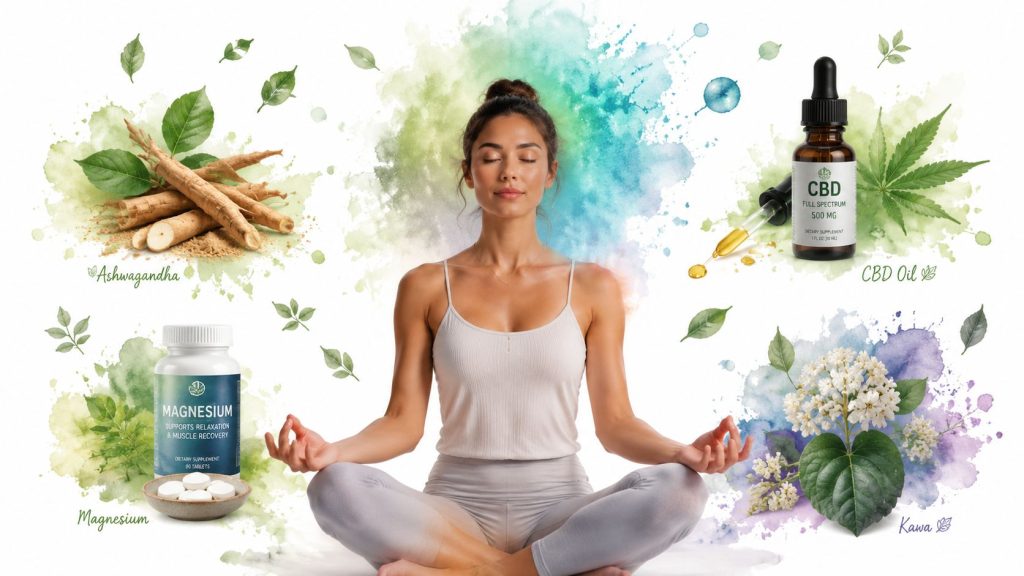
You're lying awake again, staring at the ceiling while your heart won't settle. You've tried the obvious fixes. You've probably Googled supplements at 2 a.m., hoping one of them might finally quiet the spiral. That search makes sense, because anxiety can feel relentless, but it isn't a permanent identity. It's a pattern, and patterns can change with the right combination of support, skills, and time.
The clearest place to start is with evidence, not hype. Some natural anxiety supplements have real research behind them, while others are popular mainly because they sound calming. A helpful frame comes from the science of anxiety, which explains why the body can stay stuck in a threat state even when life looks safe on paper. If you want a plain-language companion to that idea, the article on the science of anxiety from Maverick Behavioral Health is worth reading alongside this guide. If you're trying to get a quick read on your own symptoms, an anxiety checklist can also help you notice patterns before you buy anything.
Table of Contents
- Finding Real Hope When Anxiety Feels Endless
- Which Natural Anxiety Supplements Have Real Evidence
- Matching Supplements to Your Anxiety Subtype
- Dosing Quality and Safety Essentials
- Beyond Pills Building a Complete Anxiety Recovery Toolkit
- Your Path Forward to Living Panic Free
Finding Real Hope When Anxiety Feels Endless
At 2 a.m., anxiety usually does not feel abstract. It feels physical. Your chest is tight, your thoughts are racing, and every small sensation starts to look like a warning sign. In that moment, many people start looking for something natural because they want relief without feeling sedated, dependent, or out of control.
A grounded starting point is evidence, not hype. The early research on natural anxiety supplements came from careful reviews that separated ingredients with some real support from those that mainly have general wellness or sleep appeal. A 2010 systematic review found the strongest support for kava, passionflower, and L-lysine plus L-arginine, while also noting that serious side effects were not prominent in the available trials (PMC systematic review). A separate AAFP review reported that kava had substantial evidence and inositol outperformed placebo in some studies, while St. John's wort, valerian, and omega-3 fatty acids had little therapeutic value for anxiety disorders in that historical evidence base (AAFP review).
Practical rule: if a supplement claim sounds universal, treat it as a red flag. Anxiety is not one single problem, so one ingredient will not fit every person or every symptom pattern.
That matters because panic, constant worry, and sleep-driven anxiety do not always respond to the same things. Panic can feel like a smoke alarm set off by toast. Generalized worry can feel more like a background hum that never shuts off. Sleep-driven anxiety often starts with a tired nervous system that has lost its footing overnight. Matching the approach to the symptom pattern usually makes the process more sensible, especially when supplement choices are paired with grounding, app-based CBT tools, and consistent sleep support. A practical anxiety checklist can help people notice which pattern feels most familiar before they choose a next step.
Readers often feel relieved when they realize they are not trying to “cure” themselves overnight. They are building a calmer baseline step by step, and that is a workable goal. Recovery does not require perfection, only a smarter starting point. For some people, that starting point also includes understanding the science of anxiety so they can see why symptoms feel so intense and why small, steady changes can still matter.
Which Natural Anxiety Supplements Have Real Evidence
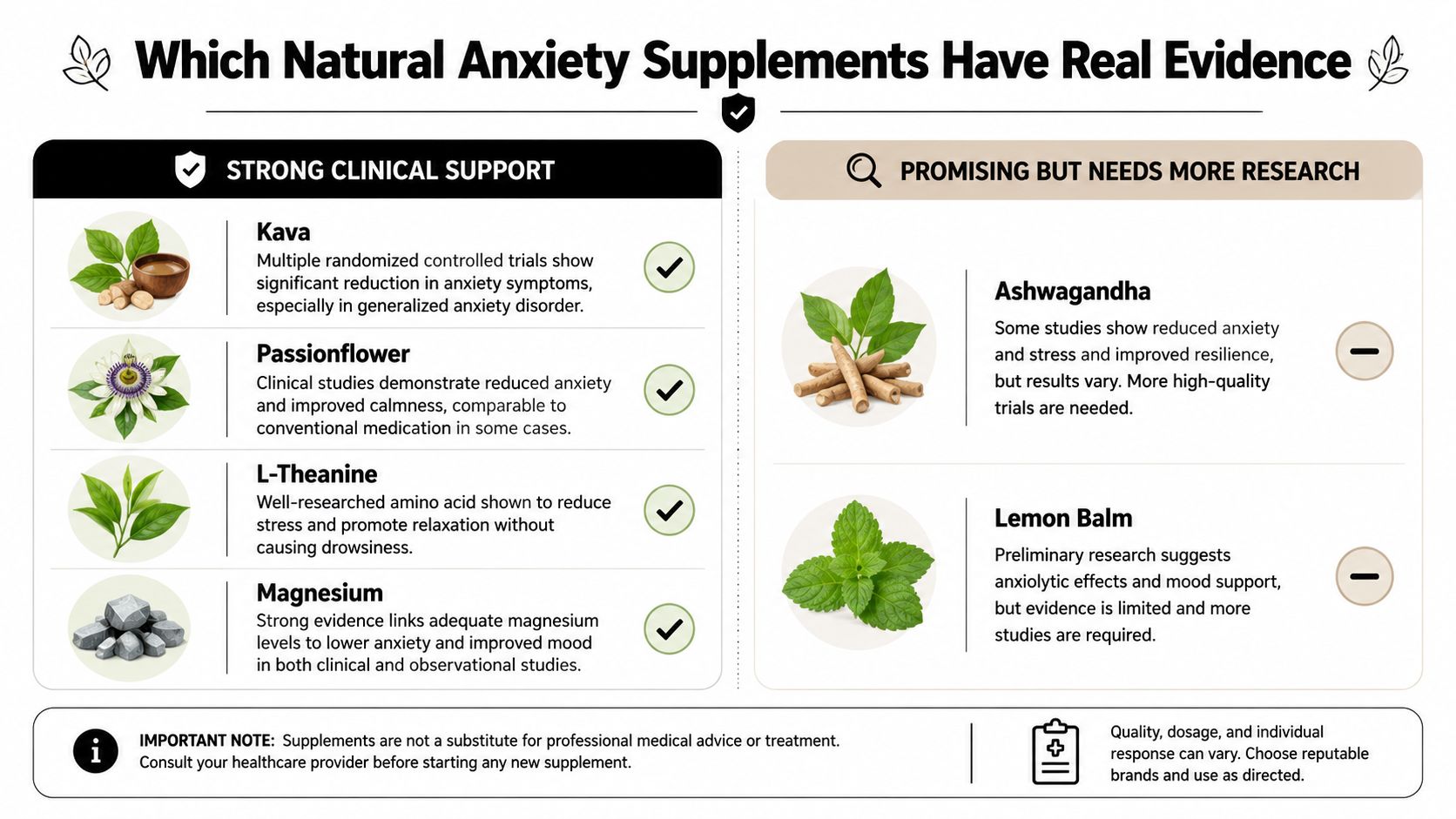
The supplement aisle is crowded, but the research is not evenly spread across ingredients. Some options have been studied in actual anxiety trials, while others are better known for general wellness, sleep, or stress support than for anxiety relief itself. The most relevant question is not what is popular. It is what has a plausible evidence trail, and for which symptom pattern.
A helpful way to sort the evidence is to ask whether a supplement fits panic, persistent worry, or sleep-driven anxiety. Panic often calls for a different approach than a racing mind at bedtime, just as a smoke alarm and a dimmer switch solve different problems. That kind of matching becomes even more useful when supplements are paired with grounding skills, app-based CBT tools, and steady sleep habits. For a practical starting point, evidence-based anxiety resources can help people compare options without getting lost in marketing language.
The stronger candidates
Kava stands out because it appeared in early evidence reviews as one of the more supported options for anxiety symptoms (PMC review, AAFP review). Passionflower also showed up among the more credible ingredients in the 2010 review (PMC review). Inositol is especially interesting because the literature suggests a possible role in panic symptoms, which makes it worth separating from broader stress remedies (anxiety.org overview).
Omega-3s deserve a cautious read. A 2018 systematic review and meta-analysis summarized in Medical News Today looked at 19 clinical trials and concluded that omega-3 supplementation could help people with anxiety (Medical News Today summary). This does not make omega-3s a universal fix, but it does place them in the “promising” category.
Vitamin B-complex is newer to the conversation, and a 2023 systematic review found that supplementation improved anxiety symptoms, depressive symptoms, and sleep quality across a range of populations (PMC 2023 review). That matters because poor sleep can keep anxiety cycling, especially when the nervous system never gets a clean reset.
Small but important distinction: “helps anxiety” and “helps every anxiety disorder” are not the same claim. The evidence is ingredient-specific and symptom-specific.
The mixed or weakly supported options
Valerian is often marketed for calm, but historical reviews found the evidence for anxiety disorders specifically to be weak or inconsistent (AAFP review). The safety note in the Medical News Today summary says valerian is considered safe for otherwise healthy adults when used for short periods, which speaks to tolerability rather than proven anxiety benefit (Medical News Today summary).
CBD gets a lot of attention, but the evidence remains mixed rather than settled (anxiety.org overview). Ashwagandha is commonly discussed as a stress adjunct, but it still sits closer to emerging support than to established anxiety treatment, and product quality matters a great deal (PMC dosing and quality review). For L-theanine and magnesium, consumer interest is high, but the most careful read is that they look more like adjuncts than stand-alone fixes.
Quick comparison
| Supplement | Research picture | Practical read |
|---|---|---|
| Kava | Stronger early support | Worth discussing with a clinician |
| Passionflower | Supportive early evidence | Better than many popular alternatives |
| Inositol | Helpful in some studies, may fit panic | More subtype-specific than generic |
| Omega-3s | Promising, not universal | Evidence depends on context |
| Vitamin B-complex | Emerging benefit for anxiety and sleep | Especially relevant if sleep is part of the picture |
| Valerian | Mixed for anxiety disorders | More often a sleep aid |
| CBD | Mixed evidence | Not a sure bet |
A careful reading of the evidence is also useful for people comparing symptom patterns alongside other health questions. The Pause Medical natural relief guide uses a similar evidence-first approach, which can be helpful if anxiety is showing up alongside hormone-related changes.
Matching Supplements to Your Anxiety Subtype
Anxiety isn't one bucket. Panic attacks feel different from persistent overthinking, and both feel different from the kind of anxiety that starts when sleep falls apart. Matching the supplement to the symptom pattern matters more than chasing the biggest label claim.
Panic attacks
If panic is the main issue, inositol is one of the more interesting options because the broader evidence base suggests it may help reduce panic symptoms. That does not mean it helps everyone, but it does mean panic deserves different thinking than general stress or vague nervousness.
Generalized worry
For chronic, low-grade worry, the better fit is often something that supports overall nervous-system resilience rather than a single acute calming effect. Kava, passionflower, and possibly magnesium or ashwagandha are often discussed in that broader calming space, though the evidence is not equally strong for each one. A smarter approach is to ask whether the person is more anxious, more tense, or more sleep deprived, because the answer changes the likely fit.
Sleep-driven anxiety
When poor sleep keeps anxiety cycling, vitamin B-complex is relevant because the 2023 review linked supplementation with better anxiety symptoms, depressive symptoms, and sleep quality. Omega-3s also come up here because mood, inflammation, and sleep often overlap in real life. The aim is to reduce the conditions that keep the alarm system switched on, not to sedate yourself.
The article on coping with overthinking and anxiety pairs well with this kind of self-triage, because overthinking often looks like “everything anxiety” when it is really a specific thought-loop pattern.
| Anxiety Subtype | Most Relevant Supplements | Evidence Strength |
|---|---|---|
| Panic | Inositol | More targeted, still limited |
| Generalized worry | Kava, passionflower, magnesium, ashwagandha | Mixed to moderate depending on ingredient |
| Sleep-related anxiety | Vitamin B-complex, omega-3s, valerian for sleep support | Emerging to mixed |
| Mixed anxiety with mood issues | Omega-3s, vitamin B-complex | Promising, not universal |
If menopause, mood swings, or stress transitions are part of the picture, the Pause Medical natural relief guide is a useful example of how symptom pattern changes the support strategy.
Dosing Quality and Safety Essentials
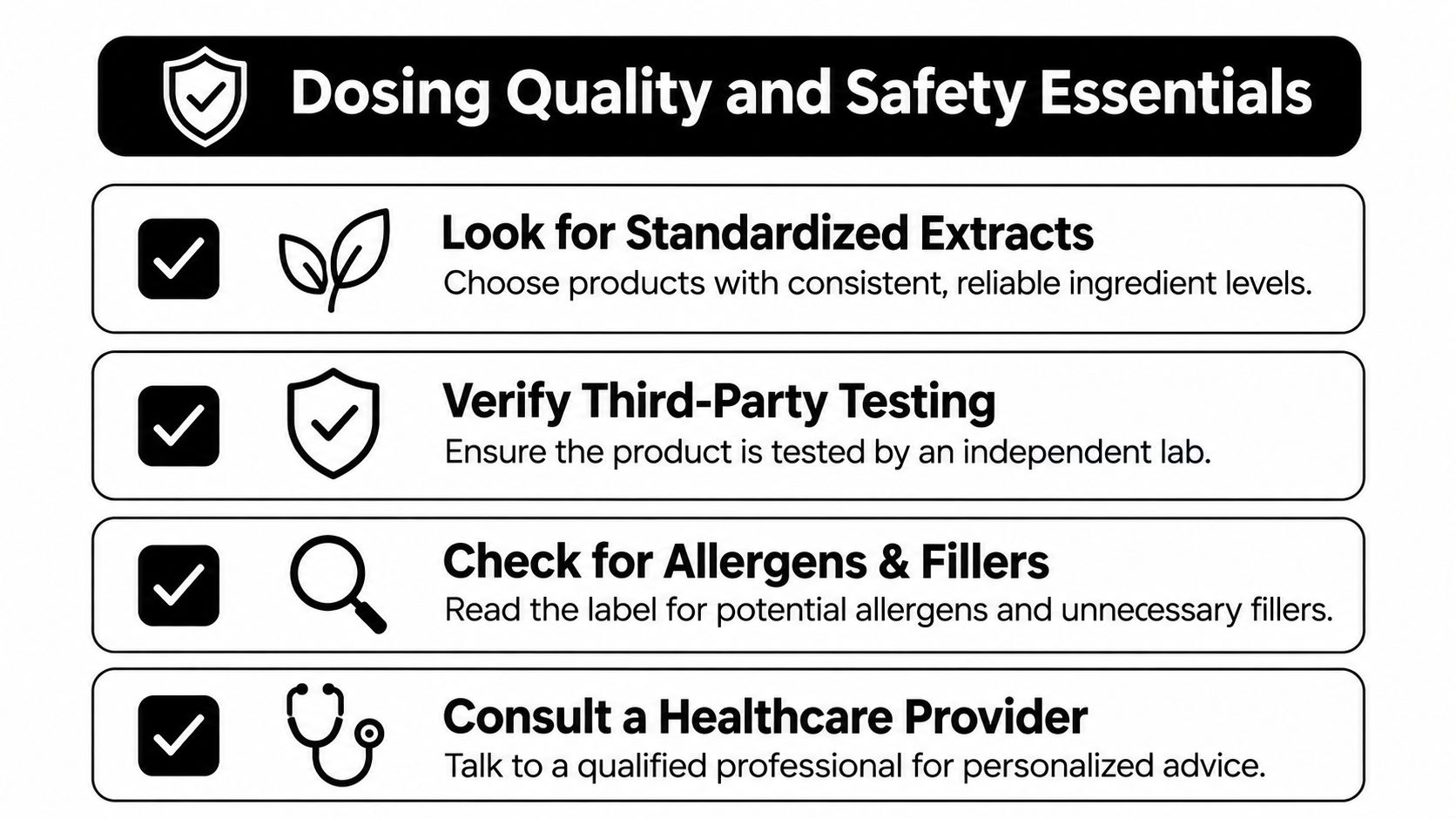
A supplement can look promising on the shelf and still underperform in real life. Dose and formulation quality matter. The products that show benefit are usually standardized, clearly labeled, and aligned with the amounts used in research, not whatever happens to be cheapest online.
Read the label like a clinician
Start with the extract type. Look for standardized extracts and clear disclosure of the active compound, because vague herbal blends make it hard to know what you're taking. A product that does not say what is in it cannot be compared fairly with the studies you may be reading.
Ashwagandha is a good example. A clinician-oriented source cited 300 mg twice daily of extract as a practical dose, which shows why “ashwagandha” alone is not enough information. A generic capsule may not match what was used in studies, so the label matters as much as the herb name.
Match the product to the evidence
Omega-3s are another case where dose matters. The evidence base summarized in the technical review suggests benefit is most apparent around 2 g/day, with lower doses possibly failing to show the same effect. That does not mean more is always better, it means the dose should be meaningful, not decorative.
A helpful way to screen a bottle is to ask a simple question. Does the label tell you the active amount clearly, or does it hide behind a blend? If the active ingredient is buried, marketing is doing more work than the science.
Screen for safety before you buy
Some products can induce anxiety rather than reduce it, especially serotonergic agents, caffeinated products, and other stimulants. The safety check matters as much as the efficacy check. A calming supplement that contains stimulants is not calming at all.
If you are comparing broader natural anxiety treatments, keep a short safety checklist in mind:
- Verify the active dose: If the amount is hidden, skip it.
- Look for third-party testing: Quality control is a real issue in supplements.
- Check for interactions: Especially if you take prescription medication.
- Avoid stimulant blends: Anything with caffeine or similar ingredients can backfire.
A useful rule of thumb is simple. If the product promises calm but also contains energizing ingredients, the fit is poor. The safest choice is usually the least flashy one, clear label, clear dose, clear reason for use.
Beyond Pills Building a Complete Anxiety Recovery Toolkit
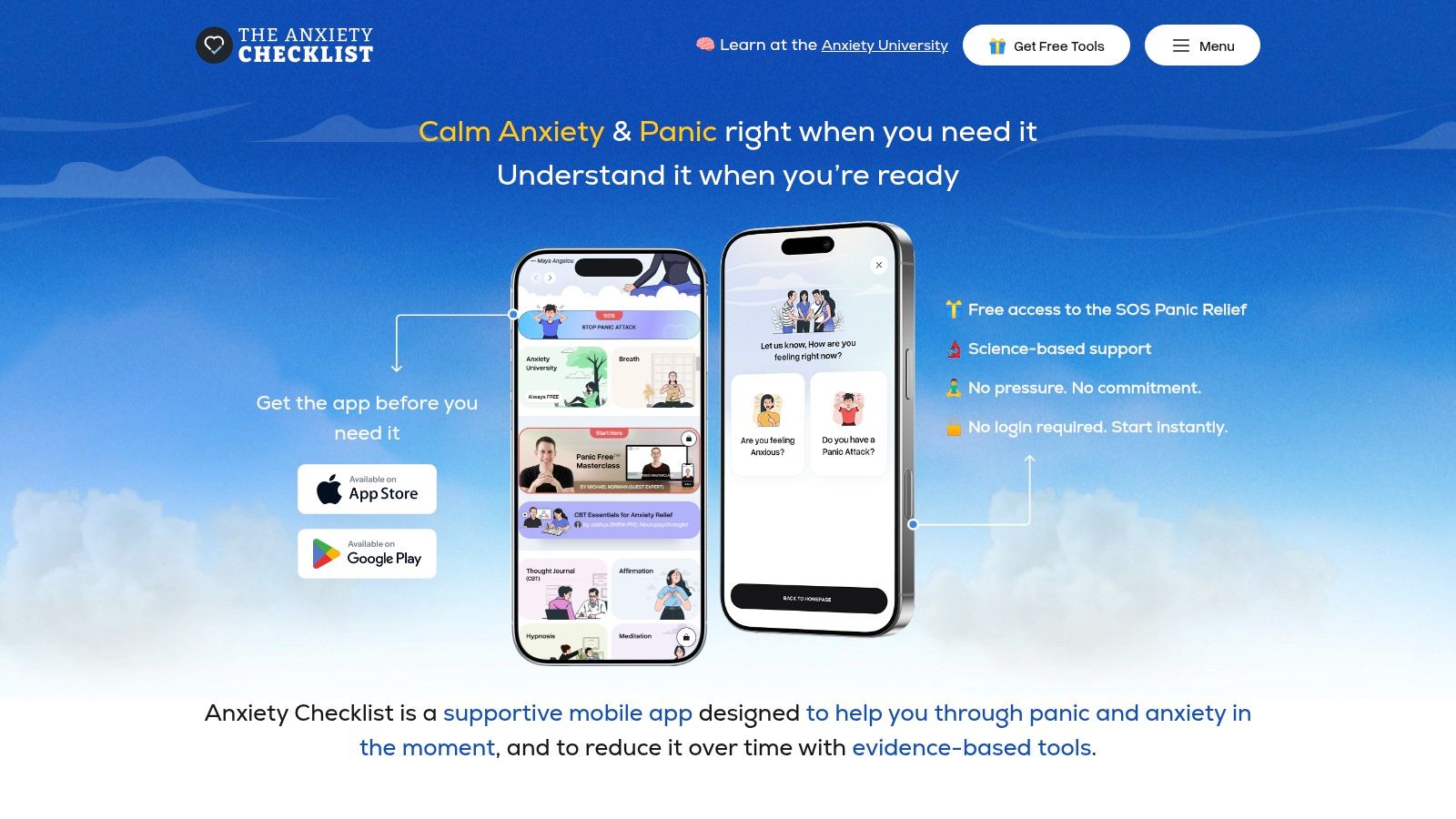
Supplements can help, but they usually work best as part of a larger nervous-system retraining plan. Anxiety gets stronger when the body learns to fear its own sensations, so the long-term answer has to teach safety back into the system. Grounding, CBT-style thought work, sleep support, and movement start pulling their weight.
Physical support can also make the mind easier to work with. The AARP article on anxiety notes that a meta-analysis found 63% of people using weighted blankets reported a reduction in anxiety symptoms, and it also notes that the blanket should weigh up to 10% of body weight (AARP article). For some people, a simple external cue like that is enough to soften the body's alarm response so thinking feels less flooded. It can be the difference between white-knuckling the day and regaining a sense of control.
A practical recovery stack
Grounding for panic: use sensory anchors when your body spikes. Name five things you can see, press your feet into the floor, and slow the exhale. The goal is not to defeat the moment, it is to send a safety signal long enough for the adrenaline surge to settle.
CBT-style thought journaling: write down the scary thought, challenge the assumption, and replace it with a more accurate statement. The AARP article also frames anxiety management as retraining anxious thoughts into more balanced ones, which fits this approach (AARP article).
Guided meditations, sleep audios, and walking sessions: these work because repetition matters. A calm walk after dinner or a ten-minute sleep audio at night can become part of the new normal. For sleep-driven anxiety, those routines often matter more than adding another bottle.
An app-based tool can fit into that routine. The Anxiety Checklist offers an always-free SOS mode with grounding prompts, plus guided meditations, sleep audios, walking sessions, and CBT self-therapy tools such as thought journaling and exposure work. It can serve as a practical bridge between “I need help right now” and “I'm building something durable.”
If you want a structured starting point, diet changes for anxiety can help connect food choices with the rest of the routine. A short video can also be useful when you need something to follow instead of something to figure out.
Consistency, not intensity, is key. A small set of tools used regularly usually beats a long list of supplements taken randomly.
Your Path Forward to Living Panic Free
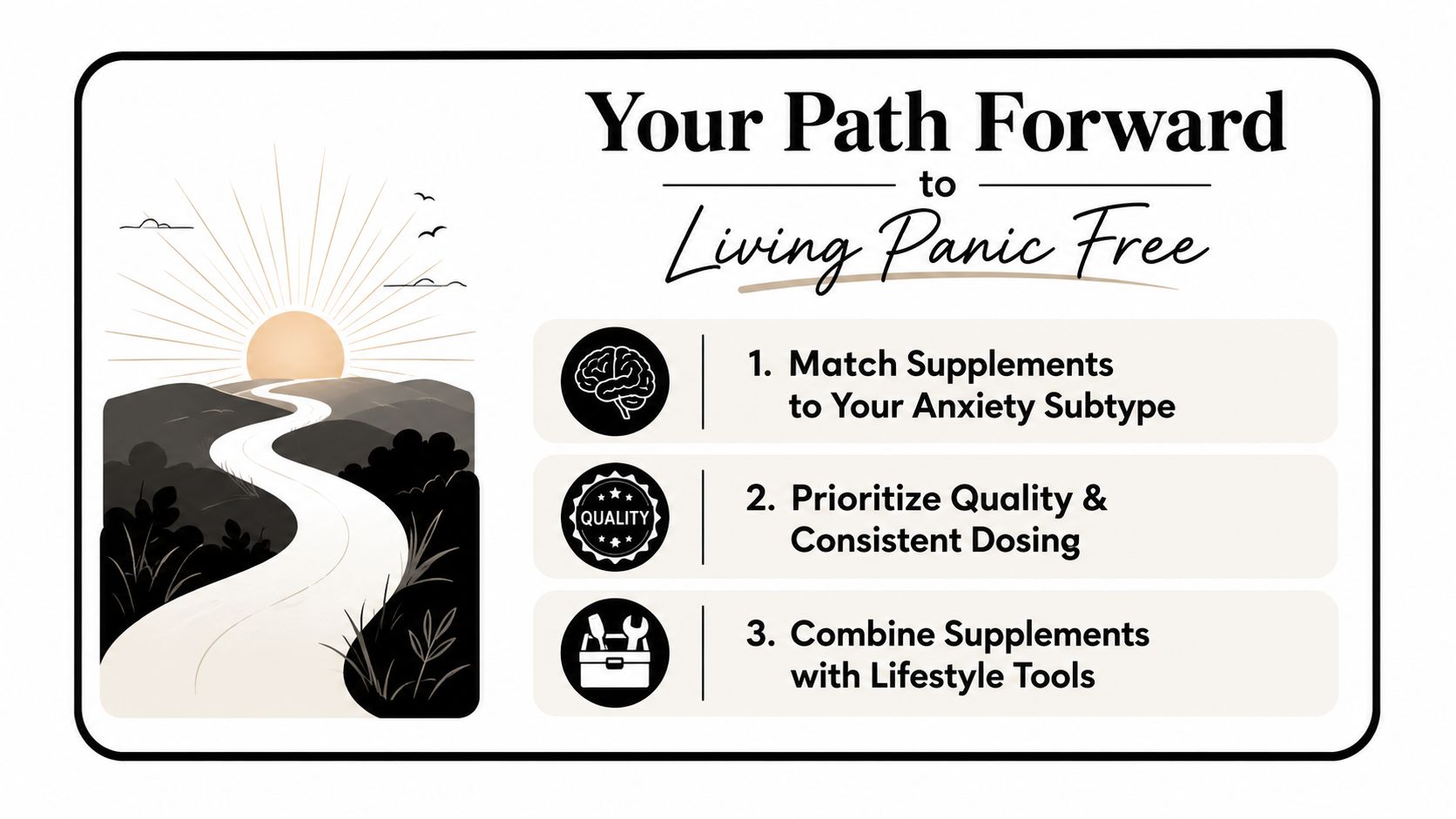
Healing from anxiety usually starts with three decisions. First, match the supplement to the symptom pattern, because panic, generalized worry, and sleep-driven anxiety do not call for the same kind of support. Second, pay attention to product quality and steady dosing, because a weak or inconsistent product is unlikely to help much. Third, pair supplements with lifestyle tools, because the nervous system responds best when it keeps getting clear signals of safety.
A useful standard: if a plan only asks you to buy something and wait, it leaves out too much.
There are also clear moments when self-care is not enough. If anxiety keeps interrupting daily life, if panic keeps coming back, or if thoughts turn toward self-harm, professional help needs to come first. Supplements can still play a role in recovery, but they are not a replacement for care when symptoms are severe or getting worse.
Recovery is usually quieter than people expect. It often shows up as fewer spikes, shorter recovery after a trigger, better sleep, and more confidence in your own body. Small changes like that matter, because they show the system is settling instead of staying on alert.
To take one concrete step today, choose one evidence-backed option, set up one grounding tool, and ask for help if the symptoms are bigger than self-management. Start with what feels doable, then build from there.