


The text is already waiting in your throat. You've rehearsed it in the car, in the shower, while staring at a text you've rewritten six times. Your chest is tight, your brain keeps offering excuses, and part of you would rather live with the tension than risk making things worse. That's what having a difficult conversation feels like for a lot of people, especially when anxiety is part of the picture.
You do not need to be perfectly calm to speak up. You need a plan that respects your nervous system, your words, and the messy truth that anxiety can make your mind go blank at the exact moment you need it most. The good news is simple, and it's real, healing from anxiety is possible, panic doesn't have to run the whole show, and one brave conversation can be the start of feeling safer in your own body again.
Table of Contents
- The Moment Right Before You Open Your Mouth
- Decide If the Conversation Is Worth Having
- Scripts and Phrasing That Lower Defensiveness
- Grounding and De-Escalation in Real Time
- Three Real Scenarios You Can Learn From
- Follow-Up Plans That Reduce the Next Conversation's Cost
- Building a Practice That Makes Hard Talks Feel Possible
The Moment Right Before You Open Your Mouth
The hardest part of having a difficult conversation is often the hour before it starts. You're not even in the room yet, but your body is already acting like it's under threat. The chest tightens. The jaw locks. The mind starts running a rehearsal loop that never quite lands on the right words.
That urge to text instead of talk is not laziness. It's protection. Anxiety is trying to keep you from rejection, conflict, shame, or that awful moment when your voice shakes and you feel exposed in front of another person.
Practical rule: if you're avoiding because you're afraid of the reaction, name the fear before you name the issue.
Avoidance is seductive because it gives short-term relief. But when you delay a hard talk, the issue doesn't disappear, it keeps gathering emotional charge. The longer a misunderstanding sits there, the more likely it is to leak into tone, trust, and daily interactions.
A steadier move is to stop asking, “How do I feel calm?” and start asking, “What does my nervous system need so I can stay present for ten minutes?” If your body is screaming, pause and try these grounding practices before you decide you're not capable. Calm is not the entry fee. Regulation is the target.
You need one sentence to steady yourself before you begin: I can feel scared and still speak clearly. Say it out loud if you have to. The goal isn't to erase dread. The goal is to stop letting dread make the decision for you.
Decide If the Conversation Is Worth Having
Not every uncomfortable feeling deserves a confrontation. That's the first filter, and it matters. A strong rule from leadership guidance is to test whether the issue is recurring, whether you want a real outcome, and whether the timing is workable, because repeated patterns should be framed as patterns, not as isolated annoyances 5 steps for tackling tough conversations.
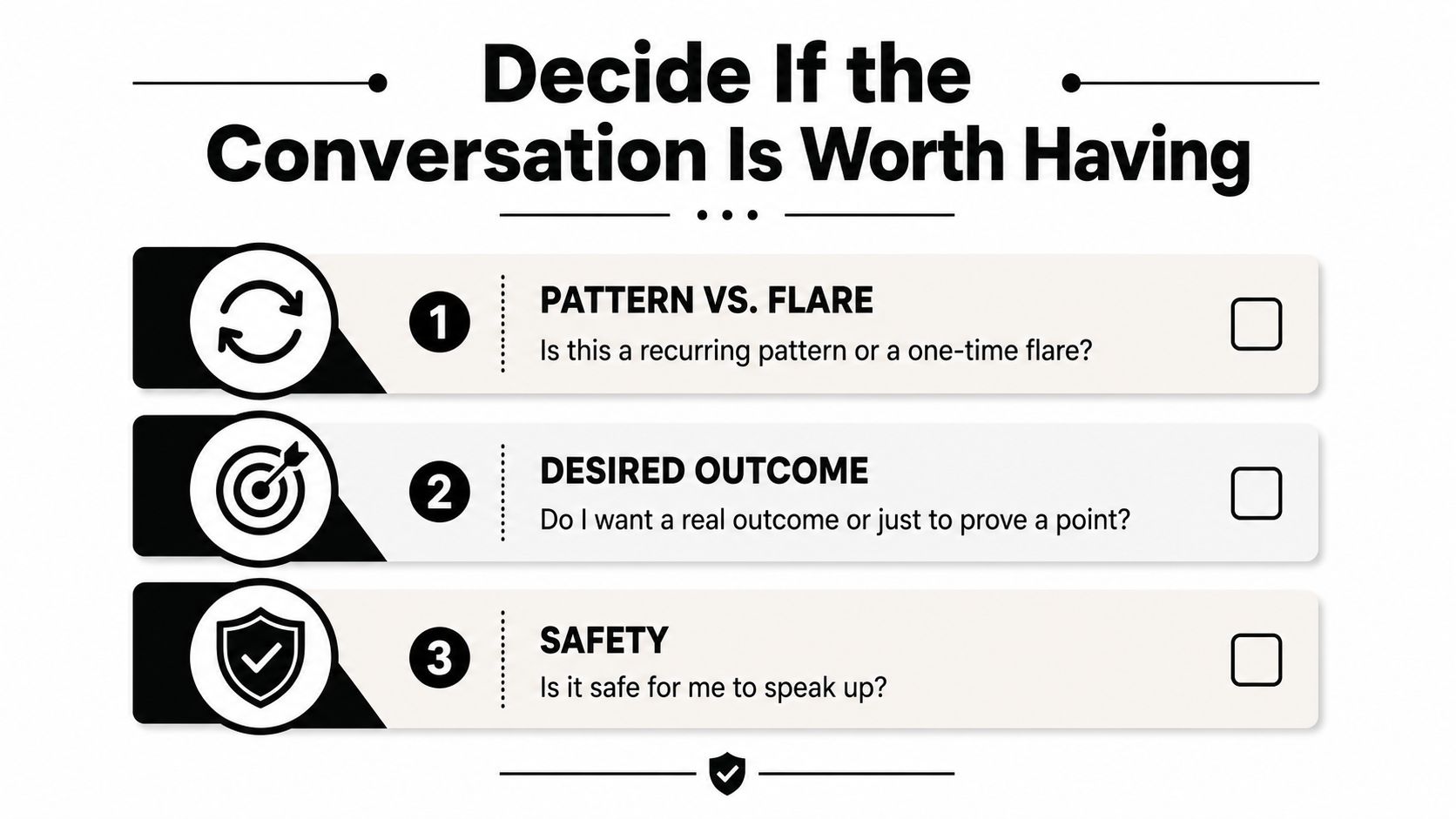
Ask the three questions that cut through panic
First, is this a one-time flare or a pattern? A single bad day may need patience. A repeat problem needs a conversation, because patterns change relationships.
Second, do I want a result, or do I just want to prove a point? If you're only trying to win, you'll probably escalate the room and leave with more anxiety than you started with.
Third, is it safe and workable to speak now? If the answer is no, postpone on purpose. That is not weakness. That is timing.
Use the next 24 hours to prepare in less than ten minutes. Choose the right setting, write the one sentence you most need to say, and name the emotion underneath the issue so it doesn't leak out as blame. If you want a practical companion for that boundary-setting step, this guide on boundaries for panic sufferers fits well with the same logic.
A lot of people feel immediate relief when they give themselves permission to say not now. That clarity lowers anxiety because it ends the internal argument. You're no longer stuck between avoiding forever and forcing a talk that isn't ready.
Scripts and Phrasing That Lower Defensiveness
The best language is plain, specific, and short. Research-based guidance keeps coming back to the same move, describe observable behavior, then invite the other person into the conversation with curiosity instead of accusation difficult conversations guidance. That's the heart of it. Say what happened, say why it matters, ask for their perspective.
Start with facts, not labels
Use a first line that points to one concrete thing.
- “When the report came in late yesterday, I had to reshuffle my afternoon.” That tells the truth without calling anyone careless.
- “When you interrupted me twice in the meeting, I lost my train of thought.” That names the behavior and the effect.
- “When plans changed after I had already made arrangements, I felt blindsided.” That keeps the focus on impact, not character.
Then move to a request.
- "Let's discuss what needs to change." That opens the door.
- "What would make this easier to handle next time?" That turns blame into problem-solving.
- "Can you walk me through what happened on your side?" That invites context instead of defensiveness.
If you need a model for a specific relationship conflict, the confront partner dating app script is a useful example of how direct language can still stay calm and specific. The point isn't the subject matter. The point is the rhythm, facts, impact, question.
Use a bridge when your mind starts to scatter
When you get interrupted or feel yourself losing your thread, say one of these:
- “Give me a second, I want to say this clearly.”
- “I'm getting overwhelmed, so I'm going to slow down.”
- “I hear you, and I still need to finish the point.”
For anyone who tends to spiral into all-or-nothing thinking, the the Anxiety Checklist guide is a good reminder that your brain may be adding drama that isn't in the room. Use that awareness to keep your sentence tight. The more you talk in specifics, the less room anxiety has to improvise catastrophe.
Grounding and De-Escalation in Real Time
Most advice falls apart here. It talks about confidence and phrasing, then leaves you alone the second your heart starts pounding and your thoughts scatter. Real skill means knowing what to do when your body goes offline in the middle of the talk.
The research-based baseline is consistent, difficult conversations should be face-to-face, private, and structured with agreement to communicate, clear problem definition, and active listening NIH/PMC review. But the missing piece is nervous-system support in the moment. That's the piece that matters when you freeze.
Use your body before you use your argument
Try a 4-4-6 breath. Inhale for four, hold for four, exhale for six. That longer exhale helps shift your state without making a scene. Use it when the other person raises their voice or when you feel the urge to over-explain every detail.
Next, drop both feet into the floor. Press down gently. Notice the chair under you. That's enough to interrupt the spiral for a moment. If you're at a table, touch the edge of it and name the texture in your head.
Then run a quick five-senses scan. Name three things you see, two things you feel, and one thing you hear. It sounds small because it is small, and that's exactly why it works. Small actions are easier to complete when your thinking brain is flooded.
Practical rule: if you can't think straight, do not try to argue harder. Regulate first, then respond.
The goal is not to become unshakable. The goal is to stay in the conversation long enough to be honest. If the room feels unsafe or the dynamic is volatile, a source on protective orders and custody in Texas is relevant when the issue touches on real safety concerns and legal boundaries.
For a guided reset, you can also calm panic with breathing exercises before you answer. That's not avoidance. That's making sure your next sentence comes from the part of you that can still choose.
Three Real Scenarios You Can Learn From
The pattern stays the same across relationships. State the issue, ask a question, listen, pause if needed, then propose a next step. What changes is the setting, the tone, and how much nervous system support you need to keep yourself in the room.
A partner asks for more help at home
I need to address our mornings. I'm noticing I'm handling most of the school prep, and I'm getting worn down.
The other person says, “I do help.”
That's the rough patch. Instead of jumping into a defense, the speaker pauses, plants both feet, and says, “I'm not saying you never help. I'm saying I'm overloaded at this point in the week.” Then comes the question, “What can you take on consistently?”
That's the move. Not a speech. A correction, then a request.
If this kind of tension shows up alongside anxious attachment or second-guessing, navigating love versus anxiety can help you tell the difference between fear and a real relationship problem.
A manager gives tough feedback to a peer
“I want to flag something from the project review. The numbers in the draft didn't match the source file, and I had to fix them before sending it up.”
The peer gets sharp and says, “You're making it sound like I can't do my job.”
The speaker doesn't chase that accusation. They slow down and say, “I'm not questioning your ability. I'm telling you what happened and what it affected.” Then they ask, “What's the cleanest way for us to prevent that next time?”
The conversation stays on the work, not on ego.
A friend addresses a small betrayal
“You told me you'd keep that private, and then I heard it from someone else.”
Now the emotion spikes. The speaker feels the urge to list every reason the friend disappointed them. Instead, they take one breath, and say, “I need you to understand why that landed badly for me. Can you tell me how it got shared?”
That question matters because it leaves room for context without excusing the breach. If the answer is vague, the speaker can still name the boundary: “I need you to be more careful with what I trust you with.”
The strongest part of these moments is not perfect wording. It's the recovery after a stumble. That's what tells your nervous system the conversation can survive discomfort.
Follow-Up Plans That Reduce the Next Conversation's Cost
What happens after the talk matters as much as what happens during it. The 24 to 72 hours afterward either lower the pressure for next time or train your body to dread the whole cycle again. The loop closes.
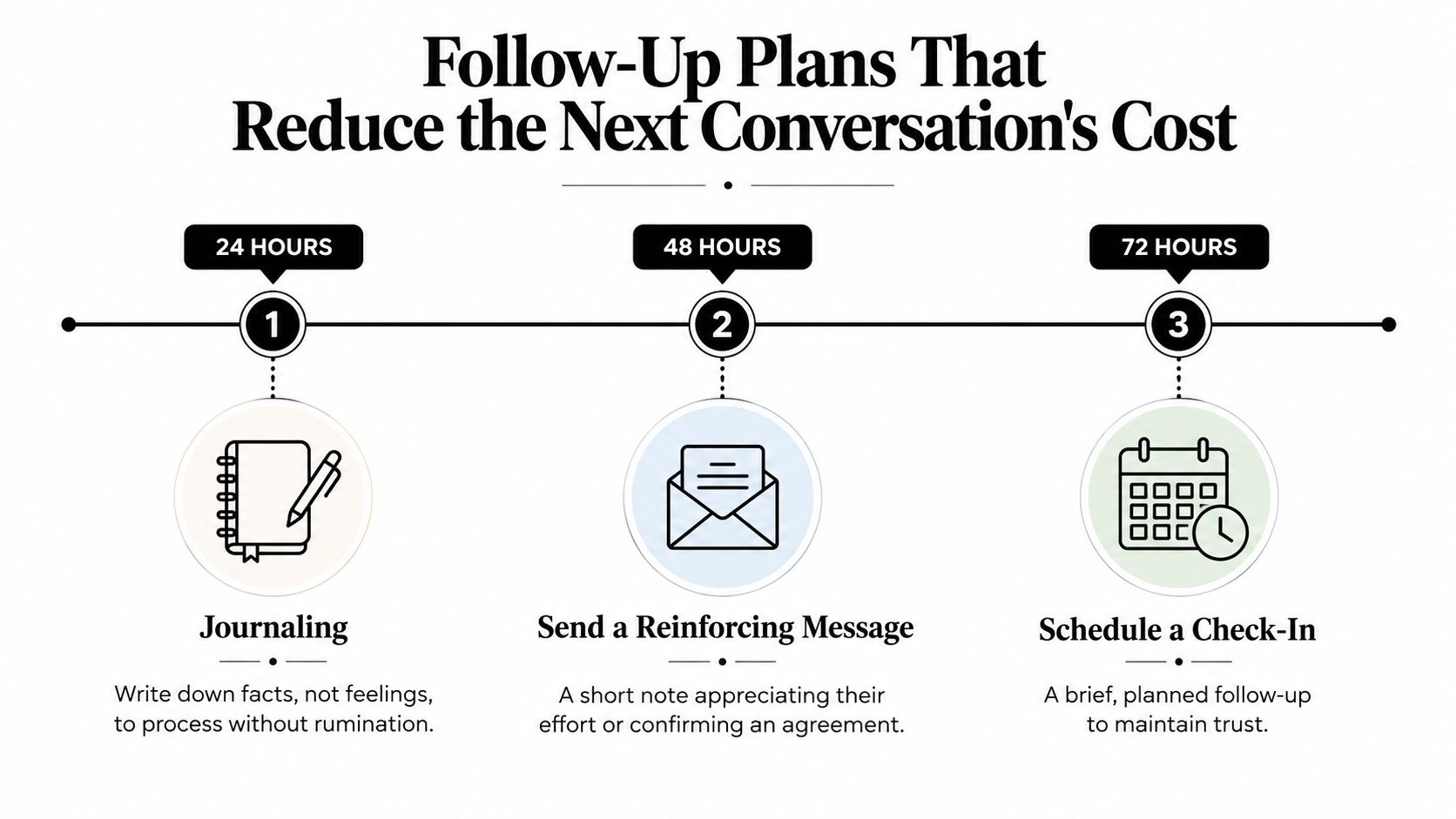
Keep the journal factual
At 24 hours, write down what happened without turning it into a courtroom transcript. Use three lines, what was said, what was agreed, and what still feels unsettled. That keeps you from spiraling into mind-reading and catastrophizing, which are common cognitive distortions after conflict.
At 48 hours, send a short message if it fits the relationship. A simple note like, “Thanks for talking through that with me, I'm glad we're clear on next steps,” is enough. You're reinforcing the agreement, not reopening the fight.
At 72 hours, check whether a planned follow-up is needed. Keep it brief and specific. The point is trust maintenance, not monitoring every detail for signs of danger.
If you want structured support for the journaling side, The Anxiety Checklist includes SOS mode, grounding prompts, and CBT thought journaling, which makes it easier to capture the conversation without turning it into rumination. Used well, tools like that help you separate facts from anxious prediction.
Use a simple question to stop over-monitoring
Ask yourself, “Am I checking in to support the agreement, or am I checking in because I don't trust my fear?” That question saves a lot of emotional energy. It keeps follow-up purposeful instead of compulsive.
The long game is straightforward. Every clean follow-up lowers the cost of the next hard talk. Every vague or avoidant follow-up raises it.
Building a Practice That Makes Hard Talks Feel Possible
The common assumption is that difficult conversations are proof you're good at conflict. I don't buy that. They're proof that your nervous system can learn. Every time you stay present, recover faster, or repair well, you teach your body that honesty doesn't automatically equal disaster.
The most useful tools are the ones you can reach for in the moment. Coping cards, short prompts, and quick next-step reminders matter because they give anxious people something concrete when language disappears. That's why app-based practice can help here, not as a replacement for real relationships, but as rehearsal. You can run grounding drills, practice a script, and capture what happened after the fact.
Make the practice smaller than your fear
Pick one conversation this week. Pick one grounding cue, maybe the exhale, maybe feet on the floor. Pick one follow-up note you'll send after. That's enough.
If you want a structured option, The Anxiety Checklist is one tool that offers SOS support, grounding prompts, CBT journaling, and exposure-style practice in the same place. That doesn't magically remove anxiety. It gives you a place to train before the next conversation shows up in real life.
Hope isn't a mood. It's a method.
You do not need to become fearless to heal. You need enough support to stay with yourself while the fear rises, enough language to say the hard thing without turning cruel, and enough follow-through to prove to your body that one conversation doesn't have to become a crisis. Start this week with one sentence, one breath, and one honest follow-up. Then keep going.
A CTA for The Anxiety Checklist.