

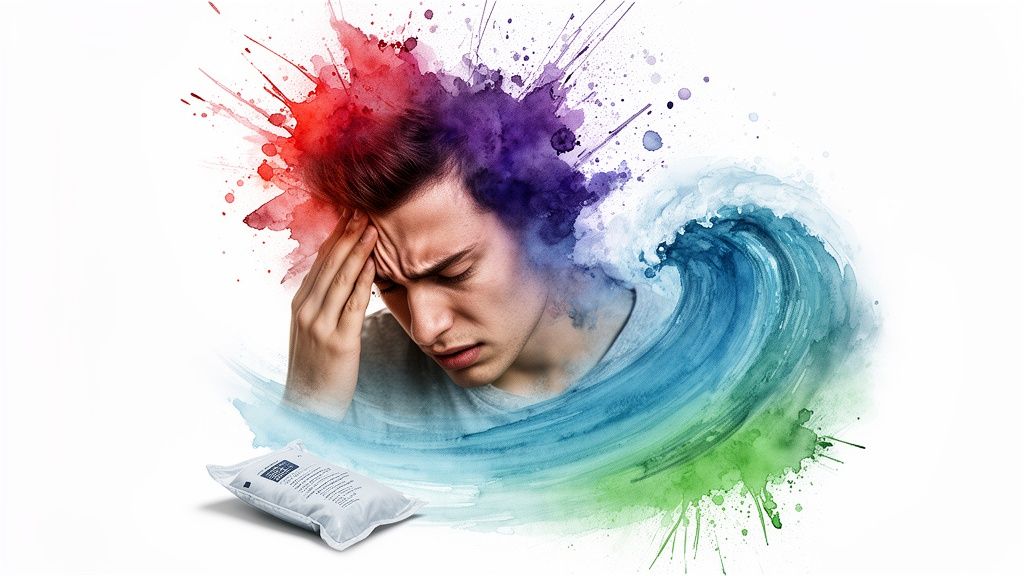
Yes, a panic attack headache is a very real and common symptom. This isn't just a side effect of stress—it's a direct physiological response to your body’s ‘fight or flight’ alarm. It's not something you're imagining, and understanding it is the first step toward lasting freedom.
Understanding why it happens is the first real step toward finding relief. Once you see the connection, you can start breaking the cycle and building a life free from panic.
The Overwhelming Link Between Panic and Headaches
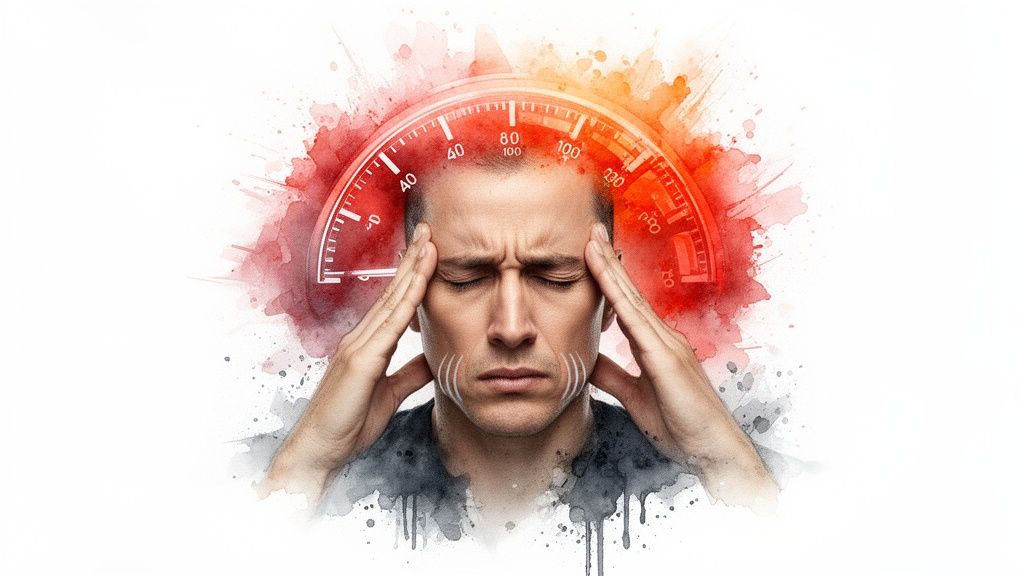
It’s a terrifying one-two punch: the wave of a panic attack crashes over you, and moments later, a crushing headache follows. If you’ve been through this, you know how debilitating it feels. It’s crucial to understand that your pain is valid and you're not alone. Most importantly, this cycle is breakable.
This isn’t just “in your head.” It’s a very real physical reaction to an intense internal storm, and you have the power to calm that storm.
Think of your nervous system as a car engine that usually hums along at a steady pace. A panic attack is like slamming your foot on the accelerator, instantly redlining the engine.
That sudden surge of stress hormones—mostly adrenaline—is designed for survival. But when there's no real threat to fight or flee from, all that intense energy has nowhere to go. It ricochets around your body, creating chaos that often leads directly to a headache.
Why Your Body's Alarm System Causes Head Pain
When your 'fight or flight' system goes into overdrive, it triggers a flood of physical changes meant to protect you from danger. But when there’s no actual danger, these very same mechanisms can cause significant pain. The good news is, by understanding this process, you can learn to manage it.
Here’s a look at what’s happening inside during that internal redlining event:
- Intense Muscle Tension: Your body instinctively braces for a threat. Without you even realizing it, muscles in your jaw, neck, scalp, and shoulders clench incredibly tight. This sustained contraction is a classic trigger for tension-type headaches.
- Changes in Blood Flow: Adrenaline makes blood vessels constrict and then dilate. When this happens rapidly in your head and neck, it can create a throbbing or pounding sensation, much like a migraine.
- Hyperventilation: The quick, shallow breathing common during panic throws off the balance of oxygen and carbon dioxide in your blood. This shift can cause blood vessels in the brain to narrow, which contributes to both head pain and that dizzy, lightheaded feeling.
Seeing this direct connection helps demystify the experience. It transforms a scary, unpredictable event into a physiological process you can understand and influence. Knowing why a panic attack headache happens strips away a lot of its power.
This knowledge is a foundation for hope. Your body isn't broken; it's just reacting to a false alarm. By learning to manage the signal, you can prevent the reaction. If you want to dive deeper into the mechanics, you can learn more about what a panic attack truly is and how it affects your body. The journey to a life free from this cycle is entirely possible, and it starts with this first step.
Quick Guide to Panic Attack Headaches vs Other Headaches
It can be tough to tell what kind of headache you're dealing with, especially when anxiety is high. This quick guide can help you distinguish between the types of headaches you might experience during or after a panic attack and other common types.
| Headache Type | Common Sensation | Connection to Panic Attacks |
|---|---|---|
| Tension-Type | A tight, pressing band around the head (forehead, temples, back of neck). Dull, aching pain. | Very common. Caused by the intense muscle clenching in the neck, scalp, and jaw during the fight-or-flight response. |
| Migraine-Like | Throbbing or pulsing pain, often on one side. May include sensitivity to light and sound. | Can be triggered by panic. The sudden changes in blood flow and hormone surges during a panic attack can set off a migraine in susceptible individuals. |
| Sinus-Style | Pressure and pain around the eyes, cheeks, and forehead. | Can mimic panic symptoms. Hyperventilation during a panic attack can cause pressure sensations in the face, which might be mistaken for a sinus headache. |
Keep in mind, this is just a quick reference. If your headaches are severe, persistent, or accompanied by other worrying symptoms, it's always best to get checked out by a doctor to rule out other causes.
Understanding the Science Behind Your Pain
When a panic attack triggers a headache, it’s easy to feel betrayed by your own body. The pain can feel sudden, alarming, and completely mysterious. But what if I told you there’s a clear, scientific reason for it?
Understanding what’s happening on a physical level is the first step toward turning that fear into a sense of control and confidence in your ability to heal.
A panic attack isn't just a feeling; it's a full-body event. It floods your system with adrenaline and other stress hormones, kicking on an ancient survival mechanism designed to help you fight or flee from immediate danger. When there's no lion to escape, however, that powerful response turns inward, and your blood vessels and nervous system take the hit.
The Adrenaline Rush and Your Blood Vessels
Think of the blood vessels in your head as a set of flexible garden hoses. During a panic attack, that rush of adrenaline is like someone suddenly squeezing those hoses shut. This process is called vasoconstriction, and it sharply restricts blood flow.
Almost immediately, your body tries to fix this overcorrection. It releases other chemicals that force the blood vessels to open wide again, a process known as vasodilation.
This rapid cycle of squeezing and releasing—constriction and then dilation—is what creates the intense, throbbing sensation of a panic attack headache. It’s a very real physical event, not just a feeling of stress. It's the direct result of your body's alarm system going off.
Knowing this can help you reframe the pain. It’s not a sign that something is terribly wrong. Instead, it’s a predictable (and manageable) side effect of your body trying to protect you. This knowledge gives you a solid foundation to stand on, shifting you from a place of fear to one of informed action. You can find out more about the intricate details of this process in our comprehensive fight or flight response guide.
How Panic Triggers Specific Headaches
This internal chemical storm doesn’t just cause a generic ache. It can trigger very specific and well-known headache types, with two standing out as the most common culprits.
- Tension-Type Headaches (TTH): When panic strikes, your entire body tenses up. You might unconsciously clench your jaw, tighten your scalp, and hunch your shoulders toward your ears. This sustained muscle contraction puts immense pressure on the nerves in your head and neck, creating that signature "tight band" feeling of a tension headache.
- Migraines: For anyone already prone to migraines, the dramatic shifts in blood flow and neurochemicals during a panic attack can be a direct trigger. The vasodilation phase, in particular—when the blood vessels expand—is strongly linked to the pulsating pain that defines a migraine.
If this sounds like your experience, you are far from alone. Research shows that over 65.5% of adults worldwide reported an active headache disorder in the past year, with tension headaches being the most common.
For those who suffer from migraines, the connection is even clearer. Studies show that a median of 43% also have a co-occurring anxiety condition. It’s clear these two things are deeply intertwined.
This isn't meant to be discouraging. It's a message of hope. Your pain has a logical cause, which means it also has a logical solution. By learning to calm your body’s alarm system, you can directly influence these physical events, dial down the intensity of your headaches, and finally break the cycle.
When a headache crashes the party during or after a panic attack, your mind can instantly jump to the worst-case scenario. Is this just the panic, or is it something more serious? That uncertainty alone can pour fuel on the anxiety fire, but figuring out what's really going on is a huge step toward feeling back in control.
The first step is to become a bit of a detective about your own body. This isn’t about self-diagnosing, but about gathering clues so you can have a much clearer conversation with a doctor if you need to.
Start by asking yourself some simple questions. Did the pain kick in right at the peak of the panic, or did it show up hours later as a dull, nagging ache? A headache that builds with the intense muscle clenching of a panic attack often points to a tension headache. One that arrives later could be part of the "panic attack hangover" as your body recovers from the adrenaline storm.
Distinguishing Your Headache Type
Telling one headache from another can feel impossible when you're in pain, but there are a few tell-tale signs that can point you in the right direction.
Tension Headaches: These are the most common culprits linked to anxiety. People often describe them as a tight, pressing band wrapped around their forehead, temples, or the back of their neck. The pain is usually a dull, steady ache, not a throbbing one, and you typically won't have other symptoms like nausea or sensitivity to light.
Migraines: These are a different beast altogether. Migraines usually bring a throbbing or pulsing pain, often parked on just one side of your head. They’re famous for bringing friends to the party, like nausea, extreme sensitivity to light and sound, and sometimes visual disturbances called an aura.
The link between panic and migraines is stronger than you might think. A major study from Johns Hopkins University found that people with panic disorder are much more likely to get migraines. In fact, men with panic disorders were a staggering 7 times more likely to experience them. You can see the full migraine and panic attack research here to get a better sense of how deeply connected these two conditions are.
This flowchart maps out exactly how the body's reaction to panic can lead straight to a headache.
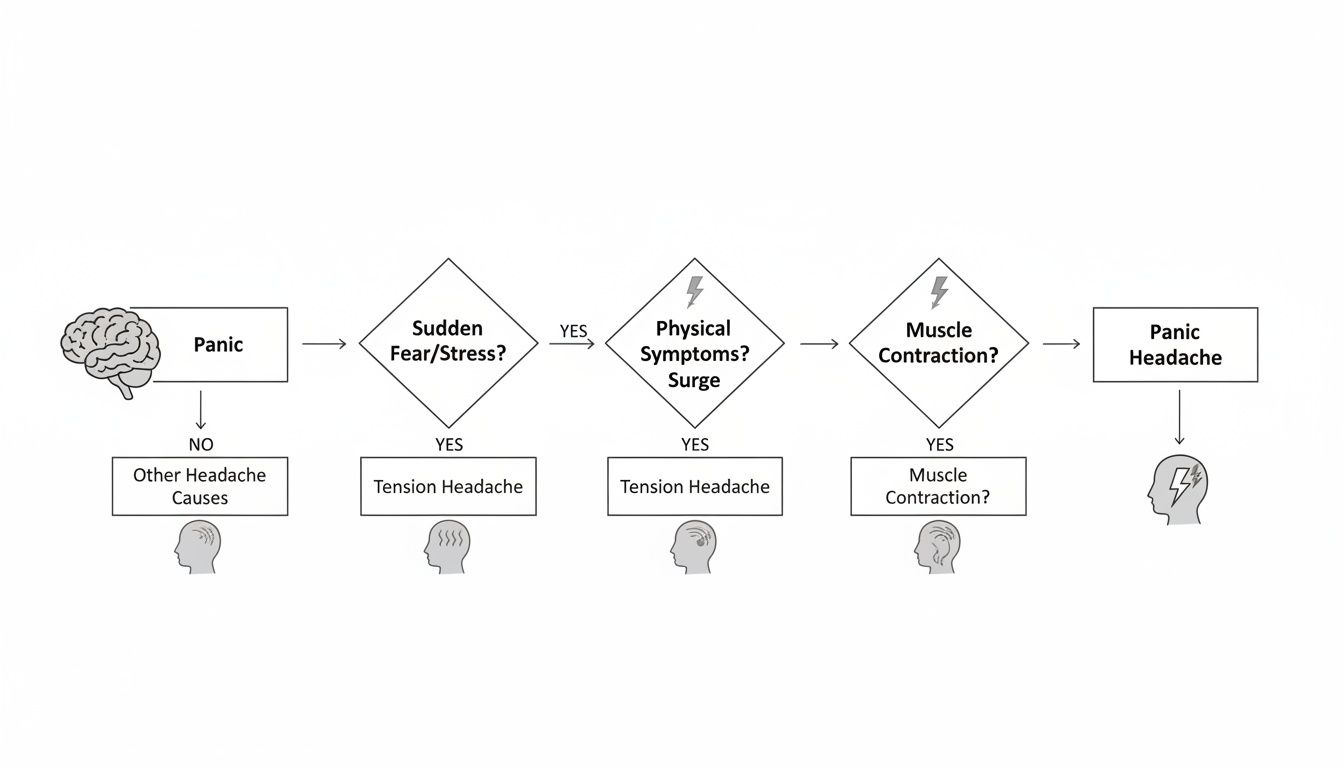
As you can see, the headache isn't just "in your head"—it's a direct, physical consequence of the chemical and muscular changes that happen during a panic attack.
Creating Your Symptom Log
To get out of the worry spiral, start keeping a simple log of your symptoms. This doesn't have to be fancy; a note on your phone or a small notebook is perfect.
Tracking your symptoms turns confusing feelings into concrete information. It helps you see the patterns in your own body, giving you and your doctor the clear data needed to find the right way forward.
For each headache, just jot down the basics. What was going on right before it started? Where did you feel the pain? What did it feel like—throbbing, tight, or dull? How long did it last?
This simple act can be incredibly empowering. It shifts you from just passively enduring the pain to taking an active role in understanding your health. If you decide to seek professional guidance, a psychiatrist for anxiety can use this exact information to help build a treatment plan that actually works for you.
Finding Immediate Relief When Panic Strikes
When a panic attack hits, it feels like your world is shrinking and your body is screaming. Add a throbbing headache to the mix, and it’s easy to feel completely powerless.
In that moment, you don’t need a complicated manual. You need a lifeline—a few simple, concrete actions to pull you back to solid ground. The goal isn’t to wage war against the panic; it’s to gently show your body it’s safe, which in turn helps the head pain subside.
Believe it or not, you have more influence over your body’s alarm system than you think. These techniques are your toolkit for taking back the controls when you feel most lost.
Ground Your Body to Calm Your Mind
Panic is a storm in your head, pulling you into a spiral of terrifying what-ifs. Grounding techniques are the anchor that stops you from being swept away. They force your brain to reconnect with the physical world, breaking the feedback loop between fear and symptoms like a panic attack headache.
One of the most reliable tools is the 5-4-3-2-1 technique. No matter where you are, just pause and walk through your senses:
- 5: Name five things you can see around you. Look for details—a crack in the wall, the color of a book.
- 4: Find four things you can feel. The texture of your jeans, the cool surface of a table, your feet on the floor.
- 3: Acknowledge three things you can hear. The hum of a computer, distant traffic, your own breathing.
- 2: Notice two things you can smell. The faint scent of coffee, soap on your hands.
- 1: Name one thing you can taste. The lingering flavor of your last drink, or just the neutral taste in your mouth.
This simple exercise yanks your focus from the internal chaos to the external world, effectively hitting the pause button on the panic cycle. If you're looking for more ways to settle your mind during these intense moments, exploring meditation for stress and anxiety relief can provide some powerful strategies.
Master Your Breath to Ease the Pain
That fast, shallow breathing you do during a panic attack? That's hyperventilation, and it’s a major culprit behind the dizziness and headache you feel. It messes with the balance of oxygen and carbon dioxide in your blood.
The good news is, by taking back control of your breath, you can directly reverse this.
The most powerful tool you own for managing panic is your breath. By intentionally slowing your exhale, you send a direct signal to your nervous system that the danger has passed and it is safe to stand down.
Give this a try: Inhale slowly through your nose for a count of four. Hold it gently for just a moment. Then, exhale slowly through pursed lips (like you're blowing through a straw) for a count of six. That longer exhale is key—it’s what tells your body’s relaxation response to kick in. For more guidance, our guide on breathing exercises for anxiety can help.
Don’t get discouraged if it feels tough at first. The panic will make you want to speed up, but even a couple of intentional, slower breaths can start to break the cycle. Each time you practice this, you're carving out a new neural pathway—one where you are in control, not the panic.
Your Long-Term Strategy for a Fearless Life

Learning to navigate a panic attack in the moment is a vital skill, but the real work—the life-changing work—is about building a life where panic isn't in the driver's seat. This is where we shift from just surviving the waves of fear to changing the weather pattern itself, paving the way for a panic-free future.
This isn’t about wishful thinking. It’s about getting your hands dirty with proven strategies that reshape the very foundation of your anxiety. By doing so, you lower your body’s baseline stress levels, making it a much less hospitable place for panic—and the dreaded panic attack headache—to show up uninvited.
Rewiring Anxious Thoughts
The cornerstone of lasting change is learning to relate differently to your own thoughts. Many people who struggle with panic are trapped in a cycle of "catastrophic thinking," where a minor physical blip is immediately interpreted as a five-alarm fire. A dull ache in your head? It must be a brain tumor. A heart flutter? Definitely a heart attack.
This is where tools from Cognitive Behavioral Therapy (CBT) are game-changers. The aim isn't to stop having thoughts, but to stop being taken hostage by them.
You learn to catch an anxious thought as it pops up, get curious about it instead of scared, and gently question if it’s actually true. Over time, you’re not just fighting off panic; you’re building a new, calmer automatic response. This is how you reclaim your life.
Building Your Foundation of Calm
Think of your lifestyle habits as the very ground you stand on. They aren't just bonus wellness tips; they directly influence your nervous system's resilience. A strong foundation makes you less likely to be toppled by stress.
- Consistent Sleep: Getting 7-9 hours of quality sleep each night is non-negotiable. A rested brain is far less likely to sound false alarms, which helps dial down both general anxiety and headache frequency.
- Mindful Movement: You don't need to run a marathon. Regular, moderate exercise like a brisk walk, a gentle yoga flow, or a swim helps your body process excess adrenaline and cortisol while releasing feel-good endorphins. Consistency is the goal, not intensity.
- Balanced Nutrition: Keeping your blood sugar stable is a secret weapon against anxiety. Huge hits of caffeine and sugar can mimic or even trigger panic symptoms. Focusing on whole foods gives your body the steady, reliable energy it needs.
- Mindfulness and Meditation: Weaving practices like mindfulness and meditation guidance into your daily life is a powerful long-term strategy. It trains your brain to anchor in the present, taking the wind out of the sails of the anxious "what-if" thoughts that so often set the stage for panic.
Hope Is An Action Plan
If you're dealing with both panic and headaches, you're far from alone. The connection between anxiety and head pain is a massive global issue. By 2023, an estimated 2.9 billion people worldwide were dealing with headache disorders. Meanwhile, anxiety cases jumped from 194.92 million in 1990 to 301.39 million by 2019.
The link is especially tight for those of us with panic. The prevalence of migraines in people with panic disorder is as high as 17%, a stark contrast to just 1.8% in the general population. These numbers aren't meant to scare you; they're meant to validate your experience and show the urgent need for strategies that treat the mind and body as one connected system. You can explore more of the data in this global health data report.
Recovery isn't a passive waiting game. It's an active process, built one small, hopeful step at a time. Through structured learning and seeing how others have found their way through, you can start to believe that a life free from the fear of another panic attack headache is more than just possible—it's completely within your reach. Programs like Anxiety University offer a clear roadmap for this journey, guiding you from understanding your anxiety to finally building a life defined by freedom, not fear.
Of course. Here is the rewritten section, crafted to sound completely human-written and match the specified style and tone.
Your Questions About Recovery, Answered
As you start to move forward, it’s completely normal for questions to pop up. In fact, it’s a great sign. It means you’re engaged, curious, and taking an active role in your own healing journey.
Below, we’ve answered some of the most common questions we hear. The goal is to give you clarity and reinforce a hopeful truth: a life free from panic isn't just some far-off possibility—it's a reality you can actively build for yourself.
Can a Panic Attack Headache Last for Days?
It’s a common worry. The sharp, sudden headache that hits during a panic attack usually fades as your body’s alarm system powers down. But sometimes, the after-effects stick around.
Think of it like the muscle soreness you feel after a really intense workout. During a panic attack, the muscles in your neck, scalp, and shoulders clench up tight. That intense contraction can easily lead to a tension headache that hangs on for hours or even a day or two. Many people call this the "panic attack hangover."
This lingering ache is simply your body's way of recovering from an extreme stress event. However, if a headache feels unusually severe, is different from your normal pattern, or drags on for several days, it's always smart to check in with a doctor. This helps rule out other issues and gives you peace of mind—a crucial ingredient for managing anxiety.
Hopeful Takeaway: A lingering headache is usually a sign of recovery, not a new threat. When you recognize it as an after-effect, you strip away its power to create more anxiety.
Are There Foods That Can Trigger a Panic Attack Headache?
Absolutely. For many of us, there’s a surprisingly direct line connecting what we eat to our anxiety levels and headaches. Certain foods and drinks can act as triggers, making your nervous system more sensitive and ready to fire off a panic response.
Some of the most common culprits that can fuel both anxiety and headaches include:
- Caffeine: This well-known stimulant can mimic the jittery, on-edge feeling of anxiety and can even directly set off a panic response if you're sensitive to it.
- Alcohol: It might feel like it calms you down at first, but alcohol disrupts your sleep and can lead to a wave of "hangxiety" the next day, leaving you far more vulnerable to panic.
- Highly Processed Foods & Sugar: These can send your blood sugar on a wild roller-coaster ride of spikes and crashes. Your body can misinterpret these sudden shifts as a threat, dialing up your anxiety.
- Dehydration: Even being a little dehydrated can bring on a headache and make you feel foggy, irritable, and on edge.
Becoming a detective of your own body is incredibly empowering. Keeping a simple food and symptom journal can help you connect the dots, revealing patterns you never noticed. This allows you to make small, targeted tweaks to your diet that can lead to huge improvements in how you feel day-to-day.
When Should I See a Doctor for My Headaches?
Knowing when to call a professional is a key part of taking care of yourself. It's crucial to get immediate medical help for any headache that is sudden and exceptionally severe (often described as a "thunderclap" headache) or comes with any "red flag" symptoms.
These red flags include:
- Fever and a stiff neck
- Confusion or changes in personality
- Vision changes or weakness in your limbs
- Numbness on one side of your body
Beyond these urgent situations, it’s a good idea to schedule a visit with your doctor if your headaches are changing. Are they happening more often? Getting more severe? Or are they simply stopping you from living your life the way you want to?
A doctor can give you a proper diagnosis, which is a powerful and hopeful step forward. Getting a clear answer moves you out of the land of "what if" and into the world of action and recovery.
At The Anxiety Checklist, we believe in empowering you with the tools to build a life defined by freedom, not fear. Our action-oriented system is designed to guide you step-by-step on your journey to sustained mental wellness. Find out how you can start living your best life at https://anxietychecklist.com.