

Somewhere in the last hour, your thoughts may have started sprinting ahead of you.
Maybe your chest got tight. Maybe the room felt strange, as if you were there but not fully there. Maybe a single thought landed with terrifying force: am i losing my mind?
I know how convincing that fear can feel. When anxiety peaks, it does not feel like “just stress.” It can feel like your brain is slipping, your control is fading, and something irreversible is happening. That fear is heavy. It is lonely. It is also a fear many people recover from.
This experience can get better. You can learn what your body is doing, lower the panic in the moment, and build a life that does not revolve around scanning yourself for signs that you are “going crazy.”
You're Not Losing Your Mind and You Are Not Alone
A lot of people reach this question in the same way. The first panic surge hits. Their heart pounds. Their thoughts get loud and fast. They feel unreal, detached, shaky, trapped, confused. Then a second layer of fear appears: “Normal people do not feel like this. Something is very wrong with me.”
That second fear often hurts more than the anxiety itself.
If that is where you are right now, pause and take in this sentence: feeling like you are losing your mind is a common anxiety experience, not proof that you are losing it.
In the U.S., 23.1% of adults experienced some form of mental illness in 2022, and adults ages 18 to 25 had the highest prevalence at 36.2%, according to the National Institute of Mental Health. That does not mean everyone felt exactly what you feel. It does mean distress on this level is far from rare.
I remember how shocking it was to learn that panic can make ordinary people feel completely unlike themselves. You can be responsible, smart, grounded, and still have a nervous system that floods you with the sensation that your mind is breaking.
What this fear often sounds like
- “I feel detached from reality.” The world may seem dreamlike, distant, foggy, or off.
- “My thoughts are too fast to control.” The mind starts throwing out catastrophic possibilities.
- “I do not trust my own brain right now.” That loss of confidence can be more frightening than any single symptom.
- “What if this is the moment I snap?” Many anxious people fear a point of no return that never comes.
The intensity of a feeling is not the same as the accuracy of a feeling.
There is hope in naming what is happening. Once you stop treating the sensation as a mystery and start seeing it as a pattern, things become less chaotic. If you want a grounded place to learn the basics of anxiety in plain English, Anxiety University is a useful starting point.
Why Your Brain Feels Like It's Breaking
When anxiety spikes, your brain is not “breaking.” It is misfiring in a protective direction.
It's comparable to a smoke alarm that is set too sensitively. A good smoke alarm helps when there is a real fire. A faulty one screams because of burnt toast. Your anxiety system works the same way. It is designed to protect you, but sometimes it reacts to stress, bodily sensations, or scary thoughts as if they are life-threatening.
The amygdala hijack
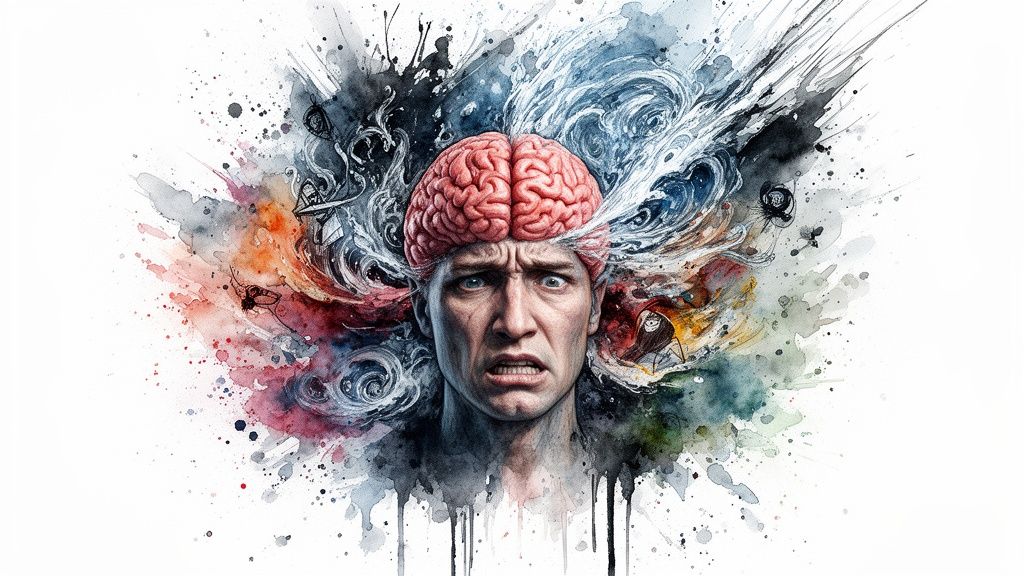
During a panic attack, the amygdala hijacks the prefrontal cortex, triggering a fight-or-flight response that can increase cortisol levels by 2 to 5 times. That hormonal surge can cause racing thoughts and derealization, which can mimic psychosis but are described as a benign and temporary response in this source from Modern Psych and Wellness.
In plain language, your alarm system jumps ahead of your thinking brain.
Your amygdala is the fast, threat-detecting part. Your prefrontal cortex helps with perspective, planning, language, and reality-checking. When the alarm system surges, clear thinking gets pushed into the background. That is why it can feel hard to reason with yourself in the middle of panic.
Why the symptoms feel so extreme
Anxiety does not just create “mental worry.” It changes how your body and attention work.
You might notice:
- Racing thoughts because your brain is scanning for danger
- Derealization where the world feels distant or unreal
- Tunnel attention where you fixate on sensations and worst-case outcomes
- A sense of doom even when nothing external is happening
This is why reassurance like “just calm down” rarely works. Your body is acting as if there is an emergency. The goal is not to win an argument with panic. The goal is to send your nervous system a signal that the danger has passed.
A fuller explanation of this body alarm can help when your symptoms start to scare you. This guide on the fight-or-flight response breaks it down clearly.
When panic says “your mind is failing,” your nervous system is often doing exactly what an alarmed nervous system does.
The key shift
Once I understood this, one thing changed for me. I stopped asking, “What hidden disaster is this symptom proving?” and started asking, “What is my alarm system reacting to right now?”
That question has a different energy. It lowers shame. It brings curiosity back online. It makes room for skill instead of terror.
Decoding the Feeling What It Could Mean
The phrase am i losing my mind covers several very different experiences. That is one reason the fear becomes so sticky. People use one sentence to describe panic, detachment, intrusive thoughts, burnout, and depressive fog.
You do not need to diagnose yourself from an article. But it helps to sort the experience into patterns. Patterns create language. Language creates options.
Panic and high anxiety
For many people, the feeling comes in waves. It builds fast, peaks hard, and leaves them exhausted afterward.
The mind usually grabs onto one catastrophic interpretation. “I am having a breakdown.” “I am about to lose control.” “I will never come back from this.” The body joins in with adrenaline, shakiness, dizziness, chest tightness, nausea, and urgency.
A person in panic often still knows, on some level, that what they are feeling is strange and frightening. They are not calm inside the experience. They are alarmed by it.
Depersonalization and derealization
This is one of the most misunderstood anxiety symptoms.
Depersonalization can feel like being disconnected from yourself. Your thoughts may feel distant. Your voice may sound odd. You may feel robotic, numb, or as if you are watching yourself from the outside.
Derealization affects how the world feels. Familiar places can seem dreamlike, foggy, flat, or unreal. Nothing may look obviously wrong, but everything feels subtly off.
That “off” feeling can trigger the most terrifying interpretation possible: “If reality feels strange, maybe I am becoming psychotic.”
A 2024 study in the Journal of Anxiety Disorders found that 62% of people with chronic anxiety misattribute depersonalization and derealization to impending psychosis, which often delays appropriate anxiety treatment, as stated in this referenced source: https://www.youtube.com/watch?v=5gfuK9B9MbQ
That confusion is common. It is also understandable.
Intrusive thoughts and OCD-like spirals
Sometimes “losing my mind” does not feel like panic in the body. It feels like terror about a thought.
A person may have a violent, sexual, blasphemous, or bizarre thought that clashes completely with their values. They do not want the thought. They are horrified by it. Then they start checking themselves.
“Why did I think that?”
“What if it means something?”
“What if I secretly want it?”
“What if I snap?”
The loop grows because the person keeps trying to prove to themselves that they are safe, normal, and in control. The thought becomes sticky not because it is meaningful, but because it scared them.
Depression and burnout fog
Not every “I am losing it” moment is acute panic. Sometimes it is a slower collapse in mental sharpness.
You may feel flat, mentally overloaded, unable to focus, unable to care, or unable to think clearly. The fear then becomes, “I am not myself anymore.” That can happen during depression, prolonged stress, burnout, grief, or sleep deprivation.
The difference is often in the tone. Panic tends to feel urgent and explosive. Burnout and depression often feel heavy, slowed, and drained.
A practical comparison
Comparing Sensations That Feel Like 'Losing Your Mind'
| Experience | Key Feature | Insight/Awareness | Common Thought Pattern |
|---|---|---|---|
| Panic or high anxiety | Sudden surge of fear, body alarm, catastrophic interpretation | Usually aware that something feels wrong and frightening | “I am about to lose control.” |
| Depersonalization or derealization | Feeling detached from self or surroundings | Often aware that the feeling is strange and unsettling | “Why does everything feel unreal?” |
| Intrusive thoughts with OCD-like fear | Unwanted thoughts that clash with values | Strong awareness that the thoughts feel disturbing or unacceptable | “What if having this thought means I will do it?” |
| Depression or burnout fog | Mental dullness, low energy, poor focus, emotional flattening | Usually aware of decline in motivation or clarity | “I cannot think like I used to.” |
The point readers often miss
People often assume that if a symptom feels bizarre, it must be severe in the most dangerous way.
That is not how anxiety works. Anxiety is famous for creating sensations that feel dramatic, foreign, and loaded with meaning. The feeling itself can become the trigger for more panic.
Here is one useful distinction. People in anxiety spirals often ask, “Why does this feel so weird?” They fear the experience. They monitor it. They try to make sense of it. That fearful self-awareness is different from being carried along by a fixed false belief without questioning it.
That is not a diagnosis rule. It is a clue that can lower unnecessary fear while you seek proper help.
If you are stuck between “panic” and “something worse”
Use curiosity before conclusions.
Ask yourself:
- Did this come with a rush of fear?
- Am I frightened by the thought or sensation itself?
- Does it come in episodes, or has it been steady?
- Do I keep checking, researching, and seeking certainty?
- Do I feel detached, or do I feel convinced of something others clearly do not share?
Those questions do not replace a clinician. They do help organize the mess in your head.
A confusing symptom is easier to survive once you can describe it accurately.
Red Flags That Require Urgent Medical Attention
Individuals who fear they are losing their mind often deal with anxiety, panic, or another treatable mental health issue. Still, some situations call for urgent help now, not more self-monitoring.
Seek immediate support if any of these are happening:
- You have a current plan to harm yourself or someone else. Thoughts alone can happen in many conditions. A plan with intent is different.
- You hear voices telling you to do things. Especially if the experience feels commanding, threatening, or difficult to resist.
- You are completely unable to tell what is real and what is not. If you cannot question the experience at all, do not try to manage it alone.
- You suddenly become confused after a medical event or substance use. New disorientation, blackouts, or severe agitation can have medical causes.
- Someone around you is frightened by a dramatic change in your behavior and cannot reach you emotionally. Take that seriously.
If any of this fits, act quickly. Call emergency services, go to the nearest emergency department, contact a crisis line in your area, or tell the nearest safe person exactly what is happening. If you need a direct next step, use this get help now page.
Getting urgent care is not overreacting. It is a strong, clear decision to protect yourself.
Your First Aid Kit for Overwhelming Moments
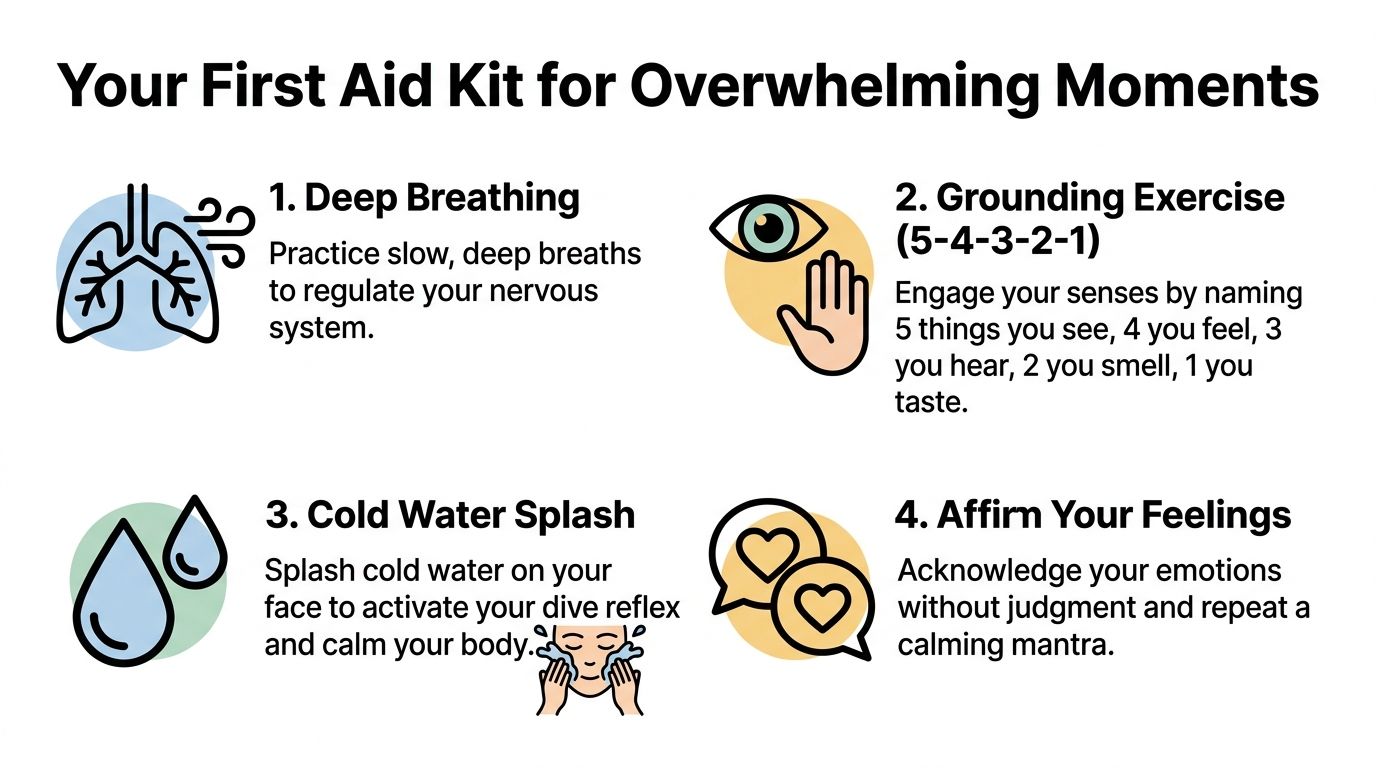
When panic starts climbing, your job is not to force yourself to feel calm instantly. Your job is to interrupt the spiral.
Keep this part simple. Use one technique. Then another. Think of these as mental first aid, not a final cure.
The 5-4-3-2-1 method
This works because panic narrows your attention inward. Grounding widens it outward.
Try this slowly:
- 5 things you can see
- 4 things you can feel
- 3 things you can hear
- 2 things you can smell
- 1 thing you can taste
Do not rush. Look around as if you are proving to your brain that you are in a room, not in a mental free fall.
Slow breathing
Fast, shallow breathing can keep panic going. Slower breathing tells your body the emergency has eased.
You can use a simple version:
- inhale gently
- pause briefly
- exhale longer than you inhaled
Do not force giant breaths. That can make you feel more air hungry. Think soft, low, and steady.
Here is a short guided practice if you want a voice to follow.
Temperature shift
Cold water on your face, a cool cloth on your cheeks, or holding something cold can cut through the intensity.
This works partly because it changes what your body is attending to. It also gives your mind a concrete sensory task. Panic thrives on abstraction. Sensation can anchor you.
A script that reduces secondary fear
A lot of suffering comes from fighting the feeling.
Try saying this out loud or to yourself:
“This is anxiety. It feels extreme, but feelings are not danger. I do not need to solve my whole life in this moment.”
That statement matters because it separates discomfort from catastrophe.
One small movement
Stand up. Press your feet into the floor. Walk to a doorway. Stretch your hands. Name the date. Drink water.
The goal is not performance. It is reorientation.
If you want a larger set of practical exercises for moments like this, these grounding techniques for anxiety can give you more options.
Building Your Path to Lasting Calm and Fearless Living
Relief in the moment matters. Lasting change comes from repetition.
You heal by teaching your mind and body a new pattern. Not in one breakthrough. In many ordinary moments where you respond differently than you used to.

Start with the boring basics
People often skip these because they do not sound dramatic enough. They matter anyway.
Sleep, food, caffeine, alcohol, movement, and downtime all affect the sensitivity of your alarm system. If your body is running on fumes, panic gets louder. If your days have no rhythm, your mind has more room to spiral.
That does not mean “fix your lifestyle and anxiety disappears.” It means the foundation matters.
Learn your pattern instead of fearing it
Anxiety feels random until you track it.
Write down:
- what happened before the episode
- what you felt in your body
- what your mind said it meant
- what you did next
- what helped, even a little
This turns a vague threat into an observable cycle. You start to notice things like, “It happens after poor sleep,” or “I always get worse when I keep checking whether I feel normal.”
That kind of clarity builds confidence.
Professional help can speed up the process
A therapist can help you sort panic from intrusive thoughts, depersonalization, burnout, grief, trauma, or depression. A doctor can help rule out medical contributors and discuss treatment options.
If medication scares you, you do not have to decide everything at once. If therapy feels intimidating, you can still begin by collecting observations and questions. The first useful step is not always the biggest one.
Why tracking matters
Unmanaged anxiety can drain work, relationships, and concentration for a long time. One cited source states that chronic anxiety costs the global economy $1 trillion annually in lost productivity, and systematic self-monitoring tools can improve adherence to recovery protocols by 28% over passive apps: https://www.youtube.com/watch?v=MPsCAvgdkzo
Even without getting lost in the economics, the practical lesson is clear. Passive hoping rarely changes a chronic pattern. Structured observation often does.
Build a system you can use
A recovery system does not need to be fancy. It needs to be repeatable.
Some people use:
- a paper notebook
- a notes app
- a spreadsheet
- therapy homework sheets
One option is The Anxiety Checklist, a digital self-help system that includes a checklist and worksheets for symptom monitoring, daily scheduling, habit tracking, and coping strategies. Used consistently, tools like that can help you spot triggers, measure progress, and bring more order to recovery.
You do not need to trust your feelings every hour. You need a process you can return to.
What fearless living really means
It does not mean you never feel anxious again.
It means anxiety stops being the unquestioned boss of your decisions. You know what is happening faster. You recover from spikes more quickly. You stop treating every strange sensation as a prophecy.
That is a real kind of freedom. Not perfection. Freedom.
A Simple Self-Assessment to Understand Your Experience
When your thoughts are tangled, a short self-check can give you language. This is not a diagnosis tool. It is a way to organize your experience before you talk to a clinician, a trusted person, or to journal it.
Ask yourself these questions
What scares me most in the moment?
Is it a physical sensation, a feeling of unreality, a disturbing thought, or the belief that I am about to lose control?Do I feel afraid of the symptom itself?
Many anxious people are frightened by how strange the experience feels.Does it come in waves or stay constant?
Episodes often feel different from a slow ongoing fog.What do I do right after it starts?
Do I google, ask for reassurance, check my thoughts, pace, avoid people, or leave places?What happened before it began?
Look for sleep loss, stress, conflict, overstimulation, caffeine, illness, or a specific intrusive thought.What helps even slightly?
Grounding, rest, movement, talking, quiet, structure, food, or stepping outside all tell you something.
Turn your answers into a short summary
Try this sentence frame:
- “When I feel like I am losing my mind, it usually starts with…”
- “The worst part is…”
- “I tend to respond by…”
- “It seems more likely when…”
- “What helps most is…”
That summary can be more useful than pages of panicked searching.
If you want a structured screening tool for generalized anxiety symptoms, the GAD-7 anxiety test can be one helpful starting point alongside professional care.
Frequently Asked Questions About Overwhelming Anxiety
Can anxiety really make me feel this disconnected and terrified
Yes. Anxiety can create intense mental and physical sensations, including racing thoughts, dread, lightheadedness, numbness, unreality, and a sharp fear that something is profoundly wrong. The feelings are real. The catastrophic interpretation is often the part that misleads you.
Why do I keep asking am i losing my mind even when part of me knows it is anxiety
Because panic is persuasive. It does not just create symptoms. It creates urgency around those symptoms. Your mind wants certainty fast, so it keeps revisiting the question. That repeated checking can keep the fear alive.
How do I explain this to family or friends
Use concrete language. Try: “My nervous system gets overwhelmed and I can feel detached or panicked. What helps most is calm company, simple reassurance, and space to ground myself.” People generally respond better to clear instructions than to abstract descriptions.
What if I am afraid of medication
That fear is common. You do not have to force a decision before you are ready. A prescribing clinician can explain options, benefits, side effects, and alternatives. You are allowed to ask questions. You are also allowed to combine non-medication strategies with professional support.
Will this ever stop happening
For many people, yes. For others, the symptoms do not vanish overnight, but they become much less powerful and much less convincing. Recovery often looks like shorter episodes, less fear of the sensations, and a stronger ability to respond well when they show up.
What is the most helpful mindset shift
Stop treating every alarming feeling as evidence. Anxiety throws out false alarms. Your task is to notice the alarm, care for your body, and gather information before you conclude that disaster is happening.
Should I keep researching symptoms online
A little education can help. Endless checking usually does not. If you notice that searching leaves you more frightened, more confused, or more stuck, that is useful information. Set a limit. Choose one grounded resource or one trusted professional instead of chasing certainty through dozens of tabs.
If you want a practical way to track triggers, symptoms, coping strategies, and daily patterns, The Anxiety Checklist offers a structured self-help system you can use to turn scattered fear into a clearer recovery plan.