



When you’re living with chronic anxiety, it can feel like you’re trapped in a never-ending fight against your own mind. But what if there was a clear path out of the struggle? What if you could do more than just cope, and truly find a way to heal and live a life free from panic?
That’s what Cognitive Behavioral Therapy (CBT) is all about. At its core, CBT is a hands-on, proven method that teaches you how to break the thought and behavior patterns that keep your anxiety going. This is where the hope begins: CBT offers a roadmap to taking your life back from fear.
A Practical Path to a Calmer You
If anxiety has a grip on you, that cycle of worry, unsettling physical symptoms, and avoiding things you used to love is probably all too familiar. It’s easy to start believing this is just who you are now, that you’re just "wired" for anxiety and that healing is not for you.
But CBT offers a more hopeful perspective. It views anxiety not as a permanent personality trait, but as a habit—a cycle of thoughts, feelings, and actions that have become tangled together. And the incredible news is, habits can be understood, and they can be changed. When you learn to shift just one part of that cycle, the others start to follow, leading you toward a calmer, more peaceful life.
This isn’t about pretending your fears don’t exist or just "thinking positive." Far from it. The whole point of using cognitive behavioral therapy techniques is to give you the tools to look your fears in the eye, understand them, and learn to respond differently. You move from being a passenger on anxiety’s wild ride to taking the driver's seat, steering your life in the direction you choose.
This is the turning point. It's that moment you realize your anxious thoughts aren't facts carved in stone. They're more like guesses or hypotheses—and you have the power to put them to the test and prove them wrong.
How CBT Builds Hope, Step by Step
There’s a reason therapists and doctors so often recommend CBT for anxiety: it’s practical, and it empowers you. It’s not just about talking; it’s about doing. From day one, you start learning real skills you can use in your daily life to find relief and build resilience.
Think of it like learning to read the instruction manual for your own brain. At first, the language feels foreign. But with a little practice, you start to recognize the patterns and can begin rewriting the internal script that’s been causing you so much distress, creating a new story of hope and healing.
This guide is built around that same practical, hopeful approach. We’re going to walk through techniques that get to the root of anxiety, helping you build a panic-free life one small, manageable step at a time. The journey really comes down to three key things:
- Identifying Your Triggers: You’ll learn to pinpoint the specific situations, thoughts, or even physical sensations that kick your anxiety into high gear.
- Challenging Anxious Thoughts: You'll develop the skill of questioning those scary, worst-case-scenario predictions and start seeing things with more clarity and calm.
- Changing Your Behavior: You'll start taking small, deliberate steps to face your fears, breaking the cycle of avoidance that gives anxiety its power and proving to yourself that you are capable.
And as you start on this path, remember that mental wellness isn't a one-size-fits-all deal. Sometimes, unexpected things can bring peace, like the surprising therapeutic effects of plant care on mental health.
Using simple, structured tools like The Anxiety Checklist available at https://anxietychecklist.com/ can also make a huge difference, helping you turn these CBT concepts from ideas into a real, personalized plan for healing. Believing that change is possible is the first step—and having the right tools makes all the difference on your path to a life free from anxiety.
How Your Thoughts Can Create Anxiety
At the heart of Cognitive Behavioral Therapy is a deceptively simple and incredibly hopeful idea: it’s not what happens to you that creates anxiety, but what you tell yourself about it. This is a massive shift in perspective because it puts the power to heal right back in your hands. Think of your thoughts as a pair of glasses—if the lenses are smudged with fear, everything you see will look intimidating.
This is where the hope comes in. It means anxiety isn't some permanent character flaw or a life sentence. It’s a pattern. And once you learn to see that pattern, you can start to change it. It’s all about understanding the internal loop that can turn a simple trigger into a full-blown anxiety spiral, and realizing you have the power to break that loop.
The Trigger to Action Cycle
This cycle is how our minds can spin out of control so quickly. It follows a predictable, four-step path that takes a perfectly neutral event and turns it into something that feels like a genuine threat. Seeing this sequence is the first, empowering step to breaking it and finding your freedom.
- Trigger: This is the spark. It can be anything from a notification on your phone to a tight feeling in your chest.
- Thought: An automatic negative thought (ANT) fires off instantly. It's a split-second, worst-case-scenario judgment.
- Feeling: The negative thought ignites an emotional and physical reaction. You feel dread or panic, and your body kicks into gear with a racing heart or shallow breaths.
- Action: Your feelings push you to do something—usually to avoid the thing you fear or escape the uncomfortable sensations.
This simple diagram shows how these four steps feed each other, creating a powerful, reinforcing loop.
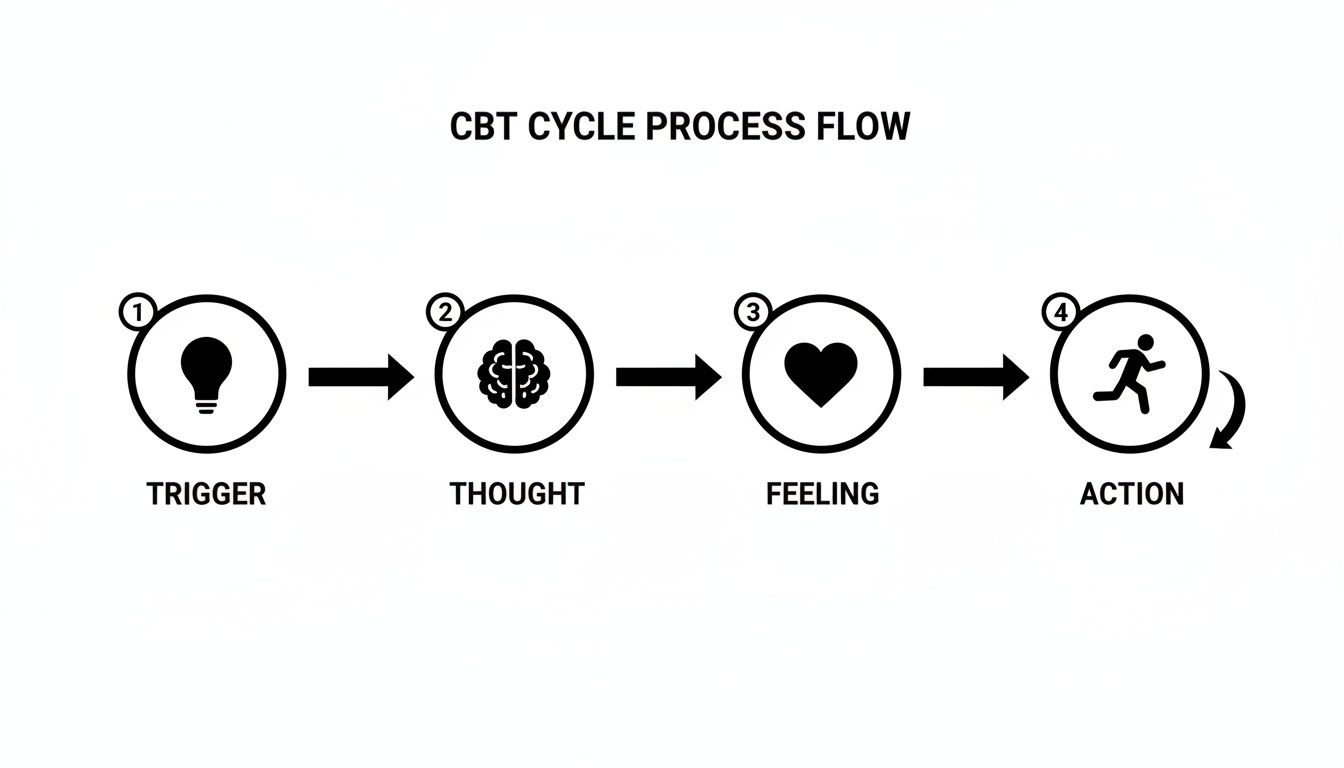
As you can see, avoiding the situation (your Action) gives you a moment of relief from the scary Feeling. But it also confirms the negative Thought was right, making the whole cycle stronger and more likely to happen next time. This is how anxiety keeps itself alive.
Seeing the Cycle in Your Life
Let’s make this real. Imagine you have a presentation at work next week.
The upcoming meeting is the trigger. Your immediate, automatic thought is, "I'm going to freeze up, stumble over my words, and everyone will think I'm incompetent." This thought is a guess, not a fact, but this kind of internal man vs self conflict feels incredibly real.
That thought instantly triggers feelings of intense anxiety—a knot in your stomach and a pounding heart. So, you take an action: you email your boss with a flimsy excuse to get out of the presentation. You feel relieved, but you’ve also just strengthened the belief that you couldn't have handled it. The cycle wins.
The core message of hope in CBT is that you can step into this cycle and interrupt it. By learning to question that automatic thought, you can change the feeling and, ultimately, your action. You learn to see these thoughts as suggestions, not commands, and realize you are in control.
This is exactly why understanding these techniques is so powerful. Their effectiveness is backed by a mountain of research, and the market for CBT is projected to hit $21.62 billion by 2031—a testament to its role as a first-line treatment for anxiety. This growth is happening because it gives people a proven roadmap to heal from these exact mental patterns.
The next step is to get familiar with your own specific thought patterns. It helps to know the common thinking traps that anxiety loves to use. Check out our guide on common cognitive distortions to learn how to spot them in your own life.
Rewiring Your Brain with Cognitive Restructuring
This is where the real work begins—and where you’ll find profound hope for a panic-free future. If your thoughts have been stoking your anxiety, cognitive restructuring is the practical skill you need to take the reins back. Think of it as becoming the architect of your own mind. You learn to systematically spot, question, and ultimately replace the thought patterns that have been fueling your fear, building a foundation for lasting peace.
It’s less about waging war against your brain and more about gently retraining it to find a calmer, more truthful path. You don't have to be a victim of your automatic negative thoughts. With this core cognitive behavioral therapy technique, you can start building a compassionate inner voice that quiets anxiety instead of cranking it up. The goal isn’t to slap on a fake, positive smile; it's to develop a realistic, balanced perspective that can stand firm when fear shows up, allowing you to move through life with more confidence.
Uncovering Your Hidden Thought Patterns
Before you can change your thoughts, you have to know what you’re working with. Many of us are on autopilot, totally unaware of the distorted thinking that runs in the background of our minds. These mental shortcuts, or cognitive distortions, act like funhouse mirrors, warping reality and making everything seem far more threatening than it actually is.
Anxiety absolutely loves these distortions because they create a never-ending feed of worst-case scenarios. Here are a few of the most common culprits:
- Catastrophizing: This is the classic "what if" spiral. You take a minor concern and blow it up into a full-blown catastrophe in your mind. A simple typo in an email becomes, "I'm definitely getting fired and will be ruined."
- Black-and-White Thinking: Also known as all-or-nothing thinking, this trap sees the world in extremes. If you aren't a runaway success, you must be an absolute failure. There is no in-between.
- Mind Reading: You assume you know exactly what others are thinking—and it's almost always negative. You "just know" that your boss thought your idea was stupid, even though you have zero actual evidence.
Learning to spot these patterns is the first huge step toward freedom. It drags them out of the shadows and into the light, where you can finally see them for what they are—just thoughts, not facts.
Your Most Powerful Tool: The Thought Record
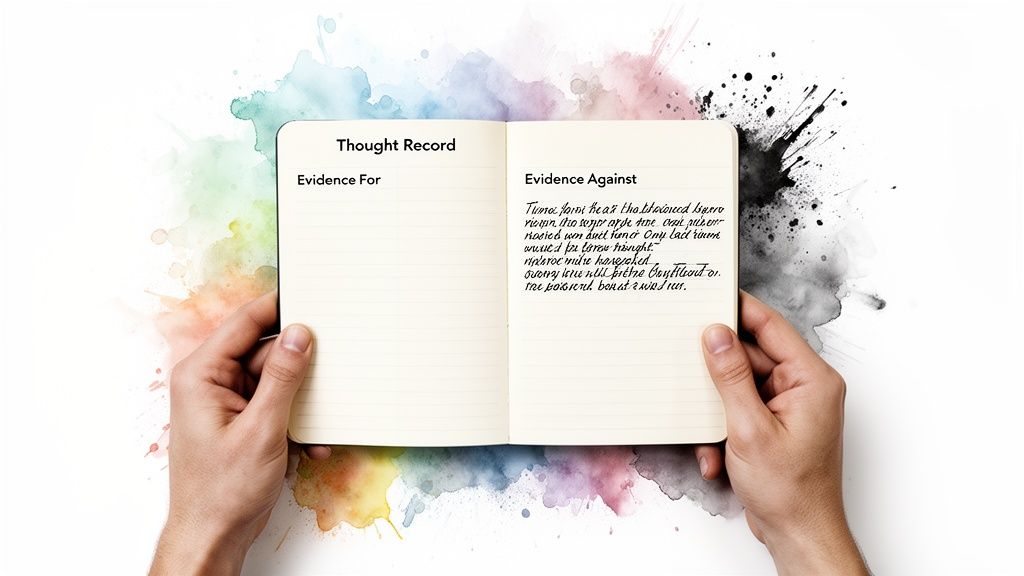
A Thought Record is a cornerstone of CBT for one simple reason: it works. It gives you a structured way to hit the pause button, capture your anxious thoughts on paper, and dissect them like a detective. Think of it as a methodical way to cross-examine your anxiety and get to the truth, proving that a calmer mindset is possible.
This tool helps you shift from reacting with pure emotion to responding with thoughtful logic. It’s a simple but incredibly powerful way to practice cognitive restructuring in your daily life and build hope.
The real magic of a Thought Record is that it gives you tangible proof that your anxious thoughts are often unreliable narrators. It’s a concrete way to build self-trust and prove to yourself, over and over, that you can handle things and that peace is achievable.
A Step-by-Step Guide to Using a Thought Record
Let's walk through a real-world scenario. Imagine you sent a big proposal to a client hours ago, and you’ve heard nothing but crickets. The anxiety starts creeping in.
-
The Situation: First, just state the facts. No emotion, no drama. "I sent an email to a key client this morning and haven't heard back yet."
-
Your Automatic Thoughts: What’s the first thing that popped into your head? Don't filter it. "They must hate my proposal. I've completely blown it with them. They're going to pull their business, and it's all my fault."
-
The Evidence For the Thought: Now, play devil's advocate for your anxiety. What actual facts support this thought? Maybe the client is usually super quick to reply. That's a data point, but is it proof of a disaster? You’ll often find this column is surprisingly short.
-
The Evidence Against the Thought: This is where you become a detective for the truth. What facts argue against your fear?
- They loved my last project and praised my work.
- It's the end of the quarter, which is a notoriously busy time in their industry.
- I have no actual information suggesting anything is wrong.
- They could be in back-to-back meetings, traveling, or just dealing with a packed inbox.
- I've worried about this kind of thing before, and it always turned out to be nothing.
-
Create a Balanced, Realistic Thought: Now, look at all the evidence. What is a more likely, level-headed truth? "While I feel anxious because I haven't heard back, there are countless reasons for the delay that have nothing to do with me or my work. The most likely scenario is that they're just busy. I'll give it until tomorrow before sending a polite follow-up."
This new thought doesn't feel like a fluffy, fake affirmation—it feels true. And because it’s believable, it has the power to dial your anxiety way down. By practicing this process, you are actively rewiring your brain for calm. For those looking to dive deeper with guided instruction, programs like Anxiety University offer structured learning to help you master these exact techniques and accelerate your journey to healing.
How to Face Your Fears with Behavioral Experiments
While challenging your thoughts is a huge step, anxiety isn't just a mental game. It's also deeply physical and behavioral. This is where you learn to prove to your brain—through action, not just logic—that you're capable and safe. This is where hope becomes real, tangible, and life-changing.
One of the most powerful cognitive behavioral therapy techniques for this is known as exposure, or what we often call behavioral experiments. Forget any scary images that might conjure up. This isn't about diving headfirst into your biggest fear. It's about slowly wading into the pool, one step at a time, until you realize the water is fine. It’s a gentle, controlled process of reclaiming your life from fear.

Building Your Fear Ladder
The secret to facing fears without getting overwhelmed is to break them down into small, manageable pieces. We do this by creating a fear ladder, also known as an exposure hierarchy. You start with something that causes just a little bit of anxiety and work your way up, building confidence with each small victory. This is how you build an unshakable belief in your own ability to heal.
The goal is to stay in the situation just long enough for your anxiety to naturally peak and then come back down. This process, called habituation, is basically your nervous system learning that the "threat" isn't actually a threat. You’re collecting real-world evidence that proves your anxious predictions wrong, one brave step at a time.
A Social Anxiety Example
Let’s see how this plays out for someone with social anxiety. Say their ultimate goal is to attend a work networking event. Just forcing themselves to go would feel terrifying and likely backfire. A fear ladder breaks it down into achievable steps, building hope along the way:
- Step 1 (Low Anxiety): Go to a coffee shop and simply make eye contact with the barista when ordering.
- Step 2 (Mild Anxiety): Go to the grocery store and ask an employee where to find an item.
- Step 3 (Moderate Anxiety): Give a stranger a simple, genuine compliment ("I like your jacket").
- Step 4 (Higher Anxiety): Attend a low-pressure social event, like a book club, with the only goal being to listen. No pressure to speak.
- Step 5 (High Anxiety): Attend the networking event and aim for just one brief, five-minute conversation.
Each step provides a win. It gives you concrete proof that you can handle these situations, directly fighting back against the anxious voice that says you can't. If you want to build your own, check out our guide on how to create a fear ladder as a powerful anxiety tool.
The profound hope in this process is realizing that fear shrinks when you face it. You’re not just learning to tolerate anxiety; you are actively expanding your world and taking back the territory that fear has claimed. Each step is a declaration that you are on the path to being panic-free.
Combating Avoidance with Action
Avoidance is the fuel that keeps anxiety burning bright. While behavioral experiments are a powerful antidote, they aren't the only tool in your kit for reclaiming your life.
Activity scheduling is another surprisingly simple yet effective technique. When we're anxious, we tend to pull back from things we enjoy. This drains our mood and energy, which, in turn, makes us even more vulnerable to worry.
Activity scheduling is just what it sounds like: deliberately planning positive or meaningful activities into your week, no matter how small. It could be a 15-minute walk, putting on a favorite album, or calling a friend. This actively fights the inertia of anxiety and reminds your brain that life can still hold moments of pleasure and accomplishment, filling you with hope.
The proof is in the results. The effectiveness of these behavioral methods is well-documented. Studies show that people using CBT see success rates ranging from 38% to 82% for anxiety and OCD. In comparison, no-treatment groups see rates of just 2% to 14%.
A large-scale review found CBT to be significantly more effective than standard treatments for generalized anxiety, with gradual exposure being a key factor. You can explore the data showing how CBT consistently outperforms other approaches. By taking these small, brave actions, you’re using a proven method to heal and build a life that isn't dictated by fear.
Building Your Personal CBT Toolkit for Daily Practice
Knowing the theory behind cognitive behavioral therapy is one thing. Actually using it when your heart is pounding and your mind is racing? That’s where the real change happens. This is the part where we move from just understanding CBT to making it a part of your daily life—a life where you call the shots, not your anxiety.
The secret is turning these powerful techniques into reliable habits. And the best way to do that is with a simple, personalized system: your own CBT toolkit. This isn't about adding more chores to your day. It’s about creating a simple, structured routine that gives you a clear path forward when you feel lost, reminding you that healing is always within reach.
Turning Concepts into Concrete Habits
Your toolkit doesn't have to be complicated. In fact, a simple notebook and pen can become your most powerful allies on this journey. The whole point is to have one central place to practice these skills, track your progress, and see just how far you’ve come. This isn't just a journal; it's tangible proof that you're actively rewriting your relationship with anxiety and building a more hopeful future.
Think of it as your command center for your mental health. This single, dedicated space brings all your CBT work together. For instance, your notebook can be your:
- Thought Record Log: A running diary to catch, question, and reframe anxious thoughts the moment they pop up.
- Fear Ladder Blueprint: The place where you map out your exposure therapy steps, breaking down huge fears into small, manageable wins.
- Activity Schedule: A log for planning and tracking the rewarding, positive activities you’re bringing back into your life.
- Grounding Technique Reminders: A quick-reference list for when you need to get out of your head and back into the present moment. Feel free to explore our full list of grounding techniques for anxiety and write down a few that work for you.
The Power of a Structured Routine
Having this toolkit gives you a reliable game plan. When anxiety hits and your mind feels chaotic, having a pre-built routine to fall back on makes all the difference. It eliminates the panicked "What do I do now?" feeling and replaces it with a clear, actionable plan filled with hope.
This structured approach is the ultimate act of self-compassion. It's you, showing up for yourself day after day, armed with proven tools and the belief that you can heal. Every time you open that notebook, you’re casting a vote for a future with less fear and more freedom.
This consistency is what creates real momentum. It’s not about being perfect—it’s about being persistent. By deliberately practicing these skills, you are training your brain to build new, calmer pathways. You are proving to yourself, one day at a time, that you are so much more than your anxiety. This is how you build real confidence and take your life back, one small, courageous step at a time.
When to Partner with a Professional Therapist
Tackling anxiety on your own with CBT techniques is a huge, empowering step. It's you, taking back the controls and choosing to heal. But real strength isn't just about going it alone; it's also about knowing when to call for backup.
Deciding to see a therapist isn’t a sign that you’ve failed. Think of it as adding a seasoned expert to your team—a strategic move on your journey toward feeling better. It reinforces the simple truth that you don’t have to do this all by yourself, and that help is a sign of hope.
So, when is it time to make that call? If your anxiety just feels too big to handle on your own, that's a clear sign. If panic attacks or constant worry are derailing your work, straining your relationships, or making it a battle just to leave the house, a therapist can offer the structure and support you need to find relief.
Another key moment is when you feel stuck. If you've been trying these techniques but just aren't seeing the progress you'd hoped for, an expert can help you figure out why and get you moving again toward a panic-free life.
Supercharging Your Therapy Sessions
Here’s something you might not expect: all the work you do on your own with cognitive behavioral therapy techniques doesn’t just disappear if you start therapy. In fact, it gives you a massive head start on your path to healing.
You’re not walking in on day one starting from zero. You’re coming in prepared, empowered, and ready to heal.
Therapy becomes less about diagnosis and more about collaboration. You and your therapist become a team, working together with a shared language and a clear understanding of the goal—a life free from panic and filled with possibility.
Because you’ve already been practicing, you’ll walk into your first session able to:
- Articulate your experience: You can clearly explain your triggers, automatic thoughts, and the behavioral patterns you’ve noticed.
- Understand the principles: You already get the "why" behind the techniques, so you can jump straight into the "how" and refine your approach for faster results.
- Bring valuable data: Your thought records and behavioral experiments give your therapist priceless insight into how your anxiety works, allowing them to tailor a plan for your success.
This self-awareness makes therapy a much more focused and efficient process right from the get-go, accelerating your journey toward a calmer life.
A Tailored Path to a Panic-Free Life
The best part about CBT is that it’s not just wishful thinking; it’s a proven method for creating lasting change, and the research consistently shows it works, offering real hope for healing.
For example, studies on generalized anxiety disorder found that CBT response rates hit 46%, which is a huge leap compared to the 14% seen in groups that didn't get active treatment.
Even better, the skills you learn through CBT often have more staying power than medication. At 6 to 12-month follow-ups, people who learned CBT skills often did better, suggesting this isn't a temporary fix. It's a permanent upgrade to your mental toolkit. You can dig into more of the research showing that CBT skills create lasting change.
Ultimately, your path to feeling better can be built around exactly what you need. Whether you do best with self-guided work, a professional partnership, or a mix of both, there is always a way forward. Hope isn’t just a feeling—it’s a strategy. You have every reason to believe in your ability to heal and live a calmer, fuller, and panic-free life.
Your Questions About CBT Techniques Answered
Starting something new, especially when it comes to your mental health, always brings up questions. That’s a great sign—it means you’re invested and ready to build a life with less anxiety.
Let's clear up some of the most common questions people have when they first dip their toes into cognitive behavioral therapy. The goal here is to give you the clarity and confidence to get started on your journey to healing.
You have every reason to believe that a calmer, more peaceful life isn’t just possible—it's something you can actively create for yourself.
How Long Until I See Results from CBT?
This is usually the first question on everyone's mind, and it comes from a deep desire for relief. The honest answer? It varies. While some techniques, like a quick grounding exercise, can bring immediate calm in a tough moment, the real, lasting change from CBT is a gradual build.
Think of it like getting physically fit. You don't get a six-pack after one trip to the gym, but you feel better, stronger, and more hopeful after every single workout.
The magic happens with consistency. It's about celebrating the small wins—the one time you successfully questioned an anxious thought, or the one tiny step you took on your exposure ladder. Focusing on that daily practice over weeks is what builds momentum and starts to genuinely rewire those old, anxious pathways in your brain. Progress isn’t a perfect, straight line, but every single step forward is a step toward healing.
The most powerful message of hope is that you don't have to wait for a "cure." Relief begins the moment you start practicing. Each small act of courage and self-compassion is a step toward the panic-free life you want to live.
Can I Do CBT on My Own Without a Therapist?
Absolutely. One of the best things about CBT techniques is that they’re designed to be practical life skills you can learn and use yourself. For many people dealing with mild to moderate anxiety, a self-guided approach using good resources and tools is incredibly effective. It puts you in charge of your own recovery and empowers you with the knowledge that you can heal yourself.
However, it’s important to see a therapist not as a sign of failure, but as an expert guide who can help you get where you want to go, faster. If your anxiety is severe, has been around for a long time, or feels really complex, a therapist provides that personalized feedback and accountability that can make all the difference.
Think of it this way: you can absolutely build a solid foundation on your own. A therapist is like bringing in a master architect to help you design and build the rest of your beautiful, panic-free life.
What If Challenging My Anxious Thoughts Feels Fake?
This is a huge, and completely valid, concern. When you’ve spent years listening to a harsh inner critic, trying to introduce a kind, rational thought can feel forced, unbelievable, and just plain silly.
Here’s the crucial mind-shift: the goal isn't 'positive thinking,' it's 'realistic thinking.' If a new thought feels fake, it's probably because your brain knows it’s not the whole truth. The path to healing is paved with honesty, not false positivity.
Instead of trying to leap from "I'm going to completely fail this presentation" all the way to "I'm going to be amazing!" start smaller. A more believable first step is to simply question the certainty of the negative thought.
A more balanced, honest thought might be, "I'm afraid I might struggle, but I've prepared for this. It's also possible that it will go reasonably well." This thought feels more authentic and is much easier for your brain to accept as a first step.
Then, you pair that new thought with a small action—a behavioral experiment. Practice your opening line in the mirror a few times. This gives your brain real-world proof that you can do it, helping that new, balanced perspective feel less fake and more real. This is how you build genuine confidence and prove to yourself, one truthful thought at a time, that you are capable of healing.
If you're ready to turn these ideas into a structured, daily practice, The Anxiety Checklist provides a complete system to guide you. It combines a practical eBook with interactive tools to help you build your personal CBT toolkit, track your progress, and take consistent, daily action toward a life free from panic. Start your journey toward fearless living today at https://anxietychecklist.com.