

If you're reading this, you’ve probably felt the walls close in. The racing heart, the what-if thoughts that won't stop spinning, the constant feeling that you're trapped inside your own mind—it can be an incredibly lonely and exhausting place to be.
But I want you to hold onto this one, crucial truth: you are not alone, and a life free from the grip of constant panic is absolutely within your reach.
This guide is more than just a list of tips. It’s a practical, step-by-step roadmap I've built from over 15 years of personal recovery and professional experience, all focused on one thing: showing you how to overcome anxiety naturally and rediscover a life filled with hope and peace.

You Are Not Alone in This Struggle
It’s easy to feel like you’re the only one fighting this invisible battle, but the reality is that anxiety has become a silent global epidemic.
The numbers are staggering. In 2021, anxiety disorders affected an estimated 359 million people worldwide, a significant jump from 301 million in 2019. Yet, because of stigma and a lack of awareness, only about 27.6% of people with anxiety ever get help.
Knowing this isn't meant to make your struggle seem small—it's to show you just how valid it is. Your experience is real, and millions of others are navigating a similar path toward healing. That's precisely why structured resources, like a dedicated anxiety self help platform, are so important. They give you the tools and a clear plan to turn the hope of recovery into real-world action.
The goal isn't to get rid of stress. That's impossible. The real goal is to build the resilience and the tools you need to handle stress without letting it spiral into overwhelming anxiety or panic. This is how you heal.
The Four Pillars of Natural Anxiety Management
To make this journey feel less overwhelming and more hopeful, we’re going to focus on four core strategies. Think of them as the pillars that will support you while you build a calmer, stronger foundation for your life. Each pillar targets a different part of the anxiety puzzle, creating a complete plan for real, lasting change and a panic-free future.
Here’s a quick look at the framework we’ll be using.
The Four Pillars of Natural Anxiety Management
| Pillar | What It Means | Why It Works |
|---|---|---|
| Immediate Coping Skills | In-the-moment tools to manage acute anxiety and panic. | Quickly activates your body's relaxation response to reduce overwhelm. |
| Cognitive Reframing | Learning to identify, challenge, and change anxious thought patterns. | Breaks the cycle of worry and rumination by building new, hopeful neural pathways. |
| Lifestyle Foundations | Optimizing sleep, nutrition, and daily routines for mental wellness. | Creates a stable biological base, enhancing your natural resilience to stress. |
| Connection & Support | Building a network of understanding people and resources. | Reduces feelings of isolation and provides encouragement on your healing journey. |
Together, these pillars create a powerful and sustainable framework for taking your life back from anxiety, one hopeful step at a time.
Calm in the Chaos With In-the-Moment Techniques
When your heart starts to pound and your thoughts begin to spiral, it can feel like you're free-falling. The most powerful shift in my own journey was realizing I could actually do something in those moments. This realization is the first spark of hope—the understanding that you are not powerless.
This isn’t about just telling yourself to "calm down"—a phrase that rarely works. It’s about having concrete, evidence-based tools that can anchor you when you feel adrift in a sea of panic, proving that you can navigate these storms.
Learning these skills does more than just get you through a tough moment. It builds the confidence that you can handle acute anxiety, which is a vital first step in managing it long-term. It slowly dismantles the fear of the fear itself, replacing it with a sense of capability and hope.
Ground Yourself With the 5-4-3-2-1 Method
One of the quickest ways to stop a panic spiral is to pull your focus out of your racing mind and back into the physical world. The 5-4-3-2-1 grounding technique is brilliant for this because it forces your brain to connect with your senses, reminding you that you are safe in the present moment.
Here’s all you have to do. Wherever you are, just pause and notice:
- 5 things you can see. Don't just glance. Look for small details: the texture of a wall, a crack on the sidewalk, the way light hits a leaf.
- 4 things you can feel. Tune into the physical sensations right now. Maybe it's the fabric of your shirt, the solid chair beneath you, or the cool air on your skin.
- 3 things you can hear. Listen past the obvious. Can you pick up the low hum of a refrigerator, distant traffic, or birds chirping outside?
- 2 things you can smell. This might be the coffee on your desk or the lingering scent of soap on your hands. If you can’t smell anything, just imagine two of your favorite scents.
- 1 thing you can taste. What’s the lingering taste in your mouth? You could also take a sip of water and focus entirely on that sensation.
Imagine you're in a crowded grocery store and you feel that familiar wave of panic rising. Your heart races, and your first thought is, "I need to get out of here." Instead, you stop your cart, take a quiet breath, and start the exercise. You spot five different colored vegetables. You feel the cold metal of the cart handle.
This simple act pulls you out of the internal storm and plants you firmly back in the present moment, proving you can find calm even in chaos.
Flip the Switch on Your Nervous System
Focused breathing is one of the most potent tools we have for calming down, and for good reason. Using specific breathing techniques can trigger an immediate shift in your nervous system. One of the most studied and effective methods is 4-7-8 breathing.
This isn't just about "taking a deep breath." It’s a specific sequence that activates your parasympathetic nervous system—the body's "rest and digest" response. Think of it as a natural tranquilizer for your overactive alarm system, a switch you can flip anytime to signal safety to your body.
The 4-7-8 breathing technique is like a light switch for your body’s stress response. It signals to your brain and body that the threat has passed and it's safe to relax.
Here’s the simple process:
- Exhale completely through your mouth, making a gentle whoosh sound.
- Close your mouth and inhale quietly through your nose to a mental count of four.
- Hold your breath for a count of seven.
- Exhale completely through your mouth, making that whoosh sound again, for a count of eight.
That’s one full breath. Just repeat the cycle three more times, for a total of four breaths. The magic is in the long exhalation, which is powerfully calming. If you want to explore how different patterns can affect your mind, you can dive into a variety of breathing exercises for anxiety and find what feels best for you.
Having these tools ready to go is incredibly empowering. It means that when anxiety spikes, you're no longer a passive victim. You have an action plan—a way to regain your footing and show yourself, moment by moment, that you can and will be okay.
Lasting calm isn't just about managing a racing heart or shaky hands. Real, deep-seated peace comes from changing the way you relate to the anxious thoughts that are pulling the strings. This might sound like a massive undertaking, but it's a skill you can absolutely learn, giving you a powerful set of tools for tackling anxiety and reclaiming your life.
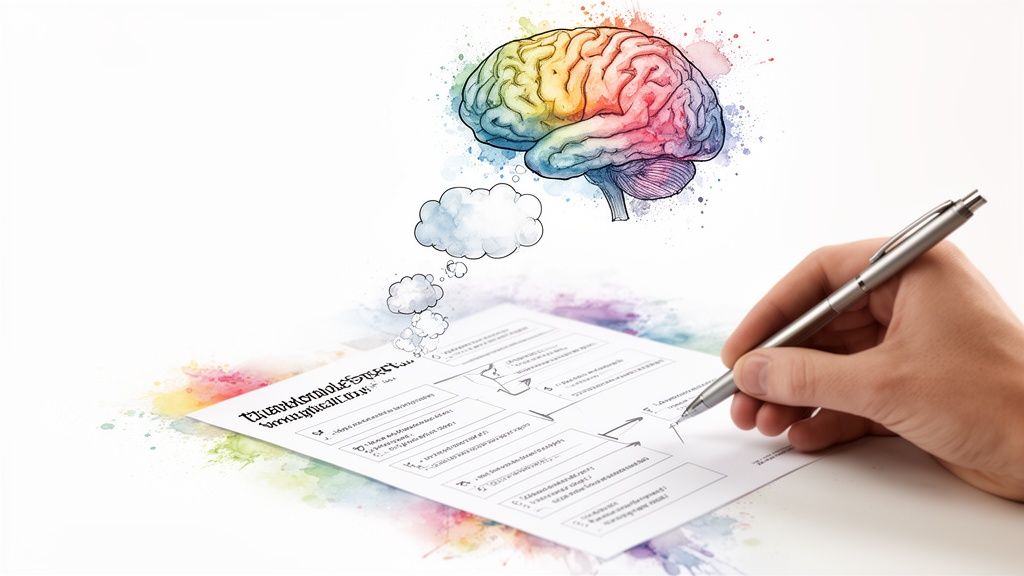
Drawing from tried-and-true methods like Cognitive Behavioral Therapy (CBT), you can start to become an observer of your own mind. This isn't about forcefully shutting down your thoughts—that's a battle you'll never win. It's about learning to question them with gentle curiosity.
By stepping back, you create a tiny pocket of space between the thought and your reaction. That pause? That's where your power is. It’s the moment you stop being a passenger on the anxiety train and start acting like the conductor, able to slow things down, change tracks, and steer toward a peaceful destination.
Become a Thought Detective
Your anxious brain is an expert storyteller, but it has a bad habit of skipping right to the worst-case scenario. The first step toward healing is to simply notice the stories it’s telling you, without judgment.
Think of yourself as a detective on a case. When you feel that familiar surge of anxiety, ask: what specific thought just went through my mind? Get it out of your head and onto paper. Writing it down makes it feel less like an all-encompassing truth and more like what it is: just a thought.
This simple act is huge. It proves that you are not your thoughts; you are the one who hears them. This separation is the beginning of freedom.
Put the Anxious Narrative on Trial
Once you've identified the anxious thought, it's time for a little cross-examination. Anxious thoughts often feel like undeniable facts, but they almost never hold up under scrutiny.
Let's walk through a common one: you're dreading an upcoming work presentation.
- The Anxious Thought: "I'm going to totally freeze up. Everyone will think I'm an idiot, and my boss will regret ever hiring me." This is a classic anxiety spiral, lumping several fears into one catastrophic prediction.
- The Evidence: Has this actually happened before? What were your past presentations really like? Maybe you were nervous, but did you completely freeze? Have you received positive feedback on other work? Stick to the facts, not the feelings.
- A More Balanced, Hopeful View: "I'm nervous about this presentation because I care about doing well. I've prepared and I know my stuff. It's okay to feel nervous. Even if I stumble over a word, it doesn't mean I'm incompetent."
This isn't about forced positivity or lying to yourself. It's about finding the realistic, more hopeful middle ground. You're not saying, "This will be the greatest presentation ever!" You're saying, "I have what it takes to get through this, and my self-worth isn't on the line."
The goal of thought challenging is not to eliminate all negative thoughts. It’s to reduce their power and believability, so they no longer dictate your emotions and actions. This is how you reclaim control.
Make It a Daily Practice
Integrating these cognitive skills into your life is a journey of healing, not a quick fix. For those who want a more structured path, guided programs like Anxiety University can provide the curriculum and support to help these skills become second nature. Consistency is everything.
Research consistently shows how valuable these self-guided tools are. Some studies find that mindfulness and cognitive behavioral techniques can reduce anxiety symptoms by 30-40% in just an 8-week period. With only 27.6% of the 359 million people suffering globally having accessed care in 2021, learning these personal skills is more vital than ever for your own path to wellness.
This process of observing and reframing literally rewires your brain's circuitry. Each time you challenge an anxious thought and choose a more balanced one, you weaken the old, familiar neural pathway and strengthen a new, calmer one. Over time, this new way of thinking starts to become your default. You become your own most effective ally in the journey toward a less anxious, more peaceful life.
Build Resilience With Foundational Lifestyle Habits
When anxiety hits, your first instinct is to find a quick fix. And while those in-the-moment tools are life-savers, the real, lasting work of building a panic-free life happens in the quiet, consistent choices you make every single day.
The way you move, the food you eat, and how well you sleep—these aren't just secondary concerns. They form the very bedrock of your mental well-being. This isn’t about a massive, intimidating lifestyle overhaul. Instead, think of it as making small, sustainable deposits into your mental health bank account. These daily habits are your biological defense against anxiety, creating stability, strength, and hope from the inside out.
Embrace Movement as Medicine
When you feel wound up with anxiety, the very idea of exercising can feel impossible. But physical activity is one of the most powerful and accessible tools we have for healing. Moving your body helps flush out stress hormones like cortisol and triggers the release of endorphins, your brain's natural mood-lifters.
This doesn’t mean you need to sign up for a marathon tomorrow. The goal is to find ways to move that you actually enjoy and can stick with, making it a source of joy, not another chore.
- Start with "Movement Snacks": If a 30-minute workout sounds overwhelming, break it up. A brisk 10-minute walk after lunch, a quick dance break in your kitchen, or a few minutes of stretching when you wake up all make a difference.
- Find Your Fun: The best exercise is the one you’ll actually do. If you hate running, don't force it. Try a hiking trail, a swim, a yoga class, or a team sport instead.
- Connect Movement to Routine: Anchor your movement to a habit you already have. For example, roll out your yoga mat for 15 minutes right after you brush your teeth, or head out for a walk the minute you get home from work.
To build long-term resilience, integrating regular physical activity is a game-changer. Learning how to balance cardio and strength training can give you a solid framework for supporting your mental well-being.
Fuel Your Brain With Mood-Stabilizing Nutrition
The connection between your gut and your brain is incredibly powerful. The food you eat has a direct line to your mood, energy, and your capacity to handle stress. You don't need a restrictive or complicated diet; a few mindful swaps can make a world of difference in your journey to feeling better.
The focus should be on adding more whole, nutrient-dense foods that keep your blood sugar stable and give your brain the fuel it needs to function well.
Trading your afternoon sugary snack for a handful of almonds and a few dark chocolate squares isn't about deprivation. It's about giving your brain the stable fuel it needs to prevent the energy crashes that can often trigger anxiety.
Here are a few simple upgrades to get you started:
- Swap sugary cereals for a bowl of oatmeal with berries and nuts.
- Trade white bread for a hearty whole-grain or sourdough option.
- Replace soda or sugary juices with sparkling water and a splash of real fruit.
By focusing on these small, positive additions, you can make a huge impact on your mental state. If you want to dive deeper, our guide to lifestyle and diet changes for anxiety management offers even more practical tips.
Master Your Sleep for a Calmer Mind
Sleep isn't a luxury; it's a non-negotiable pillar of mental health. When you're sleep-deprived, the emotional control center in your brain goes haywire, making you far more vulnerable to anxiety and stress. Creating a dedicated wind-down routine is one of the best ways to signal to your body and brain that it’s time for rest and repair.
Your Simple Sleep Hygiene Checklist
- Stick to a Schedule: Try to go to bed and wake up around the same time each day, even on weekends. Consistency is key.
- Manage Blue Light: Power down screens—phones, tablets, TVs—at least 60-90 minutes before you plan to sleep.
- Create a Sanctuary: Keep your bedroom as cool, dark, and quiet as possible.
- Build a Wind-Down Routine: Spend the last 30 minutes of your day doing something calming, like reading a physical book, taking a warm bath, or listening to gentle music.
- Avoid Stimulants: Be mindful of caffeine and alcohol, especially in the hours leading up to bedtime.
The evidence for this is incredibly strong. Exercise, in particular, is a natural powerhouse. Meta-analyses have found it can slash anxiety symptoms by 20-30% in just 4-12 weeks. Even simple activities, like taking a 30-minute brisk walk 5 days a week, have been shown to lower scores for Generalized Anxiety Disorder (GAD) by 25% in randomized trials. For the 22.8% of US adults navigating a mental illness, these are accessible and incredibly potent strategies for hope and healing. You can find more on these findings directly from the World Health Organization.
Create Your Personal Anxiety Recovery Plan
Knowing which tools can help with anxiety is a great first step. But real, lasting change happens when you start weaving them into the fabric of your daily life. This is where you shift from just knowing what to do, to actually doing it.
It’s about building a practical, day-by-day plan that turns the hope of a calmer life into your reality.
The point isn't to create some rigid, color-coded schedule that just adds another layer of pressure. Instead, think of it as a flexible framework—one that supports you, helps you see what’s working, and lets you celebrate every small win along your healing journey.
Track Your Progress to See How Far You’ve Come
When you're stuck in a rough patch with anxiety, it's incredibly easy to forget how much progress you've actually made. Tracking your journey is a powerful way to fight back against that feeling. It gives you concrete proof of your growth, which is a huge source of hope and motivation on tough days.
A simple journal or even a note on your phone can work wonders. Each day, try jotting down a few quick things:
- Your overall anxiety level on a scale of 1-10.
- Which coping tools you used (e.g., a 10-minute walk, a round of 4-7-8 breathing).
- Any specific situations or thoughts that seemed to trigger your anxiety.
Over time, you’ll start to see patterns emerge. Maybe you’ll notice your anxiety is consistently lower on days you get outside. Or perhaps you'll realize a certain "what if" thought almost always sends you spiraling. This kind of information is gold—it lets you become proactive instead of just reacting to anxiety when it hits, giving you control.
Designing Your Weekly Anxiety-Resilience Schedule
Now, let's put it all together. This is just a sample structure to give you some ideas. The real magic happens when you adapt it to your own life, your energy levels, and your schedule. What matters most is being intentional about carving out this time for yourself, because you deserve it.
Here’s what a week focused on building natural anxiety resilience might look like:
A Sample Week of Self-Care
| Day | Morning (Mindset & Movement) | Afternoon (Recharge & Refocus) | Evening (Wind-Down) |
|---|---|---|---|
| Mon | 15-min walk & listen to podcast | 5-min mindful breathing | Read a physical book for 30 mins |
| Tue | Quick stretch & gratitude list | 15-min 'worry window' | Warm bath, no screens after 9 pm |
| Wed | 20-min walk or light jog | Healthy snack & hydration break | Connect with a friend via phone |
| Thu | Thought-challenge journaling | 5-min of 4-7-8 breathing | Gentle yoga or stretching |
| Fri | 20-min walk in nature | Review weekly wins | Relaxing music, no work emails |
A 'worry window' is a designated time—say, 15 minutes each afternoon—where you give yourself full permission to worry. When anxious thoughts pop up outside this window, you can gently tell yourself, "I'll think about that at 4 PM." This helps contain worry instead of letting it take over your whole day.
This simple flowchart shows how the core pillars of movement, nutrition, and sleep work together to build a strong foundation of resilience against anxiety.
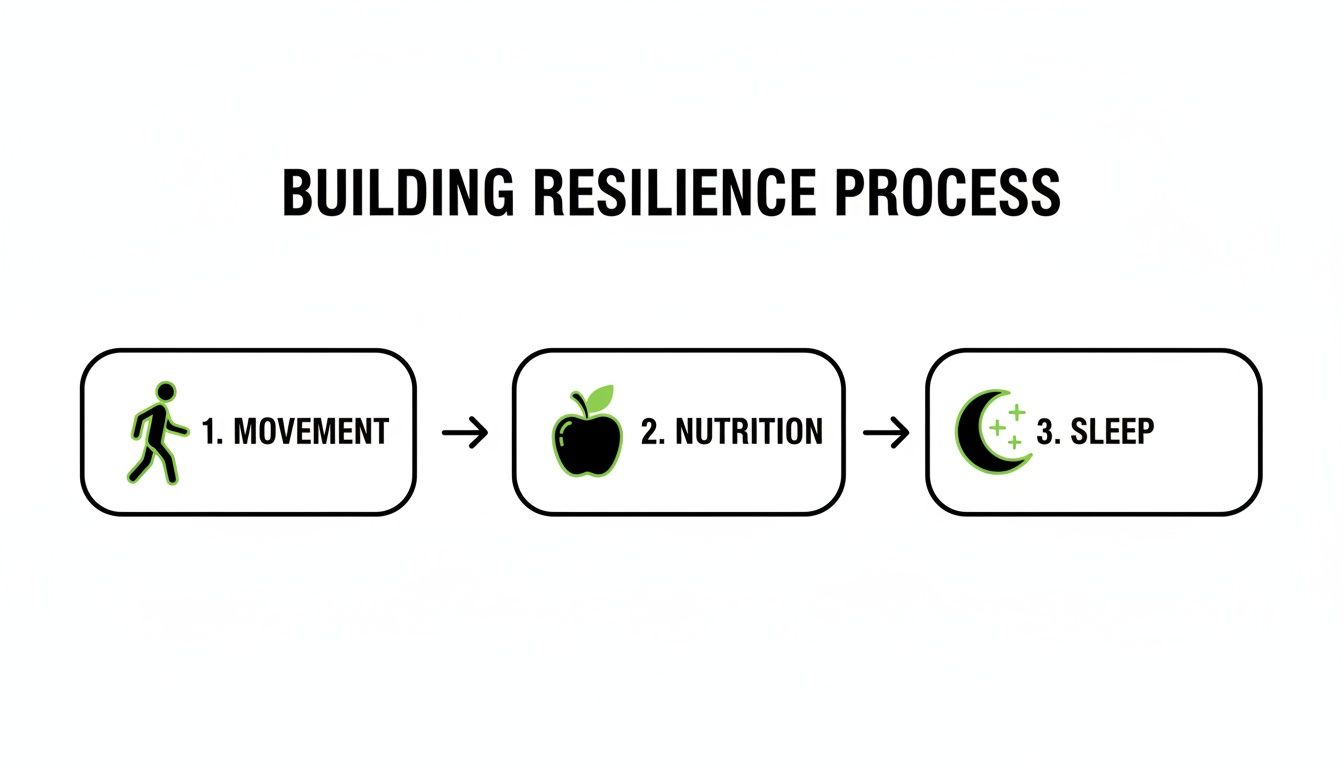
These three habits aren't just isolated actions. They're interconnected parts of a continuous process that strengthens your mental well-being from the ground up, giving you the power to heal.
Building Your Support System
You don’t have to do this alone. In fact, human connection is one of the most powerful buffers we have against anxiety. A critical part of any recovery plan is building a support system of people who get it and can cheer you on toward a brighter future.
I know this can feel daunting, especially when anxiety is screaming at you to isolate yourself. A great starting point is to break it down into smaller, more manageable steps. Our guide on how to set SMART goals for anxiety can make this process feel much less overwhelming.
Sometimes, the hardest part is just starting the conversation. Here are a few simple scripts you can adapt when talking to friends or family:
- For a partner: "I've been dealing with a lot of anxiety lately, and it's been tough. One thing that would really help me is if we could plan a quiet night in this week instead of going out."
- For a friend: "I'm working on managing my anxiety, and part of that is trying to get out for more walks. Would you be up for joining me once a week?"
- For a parent: "I want to be open with you—my anxiety has been high. I'm not looking for you to solve it, but just knowing I can text you when I'm having a hard moment would mean a lot."
This plan isn't about restriction; it's about liberation. It's proof that you have the power to create a life where you are in control, not your anxiety. This is how you take hope and turn it into a concrete strategy for a more fearless, present, and joyful life.
Your Questions on Natural Anxiety Relief Answered
Taking the first steps to manage anxiety naturally is a huge act of self-empowerment. But let's be real—it's also completely normal to have a few questions, maybe even some doubts, as you get started. This is a new path, after all, and a little uncertainty is just part of the process.
This section is all about tackling those common concerns with straight, practical answers. The goal is to reinforce what this entire guide is about: healing is absolutely possible, and you have the power to build a more peaceful, panic-free life. Let’s clear up these questions so you can move forward with total confidence.
How Long Does It Take for These Natural Methods to Work?
This is usually the first question on everyone's mind, and it comes from a deep, understandable need for relief. While some tools, like the 4-7-8 breathing technique, can bring an immediate sense of calm during an anxiety spike, the real, foundational healing is a more gradual process.
Think of it like planting a garden. You wouldn't expect a full bloom overnight. First, you have to prepare the soil (your lifestyle habits), plant the seeds (your new cognitive skills), and water them consistently (your daily practice). With that kind of steady effort, most people start to feel a meaningful, positive shift in their overall anxiety levels within 4 to 8 weeks.
The biggest win isn't some quick fix, but the slow, steady process of building a resilient foundation for your long-term mental health. Using a simple journal to track your progress can be incredibly motivating. It helps you see the small victories—a day with a little less worry, a moment you chose a walk over anxious thoughts—which proves you’re on the right track to a panic-free life.
Can I Really Overcome Anxiety Without Medication?
For many people, the answer is a definite yes. When you combine foundational lifestyle changes, consistent cognitive reframing, and effective stress management techniques, you create a powerful system for managing anxiety and reclaiming a full, vibrant life. These natural methods give you the skills to navigate challenges on your own terms and prove that you are capable of healing.
That said, it’s crucial to see this not as an "either/or" choice but as a "both/and" possibility. Natural strategies are potent on their own, and they can also be an excellent complement to professional therapy or medication if that’s part of your journey.
Acknowledging that you need professional help is not a failure of natural methods—it is a sign of profound strength and self-awareness on your path to healing.
If your anxiety feels severe, debilitating, or is getting in the way of your ability to function day-to-day, reaching out to a doctor or therapist is a brave and smart move. The natural tools you've learned here will become an invaluable part of your recovery toolkit, empowering you on whatever path you and your healthcare provider decide is best for your complete healing.
What If I Try These and I Still Feel Anxious?
First, and most importantly: be kind to yourself. Recovery is never a perfect, straight line. It's more like a dance, with forward steps, the occasional stumble, and the natural rhythm of good days and tougher ones. An anxious day after a week of feeling great doesn’t mean you’ve failed—it just means you’re human and you are learning. Hope is not lost.
Use these moments as a chance to learn. Get curious, not critical.
- Did you sleep poorly the night before?
- Did you skip the daily walk that usually helps you feel grounded?
- Did a specific thought pattern or external event trigger you?
This isn't about placing blame; it's about gathering data to better understand your own unique patterns on your healing journey. If one specific technique isn’t clicking for you, that’s okay! There are plenty of others to try. Maybe grounding exercises work better for you than breathwork, or vice versa. This is about finding what brings you peace.
If you feel consistently stuck after giving these strategies an honest try for a few months, that might be the perfect signal to bring in a professional, like a therapist. You won't be starting from scratch. You'll go into that conversation already armed with a ton of self-knowledge and a set of tools you've already practiced, ready to take your healing to the next level. Your journey so far is a powerful foundation, no matter what comes next.
The path to overcoming anxiety is a personal one, but you don't have to figure it all out alone. To help you put everything you've learned into a clear, actionable plan, The Anxiety Checklist provides a structured system with an interactive spreadsheet, habit trackers, and a comprehensive guide. It transforms these powerful concepts into a personalized toolkit, empowering you to build a life defined by courage, not by anxiety. Discover your path to fearless living at https://anxietychecklist.com.