


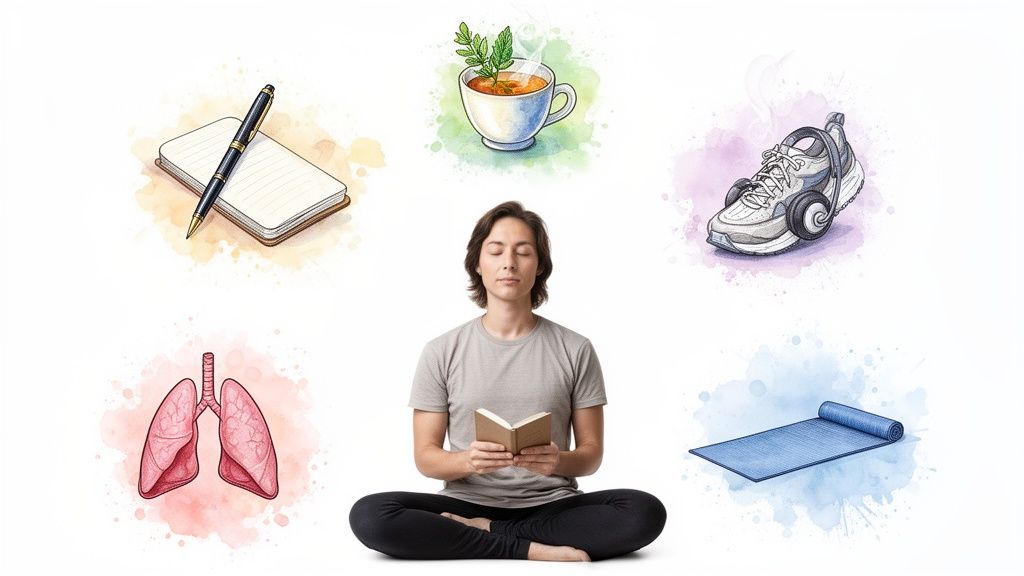
When your mind is already on high alert from chronic anxiety, the smallest frustration can feel like a direct threat, triggering an explosive burst of anger. This reaction isn't a character flaw; it's your nervous system stuck in a state of hyper-vigilance. The constant "fight" in the fight-or-flight response means your brain is primed for conflict, making anger a surprisingly common, yet often misunderstood, symptom of anxiety and panic. This cycle can feel overwhelming, but there is a clear path to healing and living a life free from panic.
This article provides a structured, actionable plan to break that cycle. Instead of offering generic advice, we will explore ten evidence-based anger management coping skills designed for the unique challenges of an anxious mind. Each technique includes step-by-step instructions, practical examples, and guidance on when to seek professional support.
By learning to identify these triggers and applying these specific strategies, you can begin to calm the inner storm. This is your toolkit for moving from anxious overwhelm to calm control. These skills empower you to respond to stress with intention rather than reacting with anger, giving you the control to build a more peaceful and resilient life.
1. Deep Breathing and Progressive Muscle Relaxation
This foundational technique combines two powerful physiological tools: controlled breathing and systematic muscle tension-and-release. When anger or anxiety hits, your body’s fight-or-flight response takes over, flooding you with adrenaline. Deep breathing and progressive muscle relaxation (PMR) directly counteract this surge by activating your parasympathetic nervous system, the body’s natural "rest and digest" state. This approach is one of the most effective anger management coping skills because it interrupts the physical anger cycle, giving you space to think before reacting.

By deliberately slowing your heart rate and releasing stored physical tension, you can regain control and find a path toward living panic-free.
How to Use It
Follow these steps to combine tactical breathing with PMR:
- Find a comfortable position, either sitting or lying down. Close your eyes if it feels right.
- Begin Box Breathing: Inhale slowly through your nose for a count of four. Hold your breath for a count of four. Exhale slowly through your mouth for a count of four. Pause for a count of four before inhaling again. Continue this pattern.
- Introduce Muscle Tension: While continuing to breathe, clench the muscles in your face and neck for 5 seconds. Feel the tension build.
- Release and Notice: As you exhale, completely release the tension. Notice the difference between tension and relaxation.
- Progress Downward: Repeat the tense-and-release cycle for your shoulders, arms, hands, abdomen, legs, and feet. Sync each release with an exhale.
Why It Works
This method is used by military personnel in high-stress situations and healthcare workers managing shift-related anxiety because it grounds you in your body. It shifts your focus from the external trigger to your internal physical sensations, providing an immediate anchor in the storm of anger.
Key Insight: The physical release of muscle tension sends a powerful signal to your brain that the perceived threat has passed, de-escalating both anger and anxiety simultaneously. This is a hopeful sign that you can directly influence your body's stress response.
Practical Tips for Success
- Practice When Calm: Dedicate 5-10 minutes daily to this technique when you feel relaxed. This builds muscle memory, making it an automatic response during moments of high emotion.
- Compound the Effect: Always pair your breathing with the muscle relaxation sequence for a more profound calming effect. Deep breathing is a cornerstone of stress reduction and emotional regulation. For practical guidance, exploring techniques like Mastering 6 Breaths Per Minute for Pain, Sleep, and Calm can significantly enhance your ability to find inner calm.
- Use Audio Guides: Watch a guided video or record your own voice walking you through the steps. This can make it easier to follow when your mind is racing.
When to Seek Professional Help
While this is a powerful self-help tool, consider seeking professional support if your anger leads to aggressive behaviors, damages relationships, or is accompanied by overwhelming feelings of hopelessness. A therapist can help you identify deeper triggers and develop a more personalized management plan, offering hope for profound healing.
2. Cognitive Restructuring and Thought Challenging
This cognitive-behavioral technique directly targets the mental root of anger. It involves identifying, questioning, and replacing the irrational or distorted thoughts that fuel your emotional response. For those whose anger is linked to anxiety, this method is especially effective. It breaks the cycle where anxious assumptions and catastrophizing thoughts automatically trigger an angry reaction, offering a path to regain control over your emotions.
This approach is one of the most powerful anger management coping skills because it teaches you to challenge your own internal narrative. Instead of being a victim of your automatic thoughts, you become an active participant in shaping a more balanced, realistic perspective, which is a key step toward living a life free from constant panic and reactivity.
How to Use It
Use the "ABC Model" popularized by Dr. Albert Ellis to deconstruct and reframe your anger-provoking thoughts:
- A – Activating Event: Identify the specific situation that triggered your anger. (e.g., "My boss gave me critical feedback in a team meeting.")
- B – Belief: Pinpoint the automatic thought or belief you had about the event. (e.g., "My boss deliberately humiliated me to show everyone I'm incompetent.")
- C – Consequence: Acknowledge the emotional and behavioral result of that belief. (e.g., Feeling intense anger, withdrawing, and being unable to focus for the rest of the day.)
- D – Dispute: Challenge the belief by asking critical questions. Is it 100% true? What's the evidence against it? Is there another way to see this? (e.g., "Maybe the feedback was clumsy, but it's information, not a personal attack. Others got feedback too.")
- E – Effective New Belief: Formulate a more balanced, rational thought. (e.g., "My boss's feedback felt harsh, but I can use it to improve. It doesn't define my worth.")
Why It Works
This method puts you in the driver's seat of your own mind. It separates the objective event from your subjective interpretation of it. By creating a deliberate pause to question your thoughts, you interrupt the lightning-fast jump from trigger to rage. You learn that feelings like anger are not direct results of events, but of the meaning you assign to them.
Key Insight: Your anger is often a reaction to a story you're telling yourself, not the event itself. By rewriting the story, you can change your emotional outcome and find a more peaceful response. This is incredibly hopeful because it means you have the power to change your reality.
Practical Tips for Success
- Create a Thought Record: Use a notebook or spreadsheet to track your ABCs. This makes abstract thoughts concrete and helps you spot recurring patterns in your cognitive distortions.
- Start Small: Practice this technique on low-stakes annoyances first, like someone cutting you off in traffic. This builds the mental muscle needed for high-anger situations.
- Write It Down: Physically writing out your alternative, more balanced thoughts helps reinforce new neural pathways, making them more automatic over time.
- Review Weekly: Look over your thought record each week to identify which cognitive distortions (like catastrophizing or mind-reading) you rely on most.
When to Seek Professional Help
If you find it consistently difficult to challenge your own thoughts or if your anger feels uncontrollable despite your best efforts, a therapist specializing in Cognitive Behavioral Therapy (CBT) can provide expert guidance. They can help you uncover deep-seated core beliefs that may be fueling your anger and anxiety, and offer structured support as you work to change them, lighting the way to a panic-free future.
3. Time-Out and Strategic Pause
This behavioral intervention technique involves strategically removing yourself from an anger-triggering situation to cool down and regain emotional control. When frustration or anger builds, especially alongside anxiety, your capacity for rational thought diminishes rapidly. Taking a time-out prevents impulsive reactions and creates essential space for clear thinking, making it one of the most practical anger management coping skills. It is not avoidance; rather, it’s a commitment to return to the issue once you feel centered.
By pausing the interaction, you interrupt the emotional escalation cycle. This gives you the power to break free from reactive patterns and approach conflict with a calmer, more constructive mindset, reinforcing the path to living panic-free.
How to Use It
Follow these steps to implement a strategic pause effectively:
- Recognize Your Cues: Identify your personal signs of rising anger, such as a racing heart, clenched jaw, or feeling overwhelmed.
- State Your Need Clearly: Calmly communicate your intention. Say something like, "I'm feeling too upset to talk about this right now. I need to take a 15-minute break, and then we can continue."
- Remove Yourself: Step away from the situation. Go to a different room, step outside for a walk, or find a quiet space.
- Engage in a Calming Activity: Use the time to regulate your emotions. Listen to calming music or journal your thoughts. Avoid activities that might fuel your anger, like scrolling through social media.
- Return and Re-engage: Once the agreed-upon time is up, return to the conversation. Start with a statement like, "Thank you for the space. I've had time to think, and I'd like to try discussing this differently."
Why It Works
This method gives your prefrontal cortex, the rational part of your brain, time to come back online after being hijacked by the amygdala's fight-or-flight response. It stops you from saying or doing things you'll later regret and models healthy conflict resolution for others, whether at home with a partner or during a disagreement at work.
Key Insight: A strategic pause is an act of self-control, not a retreat. It communicates that the relationship and the conversation are important enough to handle with care rather than in the heat of the moment. This is a skill that promises healthier interactions and a calmer life.
Practical Tips for Success
- Establish Ground Rules: Before a conflict arises, agree on a time-out signal and rules with your partner or family. This prevents the act of pausing from being misinterpreted as abandonment.
- Set a Timer: Commit to a specific duration, such as 15 or 30 minutes. This reinforces that the pause is temporary and you intend to resolve the issue, not avoid it indefinitely.
- Capture Your Thoughts: During the break, jot down your feelings and what you want to communicate. This helps you organize your thoughts for a more productive conversation when you return.
When to Seek Professional Help
If taking a time-out feels impossible because your anger is too explosive, or if the other person consistently refuses to respect your need for a pause, professional guidance can be beneficial. A therapist can help you practice de-escalation skills in a safe environment and mediate communication issues, helping you find a way to heal.
4. Physical Activity and Exercise
This somatic coping technique uses physical movement to metabolize the stress hormones like cortisol and adrenaline that flood your system during anger or anxiety. When the fight-or-flight response takes over, your body prepares for intense physical action. Exercise provides a healthy, productive outlet for this surge, converting that raw, aggressive energy into purposeful movement. This powerful anger management coping skill directly addresses the physical component of anger, offering a path to regain control and build long-term emotional resilience.
How to Use It
Channel your body's energy into a healthy physical outlet instead of an emotional outburst.
- Identify the Energy: Recognize the physical sensations of anger- a racing heart, clenched fists, or a desire to move.
- Match the Intensity: Choose an an activity that matches the level of your anger. For intense rage, consider running, heavy bag boxing, or a high-intensity interval training (HIIT) session. For simmering frustration, a brisk walk, yoga, or cycling might be more appropriate.
- Engage Mindfully: Focus on your body's movements and your breathing. Pay attention to how your feet hit the pavement or how your muscles contract and release. This shifts your focus away from the anger trigger.
- Cool Down and Reflect: After the activity, take a few minutes to stretch and breathe deeply. Notice how your emotional state has shifted.
Why It Works
Based on research from institutions like Harvard Medical School, exercise directly counteracts the physiological effects of anger. It boosts the production of mood-elevating neurochemicals like endorphins and provides a physical release for pent-up tension. This process clears the hormonal fog of anger, creating mental space for clearer thinking and problem-solving.
Key Insight: Movement gives the "fight" impulse a job to do. By physically discharging the energy your body has prepared for a confrontation, you signal to your brain that the crisis is over, allowing your nervous system to return to a state of calm. This tangible reset is a powerful reminder that healing is possible.
Practical Tips for Success
- Be Proactive: Schedule exercise before anticipated high-stress periods, like a difficult meeting. This can establish a baseline of emotional resilience for the day.
- Create an "Anger Playlist": Curate a playlist of high-energy music that motivates you to move when you feel anger building.
- Habit Stack Your Movement: Following James Clear’s Atomic Habits model, link your exercise to an existing daily habit. For example, go for a walk immediately after your morning coffee.
- Incorporate Mind-Body Activities: Add yoga or tai chi to your weekly routine. These practices are excellent for improving body awareness and regulating the anxiety that often fuels anger.
When to Seek Professional Help
If physical activity temporarily helps but your anger still feels unmanageable, causes relationship damage, or leads to destructive actions, professional guidance is recommended. A therapist can work with you to uncover the root causes of your anger and create a more comprehensive plan for lasting emotional regulation and a life free from panic.
5. Assertive Communication and Boundary Setting
This communication-based technique addresses anger stemming from unmet needs, disrespect, or violated personal limits. Instead of reacting with aggression (lashing out) or passivity (silent resentment), assertive communication allows you to express your feelings, needs, and boundaries clearly and respectfully. This approach is one of the most effective anger management coping skills because it transforms anger from a destructive force into a tool for constructive dialogue, allowing you to address the root cause of your frustration.
By learning to advocate for yourself calmly and firmly, you can reduce long-term resentment and build healthier, more balanced relationships. This skill empowers you to address issues directly, fostering a sense of control and self-respect that is crucial for living with less anxiety.
How to Use It
Use this simple, direct formula to structure your communication: "I feel [emotion] when [specific, non-judgmental description of behavior] because [impact on you]. I need [clear, actionable request]."
- Instead of: "You always change things last minute!"
- Try: "I feel frustrated when deadlines change without notice. I need at least 48-hour advance warning to adjust my workflow."
- Instead of: Snapping at your kids after work.
- Try: "I feel overwhelmed when I first get home. I need 15 minutes of quiet time to decompress before we start family activities."
- Instead of: Withdrawing in anger from a partner.
- Try: "I feel unheard in our conversations. I'd like us to set aside phone-free time to talk each evening."
Why It Works
This method, influenced by the work of experts like Marshall Rosenberg and Brené Brown, reframes conflict. It shifts the focus from blaming the other person’s character to addressing a specific, changeable behavior. By stating your needs without accusation, you invite collaboration rather than defensiveness, making it more likely that the other person will hear you and respond positively.
Key Insight: Assertive communication is not about winning an argument; it's about honoring your own needs and feelings while respecting the other person, creating a foundation for mutual understanding and resolving conflict before it escalates into anger. This creates real hope for healthier relationships.
Practical Tips for Success
- Practice with Low Stakes: Rehearse the "I feel…" formula in low-pressure situations, like with a customer service representative or an acquaintance, before tackling high-stakes conversations.
- Breathe First: Before initiating a difficult conversation, use deep breathing to calm your nervous system. This ensures you are speaking from a place of clarity, not reactivity.
- Listen Actively: After stating your piece, be prepared to listen to the other person's perspective. True dialogue is a two-way street.
- Document Agreements: For recurring boundary issues, especially at work or in co-parenting, writing down the agreed-upon solution can provide clarity and prevent future misunderstandings.
When to Seek Professional Help
If your attempts at assertive communication consistently lead to explosive arguments, or if you are in a relationship where expressing your needs feels unsafe, it is important to seek professional support. A therapist can provide coaching for high-stakes relationships and help you navigate situations involving power imbalances or emotional manipulation, guiding you toward a more peaceful life.
6. Mindfulness and Present-Moment Awareness
This mental discipline trains you to pay attention to the present moment without judgment, interrupting the cycles of rumination and catastrophic thinking that often fuel anger. Mindfulness is an exceptional anger management coping skill because it helps you detach from your angry thoughts. Instead of identifying with the emotion ("I am angry"), you learn to observe it as a temporary sensation ("I notice the feeling of anger in my body"). This creates vital psychological distance, giving you the choice to respond thoughtfully rather than react impulsively.
By grounding yourself in the here-and-now, you can weaken the grip of anxiety-driven anger and intrusive thoughts, finding a clear path toward a more peaceful and panic-free existence.
How to Use It
Follow these steps to cultivate present-moment awareness:
- Start with Mindful Breathing: Find a quiet space and focus solely on the sensation of your breath entering and leaving your body. Do this for just 2-3 minutes.
- Observe Without Judgment: As thoughts or feelings of anger arise, label them gently in your mind ("thinking," "anger," "tightness in chest").
- Return to the Anchor: Acknowledge the thought or feeling without getting caught up in its story, then gently guide your attention back to the physical sensation of your breath.
- Practice a Body Scan: Lie down and mentally scan your body from your toes to your head. Notice any areas of tension or discomfort without trying to change them. This builds awareness of how anger physically manifests.
Why It Works
Pioneered in a clinical context by Jon Kabat-Zinn, Mindfulness-Based Stress Reduction (MBSR) is shown to change brain structures associated with emotional regulation. It weakens the connection to the amygdala (the brain's alarm center) and strengthens the prefrontal cortex (the center for rational thought). This allows you to observe anger without being hijacked by it.
Key Insight: Mindfulness separates the experience of anger from your reaction to it. You learn that a thought is just a thought, not a command, giving you the power to choose a different, more constructive response. This is the very definition of hope—realizing you have a choice.
Practical Tips for Success
- Start Small: Begin with just five minutes of guided meditation daily using apps like Insight Timer or Calm. Consistency is more important than duration.
- Integrate into Routines: Practice mindfulness while doing everyday activities like brushing your teeth or washing dishes. Focus completely on the sensory details of the task.
- Use Anchors: Place a small, unique object on your desk or a reminder on your phone to prompt you to take a few mindful breaths throughout the day.
- Track Your Practice: Note your sessions in a journal or habit tracker. This provides a sense of accomplishment and helps you see patterns in your emotional responses over time.
When to Seek Professional Help
If your anger feels uncontrollable despite practicing mindfulness, or if it leads to self-harm, thoughts of harming others, or significant relationship distress, it is crucial to seek professional support. A therapist specializing in mindfulness-based cognitive therapy (MBCT) can provide structured guidance and help you address the root causes of your anger and anxiety, empowering you to heal.
7. Journaling and Emotional Expression
This reflective technique channels angry and anxious thoughts onto paper, externalizing emotions to allow for processing and understanding. Structured journaling provides an immediate emotional release while creating distance between you and your overwhelming thoughts. This approach is one of the most effective anger management coping skills because it combines emotional catharsis with cognitive processing, helping you identify patterns, triggers, and the deeper sources of your anger.
By giving your anger a voice without judgment, you can untangle its roots and discover what needs are not being met, clearing a path toward a more peaceful, panic-free existence.
How to Use It
Follow these steps to begin a structured journaling practice:
- Start with an Anger Letter: When feeling intense rage, write a letter to the person or situation causing it. Express everything without filters. Afterward, safely destroy the letter to symbolize release.
- Document Daily Triggers: At the end of each day, note any moments of anger. Rate the intensity on a scale of 1-10 and describe what helped you calm down.
- Use Journaling Prompts: Guide your reflection with questions like, "What am I really angry about?" or "What need isn't being met right now?"
- Reframe and Find Gratitude: Conclude your entry by writing down one thing you learned from the experience or one positive aspect of your day, however small.
Why It Works
Pioneered by researchers like James Pennebaker, expressive writing helps organize chaotic thoughts and feelings, reducing their emotional power. It shifts your brain from a reactive, emotional state to an analytical, problem-solving one. By externalizing your anger, you can examine it with more objectivity.
Key Insight: Writing about your anger separates your identity from the emotion. You are not an angry person; you are a person experiencing a moment of anger, and you have the power to understand and move through it. This realization offers immense hope for lasting change.
Practical Tips for Success
- Establish a Routine: Choose a consistent time to journal, such as in the morning for clarity or in the evening for processing the day's events.
- Write Without Judgment: The goal is authentic expression, not perfect prose. Don't worry about grammar or spelling; just let the thoughts flow.
- Review Weekly Entries: Look for recurring triggers, thoughts, or situations. This practice is key to identifying the patterns that fuel both anger and anxiety.
- Ensure Privacy: Use a password-protected digital app or a physical journal you can keep in a secure place. This will help you feel safe enough to be completely honest.
When to Seek Professional Help
If your journal entries consistently reveal themes of violence, self-harm, or uncontrollable rage that frightens you, it's a clear signal to seek professional help. A therapist can provide a safe space to explore these intense emotions and develop strategies to ensure your safety and well-being, assuring you that you don't have to face this alone.
8. Social Support and Connection
This relational coping technique uses the power of relationships and community to process anger, gain perspective, and receive emotional support. When anger and anxiety surface, the instinct can be to withdraw and isolate. However, this often intensifies rumination and distress. Leaning on a trusted social network directly counters this by providing validation, alternative viewpoints, and a sense of belonging, which are essential anger management coping skills.
By sharing your feelings with someone you trust, you stop the cycle of internal escalation. This approach provides a path toward living panic-free by reminding you that you are not alone in your struggle.
How to Use It
Follow these steps to build and use your support system:
- Identify Your Circle: Make a short list of 2-3 people you feel safe being vulnerable with. This could be a friend, family member, or partner.
- State Your Need Clearly: When you reach out, be specific. Say, "I had a frustrating day and just need someone to listen for 10 minutes without offering advice. Can you do that?" This prevents misunderstandings.
- Choose the Right Outlet: For immediate, shared understanding, consider an anxiety support group or an online community. For structured processing, schedule time with a therapist.
- Process the Incident: Briefly describe what triggered your anger. Explain how it made you feel, focusing on your own emotional experience rather than just blaming others.
- Listen to Their Perspective: Be open to hearing their feedback or simply accept their validation. The goal is connection, not necessarily a solution.
Why It Works
As vulnerability researcher Brené Brown's work highlights, human connection is a fundamental need that helps regulate our nervous systems. When you share your anger with an empathetic listener, their calm presence can help soothe your own agitated state through a process called co-regulation. It externalizes the problem and breaks the isolating grip of anger, showing you that your feelings are valid and manageable.
Key Insight: Voicing your anger to a supportive person shifts it from an overwhelming internal state to a shared, solvable problem. This act of connection itself reduces the emotional charge and shines a light of hope on the path forward.
Practical Tips for Success
- Create a Go-To List: Save the numbers of your key support contacts in your phone under a specific name like "Calm Down Crew" for quick access in a crisis.
- Set Clear Boundaries: It's okay to set a time limit. For example, "I'm going to vent for 10 minutes, and then I’d love to shift the topic to something lighter."
- Reciprocate Support: Be there for your friends when they need you. Strong, supportive relationships are built on mutual trust and care.
- Explore Peer Support: Joining a group, such as those recommended by the Anxiety & Depression Association of America (ADAA), can provide a unique sense of community with people who truly understand.
When to Seek Professional Help
If you find that your anger is consistently pushing friends and family away, or if you don't have a support system to turn to, a therapist can be your first and most reliable connection. They can provide a safe, non-judgmental space to explore your anger and help you build skills to foster healthier relationships with others, proving that healing is possible.
9. Solution-Focused Problem Solving
This cognitive-behavioral technique channels angry energy into identifying and implementing solutions for the problems that cause it. Instead of dwelling in frustration, this method redirects your attention toward what you can control and change. This approach is one of the most empowering anger management coping skills because it transforms feelings of helplessness, often rooted in anxiety, into proactive steps toward resolution.
By focusing on solutions rather than the problem, you reclaim your sense of agency. This shift can interrupt the cycle of anxiety-driven anger and clear a path toward feeling more in control of your life and living panic-free.
How to Use It
Follow these steps to turn frustration into a concrete plan:
- Clearly Define the Problem: Write down exactly what is making you angry. Be specific. Instead of "my workload," try "I have three major project deadlines in the same week and not enough time."
- Brainstorm Solutions: Generate at least five possible solutions without judging them. For the workload example, this could be: ask for an extension, delegate a task, block off your calendar, discuss priorities with your manager, or work a weekend.
- Evaluate and Choose: Review your list and select the most realistic and effective option to start with.
- Create an Action Plan: Break the chosen solution into small, specific steps. Detail who will do what and by when. For example: "I will email my manager by 10 AM tomorrow to request a 30-minute meeting to discuss project priorities."
- Execute and Review: Implement the first step. Afterward, review your progress and adjust the plan as needed.
Why It Works
Anger often stems from feeling powerless or stuck. This structured, logical process provides a clear path forward, directly countering those feelings. By breaking down a seemingly overwhelming issue into manageable tasks, it reduces anxiety and gives your angry energy a productive outlet.
Key Insight: Shifting your mental focus from the injustice of a problem to the mechanics of a solution moves you out of the emotional brain and into the logical, planning-oriented prefrontal cortex. This creates immediate psychological distance from the anger and instills a powerful sense of hope and capability.
Practical Tips for Success
- Separate Controllables: Divide the problem into parts you can control and parts you cannot. Focus your energy exclusively on the controllable aspects.
- Start Small: Choose the easiest, quickest solution to implement first. A small, early victory builds momentum and confidence.
- Document Everything: Use a problem-solving worksheet or a checklist to track each step: Define, Brainstorm, Evaluate, Plan, and Execute. This keeps you organized and focused.
- Be Specific: When planning, ensure your steps are concrete. Vague goals like "be more organized" are less effective than "spend 15 minutes every Friday afternoon planning next week's tasks."
When to Seek Professional Help
If you consistently find yourself unable to identify or implement solutions, or if your anger about problems feels all-consuming despite your efforts, it may be time to seek professional guidance. A therapist can help you uncover deeper patterns of avoidance or cognitive distortions that may be sabotaging your problem-solving abilities, guiding you toward a life with less panic and more peace.
10. Grounding and Sensory Regulation Techniques
This somatic approach uses immediate sensory input to interrupt the anger cycle and pull your attention firmly into the present moment. When intense anger or panic feels like it's hijacking your brain, cognitive techniques can feel impossible. Grounding techniques are highly effective anger management coping skills because they bypass complex thought processes and create a circuit-breaker on escalating emotions by engaging your five senses.
By shifting focus to tangible sensations, you can disrupt the mental loop of anger and create a safe anchor in your own body. This process provides a vital pause, giving you the space needed to regain control and choose a path toward calm instead of reacting impulsively.
How to Use It
Follow these steps to use the popular 5-4-3-2-1 grounding technique:
- Pause and Look: Take a slow breath. Look around you and silently name five things you can see (e.g., "I see my desk, a blue pen, the light switch, a crack in the wall, my fingernail").
- Feel: Bring your awareness to your sense of touch. Acknowledge four things you can physically feel (e.g., "I feel my feet on the floor, the texture of my jeans, the smooth surface of the table, the air on my skin").
- Listen: Quiet your mind and listen carefully. Identify three distinct sounds (e.g., "I hear the hum of the computer, a car outside, my own breathing").
- Smell: Tune into your sense of smell. Notice two scents in your environment (e.g., "I can smell coffee, the scent of a book").
- Taste: Finally, focus on your sense of taste. Name one thing you can taste (e.g., "I can taste the mint from my gum" or even just the neutral taste in your mouth).
Why It Works
This method is a core component of trauma-informed care and Dialectical Behavior Therapy (DBT) because it effectively pulls your brain out of an emotional spiral. Anger and anxiety often trap you in past grievances or future worries. Grounding forces your mind to process the here and now, which is often much safer than the internal storm you are experiencing.
Key Insight: You cannot be fully present in your five senses and simultaneously be lost in an angry rumination. Engaging your senses acts as a direct command to your brain: "Pay attention to this, right now." This simple truth is a beacon of hope when you feel lost in emotion.
Practical Tips for Success
- Create a Sensory Kit: Keep items with strong sensory input accessible, like sour candies, a small bottle of essential oil, a rough-textured stone, or even a couple of ice cubes in a thermos.
- Practice When Calm: Rehearse different grounding techniques (like holding ice or pressing your feet into the floor) when you feel relaxed. This builds the skill so it's ready when you need it most.
- Combine with Breathing: As you go through a grounding exercise, try to maintain a slow, steady breathing pattern. This amplifies the calming effect on your nervous system.
- Keep It Simple: In moments of peak anger, simply focusing on one sensation, like the intense cold of an ice cube in your hand, can be enough to break the cycle.
When to Seek Professional Help
If your anger feels uncontrollable despite using these techniques, or if it consistently leads to risky behaviors or severe relationship strain, it is a sign that deeper issues may need addressing. A therapist can help you explore the roots of your anger and create a comprehensive treatment plan that makes you feel more in control, showing you there is always hope for a calmer future.
Top 10 Anger Coping Skills Comparison
| Technique | 🔄 Implementation complexity | ⚡ Resource requirements & speed | ⭐ Expected effectiveness | 📊 Expected outcomes | 💡 Ideal use cases / key tips |
|---|---|---|---|---|---|
| Deep Breathing and Progressive Muscle Relaxation | Low — simple steps; ~15 min to learn, 2–3 weeks to automate | Minimal equipment; quick effect (5–10 min) | ⭐⭐⭐⭐ | Immediate physiological calming; lowers cortisol/adrenaline | Practice daily when calm; pair breathing with muscle release |
| Cognitive Restructuring and Thought Challenging | Moderate–High — requires self-reflection and worksheets; 4–8 weeks to master | Low material needs; slow-changing (weeks) | ⭐⭐⭐⭐ | Reduces rumination; addresses root cognitive triggers for lasting change | Use ABC model and thought records; practice with low-stakes examples |
| Time-Out and Strategic Pause | Low — behavioral strategy; immediate to implement and refine | No equipment; short to moderate duration (20–30 min) | ⭐⭐⭐ | Interrupts escalation; prevents regrettable actions if followed by resolution | Pre-agree signals, set timer, plan a structured return conversation |
| Physical Activity and Exercise | Moderate — habit formation and planning; 3–12 weeks for neurochemical change | Low–moderate (time, space); acute (20–60 min) and cumulative benefits | ⭐⭐⭐⭐ | Metabolizes stress hormones; improves mood, sleep, long-term resilience | Choose intensity to match anger; schedule regularly and combine with breathing |
| Assertive Communication and Boundary Setting | Moderate — skill-building over weeks; requires practice | Low resources; ineffective during very high arousal without prep | ⭐⭐⭐⭐ | Reduces resentment; strengthens relationships; prevents buildup | Use I-statements, rehearse when calm, document agreements for clarity |
| Mindfulness and Present-Moment Awareness | Moderate–High — consistent practice (20–30 min/day optimal) | Low cost (apps/books); benefits accumulate over weeks/months | ⭐⭐⭐⭐ | Decreases rumination; increases response flexibility and regulation | Start 5 min/day, use guided meditations, integrate into daily routines |
| Journaling and Emotional Expression | Low–Moderate — easy to start, needs structure to avoid rumination | Minimal (paper/app); immediate catharsis, patterns visible in weeks | ⭐⭐⭐ | Externalizes thoughts; identifies triggers; supports therapy work | Use prompts/templates, balance venting with solution questions, ensure privacy |
| Social Support and Connection | Low–Moderate — depends on relationship availability and quality | Relational resources required; immediate emotional relief possible | ⭐⭐⭐⭐ | Provides validation, perspective, co-regulation; reduces isolation | Identify 2–3 trusted contacts, be an explicit about needed support, save crisis contacts |
| Solution-Focused Problem Solving | Moderate — cognitive planning plus action; 1–4 weeks for results | Low materials; time for planning (30+ min) | ⭐⭐⭐⭐ | Converts anger into actionable change; reduces helplessness; builds agency | Separate controllable/uncontrollable parts, generate 5+ solutions, start with small wins |
| Grounding and Sensory Regulation Techniques | Low — simple to learn; immediate effectiveness with practice | Minimal (ice, gum, environment); works in seconds–minutes | ⭐⭐⭐⭐ | Rapid interrupt of escalation; temporary relief best paired with longer-term strategies | Learn multiple techniques in calm moments; combine with breathing and keep small items handy |
Your Path to a Fearless Life: Building Your Personal Anxiety and Anger Toolkit
You've just explored a powerful collection of ten distinct anger management coping skills, each one a potential key to unlocking a calmer, more controlled response to the intertwined challenges of anxiety and anger. This journey is not about finding a single, magical cure. Instead, it's about systematically and patiently building a personal toolkit, a customized set of strategies you can depend on when the familiar heat of frustration or the cold grip of panic begins to rise.
Think of this article as your initial blueprint. We've covered techniques ranging from immediate, in-the-moment interventions like deep breathing and progressive muscle relaxation to more profound, long-term strategies like cognitive restructuring and assertive communication. The goal is to move from simply reacting to your emotions to consciously responding to them. This shift is the very foundation of lasting change and the path toward a life free from panic.
From Knowledge to Action: Your Next Steps
The true value of these skills lies in their application. Reading about them is the first step, but integrating them into your life is where the real work and reward begin. Your immediate task is to experiment.
- Identify Your Go-To Skills: Which of the ten strategies resonated most with you? Perhaps the idea of a strategic time-out feels achievable, or the concept of challenging your thoughts seems particularly relevant. Start with two or three that feel most accessible.
- Practice When You're Calm: Don't wait for a moment of intense anger or anxiety to try these for the first time. Practice deep breathing while waiting in line, or run through a grounding exercise before starting your workday. This builds the muscle memory you'll need when stress is high.
- Track Your Progress: Notice how you feel before and after using a technique. A simple journal entry can reveal powerful patterns, showing you what works best and under which circumstances. For immediate relief and self-regulation, exploring practical grounding techniques for anxiety can help you return to the present moment.
Mastering your emotional responses is an active process, one that grants you the power to reclaim your peace and confidence. By consistently practicing these anger management coping skills, you are not just managing symptoms; you are fundamentally rewiring your brain's response to triggers. This process is the essence of building resilience. It is how you take back control from the chaotic cycle of anxiety and anger and begin to live a more fearless, intentional, and fulfilling life. There is immense hope in this process, as every small, consistent action builds toward a future where you are in the driver's seat.
Ready to turn these concepts into a structured, daily practice? The Anxiety Checklist provides the system you need, with interactive spreadsheets, an eBook, and worksheets designed to help you track your progress and build lasting habits. Start building your personalized toolkit today by visiting The Anxiety Checklist.