

Your path to a panic-free life starts here. If you've ever sat in your car after arriving somewhere and felt unable to get out, or woken in the night with a racing heart and the fear that something is terribly wrong, you're not alone. Anxiety can make ordinary moments feel dangerous, exhausting, and small.
But anxiety isn't proof that you're broken. It often means your mind and body have learned to stay on high alert, even when you want peace. That learned pattern can change. Healing is possible, and many people build calmer, fuller lives by practicing the right mental health coping strategies with patience and consistency.
That matters because not all coping habits help in the same way. In a web-based survey of 537 adults during the COVID-19 era, distraction was the most frequently reported coping strategy at 43%, while behavioral activation was the most frequently reported effective strategy at 50%. The same study found that people who commonly used an evidence-based strategy had lower depressive and anxiety symptoms, and 29% said the same strategy was both their common and effective approach, according to Frontiers in Psychology research on coping effectiveness.
The hopeful takeaway is simple. Relief gets stronger when you move beyond quick escape strategies and build a real toolkit. The ten approaches below can help you calm panic in the moment, reduce fear over time, and start trusting yourself again.
Table of Contents
- 1. Cognitive Behavioral Therapy (CBT)
- 2. Grounding Techniques (5-4-3-2-1 Method)
- 3. Guided Meditation and Mindfulness
- 4. Breathing Exercises and Diaphragmatic Breathing
- 5. Thought Journaling and Cognitive Restructuring
- 6. Progressive Muscle Relaxation (PMR)
- 7. Exposure Therapy and Habituation
- 8. Hypnotherapy and Guided Imagery
- 9. Physical Exercise and Movement
- 10. Social Support and Connection
- 10-Strategy Mental Health Coping Comparison
- Building Your Toolkit for a Hopeful Future
1. Cognitive Behavioral Therapy (CBT)
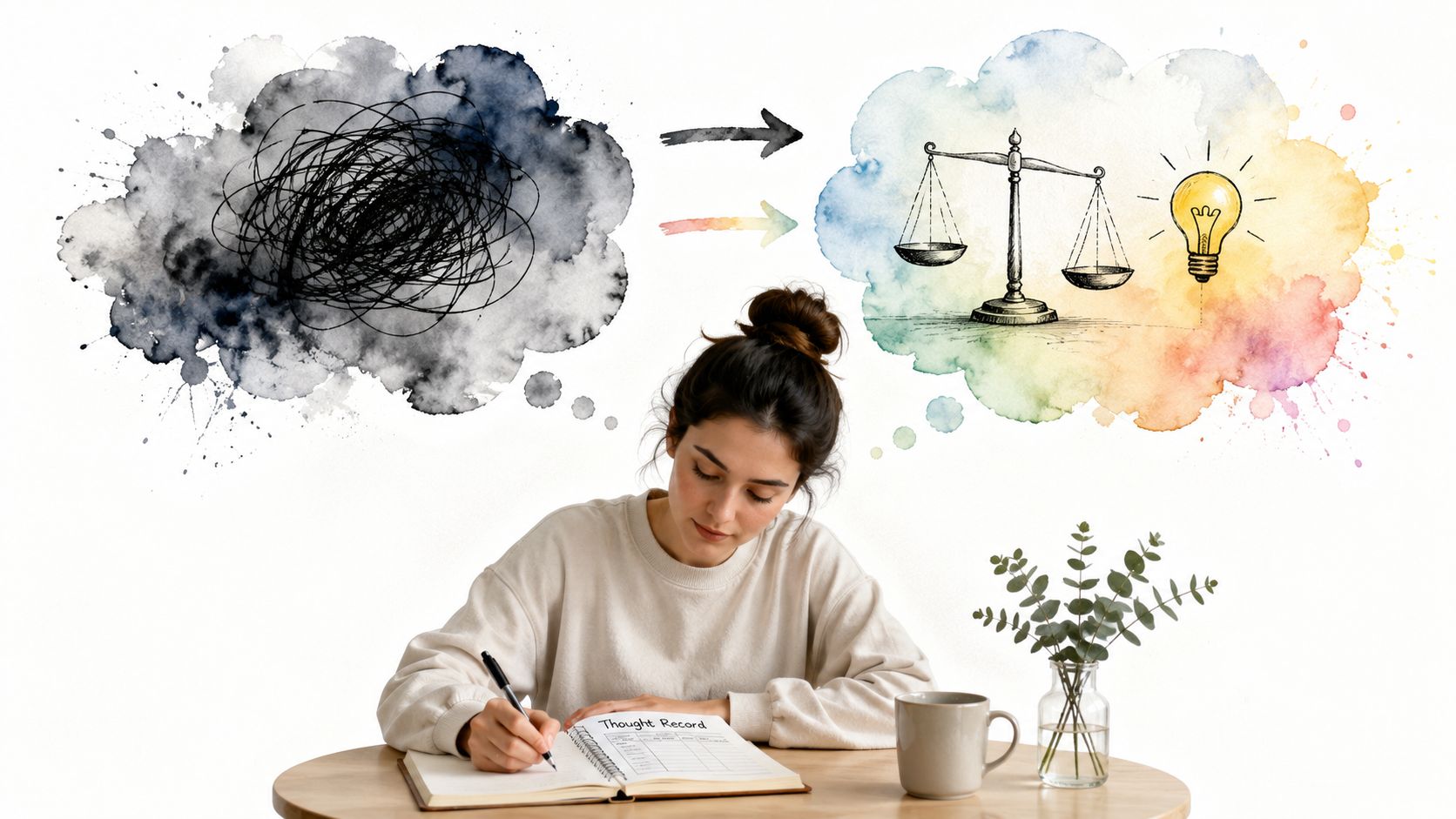
CBT is one of the most practical mental health coping strategies because it teaches you to catch anxiety in motion. Instead of treating fear like a mystery, it breaks the experience into parts: situation, thought, body sensation, emotion, and behavior. Once you can see the pattern, you can start changing it.
Say you feel a flutter in your chest before a meeting and immediately think, “I'm going to panic and embarrass myself.” CBT helps you pause and examine that thought rather than obey it. You learn to ask whether the fear is a fact, a prediction, or a worst-case story.
How CBT changes the anxiety cycle
A simple thought record can help. You write the trigger, your automatic thought, the evidence for it, the evidence against it, and a more balanced thought. Over time, this trains your brain away from catastrophizing and toward accuracy.
You can also use behavioral experiments. If social anxiety tells you that asking one question in a group will lead to rejection, you test that prediction in a small, planned way. Many people find that reality is less dangerous than anxiety promised.
Practical rule: Don't wait until you feel perfectly calm to use CBT. Use it when your thoughts are messy. That's when the skill matters most.
If you want guided support, CBT tools for anxiety relief can make the process more structured. Whether you work with a therapist or use a self-guided format, CBT helps you build something powerful: confidence in your ability to respond to fear differently.
2. Grounding Techniques (5-4-3-2-1 Method)
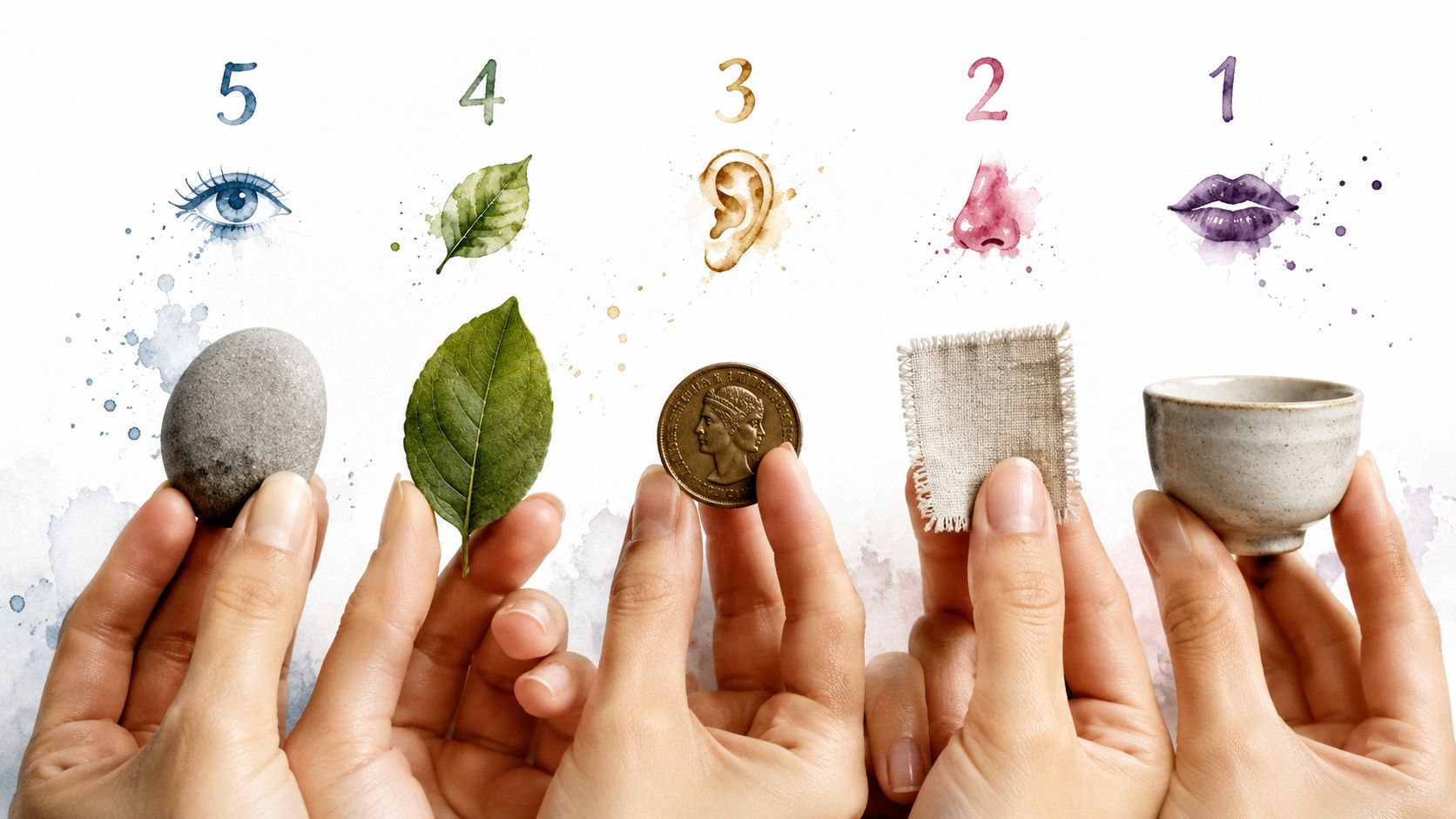
Grounding is what you use when anxiety yanks you out of the present. Your mind says danger is everywhere. Your body joins in. The 5-4-3-2-1 method gives you a script to interrupt that spiral.
It works by redirecting attention from internal alarm signals to the outside world. You name five things you can see, four you can feel, three you can hear, two you can smell, and one you can taste. That sensory sequence helps pull your brain back to the room you're in.
A fast way to return to the present
A person on a crowded train might name the blue backpack across from them, the cool metal pole in their hand, the sound of the doors closing, the scent of coffee nearby, and the mint they just chewed. A child with separation anxiety can do a simpler version with colors, textures, and sounds. The method is flexible.
Try practicing when you're already calm. That way it won't feel unfamiliar when panic hits.
- Make it concrete: Name exact objects like “silver laptop” or “rough denim sleeve,” not vague categories.
- Adapt the steps: If smell or taste isn't available, spend longer on touch or sound.
- Pair it with breath: A slow exhale after each sensory item can deepen the calming effect.
Grounding doesn't erase anxiety instantly. It gives your mind something steadier to hold onto while the wave passes.
If you'd like more examples, The Anxiety Checklist's grounding tips show how to use sensory anchors in daily life, at work, and during panic.
3. Guided Meditation and Mindfulness
You climb into bed, the lights are off, and your body is finally still. Then your mind starts sprinting. It replays the awkward comment, tomorrow's deadline, the strange symptom you noticed at lunch. Guided meditation and mindfulness give that mental energy a safer track to run on.
Guided meditation offers structure. A voice, a body scan, or a short prompt gives your attention one clear job. Mindfulness builds a related skill. It teaches you to notice thoughts, feelings, and body sensations without treating each one like an emergency.
That shift matters. Anxiety often acts like an overprotective smoke alarm that reacts to burnt toast as if the house is on fire. Mindfulness helps you hear the alarm without immediately tearing through the house looking for flames. You notice, pause, and respond with more choice.
Learning to observe instead of react
A lot of people worry they are “bad at meditation” because their mind wanders. Wandering is part of the practice. The skill is returning to an anchor such as the breath, the feeling of your feet on the floor, or the sound of a guide's voice. Each return is a repetition, much like strengthening a muscle through repeated movements.
This can look different from person to person. A bedtime body scan may help if your brain reviews the day the moment you lie down. A short guided practice between meetings can create a reset before stress piles up. If sitting still makes you feel cornered, mindful walking may fit better because it gives your body motion while your mind learns steadiness.
Mindfulness also works best as one tool in a larger coping toolkit. On some days, quiet observation is enough to lower the intensity. On other days, you may need journaling, movement, connection, or a grounding exercise alongside it. Healing from anxiety usually works this way. You build a set of skills, then use the one that fits the moment.
A few ways to make the practice easier to keep:
- Start with a short window: Three to five minutes is enough to begin. Consistency matters more than length.
- Match the practice to the problem: Use sleep meditations at night, calming guidance during stress, or walking mindfulness if stillness feels hard.
- Use a simple anchor: Breath, sounds, hand on chest, or feet on the floor all work.
- Expect discomfort, not perfection: Restlessness, boredom, and mental noise do not mean you are failing.
Mindfulness does not erase emotion. It helps you create a little space between the anxious signal and your next move.
That space is where control starts to return. Over time, guided meditation and mindfulness can help you build a life that feels less driven by anxiety and more directed by your own choices.
4. Breathing Exercises and Diaphragmatic Breathing
When anxiety rises, breathing often becomes quick, shallow, and stuck high in the chest. That can make panic feel even more convincing. Diaphragmatic breathing helps reverse that loop by inviting slower, fuller breaths that tell your body the threat is passing.
Put one hand on your chest and one on your belly. As you inhale, aim for the belly hand to move more. Then exhale slowly. For many people, the extended exhale matters most because it supports a sense of settling.
Teaching your body that it is safe
Different patterns work for different people. Box breathing gives structure. A gentle inhale followed by a longer exhale can feel better if breath holding makes you tense. Before a stressful conversation, even three slow cycles can take the edge off.
Here's a guided example to follow:
Use breathing exercises as practice, not just rescue. If you only try them in the middle of panic, they can feel unfamiliar or frustrating.
Slow is helpful. Forced isn't. If a breathing pattern makes you more uncomfortable, switch to a gentler rhythm and focus on a longer exhale.
People often pair breathing with grounding, a hand on the chest, or a calming phrase such as “This is anxiety, not danger.” That combination can help the body and mind work together instead of pulling in opposite directions.
5. Thought Journaling and Cognitive Restructuring
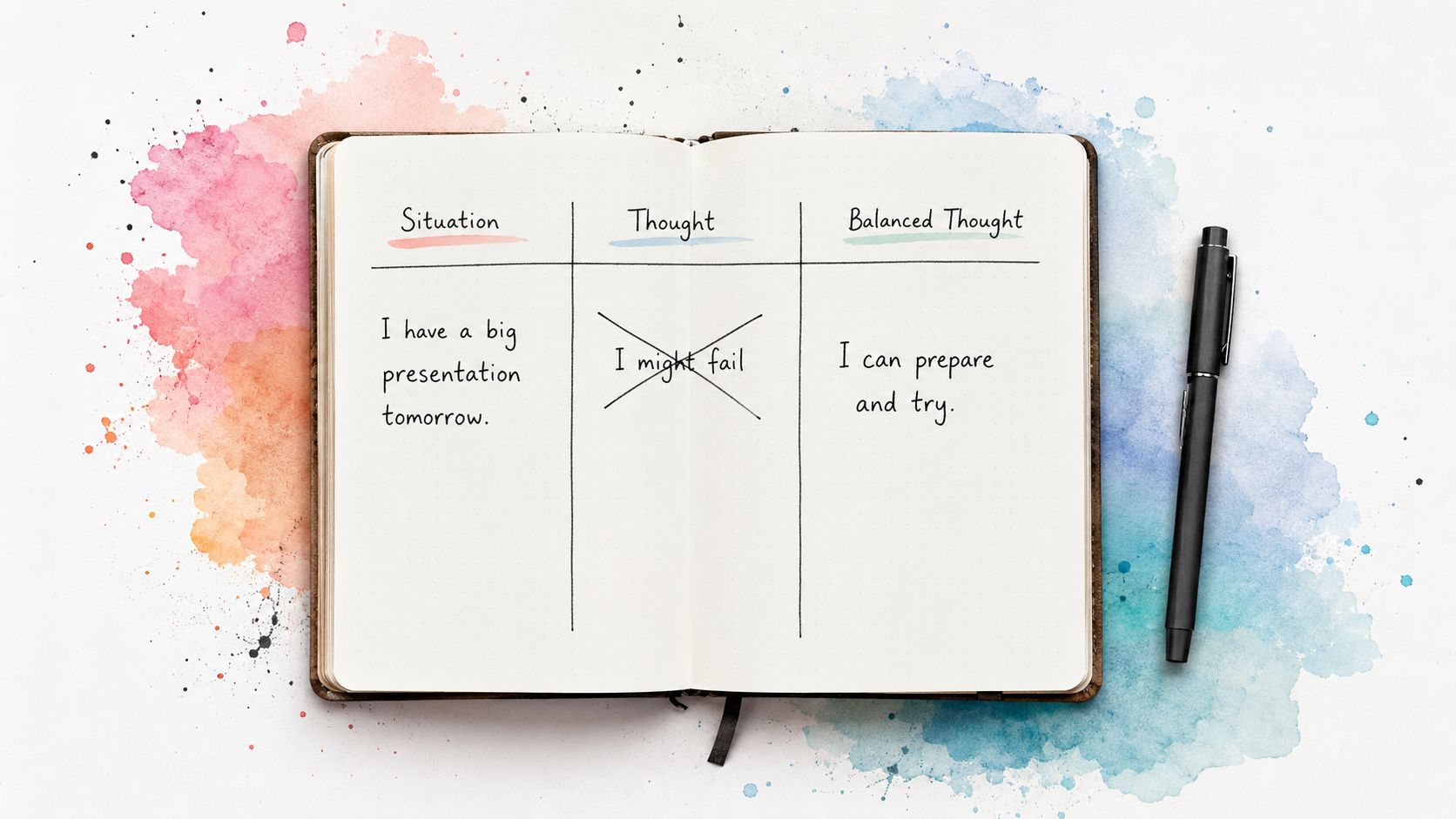
Anxious thoughts feel true because they arrive fast and loud. Thought journaling slows them down enough for you to examine them. Once words are on paper, they often lose some of their power.
You might write, “If I stumble during my presentation, everyone will think I'm incompetent.” Then you ask a few questions. What evidence supports that? What evidence doesn't? What would I tell a friend who had this fear? The goal isn't fake positivity. It's a more accurate, less punishing perspective.
Putting anxious thoughts on paper
A useful journal entry can include the situation, automatic thought, emotion, body sensations, evidence for, evidence against, and a balanced replacement thought. Over several days, patterns become easier to spot. Maybe you mind-read in social settings, catastrophize about health, or treat uncertainty as danger.
Recent research also adds an important layer. This study on student coping patterns and avoidance-related responses notes that people don't always cope in obviously constructive ways, and that anxiety can lead to waiting, isolating, distraction, or reassurance-seeking. That matters when you journal, because a thought isn't just a sentence in your mind. It often drives a behavior that keeps anxiety alive.
Try prompts like these:
- Name the distortion: Is this catastrophizing, all-or-nothing thinking, or mind-reading?
- Check the function: Is this thought helping me solve a problem, or just pushing me toward avoidance?
- Write a balanced response: “I may feel anxious, but I can still get through this.”
If repetitive thinking is your main struggle, how to stop overthinking and worrying can offer more structured support.
6. Progressive Muscle Relaxation (PMR)
Some people say, “My mind is anxious, but my body is fine.” Then they try PMR and realize their jaw is clenched, shoulders are raised, fists are tight, and stomach is braced. Anxiety often lives in the muscles long before we notice it consciously.
PMR works by tightening one muscle group and then releasing it. That contrast teaches you what tension feels like and what relaxation feels like. For many people, that physical learning is easier than trying to think their way into calm.
Releasing tension you may not notice
A simple routine starts at the feet and moves upward. Tighten the feet, release. Tighten the calves, release. Then thighs, stomach, hands, shoulders, jaw, and forehead. Evening practice can prepare the body for sleep, while a shortened version can help before a meeting or after a stressful commute.
A few reminders make PMR more effective:
- Go gently: Tension should be deliberate, not painful.
- Notice the contrast: Spend more time feeling the release than the squeeze.
- Practice regularly: Repetition helps your body recognize and choose relaxation faster.
People who struggle with constant physical arousal often find PMR surprisingly reassuring. It creates proof that your body can shift states. That sense of control can offer significant hope when panic has made you feel trapped inside your own nervous system.
7. Exposure Therapy and Habituation
Avoidance feels protective, but it usually teaches anxiety to grow. If you stop driving because of panic, avoid eye contact because of social fear, or refuse exercise because a faster heartbeat scares you, your world gets smaller and anxiety gets louder.
Exposure therapy helps reverse that pattern. You face a feared situation in small, planned steps, long enough to learn something new. The new lesson might be, “This feeling is uncomfortable, but not dangerous,” or “I can handle more than I thought.”
Stopping avoidance from running your life
Someone with social anxiety might begin by saying hello to a cashier, then asking a stranger for the time, then speaking briefly in a meeting. Someone with panic disorder might practice safe interoceptive exposure, such as briefly increasing heart rate, so the body sensation stops feeling like a catastrophe. The point is repeated contact with fear, not one dramatic leap.
The best exposure target is usually not the scariest one. It's the one you can repeat often enough to teach your brain a different outcome.
Helpful principles include:
- Build a ladder: Rank feared situations from easier to harder.
- Stay long enough: Give anxiety time to rise and then settle on its own.
- Repeat the practice: One exposure can help, but repetition is what changes learning.
If you'd like a practical framework, The Anxiety Checklist's insights on exposure therapy explain how to approach fear in gradual, structured steps. Exposure is one of the clearest paths from “I can't” to “I did.”
8. Hypnotherapy and Guided Imagery
Hypnotherapy and guided imagery can sound mysterious, but the core idea is straightforward. Focused attention changes how you experience thoughts, sensations, and expectation. In a calmer, more receptive state, you may find it easier to practice safety, imagine competence, and interrupt old fear patterns.
Guided imagery is often the simpler entry point. You picture a place that feels safe, steady, and detailed. Maybe it's a quiet beach, a shaded trail, or a familiar room. The more sensory detail you add, the more your body can settle into the image.
Using focused attention to build calm
Some people use imagery before sleep. Others use it before a flight, medical visit, or difficult conversation. Hypnotherapy sessions may also include suggestions that support calmer breathing, less catastrophic thinking, or more confidence in handling bodily sensations.
Digital tools can make these methods easier to access at home. Independent review literature describes how digital mental-health tools can improve access and behavior change when they combine telemedicine, online therapy, wearables, social platforms, and AI-driven virtual agents. The same review notes that chatbots can offer 24/7 support, personalized recommendations through machine learning, and immediate links to hotlines, therapy platforms, and support groups, according to this review of digital mental-health technologies.
That doesn't mean every audio track or chatbot is right for every person. It does mean structured, always-available support can be valuable when anxiety spikes outside office hours. For some people, a calming voice and a repeatable mental image become a reliable bridge back to safety.
9. Physical Exercise and Movement
Anxiety creates energy. Movement gives that energy somewhere to go. A brisk walk, a yoga session, dancing in your kitchen, or a short run can interrupt spiraling thoughts and help your body complete a stress cycle instead of staying stuck in it.
Exercise also gives you a direct experience of bodily sensations that anxiety often misreads. A faster heartbeat during movement isn't an emergency. Heavy breathing after a climb isn't a sign that you're losing control. Relearning those signals can be healing.
Why movement helps anxious minds
You don't need a perfect routine. The best starting point is the kind of movement you're most likely to repeat. For one person that's a morning walk with music. For another it's stretching before bed or a short class after work.
If you enjoy running, some people describe the lift in mood that can follow sustained movement, as explored in this Swift Running article on euphoria. You don't need to chase that feeling, though. Regular movement helps even when it feels modest.
A practical way to use exercise for anxiety:
- Choose a low-friction option: Walking shoes by the door beats a complicated plan you'll avoid.
- Track your response: Notice mood and body tension before and after movement.
- Use movement preventively: Don't save it only for bad days.
Movement doesn't have to look athletic to count. It just has to help your body remember that activation can lead to relief instead of panic.
10. Social Support and Connection
Anxiety often tells you to pull back, stay quiet, and handle everything alone. That usually makes suffering heavier. Safe connection can reduce shame, add perspective, and remind you that panic feels isolating but isn't isolating in reality.
A supportive person doesn't have to say the perfect thing. What helps most is consistency, emotional steadiness, and a willingness to stay present. A regular call, a check-in text, a support group, or a therapist who understands anxiety can all become part of your coping system.
Healing happens faster with support
This matters even more when standard advice isn't easy to use. CDC guidance on living with mental health conditions highlights practical barriers such as cost, travel distance, stigma, confidentiality concerns, and lack of culturally relevant care. It also points toward options like telehealth, community-based support, sliding-scale care, and culturally adapted resources. Sometimes the most effective coping strategy is the one you can access and sustain.
If social anxiety is part of the picture, connection may need to start small. One trusted person is enough to begin.
- Say what kind of support you need: “Please listen” is different from “Please help me solve this.”
- Choose emotionally safe people: Not everyone earns a front-row seat to your vulnerability.
- Keep contact scheduled: Anxiety can make you cancel when support would help most.
If fear of judgment keeps you isolated, how to overcome social anxiety can help you start building connection without forcing yourself into overwhelming situations.
10-Strategy Mental Health Coping Comparison
| Intervention | 🔄 Implementation complexity | 💡 Resource requirements | ⚡ Speed / immediacy | ⭐ Expected outcomes | 📊 Ideal use cases |
|---|---|---|---|---|---|
| Cognitive Behavioral Therapy (CBT) | Moderate–High: structured protocol, therapist guidance and homework | Trained therapist or credible app; weekly sessions (12–20) | Moderate: benefits develop over weeks–months | High: durable symptom reduction for many anxiety disorders | Panic, GAD, social anxiety, skills-focused change |
| Grounding Techniques (5-4-3-2-1) | Low: simple sensory steps, easy to learn | None: portable and discreet | Immediate: minutes to interrupt panic | Moderate (temporary): rapid symptom relief but short-lived | Acute panic attacks, situational anxiety, travel/public spaces |
| Guided Meditation & Mindfulness | Low–Moderate: easy to start, requires consistent practice | Audio guides/apps or instructor; short daily time commitment | Fast calming effects possible; deeper gains over weeks | Moderate–High with practice: improved regulation and reduced rumination | Stress management, sleep support, daily resilience building |
| Breathing Exercises & Diaphragmatic Breathing | Low: simple techniques, quick to learn | None: can be self-taught via apps/videos | Immediate: seconds–minutes for physiological calming | Moderate (acute): reliable short-term nervous system downregulation | Panic symptoms, pre-event calming, in-the-moment regulation |
| Thought Journaling & Cognitive Restructuring | Moderate: structured practice, disciplined self-reflection | Journal or app; time for regular entries and review | Gradual: insights and cognitive shifts over weeks | High when consistent: improves cognitive patterns and self-awareness | Persistent worry/rumination, CBT self-therapy, relapse prevention |
| Progressive Muscle Relaxation (PMR) | Moderate: stepwise body-focused routine | Guided audio recommended; 20–45 min for full session | Slower: full effect takes longer (short versions exist) | Good for physical tension and sleep improvement | Insomnia, chronic muscle tension, pre-sleep routines |
| Exposure Therapy & Habituation | High: planned hierarchy, repeated practice; often therapist-led | Therapist guidance advised; time-intensive repeated exposures | Gradual: exposures produce change over repeated sessions | Very High for specific fears and OCD when done correctly | Phobias, OCD, social anxiety, panic with avoidance |
| Hypnotherapy & Guided Imagery | Moderate: requires trained facilitator or quality recordings | Hypnotherapist or recorded sessions; quiet space | Variable: can induce rapid relaxation for some | Variable: effective for relaxation/insomnia; mixed for core anxiety | Relaxation, sleep issues, adjunct to other therapies |
| Physical Exercise & Movement | Low–Moderate: planning and motivation required | Minimal equipment; time commitment (regular sessions) | Immediate mood boost; long-term benefits in weeks | Moderate–High long-term: reduces baseline anxiety and improves sleep | General anxiety prevention, mood regulation, lifestyle intervention |
| Social Support & Connection | Variable: depends on relationship-building effort | Time and emotional investment; may use groups/online communities | Can provide immediate emotional relief | High as a protective factor: reduces isolation and stress | Chronic distress, loneliness, ongoing emotional support |
Building Your Toolkit for a Hopeful Future
It is 9:30 p.m. Your chest is tight, your thoughts are racing, and part of you wants one perfect fix that makes the whole problem disappear. Anxiety rarely works that way. Recovery usually looks more like building a well-stocked toolbox. You reach for one tool during a spike, another during a quiet evening, and a different one when you are ready to make deeper changes.
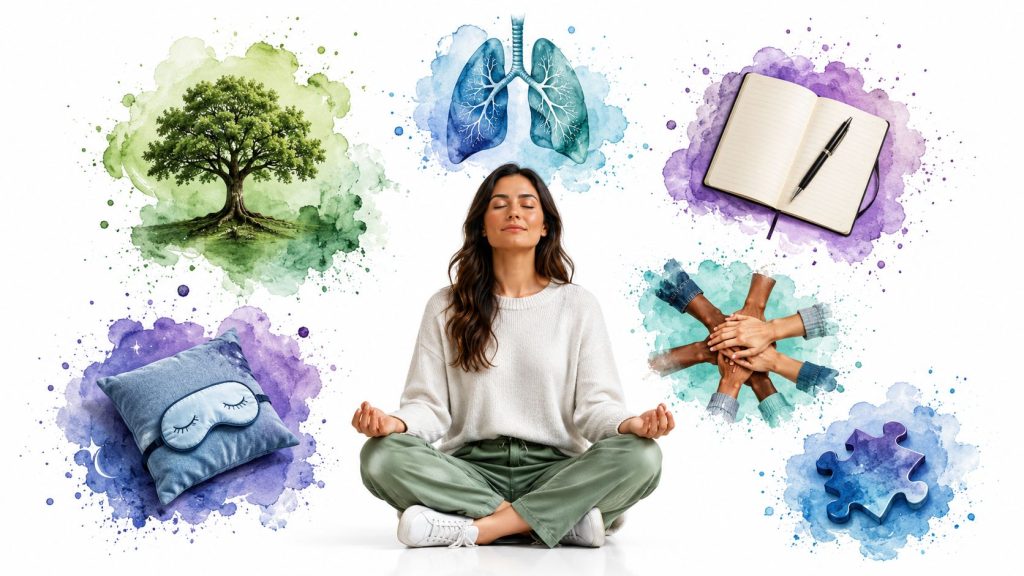
That is why these ten approaches work better as a system than as a test of willpower. Grounding and breathing can steady you in the moment. CBT, journaling, exposure, movement, and connection help reshape the patterns that keep anxiety going. Each skill has a job. Together, they give you more ways to respond instead of react.
Research discussed earlier supports this broader view of coping. People tend to do better when they have several healthy strategies available rather than depending on a single method. The message is hopeful and practical. Healing does not depend on finding one perfect trick. It grows as you build a wider range of responses and learn when to use each one.
If you feel worn down, start smaller than you think you should. Choose one tool for immediate relief and one for longer-term progress. You might use grounding during panic and thought journaling at night. You might practice diaphragmatic breathing during the day and do planned exposure work twice a week. Small, repeatable actions train the nervous system the way steady physical therapy retrains an injured muscle. Slow repetition often changes more than occasional intense effort.
Progress can be uneven.
A better week does not mean you are cured, and a hard day does not mean you are back at the beginning. Improvement often shows up in quieter ways first. You recover faster after a surge of fear. You feel less intimidated by physical sensations. You return to daily life with less bargaining and avoidance. These changes are significant, even before anxiety fully loosens its grip.
Hope helps most when it becomes concrete. It is not only the belief that life can improve. It is the evidence you collect through practice. Each time you stay with a wave of anxiety instead of fleeing, question a catastrophic thought, walk outside despite fear, or reply to someone instead of isolating, you are teaching your brain something new. Safety can be learned. Flexibility can be learned. Connection can be rebuilt.
If you want integrated support, The Anxiety Checklist is one option that brings several of these tools into one place. It includes grounding support, guided sessions, CBT-based exercises, and educational material for both immediate relief and ongoing practice. That kind of structure can help on the days when anxiety scrambles your memory and makes it hard to decide what to do next.
You do not need to wait until you feel fearless. Begin while you still feel unsure. Begin with one slower breath, one line in a journal, one walk around the block, one honest conversation. That is how healing usually happens. Step by step, skill by skill, until anxiety is no longer in charge of your life.