



You're standing in a crowded supermarket when your chest tightens, your pulse races, and the shelves seem to close in around you. Or it's three in the morning, your body is tired, but your mind keeps rehearsing everything that could go wrong. In moments like these, “just relax” feels impossible because your nervous system is responding as if danger is already present.
Safe place visualization gives your attention somewhere specific and reassuring to go. You build a mental scene, return to it through sensory details, and use it as a portable cue for steadiness. It won't erase every anxious thought, and it isn't a substitute for professional care, but it can become one practical part of learning that panic can pass and that a calmer life is possible.
Table of Contents
- What a Safe Place Visualization Actually Does When Panic Hits
- The Evidence Behind Safe Place Visualization and Guided Imagery
- Build Your Own Safe Place Step by Step
- Using Your Safe Place in Real SOS Moments
- Trauma-Sensitive Adjustments When Your Mind Goes Blank
- A Realistic 14-Day Practice Routine
- Growing From Calm Moments to Living Panic Free
What a Safe Place Visualization Actually Does When Panic Hits
Panic narrows attention. You may notice tunnel vision, a racing pulse, tense muscles, shallow breathing, or a mind locked into one frightening prediction. A safe place visualization offers a rehearsed internal environment that competes with the alarm loop without asking you to argue with every thought.
The scene might be a quiet lakeside cabin, an invented room with a locked door and soft lighting, or a beach that feels comforting rather than exposed. You engage sight, sound, smell, touch, and taste, allowing your brain to process a fuller pattern than the single message, “Something is wrong.”
It's more than distraction
Distraction tries to pull attention away from distress for a while. Positive thinking tries to replace a frightening idea with a reassuring one. Safe place visualization is different. You deliberately construct a scene and practice returning to it, while keeping enough awareness of your body and surroundings to remain oriented in the present.
The technique belongs to the wider family of guided imagery and is used in approaches connected with cognitive behavioral therapy and clinical hypnotherapy. It's also different from replaying a real memory. A real location can work if it carries neutral or positive associations, but an imagined place may feel more controllable for someone whose memories include fear or loss.
Practical rule: Build the scene before you need it. Panic is a poor time to invent every detail from scratch.
During a spike, use one sensory cue rather than demanding a vivid movie in your mind. You might repeat, “Warm sand under my feet,” while lengthening your exhale. If fear itself becomes the focus, learning how to overcome fear of fear can help you understand why bodily sensations often become frightening in their own right.
The purpose isn't to prove that nothing difficult is happening. It's to give your nervous system a practiced route toward steadiness, then help you choose what to do next.
The Evidence Behind Safe Place Visualization and Guided Imagery
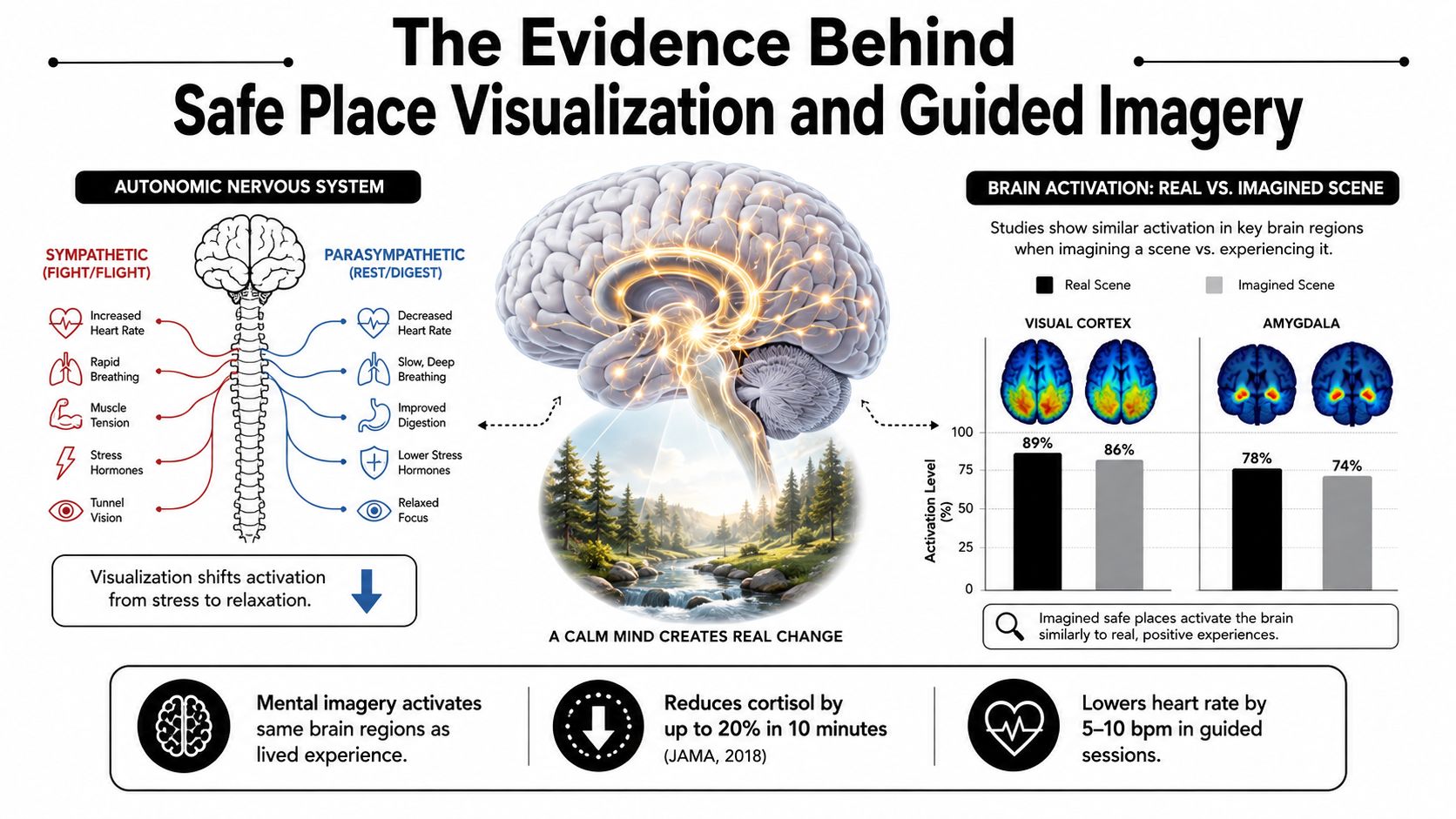
Mental imagery can influence the body because imagined sensory experiences are not processed as meaningless words. When you picture warmth, hear imagined waves, or sense your feet on solid ground, attention shifts toward a pattern associated with comfort and orientation. That shift may support movement away from high alert and toward the body's rest-and-digest response.
The evidence is strongest for guided imagery as a broader category, not for every version of safe place visualization used on its own. A 2020 meta-analysis screened 1,101 records, included 21 studies in its qualitative synthesis, and pooled eight trials quantitatively. It found meaningful anxiety reduction across settings, including a large effect on preoperative state anxiety in children, a moderate effect on preoperative trait anxiety in adults, and a small reduction in adult postoperative pain. The review in PubMed also described guided imagery as easy and low cost.
A 2023 systematic review began with 740 studies and narrowed them to 12 eligible articles, with statistically significant anxiety reduction reported in all 12 included studies. A later 2025 meta-analysis included nine randomized controlled trials with 837 participants and found a significant overall anxiety reduction, with a standardized mean difference of -1.30, a 95% confidence interval from -1.98 to -0.63, and p < .001. Those findings support guided imagery, while still leaving room for questions about which people benefit most from a specific safe place exercise. The systematic review record provides the broader research context.
What the evidence can and can't promise
Protocols differ in length, wording, therapist involvement, and sensory detail. People also vary in how they experience imagery. Some see clear pictures, while others notice sound, body sensations, emotion, or only a faint sense of place.
Direct safe-place research remains limited. A 2026 exploratory case series found that a three-minute relaxation period increased self-reported relaxation in both traditional imagery and personalized virtual reality, without a statistically significant difference between the conditions. A pilot study of the Safe Place collage protocol involved 22 trauma-exposed clients and found a statistically significant decrease in State-Trait Anxiety Inventory scores, with the largest reductions among participants who used an integrating strategy. The small pilot design supports caution, not certainty, and suggests that pairing imagery with reflection may be more useful than treating it as a complete therapy.
For a wider collection of evidence-based anxiety resources, look for material that presents visualization as a support skill rather than a guarantee.
A statue-inspired practice can also help some readers approach stillness through a physical symbol of shelter and composure. This statue-inspired meditation practice offers a culturally rooted contemplative perspective that may complement, but shouldn't replace, mental-health treatment.
Build Your Own Safe Place Step by Step
A useful safe place doesn't need to be beautiful, exotic, or impressive. It needs to feel believable enough for your nervous system to approach and personal enough that you want to return to it.
Seven moves for creating the scene
-
Choose the setting. Pick a real or imaginary place with manageable sensory qualities. A quiet cabin, a shaded garden, or a small room with a comfortable chair may work better than a vast outdoor scene.
-
Give it a reason. Decide what makes this place safe. Perhaps nobody enters without permission, the door opens easily, the weather stays gentle, or you can leave whenever you choose. A reason gives the scene structure.
-
Add sensory detail slowly. Start with what you see, then add sound, smell, touch, and taste. You don't need all five senses immediately. One strong, pleasant cue is enough for the first practice.
-
Include a symbol of protection. This might be a warm lamp, a sturdy fence, a trusted animal, or a blue stone in your hand. The symbol should feel supportive, not demanding.
-
Write a 60-second script. Keep the language short enough to remember when anxious. Record it in your own voice if hearing guidance helps.
-
Test it during low stress. Practice while sitting comfortably, not for the first time during a severe panic spike. Notice whether the scene settles you, feels neutral, or creates discomfort.
-
Refine without judgment. Remove a sound that irritates you, brighten the room, add an exit, or replace the entire scene. Adaptation is part of the method.
A worked example
I'm at my quiet lakeside cabin. I see still water beyond the window and pale light resting on the wooden floor. I hear small waves touching the shore and the soft hum of the room. The air smells like pine and clean water. My hands feel warm around a smooth mug, and the chair supports my back. I taste a mild herbal tea. I breathe in slowly, then let my breath leave at an easy pace. I can stay for a moment, and I can leave whenever I choose.
Use language that keeps you oriented. “I'm noticing the lake in my mind” may feel safer than pretending you've physically left your current location. If closing your eyes makes you uneasy, keep them open and soften your gaze.
Your physical environment can reinforce the practice. A supportive chair, gentle lighting, and reduced visual clutter may make it easier to settle, and this guide to designing a stress-reducing room offers ideas for shaping a calming space around your routine. Save your script in your phone, notebook, or voice recorder, then practice it regularly enough that the wording becomes familiar.
Using Your Safe Place in Real SOS Moments
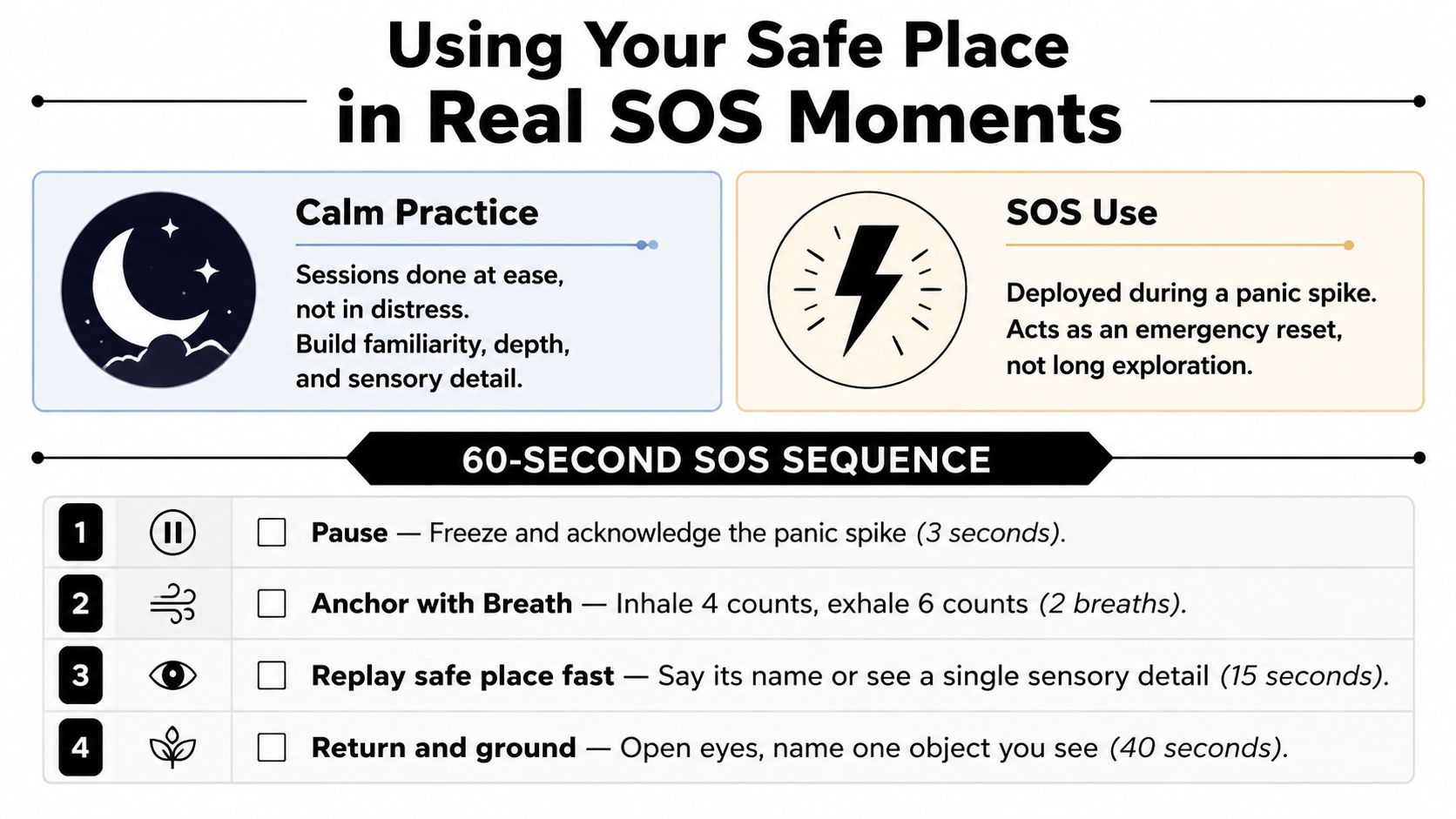
Quiet practice and emergency use serve different purposes. During calm practice, you build depth and learn which details help. During a panic spike, you need a short sequence that works even when concentration is limited.
Use these signs as a prompt to switch to your prepared scene:
- Body alarm: Your pulse is racing, your chest feels tight, or your muscles are bracing.
- Attention narrowing: You notice tunnel vision, scanning, or difficulty taking in the whole room.
- Thought loops: The same intrusive worry repeats without producing a useful action.
- Urge to escape: You feel compelled to flee, check, seek reassurance, or avoid a situation immediately.
The 60-second SOS sequence
-
Pause. Stop moving for a moment and name what's happening: “This is a panic spike. I can take the next step.”
-
Anchor with breath. Inhale for four counts and exhale for six counts, repeating for two breaths. Keep the breath gentle. Don't force a deep inhale if that makes bodily sensations more intense.
-
Replay the scene fast. Say its name or select one sensory detail. “Cabin, pine smell.” “Garden, cool soil.” “Beach, warm sand.”
-
Return and ground. Open your eyes if they're closed and name one object you see. Let the room come back into focus.
Try this compressed beach script: “I'm beside the water. Waves move in and out. I smell salt air. Warm sand supports my feet. I breathe out slowly, then notice the room around me.” The aim is not to stay in the beach indefinitely. Extend the scene if your body is becoming steadier and attention remains flexible. Return to slow breathing and present-moment grounding if the imagery becomes effortful, unreal, or activating.
Rehearse this short version after your longer practice. Automaticity grows from repetition, not from waiting for the perfect crisis.
Trauma-Sensitive Adjustments When Your Mind Goes Blank
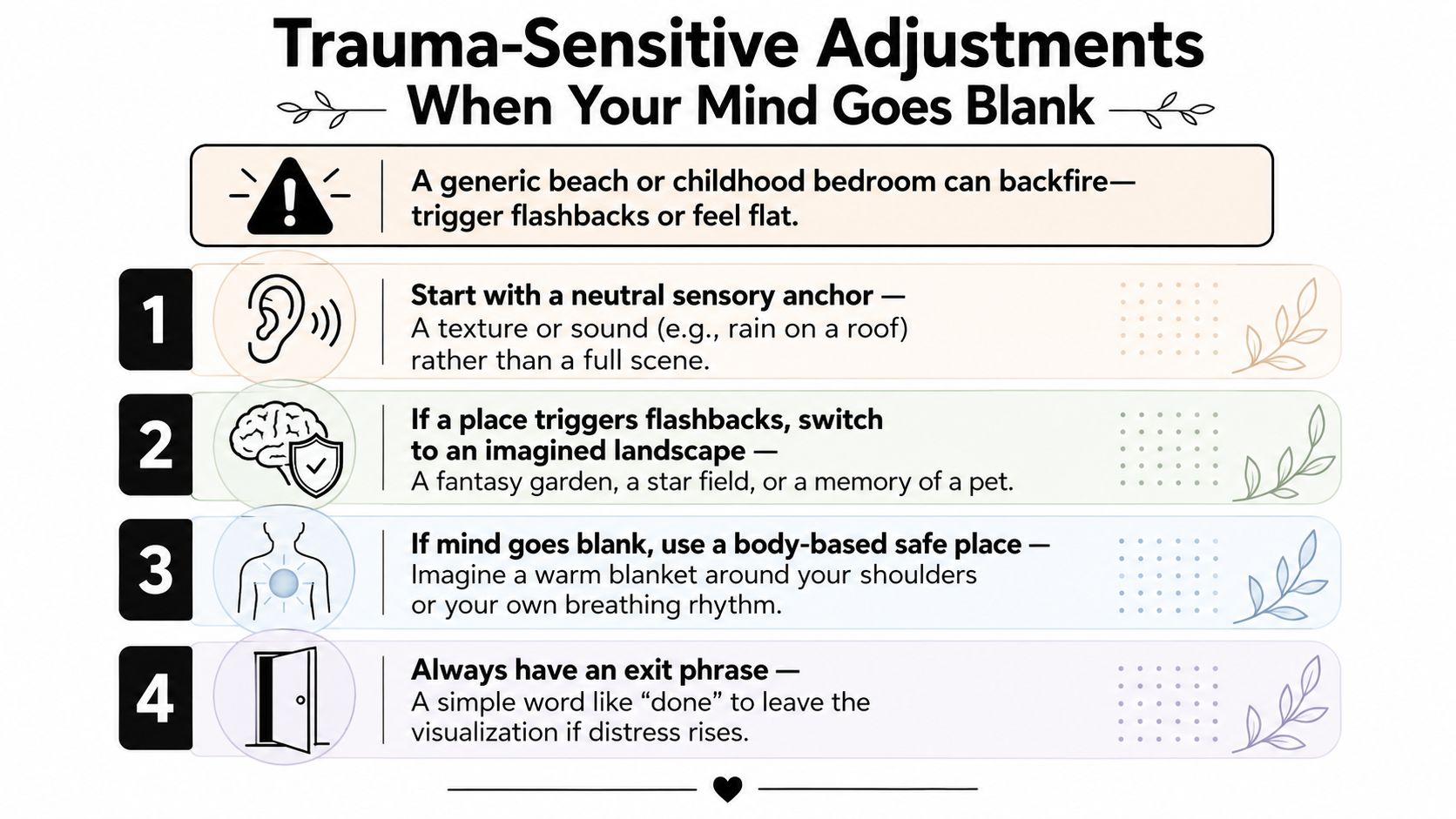
The common instruction to “picture a beach” assumes that beaches feel safe, that the person can form pictures, and that leaving the present feels comfortable. Those assumptions don't hold for everyone. A childhood bedroom may contain painful associations, an open expanse may feel exposed, and intense visualization may increase dissociation rather than reduce it.
Research on direct safe-place exercises is still developing. A 2026 study found comparable short-term relaxation from AI-generated virtual reality and eyes-closed traditional imagery, rather than a clear advantage for technology. That finding supports a practical conclusion: tools may improve access or engagement, but they don't remove the need to choose a scene carefully.
Use a decision guide
-
If the scene feels neutral but flat, switch sensory channels. Stop trying to see a complete place and focus on rain on a roof, a soft fabric, or the rhythm of your breathing.
-
If the scene triggers a flashback, leave it. Open your eyes, press your feet into the floor, name objects in the room, and choose a new imagined setting with clear boundaries and an exit.
-
If your mind goes blank, use a body-based safe place. Imagine a warm blanket around your shoulders, the weight of your feet, or a steady hand resting over your chest.
-
If you feel detached or unreal, don't push harder. Say your exit phrase, such as “done,” orient to the date and location, and use ordinary grounding instead of imagery.
An imaginary room can be easier to control than a memory. Give it a visible door, adjustable lighting, and a chair that faces the entrance. A fantasy garden, star field, or calm animal companion can also work when real-world settings carry too much history.
Stop signal: If distress rises, leaving the visualization is a successful choice. You're practicing control, not endurance.
You can use shadow work prompts for anxiety for reflection later, but don't use journaling to force yourself into traumatic material during acute distress. A therapist trained in trauma treatment can help you decide whether imagery, grounding, exposure, or another approach fits your needs.
A Realistic 14-Day Practice Routine
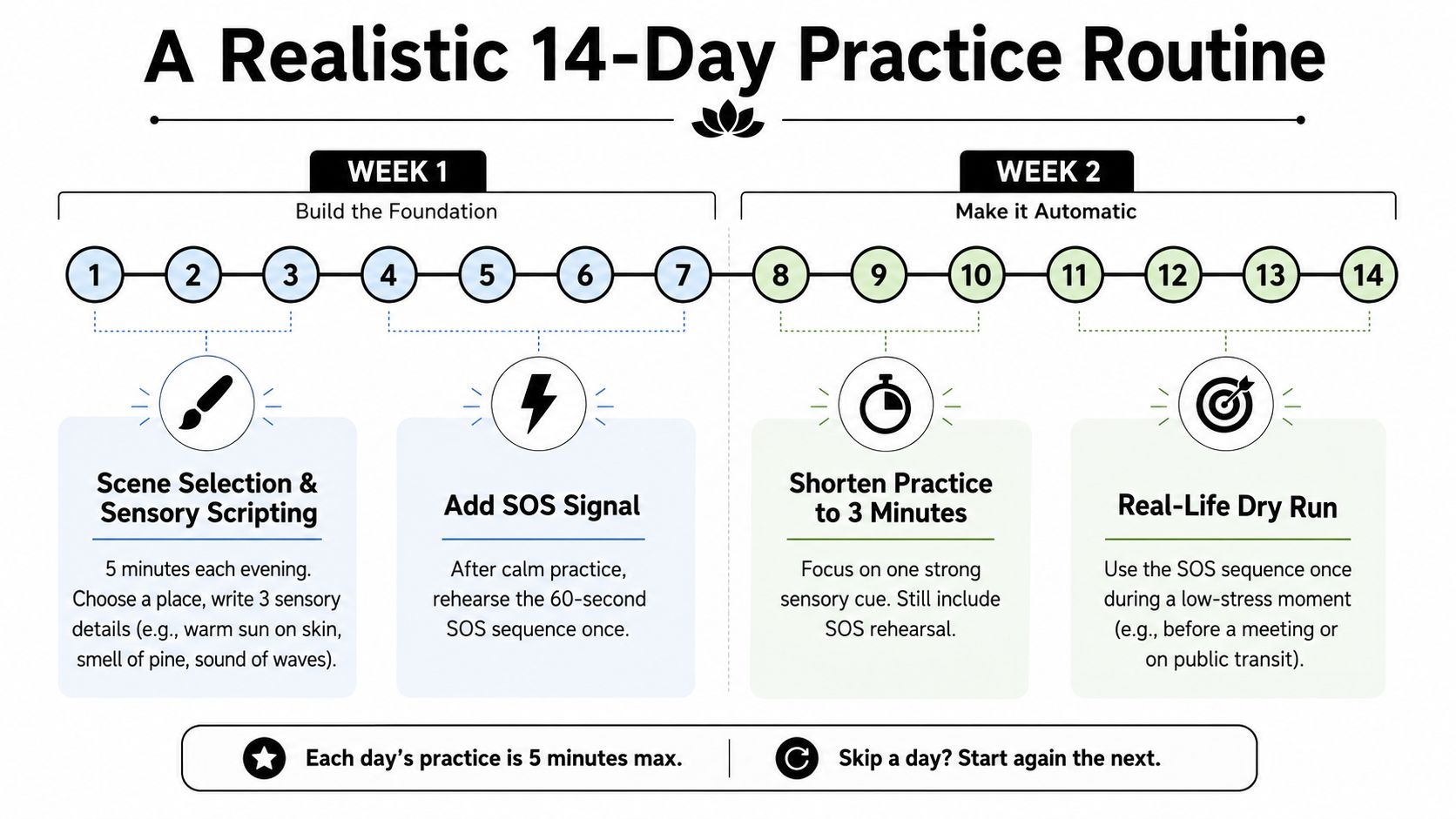
A two-week routine works best when it fits ordinary life. Keep the practice brief and treat missed days as information, not failure.
Week one builds familiarity
-
Days 1 to 3: Spend five minutes each evening choosing a setting and writing sensory details. Select one sight, one sound, and one body sensation. Don't worry if the scene feels mechanical.
-
Days 4 to 7: Read or speak the full script once, then rehearse the compressed SOS version. Practice while calm so the short sequence feels recognizable later.
The first week may feel like reading instructions rather than entering a peaceful place. That's normal. Your task is repetition, not vividness.
Week two adds flexibility
-
Days 8 to 10: Introduce one trauma-sensitive adjustment. Try sound instead of pictures, add an exit phrase, or create a second scene with stronger boundaries. Rehearse the SOS sequence after the shorter practice.
-
Days 11 to 13: Use the skill during a low-stress transition, such as a commute, lunch break, or pre-meeting ritual. Keep your eyes open if that helps you stay oriented.
-
Day 14: Review the routine. Ask yourself: What detail came easily? What felt stuck? Did the scene calm me, ground me, or make me more distant? What needs changing?
Vividness often arrives later, sometimes during the second week, but vivid imagery isn't the only sign of progress. A softer exhale, quicker orientation, or greater confidence in your ability to stop the exercise can matter just as much.
If you use a guided imagery app between sessions, choose one with a voice and pace that feel comfortable. You can also use ways to calm an overactive mind when worry loops make it difficult to begin.
Growing From Calm Moments to Living Panic Free
A safe place becomes more valuable when you treat each calm moment as practice for recovery, not as an isolated escape. The script can sit alongside regular sleep routines, gentle movement, breathwork, supportive relationships, and professional treatment when needed. These supports address different parts of anxious living, so one exercise doesn't have to carry the entire burden.
Look for functional changes rather than perfect calm. You might fall asleep more easily, notice fewer spiraling thoughts before a meeting, or recover sooner after an upsetting interaction. Those changes can show that you're building a wider response range, even if anxiety still appears.
When to deepen the work
App-based guided imagery can provide structure when you struggle to practice alone. Journaling can help you record which sensory cues work and which ones activate you. Therapist-led imaginal exposure may be appropriate when avoidance keeps panic in place, but it should be planned with a qualified professional rather than attempted through an improvised safe-place script.
Panic disorder has effective, structured treatments. In one randomized effectiveness trial, 29% of patients receiving collaborative CBT plus medication were in remission at 12 months, compared with 16% receiving usual care. Response occurred in 63% of the collaborative-treatment group and 38% of the usual-care group, according to the JAMA Psychiatry trial. Remission was defined conservatively as no panic attacks alongside minimal anticipatory anxiety and phobic avoidance.
Exposure-based CBT targets the fear of bodily sensations directly. A review found that effective panic-disorder CBT packages commonly included face-to-face treatment and interoceptive exposure, while a meta-analysis found no statistically significant difference between exposure therapy and cognitive therapy overall. The panic-treatment review explains why deliberately and repeatedly experiencing feared sensations can weaken the fear-of-fear cycle.
Longer-term maintenance also matters. A clinical guideline reported relapse of 5.2% with monthly maintenance CBT over nine months, compared with 18.4% without maintenance CBT, with benefits preserved up to 21 months. The guideline supports a hopeful message: recovery can involve ongoing skill use, not just temporary suppression.
Panic feels permanent while it's happening, but your nervous system can learn new associations. Your safe place script, practiced carefully and adjusted when necessary, can travel with you into meetings, shops, commutes, and unfamiliar situations. For readers building broader support, these social anxiety self-help strategies can complement the same gradual movement toward confidence and participation.
The Anxiety Checklist offers an always-free SOS mode with grounding techniques, affirmations, and quick prompts for moments when your mind goes blank, along with guided meditations, sleep audios, hypnosis sessions, walking sessions, and CBT self-therapy tools for longer-term practice. Visit The Anxiety Checklist to pair your safe place routine with practical support you can access when panic rises.