

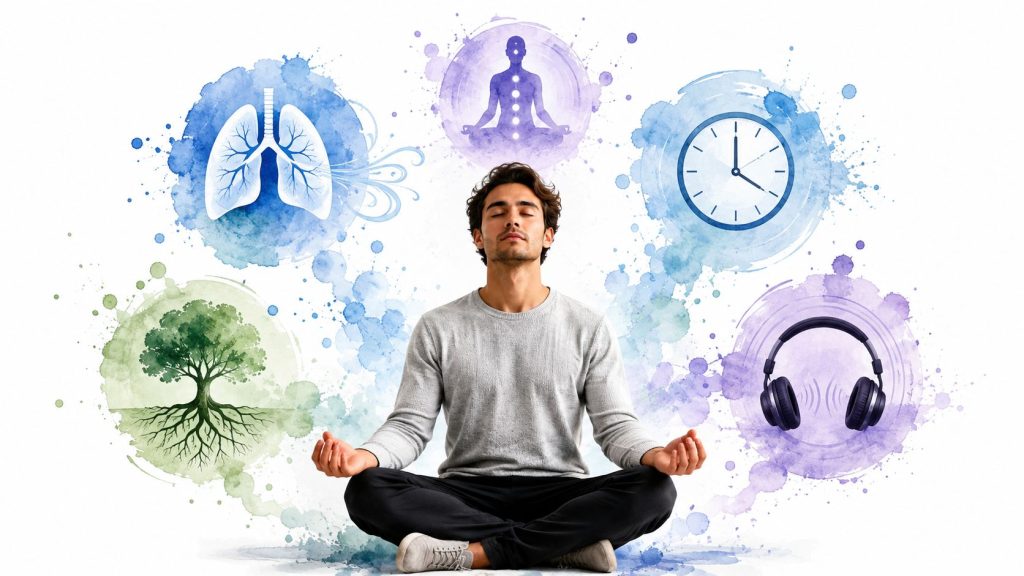
Your mind is racing, your chest feels tight, and a sudden wave of panic has made even choosing what to do feel difficult. In that moment, a short guided meditation can give your attention somewhere steady to land. It won't erase the source of your stress or replace professional care, but it can offer a practical starting point while consistent support helps you rebuild a sense of safety over time.
This list compares guided meditations for stress relief by the need you have right now: immediate SOS support, free access, sleep, grounding, body awareness, personalized plans, or longer-term nervous-system and CBT-informed practice. It considers each tool's technique, session format, likely use case, cost, and access. Meditation is self-help support, not emergency treatment. If you're in immediate danger or experiencing a mental health crisis, seek emergency or professional help.
Table of Contents
- 1. The Anxiety Checklist
- 2. Calm
- 3. Headspace
- 4. Insight Timer
- 5. UCLA Mindful
- 6. Healthy Minds Program
- 7. Balance
- Guided Meditations for Stress Relief: 7-Platform Comparison
- Choose the Practice You Can Return To
1. The Anxiety Checklist
When panic arrives suddenly, the hardest part may be remembering what usually helps. The Anxiety Checklist is built around that problem. Its Always-Free SOS mode requires no login and no setup, so you can open it and follow grounding prompts, guided affirmations, and step-by-step instructions when anxiety makes your mind go blank.
That makes it especially useful for an acute spike at work, during travel, or at home when your breathing feels difficult to control. The SOS experience is focused on the next few moments rather than asking you to commit to a long course before receiving support.
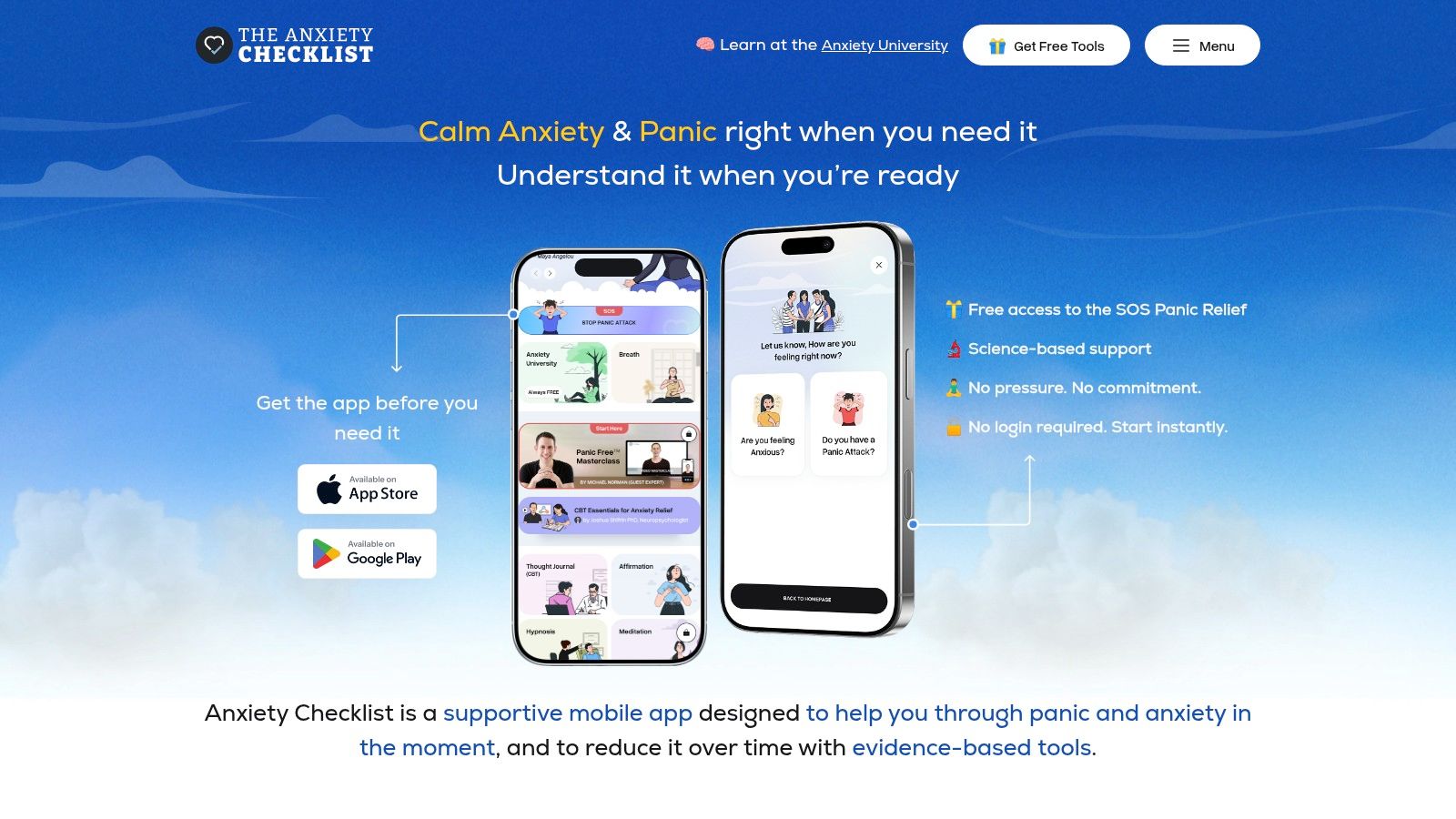
A three-level approach to anxiety support
The app also goes beyond immediate grounding. Daily tools include hypnosis, sleep audios, guided meditations, walking sessions, and affirmations, giving you several ways to practise calming your nervous system when you aren't in crisis. You might use a sleep audio at night, a walking session after a stressful meeting, or a short meditation as part of a morning routine.
For deeper work, the app includes CBT tools such as thought journals, belief experiments, exposure ladders, and expert-led education. That education includes a CBT introduction by Dr. Joshua Shifrin, PhD, and the 5+-hour PanicFree Masterclass by Michael Norman, alongside 65+ educational articles in the free anxiety education hub.
Practical rule: Use the SOS mode for the immediate wave, then return later to daily and CBT-based tools when your body feels safer and you can reflect.
The SOS tools are always free and don't require an account. Premium daily and deeper-recovery content has a 7-day free trial, although subscription rates aren't listed on the site. The Anxiety Checklist clearly presents itself as an evidence-informed self-help tool, not a replacement for professional or emergency care, and it includes crisis resources for urgent needs. For additional anxiety management tips from Maximum Health, consider broader support alongside meditation.
Best for: People living with chronic anxiety or panic attacks, supporters helping someone with anxiety, clinicians seeking structured tools, and budget-conscious users who want to start without a login.
Trade-off: The most useful real-time support is free, while deeper content requires a paid tier after the trial. The site doesn't list exact subscription pricing.
2. Calm
Calm is a strong choice when you want a polished library that makes it easy to choose a practice for a particular situation. Its guided meditations cover stress, anxiety, resilience, breathing, and sleep, so you can shift between a short daytime reset and a slower practice before bed.
The app's format suits beginners who don't want to design their own routine. Daily Calm sessions and topic playlists provide a clear entry point, while Sleep Stories, soundscapes, and breathing exercises support relaxation when sitting still and focusing on the breath feels too demanding.
Useful formats for changing stress levels
Calm also includes short emergency tracks for moments when stress rises quickly. These can be a better fit than a longer course when you have only a few minutes before a meeting or when your thoughts are moving too fast for extended silence. Live and seasonal programming adds sessions related to real-life stressors, and a family plan can support up to six people.
If you're unsure how to begin, pair the app with this practical guide on how to meditate when anxious. The goal isn't to force your thoughts to stop. Follow the voice, notice when attention wanders, and return gently to the breath or the current instruction.
Best for: Beginners who want a refined, broad library with especially strong sleep and relaxation content.
Pros: Daily and topic-based programming, Sleep Stories, soundscapes, breathing tools, emergency tracks, and live or seasonal sessions.
Trade-off: Pricing varies by platform and can be higher than some alternatives. A lifetime option also involves a substantial upfront payment.
Explore the Calm meditation and sleep platform if you want one app that covers stress relief and nighttime winding down.
3. Headspace
Headspace suits people who learn better through a planned sequence than through an open library. Its structured stress program uses CBT-informed strategies, and shorter sessions offer support during work, commuting, or an ordinary stressful afternoon. The curriculum works like a marked trail: each exercise builds a skill before the next one asks you to use it.
That guidance reduces decision fatigue. If motivation falls when you must compare teachers, voices, and techniques, a recommended path makes it easier to begin and return the next day. Choose a breathing session when your body feels activated, or a grounding exercise when thoughts keep pulling you away from the present.
Short support and deeper learning
Headspace's stress collection includes breathwork and tracks for specific situations, including post-travel stress. SOS-style sessions provide a brief pause during a spike in pressure. Longer courses explain the method, repeat the core steps, and give you time to notice patterns. A short track is easier during panic, while a course offers more room to build a lasting skill.
Live monthly meditations and quarterly workshops cover subjects such as financial stress and sleep. They connect practice with the situations that can trigger anxiety. Readers who want to pair meditation with movement can find your yoga style in Tulum.
For repetitive mental loops, this guide on how to stop overthinking and worrying can complement a guided session. During practice, observe the thought, label it as thinking, and return to the narrator's instructions. The aim is a gentle return, not a perfect blank mind.
Best for: Users who prefer step-by-step series, CBT-informed framing, and clear routes toward regular practice.
Pros: Organized programs, stress-focused tracks, breathwork, short SOS sessions, and live programming.
Trade-off: Full access requires a paid subscription, with pricing varying by platform. Some content is arranged as longer courses rather than individual tracks.
Visit Headspace if a structured learning path helps you practice more consistently.
4. Insight Timer
Insight Timer is the strongest fit for breadth and free access. Its library includes 300,000+ guided practices, with search filters for stress, anxiety, panic, breathwork, sleep, and other needs. That range lets you try different voices, pacing, and meditation styles without committing to one approach immediately.
The free tier is especially useful when cost is the deciding factor. You can begin without payment, search for a grounding practice during a stressful afternoon, or choose a sleep meditation at night. Filters and ratings can narrow the selection, although they don't remove the need to listen for a style that feels safe and comfortable.
Freedom can create choice overload
The same abundance that makes Insight Timer flexible can also make it tiring to use. Teacher quality, tone, pacing, and language vary, and a person in the middle of panic may not have the capacity to compare several tracks. Save one or two practices that feel grounding before you need them, so you aren't searching from scratch during an anxious episode.
MemberPlus adds courses, offline downloads, and other premium features. There isn't currently a family plan for MemberPlus, so the platform is better suited to individual exploration than shared household access.
If sound-based practices interest you, read about ways to relieve anxiety with binaural beats, then choose audio that feels calming rather than overstimulating.
Best for: Budget-conscious users who want a generous free plan and many teacher perspectives.
Pros: Large free library, strong search, teacher-led variety, ratings, filters, and frequent new uploads.
Trade-off: Choice overload and inconsistent style can make selection difficult. Premium family access isn't available for MemberPlus.
Start browsing the Insight Timer meditation library when you want maximum choice without an initial payment.
5. UCLA Mindful
UCLA Mindful offers a simpler experience than the major commercial apps, and that simplicity is part of its appeal. The collection provides fully free guided meditations through the web and the UCLA Mindful app, with practices addressing stress and anxiety in a research-informed setting.
There are no ads or paywalls to work through. You can choose a track, sit with your feet supported, and follow instructions without being pushed toward a subscription or a large content ecosystem. The collection also includes meditations in English and other languages.
A calmer way to practise with others
UCLA Mindful offers ongoing free drop-in sessions, both virtual and in person. Community practice can help when anxiety makes solo routines difficult, because the appointment itself supplies a gentle structure. The clinician and academic teaching background may also reassure readers who want a reputable source without a commercial wellness tone.
Try this approach when grounding through physical surroundings feels more helpful than analysing anxious thoughts. A session might guide you toward contact with the floor, the chair beneath you, or sounds in the room. You can also use these grounding anxiety exercises when closing your eyes or focusing inward doesn't feel comfortable.
Best for: Anyone seeking no-cost, no-ads meditation from a reputable academic center.
Pros: Completely free access, evidence-informed content, multilingual options, and free community sessions.
Trade-off: The catalog is smaller, and the app has fewer personalization and progress-tracking features than paid competitors.
The UCLA Mindful guided meditation collection is a good starting point if trust, accessibility, and cost matter more than advanced app design.
6. Healthy Minds Program
The Healthy Minds Program, offered by Humin, is designed for users who want education alongside meditation. Rather than presenting every session as a standalone relaxation track, it combines short practices with learn-and-do lessons built around Awareness, Connection, Insight, and Purpose.
That framework gives daily practice a wider context. Awareness can help you notice breath, body sensations, and mental activity. Connection and purpose can make the work feel less like a private attempt to suppress stress and more like a way to respond to yourself and other people with greater steadiness.
Learning can support consistency
The app includes hundreds of days of audio lessons and guided practices, and it's entirely free through donation support. Its research-grounded development, involving researchers affiliated with the Center for Healthy Minds and Richard J. Davidson, PhD, may appeal to people who want a clear explanation of why they're practising.
The trade-off is a simpler interface and smaller library than Calm or Headspace. That can be helpful if large catalogs overwhelm you, but it may feel limiting if you want a new meditation for every possible situation. There also isn't a premium tier for users seeking additional paid features.
Best for: People who prefer a structured daily curriculum and want educational context about emotional regulation.
Pros: Free access, a clear four-part framework, guided practices, and lessons that connect meditation with broader wellbeing skills.
Trade-off: The interface and catalog are less expansive than those of major commercial apps, and there are no paid add-ons.
Try the Healthy Minds Program from Humin if understanding the practice helps you keep returning to it.
7. Balance
Balance is the best option here for readers whose main obstacle is choosing and staying motivated. Its onboarding asks about goals and experience, including aims such as reducing stress or improving mood, then uses those answers to shape a more personalized meditation path.
The app teaches about 10 concrete techniques, including breath control, with clear skill-building rather than treating every session as an isolated exercise. Short, approachable practices make it easier to fit meditation into a morning routine, lunch break, or evening wind-down.
Personalization can lower the starting barrier
The Today journey supplies a daily destination, which removes the question of what to play next. Health app integration on iOS can also track mindful minutes, giving you a simple record of practice without requiring extensive journaling.
Balance's library is smaller than Calm's or Headspace's, so it isn't ideal if you want endless teacher variety. Most content and features also require a subscription after the free trial. Still, a smaller, well-directed path may be more useful than a huge catalog if decision fatigue is already part of your anxiety.
Best for: Users who want personalized plans, bite-size sessions, and concrete skills that transfer into daily stress coping.
Pros: Goal-based onboarding, short sessions, skill progression, daily plans, and iOS Health integration.
Trade-off: The public library is smaller than those of larger apps, and most features become subscription-based after the trial.
Explore Balance if personalization is likely to help you practise consistently.
Guided Meditations for Stress Relief: 7-Platform Comparison
| Product | Implementation complexity 🔄 | Resource requirements ⚡ | Expected outcomes ⭐📊 | Ideal use cases 💡 | Key advantages ⭐ |
|---|---|---|---|---|---|
| The Anxiety Checklist | Low, instant SOS (no login); optional signup for curriculum | Low–Moderate, SOS free; premium tier after 7‑day trial | ⭐⭐⭐⭐, immediate panic relief; long‑term anxiety reduction with consistent CBT use | People with panic attacks, chronic anxiety, clinicians & budget‑conscious users | Instant SOS, CBT curriculum, expert content |
| Calm | Low, polished, beginner‑friendly UX | Moderate–High, subscription (family plan); lifetime option costly | ⭐⭐⭐⭐, strong sleep/relaxation and stress downshifts | Beginners focused on sleep, relaxation, and guided content | Rich sleep content, polished app, frequent updates |
| Headspace | Moderate, structured courses and step‑by‑step paths | Moderate, subscription required | ⭐⭐⭐⭐, habit formation and structured stress reduction | Users who prefer evidence‑framed series and consistent practice | Clearly organized paths, SOS meditations, live workshops |
| Insight Timer | Low, minimal setup but large choice to navigate | Low, very generous free tier; MemberPlus optional | ⭐⭐⭐, broad exposure; effectiveness varies by teacher | Budget‑conscious users seeking variety and many teacher perspectives | Massive free library, many teacher voices |
| UCLA Mindful (UCLA Health) | Low, simple access via web/app | Very Low, 100% free, no ads | ⭐⭐⭐⭐, research‑informed meditations with high quality | Users wanting no‑cost, evidence‑based sessions from academia | Free, high‑quality, research‑backed content |
| Healthy Minds Program (Humin) | Low–Moderate, curriculum + lessons | Very Low, free/donation‑supported | ⭐⭐⭐⭐, educationally framed wellbeing gains with practice | Users who want neuroscience context with meditation practice | Research‑grounded curriculum, free structured learning |
| Balance | Moderate, onboarding for personalization; adaptive plans | Moderate, subscription after trial | ⭐⭐⭐⭐, personalized skill‑building and daily consistency | Users wanting tailored daily plans and short, actionable sessions | Highly personalized guidance and clear skill progression |
Choose the Practice You Can Return To
The best guided meditation for stress relief isn't necessarily the one with the largest catalog or the most advanced design. It's the practice you can open when your chest feels tight, follow when your thoughts are loud, and return to often enough that the steps become familiar.
For an acute spike, start with an SOS-style option such as The Anxiety Checklist. If cost matters most, explore UCLA Mindful, Healthy Minds Program, or Insight Timer's free access. Choose Calm when sleep and relaxation are central, Headspace when structured lessons keep you engaged, and Balance when personalization removes the burden of deciding what to practise.
Match the technique to the experience in front of you:
- Breathing: Choose a breath-focused session when your attention needs a simple, repeatable anchor.
- Grounding: Use sensory or contact-based prompts when you feel detached, overwhelmed, or stuck in a panic loop.
- Body awareness: Try a body scan when anxiety appears as jaw tension, tight shoulders, stomach discomfort, or restlessness.
- Sleep: Select a slower body scan, visualization, sleep audio, or soundscape before bed.
- Daily resilience: Use a structured curriculum, walking meditation, affirmations, or CBT-informed practice to build familiarity outside crisis moments.
Evidence supports realistic hope, not instant perfection. A 2023 individual participant data meta-analysis found that mindfulness-based programs produced a small-to-moderate reduction in psychological distress that lasted at least 6 months across settings, as reported in this analysis of randomized controlled trials. That doesn't mean every session will work equally well or that meditation replaces therapy. It means repeated practice can be a defensible part of a broader plan.
Start with one manageable session and notice what feels most supportive, breathing, grounding, body awareness, or educational guidance. You don't need the perfect track. You need a repeatable next step, and with appropriate support, anxiety and panic can become more manageable. A panic-free life can be a realistic direction, even if healing happens gradually. If symptoms are severe, frequent, worsening, or connected to immediate danger, contact a licensed professional or emergency service.
For a gentle introduction to building a meditation habit, use this beginner meditation guide.
The Anxiety Checklist combines an always-free SOS mode for immediate grounding with daily guided meditations, sleep audios, walking sessions, affirmations, and CBT self-help tools for longer-term change. Visit The Anxiety Checklist to start without a login and explore practical support for panic, stress, and anxiety at your own pace.