


You're sitting at a traffic light when your chest suddenly tightens. Your breathing turns shallow, your heart pounds, your palms become damp, and the edges of your vision seem to narrow. Nothing outside has changed. Cars are waiting, the light is still red, and other drivers appear completely ordinary. Yet your mind delivers a terrifying conclusion: something is medically wrong.
Panic can feel both intensely physical and isolating. Many people also feel ashamed afterward, as though their body's reaction proves they're weak or unable to cope. It doesn't. Panic is a physiological event involving the autonomic nervous system, and the body's alarm circuits can be reshaped through understanding, practice, and appropriate treatment. Learning about coping with fear of anxiety itself is one part of that process.
The parasympathetic nervous system offers a useful map. It isn't a single button that instantly turns fear off. It's a distributed collection of circuits that can slow the heart, support digestion, and help the brain interpret internal signals as safe. With the right combination of skills and professional support, many people recover from panic and live substantially freer lives.
Table of Contents
- The Moment Your Body Sounds the Alarm
- What the Parasympathetic Nervous System Is
- Parasympathetic Versus Sympathetic at a Glance
- How the Vagus Nerve Powers Your Calm
- Measurable Signs Your Body Is Calming Down
- Evidence-Based Ways to Stimulate the Parasympathetic Nervous System
- Using These Tools During an Acute Panic Attack
- Building Long-Term Calm and Living Panic Free
The Moment Your Body Sounds the Alarm
At the traffic light, your body has moved into emergency mode before you've had time to form a careful thought. The sympathetic branch of the autonomic nervous system increases alertness and prepares you to respond. Your heart beats harder and faster, your breathing changes, sweat helps regulate your body temperature, and blood flow is prioritized for immediate action.
The problem is that the alarm may have no matching danger. A sensation such as a skipped beat, a breath that feels incomplete, fatigue, or a thought about losing control can become the trigger. Your brain notices the sensation, interprets it as threatening, and sends another wave of alarm through the body. The symptoms then become evidence for the frightening interpretation.
The sensation is real, but a real sensation isn't automatically proof of danger.
During panic, it's common to feel dizzy, detached, nauseated, or unable to think clearly. Vision may seem narrow because attention has become tightly focused on threat. The parasympathetic nervous system hasn't necessarily disappeared, but its stabilizing influence can be overwhelmed by the intensity of sympathetic activation. That distinction matters because it means your calming capacity is still part of your physiology, even when you can't feel it.
A panic episode can also create fear of the next episode. You may begin avoiding traffic, shops, public transport, exercise, or being alone. Avoidance can provide short-term relief while teaching the brain that the situation was dangerous, which keeps the alarm sensitive.
The first therapeutic shift is compassionate accuracy: your body is sounding an alarm, not revealing a personal flaw. Panic symptoms deserve medical attention when they're new, severe, or unusual, but recurring panic can also be treated as a learned alarm pattern. Breathing practice, grounding, and cognitive-behavioral therapy can help you retrain the loop rather than spending your life organizing it around fear.
What the Parasympathetic Nervous System Is
The parasympathetic nervous system is one of two continuously active divisions of the autonomic nervous system. Its partner, the sympathetic nervous system, prepares the body for action. Parasympathetic activity supports rest and digest functions, including energy conservation, digestion, recovery, and routine maintenance when immediate action is not required. The National Library of Medicine's overview of autonomic anatomy describes it as an ongoing part of autonomic regulation, not a switch that turns on only after stress.
Its organization is called craniosacral. In plain language, parasympathetic preganglionic nerve fibers begin in the brainstem and sacral spinal cord. Brainstem pathways travel through cranial nerves, particularly the vagus nerve, while sacral pathways serve lower pelvic organs. The fibers connect with ganglia near or within the organs they influence, allowing several relatively targeted circuits rather than one central calm switch.
That distinction helps explain why different calming practices may affect different pathways. Breathing and HRV biofeedback emphasize heart and breathing-related vagal regulation. Cold exposure activates temperature and cardiovascular signals, while grounding uses sensory input and attention to reduce threat processing. These tools can be combined into a personal, layered calming protocol instead of treating one technique as sufficient for everyone.
The term “parasympathetic nervous system” was introduced by John Newport Langley in 1921, a historical milestone that helped establish it as a counterpart to the sympathetic division. That framework still shapes medical teaching and autonomic physiology.
A chemical signal with local effects
The primary neurotransmitter used at both parasympathetic synapse types is acetylcholine. In the heart, it acts on muscarinic receptors and changes the electrical behavior of the sinoatrial node, the natural pacemaker. It increases potassium conductance while reducing pacemaker and slow inward calcium currents. Pacemaker firing slows, supporting beat-to-beat cardiac control. This mechanism is described in a review of vagal control and heart-rate regulation from the National Library of Medicine.
Calming is therefore a body process as well as a thought process. Breathing, pressure sensors, digestion, temperature, movement, and attention can all influence autonomic activity. Anxiety Checklist Anxiety University offers accessible education about anxiety, panic, and practical coping skills. Panic is treatable, and learning which signals help your body settle can make practice more purposeful.
Parasympathetic Versus Sympathetic at a Glance
The sympathetic and parasympathetic branches work as partners. The accelerator-and-brake comparison is helpful, provided you remember that the body doesn't use only one pedal at a time. You need sympathetic activation to respond to genuine demands, and you need parasympathetic influence to recover, digest, and settle afterward.
| Body System | Sympathetic (Fight-or-Flight) | Parasympathetic (Rest-and-Digest) |
|---|---|---|
| Heart | Raises heart rate and supports stronger circulation during action | Slows pacemaker activity and supports resting cardiac control |
| Pupils | Dilates pupils to increase visual readiness | Constricts pupils for closer, less threat-focused vision |
| Digestion | Suppresses digestive activity and redirects resources toward action | Stimulates salivation, gut motility, and digestive function |
| Airways | Relaxes airway muscles to support rapid oxygen intake | Tightens airway muscles toward resting respiratory needs |
| Blood flow | Redirects circulation toward muscles and immediate survival demands | Supports routine organ maintenance and digestion |
| Sexual function | Supports bodily readiness associated with arousal and climax | Supports sexual arousal and secretion |
At rest, parasympathetic influence generally becomes more prominent, including during sleep. But autonomic balance changes constantly with posture, food, movement, emotion, pain, and environmental demands. A faster heart rate after climbing stairs isn't evidence that your sympathetic system is malfunctioning. It's an appropriate response to work.
Panic creates confusion because ordinary sympathetic sensations can be interpreted as signs of catastrophe. A racing heart may be read as heart failure. A change in breathing may be read as suffocation. Digestive slowing or stomach tension may be interpreted as evidence that something is seriously wrong. Understanding the science behind fight or flight helps separate the body's protective response from the story fear attaches to it.
Healthy regulation means flexibility, not permanent calm.
The goal isn't to eliminate sympathetic activation. A person who never becomes alert would struggle to react to genuine danger. The goal is to improve the transition back toward recovery, so an alarm can rise when needed and settle when the situation is safe.
How the Vagus Nerve Powers Your Calm
The vagus nerve is the largest and most widely distributed parasympathetic pathway. It begins in brainstem nuclei, travels through the neck, and branches through the chest and abdomen. Its efferent fibers carry signals from the brain to organs, while its afferent fibers carry information back to the brain.
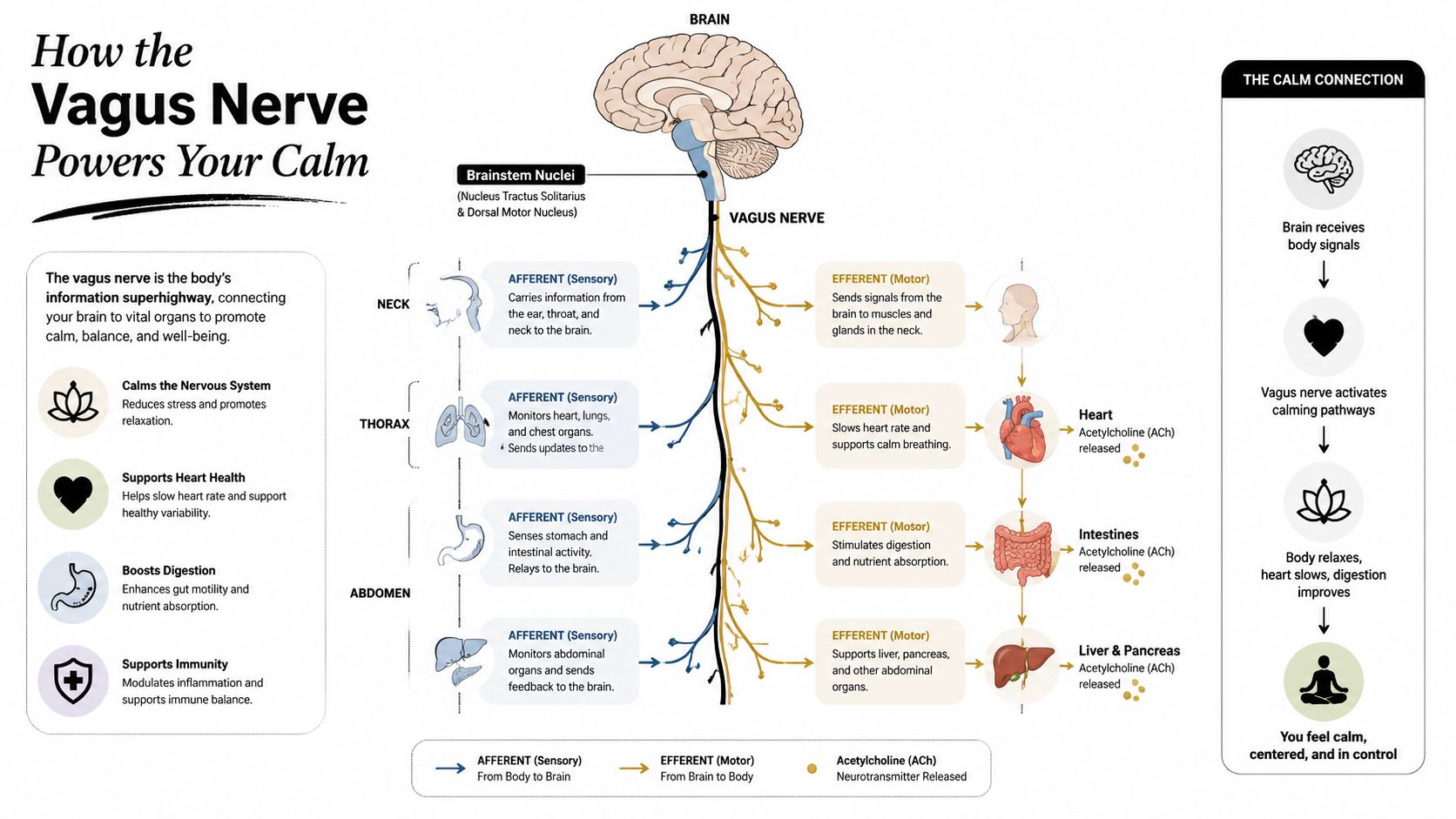
The vagus nerve functions as a two-way communication route, rather than a one-way relaxation cable. Outgoing signals can influence the heart, lungs, and digestive tract. Incoming signals report heart rhythm, blood pressure, gut stretch, and other internal changes. The brain combines those messages with memory, context, and the current situation to decide whether the body should stay prepared or begin recovering.
The brain receives information from the body
Section 3 covered how parasympathetic input can slow cardiac activity. Here, the more useful question is how the brain learns that the body may be safe enough to reduce alarm.
Baroreceptors are pressure-sensitive sensors in blood vessels. They detect changes in arterial pressure and send information upward through autonomic pathways. When those signals suggest that circulation is stable, the brain can adjust cardiovascular output and reduce unnecessary defensive activation.
The gut supplies another stream of information. Stretch in the stomach and intestines, digestive movement, and other visceral signals travel upward through vagal pathways. These signals do not create calm by themselves. They form part of the internal evidence the brain uses when assessing the body's condition.
Vagal influence also involves distinct circuits rather than one universal calm switch. Breathing mainly changes respiratory and cardiac timing. Grounding redirects attention away from catastrophic interpretations. Carefully applied cold stimulation adds sensory input that can alter the immediate autonomic response. HRV biofeedback uses real-time feedback to help a person practice steadier breathing and improve awareness of those changing signals.
A personalized calming protocol can therefore layer techniques instead of depending on one method. One person may respond best to a longer exhale and grounding, while another may add cautious cold exposure or HRV biofeedback. The aim is to give the brain repeated, understandable evidence that the present moment is manageable.
For practical context on cold exposure and anxiety, The Anxiety Checklist on cold showers discusses the approach. Cold stimulation is not suitable for everyone, particularly people with certain cardiovascular or fainting risks. Use it cautiously and discuss it with a clinician when appropriate.
Measurable Signs Your Body Is Calming Down
Calming has both observable and subjective dimensions. A wearable may estimate heart rate, resting heart rate, or heart rate variability, while you may notice that your jaw softens, your breath feels easier, or your stomach begins to settle. Neither category tells the whole story by itself.
Heart rate variability, or HRV, describes variation in the timing between heartbeats. It isn't a score for bravery, emotional strength, or permanent calm. A relatively higher reading can reflect greater flexibility in cardiac regulation, while a single lower reading may reflect sleep, illness, exercise, alcohol, stress, measurement conditions, or ordinary day-to-day variation. To understand your HRV score, focus on patterns and context rather than treating one measurement as a diagnosis.
Respiratory sinus arrhythmia, or RSA, is the natural pattern in which heart rate tends to increase during inhalation and decrease during exhalation. Increasing respiratory sinus arrhythmia and improving baroreflex responsiveness from about 32 weeks of gestation onward indicate developing vagal modulation before birth, according to a developmental review in the National Library of Medicine. That finding illustrates that parasympathetic control develops as a measurable physiological capacity, not merely as a subjective feeling.
| Biomarker | What It Measures | Typical Healthy Signal | How to Measure |
|---|---|---|---|
| HRV | Variation in intervals between heartbeats | Flexible variation that changes with context | Compatible watches, rings, chest straps, or clinical recordings |
| RSA | Heart-rate changes linked to breathing | A gentle rise on inhalation and dip on exhalation | ECG-based devices or some wearable estimates |
| Resting heart rate | Baseline cardiac pacing at rest | A stable personal pattern rather than one universal target | Watch, pulse measurement, or clinical vital signs |
A useful calming check combines the data with direct observation. Ask whether your exhale has lengthened, your shoulders have dropped, your attention has widened, and your digestion feels less clenched. The body may be recovering even when a device hasn't updated, and a favorable reading doesn't guarantee that panic-related thoughts have resolved.
Evidence-Based Ways to Stimulate the Parasympathetic Nervous System
No single technique activates every calming circuit. A personalized protocol works better when you match the tool to the problem: breathing for respiratory-cardiac coupling, grounding for sensory attention, muscle relaxation for tension, and structured therapy for fear-based interpretations.
Start with the breath
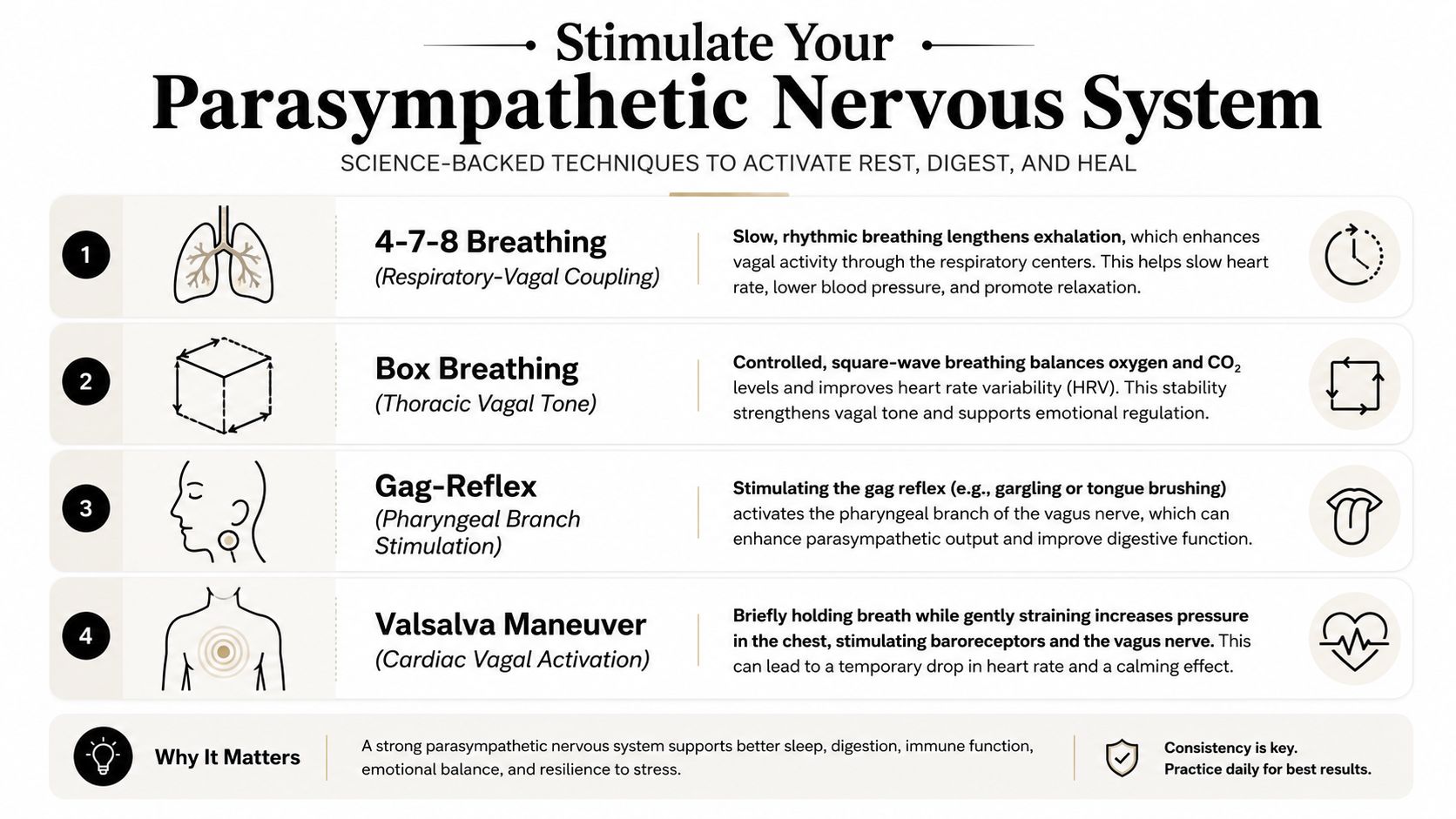
Try six comfortable breaths per minute for five minutes, allowing the exhale to extend by about two seconds beyond the inhale. The aim isn't to force a huge breath. It's to breathe gently enough that you don't create light-headedness through overbreathing.
4-7-8 breathing uses an inhale, a pause, and a longer exhale. If the counts feel uncomfortable, shorten them while preserving the basic pattern. Box breathing gives equal phases for inhaling, holding, exhaling, and holding again. People with panic can find breath holds activating, so comfort and steadiness matter more than rigid timing. The Anxiety Checklist's SOS breathing techniques for relief can serve as a ready reference during an anxious moment.
HRV biofeedback adds visual feedback to slow breathing. You breathe at a comfortable rhythm while a sensor displays changes in heart-rate timing. The feedback helps you learn the connection between respiratory rhythm and cardiac flexibility, but it shouldn't turn every session into a test you can fail.
Add sensory and muscular signals
The 5-4-3-2-1 grounding exercise shifts attention toward immediate sensory information. Name five things you can see, four you can feel, three you can hear, two you can smell, and one you can taste. This doesn't directly erase danger thoughts. It gives the brain competing evidence that you're in the present environment.
Progressive muscle relaxation works from the body upward. Briefly tense a muscle group, release it, and notice the contrast. Move through the jaw, shoulders, hands, abdomen, and legs. The goal is to teach your nervous system what reduced guarding feels like.
A short mindfulness practice can also help. Set a timer for ten minutes, notice the breath or contact with the chair, and label thoughts as thoughts rather than commands. This supports the parts of the brain involved in attention and interpretation without requiring you to feel peaceful immediately.
Use direct vagal maneuvers carefully
A Valsalva maneuver involves bearing down against a closed airway. A gag reflex can stimulate pharyngeal sensory pathways. These maneuvers can affect heart rhythm and blood pressure, so they aren't appropriate for everyone and shouldn't be performed forcefully during unexplained chest symptoms or without medical guidance.
Brief cold stimulation is another option. A cold cloth or cool water on the face may provide a strong sensory input, particularly around the cheeks and eyes. Avoid extreme exposure, breath-holding contests, or prolonged immersion. People with heart rhythm conditions, fainting histories, or other medical concerns should ask a clinician first.
The digestive system can also influence how anxiety feels. For practical food and gut-related considerations, Yuve gut reaction strategies offer another perspective, but digestive symptoms that persist deserve medical evaluation.
This video provides a visual breathing option to accompany the written steps:
Using These Tools During an Acute Panic Attack
When panic rises, complicated choices become difficult. Use a short script and treat each step as support, not a test.
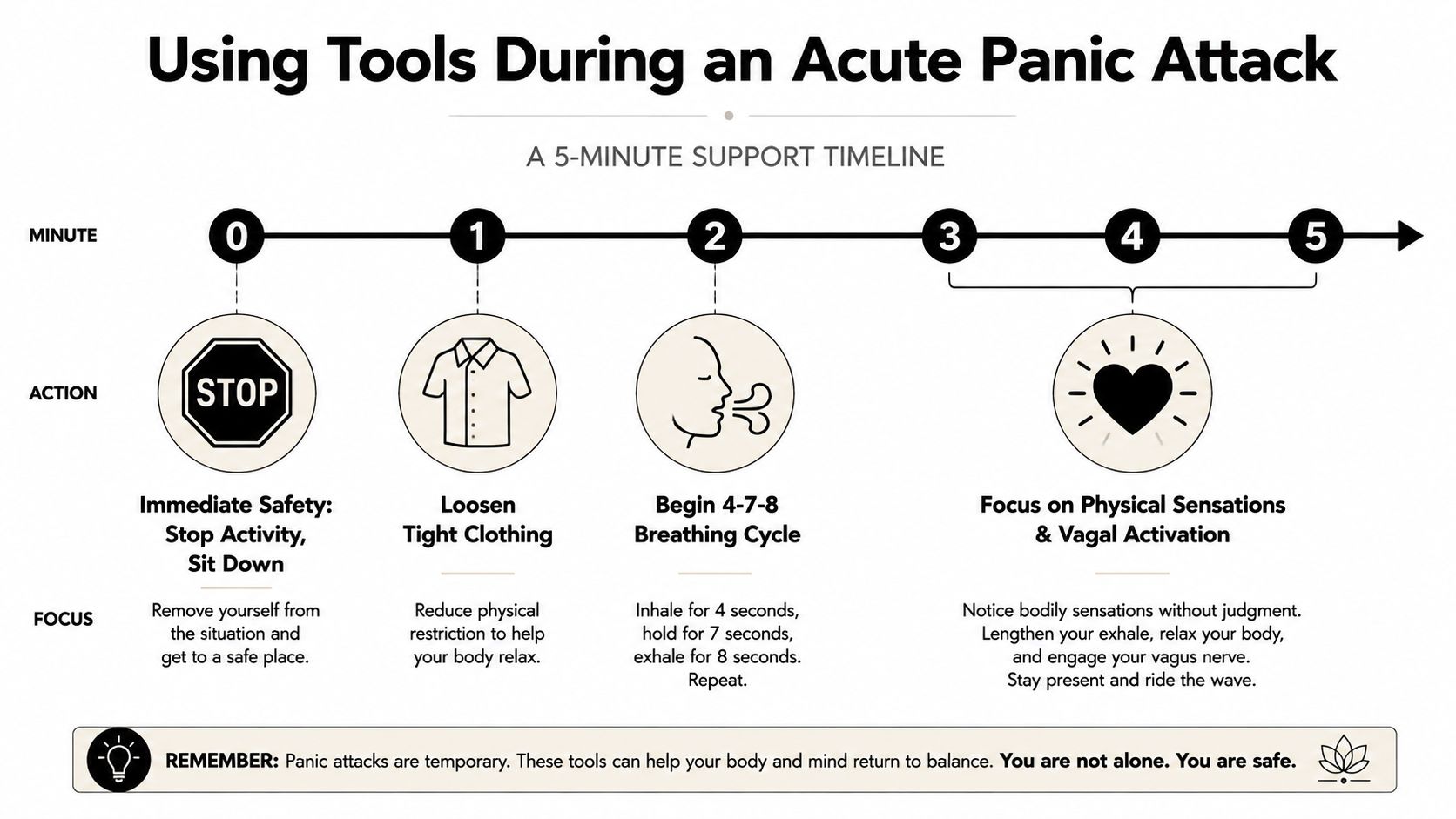
At the first sign, stop driving or operating equipment. Pull over safely, sit down, loosen tight clothing, and place both feet on the floor. If you're in a public place, tell someone you're having a health concern and need a moment. Say, “This feels like a panic alarm. I can respond one step at a time.”
During the next few minutes, breathe gently rather than chasing a perfect deep breath. Try a comfortable 4-7-8 pattern, or inhale softly and extend the exhale by about two seconds. If counting makes you more anxious, follow the sensation of air leaving your body instead.
After several breaths, try a long, gentle exhaling sigh for about 30 seconds. Don't strain. If you've previously been told that a Valsalva-like maneuver is safe for you, you may use mild bearing down. Otherwise, skip it and continue with breathing and grounding.
A practical five-minute sequence
- Minute zero: Stop the activity, sit, and check immediate safety.
- Minute one: Loosen restrictive clothing and identify the sensations without predicting catastrophe.
- Minute two: Begin comfortable paced breathing.
- Minutes three to five: Use 5-4-3-2-1 grounding, then apply a cool cloth or ice pack to the cheeks if it feels safe and helpful.
The first wave of panic commonly feels as though it will keep climbing forever. It will change, even if the change is gradual. These tools stack rather than replace one another, and prescribed panic medication should be taken exactly as directed by your prescriber.
Seek emergency evaluation for chest pain radiating to the arm, slurred speech, fainting, severe breathing difficulty, or a first-ever attack. Calling for help is appropriate, not embarrassing. Panic is treatable, but urgent symptoms should never be dismissed as anxiety without assessment.
Building Long-Term Calm and Living Panic Free
Daily practice works best when you treat it as nervous-system fitness, not an emergency fix. A brief breathing session on a calm morning gives you a chance to learn the skill before fear makes concentration difficult. HRV biofeedback can help you observe how breathing changes cardiac timing, while consistent sleep and caffeine habits reduce avoidable strain on the system.
The deeper change comes from combining body-based regulation with cognitive learning. Cognitive-behavioral therapy for panic disorder typically includes psychoeducation, self-monitoring, cognitive restructuring, exposure to feared cues, changes to anxiety-maintaining behaviors, and relapse prevention. The APA guideline describes treatment as typically lasting about 10 to 15 weekly sessions and states that its effects are durable, supporting a structured path beyond indefinite symptom management. See the APA guideline for panic disorder.
Exposure matters because the brain needs new experiences, not only explanations. A review describes CBT as a first-line treatment commonly delivered in 12 to 15 sessions, helping people break the cycle of anticipatory anxiety, panic, and agoraphobic avoidance by reducing fear of the panic sensations themselves in this clinical review. A meta-analysis found an overall mean remission rate of 51.0% for CBT across adult anxiety disorders, with remission highest when it reflected good end-state functioning or no longer meeting criteria for the primary diagnosis as reported in the meta-analysis.
Track your practice without turning it into surveillance. Note what you used, the situation, the sensations, how long recovery seemed to take, and what helped you stay engaged with life. Data should be feedback, not a verdict. A low HRV reading or difficult day doesn't define your health or your future.
The larger message is hopeful: panic is a learned alarm signal, and learned signals can change. Breathing, grounding, exposure, and therapy give your brain repeated opportunities to discover that bodily sensations can pass without catastrophe. Recovery isn't a fantasy reserved for someone else. With the right blend of skills and support, living panic free can become a realistic direction.
The Anxiety Checklist offers an always-free SOS mode with grounding prompts, affirmations, and breathing guidance for moments when panic makes it hard to think, along with CBT self-therapy tools, meditations, sleep audios, walking sessions, and educational material for longer-term practice. Visit The Anxiety Checklist and keep practical support close while you build a calmer, more flexible response to anxiety.