


You might be here with a flight booked, a knot in your stomach, and a browser full of searches that all ask the same question in different ways: can this get better?
You know planes are supposed to be safe. You may even know that other people fly every day without thinking twice. But your body doesn't care about logic when your heart starts racing at the thought of takeoff, turbulence, or being trapped in a seat with no easy exit. That mismatch can feel discouraging. It can also make you think you're broken.
You're not broken. A fear response can be learned, and learned responses can be retrained. That's where fear of flying hypnosis can help. Not as a magic trick. Not as stage entertainment. As a practical way to teach your brain and nervous system that a flight doesn't need to trigger alarm.
Table of Contents
- Why Your Fear of Flying Persists (And How to Change It)
- How Hypnosis Retrains Your Brain for Calm Flying
- Exploring Your Options Clinical Hypnotherapy and Audio Apps
- What a Fear of Flying Hypnosis Session Actually Feels Like
- How to Choose a Hypnotherapist or Hypnosis App
- Building Your Panic-Free Plan Beyond Hypnosis
Why Your Fear of Flying Persists (And How to Change It)
A common pattern goes like this. You book the trip and feel tense immediately. The week before the flight, your mind starts generating scenes you don't want. At the airport, every announcement sounds ominous. During boarding, your body acts as if you're walking into danger, even while another part of you knows that's not true.

That split matters. Fear of flying often persists because the thinking mind and the alarm system are sending different messages. Logic says, "This is routine." Your body says, "Get out now." Hypnosis is often useful because it works with the alarm system, not just the rational argument.
Why logic often isn't enough
You can read reassuring facts and still panic. That doesn't mean you're irrational. It means your brain has linked flying with threat, and once that link gets strong, it fires fast.
About 25 million people in the United States experience some form of anxiety related to flying, even though the fatal-accident rate in 2022 was about 0.000016%, based on 5 fatal accidents in 32.2 million flights reported in an industry summary citing aviation safety data from Stratos Jets' overview of fear of flying statistics and trends. The emotional brain often reacts to the feeling of danger rather than the actual level of risk.
You don't need more willpower. You need your nervous system to stop treating the flight like an emergency.
What change can look like
For some people, healing starts before the airport. They stop spiraling when they see the confirmation email. They sleep the night before a trip. They hear turbulence and notice discomfort, but not full panic. That's a different goal than "white-knuckling your way through it."
Fear of flying hypnosis aims to help your inner alarm become less reactive. If part of your fear is fear of panic itself, this piece on how to overcome fear of fear may help you make sense of why the cycle feels so sticky.
How Hypnosis Retrains Your Brain for Calm Flying
Think of hypnosis like updating old mental software. Your current program might say: airport equals danger, takeoff equals loss of control, turbulence equals catastrophe. Those reactions may feel automatic because, in a sense, they are. Your brain learned them through repetition, vivid imagination, or a past panic experience.
Hypnosis doesn't erase your mind or put you under someone else's control. It creates a state of focused attention where your usual mental noise settles enough for new associations to land. Instead of rehearsing disaster, you begin rehearsing safety, steadiness, and competence.
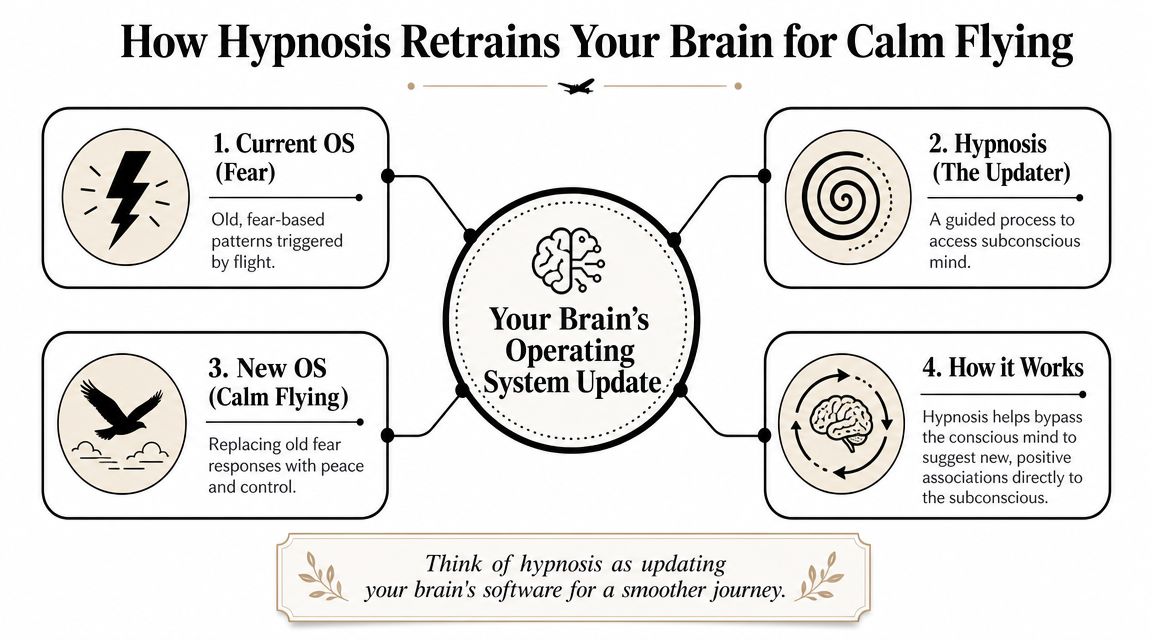
The operating system analogy
If a smoke alarm went off every time you made toast, you wouldn't call the toast dangerous. You'd say the alarm is too sensitive. Flight anxiety works in a similar way. The trigger isn't always the problem. The sensitivity is.
Hypnosis can help by supporting a few shifts:
- Interrupting the old loop: The usual chain of thought, image, and body sensation gets less automatic.
- Installing calmer associations: Your mind begins pairing flying with steadier internal cues.
- Rehearsing a new response: Instead of mentally practicing panic, you practice staying oriented and grounded.
Practical rule: Hypnosis is less about "zoning out" and more about giving your brain a better script to follow under stress.
What evidence says about lasting change
A landmark clinical follow-up study tracked 178 consecutive flying-phobia patients and found that a single 45-minute session combining hypnosis with a problem-restructuring strategy produced measurable long-term outcomes. 158 patients (89%) completed follow-up questionnaires over a window of 6 months to 10.5 years, and people judged hypnotizable were more than 2.5 times as likely to report some positive treatment impact as those judged nonhypnotizable, according to the PubMed record for the fear-of-flying hypnosis follow-up study.
That doesn't mean every person gets the same result, or that one audio session fixes everything. It does mean fear of flying hypnosis deserves to be taken seriously as more than a relaxation exercise. It can function as retraining.
If you want a broader foundation first, this guide to hypnotherapy for anxiety sufferers explains the general process in plain language.
Why repetition matters
A new pattern sticks when you repeat it. That's why many people benefit from listening to the same session more than once, especially in the days leading up to travel. You're not trying to force calm. You're helping your brain become more familiar with it.
Exploring Your Options Clinical Hypnotherapy and Audio Apps
Some people want a live professional guiding the process. Others want something private they can use at home. Both can be reasonable starting points. The right fit depends on your budget, schedule, and how much personalization you want.
Three common ways to use fear of flying hypnosis
A clinical hypnotherapist can tailor the session to your exact triggers. If your fear spikes during turbulence, that's different from panic tied to being unable to leave the cabin. A trained clinician can work with the pattern driving your fear.
A guided audio or app-based session is more flexible. You can listen at bedtime, on the way to the airport, or the night before your trip. Some people prefer this because repetition is easy and private. If you're exploring app-based support, you might also like guided affirmations for anxiety as part of your routine.
Self-hypnosis sits somewhere in the middle. You learn a structure, then guide yourself through it. This can build confidence and independence for people who want a sense of active participation rather than relying on outside support every time.
Comparing Hypnosis Methods for Fear of Flying
| Method | Best For | Typical Cost | Pros | Cons |
|---|---|---|---|---|
| Clinical hypnotherapy | People with strong triggers, complex panic patterns, or a desire for personalized support | Varies by provider | Tailored approach, real-time guidance, room for questions and adjustment | Scheduling, cost can be a barrier, quality varies by practitioner |
| Audio apps | People who want privacy, convenience, and repetition | Often low-cost or subscription-based | Easy to repeat, accessible at home, helpful before travel | Less personalized, depends on whether the voice and style fit you |
| Self-hypnosis | People who like practicing skills on their own | Usually low cost after learning the method | Builds self-trust, portable, can be paired with other calming tools | Takes practice, may feel harder if panic rises quickly |
If you freeze when anxiety hits, a pre-recorded session can be useful because it removes the pressure to "do it right" in the moment.
No format is automatically enough on its own. The better question is this: which format will you use consistently?
What a Fear of Flying Hypnosis Session Actually Feels Like
Many first-time clients expect something dramatic. What they usually find is much simpler. You sit or lie down, hear a steady voice, and gradually narrow your attention. Your body may feel heavier, warmer, or looser. Your mind may drift, but you still know where you are.

A good comparison is getting absorbed in a book and not noticing the room for a minute, or driving a familiar route and realizing your focus turned inward. You're not unconscious. You're concentrated.
What usually happens during the session
A session often begins with simple settling. You might be guided to notice your breathing, unclench your jaw, or release tension from shoulders and hands. Some recordings use imagery, such as picturing a smooth journey from home to destination. Others use direct suggestions, reinforcing safety, steadiness, and a growing sense of control.
That body-based settling can overlap with methods like effective progressive muscle relaxation for anxiety, especially if your fear shows up as tight muscles, shallow breathing, or trembling.
Then the hypnotic part deepens. You may hear phrases that connect flying with calm preparation, grounded breathing, and non-catastrophic interpretation of normal flight sensations. The point isn't to pretend you love every second of flying. It's to stop your body from reacting as if every normal sound means danger.
What hypnosis does not feel like
It doesn't feel like mind control. You won't reveal secrets because someone asked. You won't lose your morals, your memory, or your ability to stop.
Most people in hypnosis are aware enough to notice the room, hear outside sounds, and choose whether to continue following the guidance.
If seeing it helps, this short example gives you a sense of the pacing and tone people often expect from guided work:
What if you don't go very deep
Depth isn't the only thing that matters. Some people enter hypnosis easily. Others stay in a lighter, more aware state and still benefit. One report summarizes that people more responsive to hypnosis were 2.5 times more likely to report lasting relief, suggesting that repeated listening or self-hypnosis practice can strengthen the effect over time, as discussed in this article on overcoming fear of flying with hypnosis.
That can be reassuring if your first reaction is, "I don't think I was fully under." You don't need a theatrical trance. You need useful learning.
How to Choose a Hypnotherapist or Hypnosis App
The quality of the guide matters. So does the fit between the method and your nervous system. A soothing voice that helps one person may irritate another. A therapist with broad experience may still not understand phobias well.
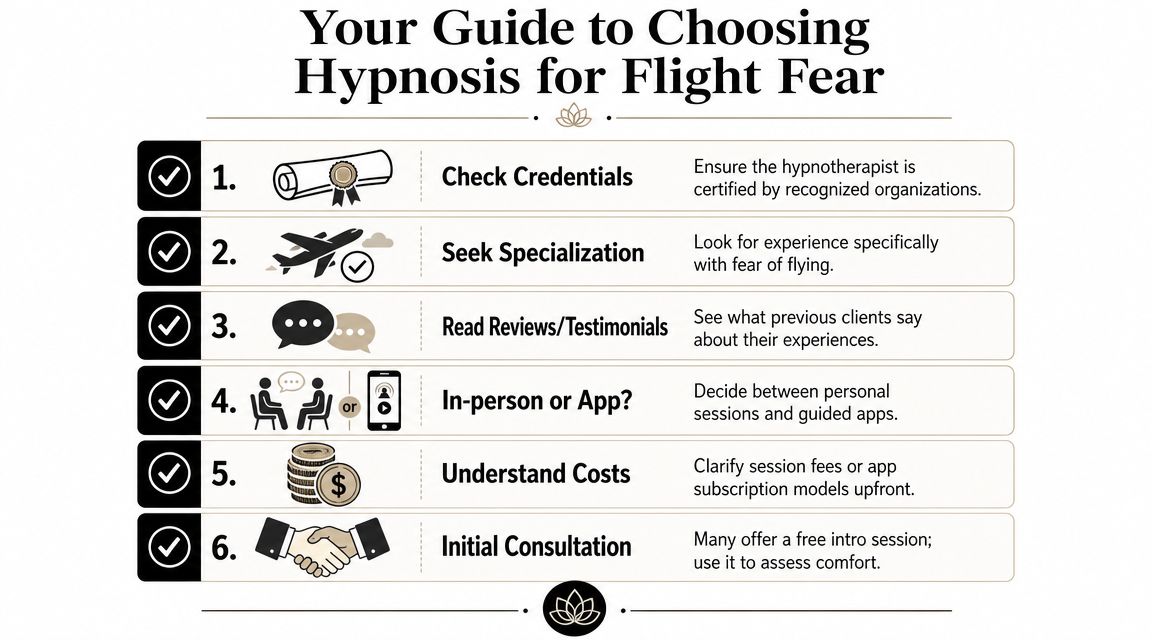
If you're considering a hypnotherapist
Use a simple filter:
- Look for relevant training: Choose someone with formal hypnotherapy training and experience working with anxiety or phobias.
- Ask about flight-specific work: Fear of flying has its own trigger patterns. It helps if they understand turbulence fear, claustrophobic elements, anticipatory dread, and panic loops.
- Notice how they speak: You should feel respected, not pressured or mystified.
- Ask how they structure sessions: Clear explanations are a good sign.
If you're choosing an app or audio track
Listen for practical quality:
- Voice fit matters: If the speaker's voice doesn't calm you, keep looking.
- Language should feel steady: Avoid tracks that sound dramatic, overly forceful, or full of vague promises.
- Check whether you can repeat sessions easily: Repetition is part of the work.
- Choose content that supports real-world use: Good tracks often help before travel, during anticipatory anxiety, or while practicing at home.
A solid option should make you feel more oriented and capable, not dazzled.
Building Your Panic-Free Plan Beyond Hypnosis
Hypnosis can be powerful, but many people do best when they combine it with other tools. That's because flight anxiety has layers. One part may be subconscious association. Another may be body panic. Another may be catastrophic thinking. Different tools target different layers.
Independent guidance on phobias describes exposure as the most successful approach to feared triggers, while hypnotherapy is described as a way to change thoughts and reactions in this overview of fear of flying and hypnotherapy options. That makes hypnosis especially useful as part of a larger plan rather than a stand-alone promise.
A stronger plan uses more than one lever
A randomized controlled trial of the internet-based NO-FEAR Airlines program found that flying-phobia symptoms improved significantly versus waiting list controls, with gains maintained at follow-up. The intervention used self-administered exposure scenarios with images and real sounds, which matters because exposure targets the fear network directly rather than relying on relaxation alone, as described in the NO-FEAR Airlines trial published on PMC.
That leads to a practical approach:
- Use hypnosis for retraining: This helps loosen the old threat association.
- Use exposure for tolerance: This teaches your system that flight-related cues can be handled.
- Use cognitive tools for interpretation: These help you answer "what if" thoughts without spiraling.
- Use in-the-moment grounding: This supports you when symptoms rise before or during travel.
For example, The Anxiety Checklist's app includes hypnosis sessions alongside exposure tools, grounding support, and CBT-style exercises. That's one example of a combined format rather than a single-method approach.
Healing often looks less like one breakthrough moment and more like your brain slowly deciding, "I don't need to sound the alarm this time."
If you want a panic-free life, that's still a realistic hope. Not because anxiety disappears overnight, but because the brain can learn new responses. With repetition, support, and the right mix of tools, flying can become ordinary again.
If you're looking for structured support in one place, The Anxiety Checklist offers tools for immediate panic relief and longer-term anxiety retraining, including hypnosis sessions, grounding exercises, exposure support, and CBT-based self-help resources.