


Your heart is pounding. Your stomach is tight. You're scanning your body for signs that something is wrong, and the more you check, the worse it feels. If you're reading this in that state, or in the exhausted aftermath of it, I want to start with something steady and clear: anxiety is not proof that you're broken, and panic is not a life sentence.
A lot of people think they either “have a calm nervous system” or they don't. That's not how this works. Your nervous system can learn. It can become easier to settle, easier to recover, and less likely to fire alarms at full volume.
That's where vagal tone exercises matter. Used the right way, they can help in two very different moments: when panic is already happening, and when you want to make panic less likely in the first place. That difference matters. It gives you a way to stop guessing and start practicing with purpose.
Table of Contents
- Your Body's Secret Weapon Against Anxiety
- The Two Paths to Reclaiming Your Calm
- SOS Vagal Resets for In-the-Moment Panic
- Daily Practices to Build Lasting Vagal Resilience
- Creating Your Personal Vagal Tone Toolkit
- You Have the Power to Heal Your Anxiety
Your Body's Secret Weapon Against Anxiety
Think of the vagus nerve as part of your body's brake pedal. When anxiety hits, your system acts like the gas pedal is jammed down. Your heart speeds up, your breathing changes, digestion gets messy, and your mind starts predicting danger. The vagus nerve helps send the opposite message: slow down, settle, you're safe enough to come out of emergency mode.
Why the vagus nerve matters
The vagus nerve connects the brain with major body systems, including the heart, lungs, and gut. That's why anxiety rarely feels “just mental.” It shows up as a racing pulse, shallow breathing, nausea, chest discomfort, or that knotted feeling in your stomach. Your body and brain are talking to each other all day, and the vagus nerve is one of the main lines of communication.
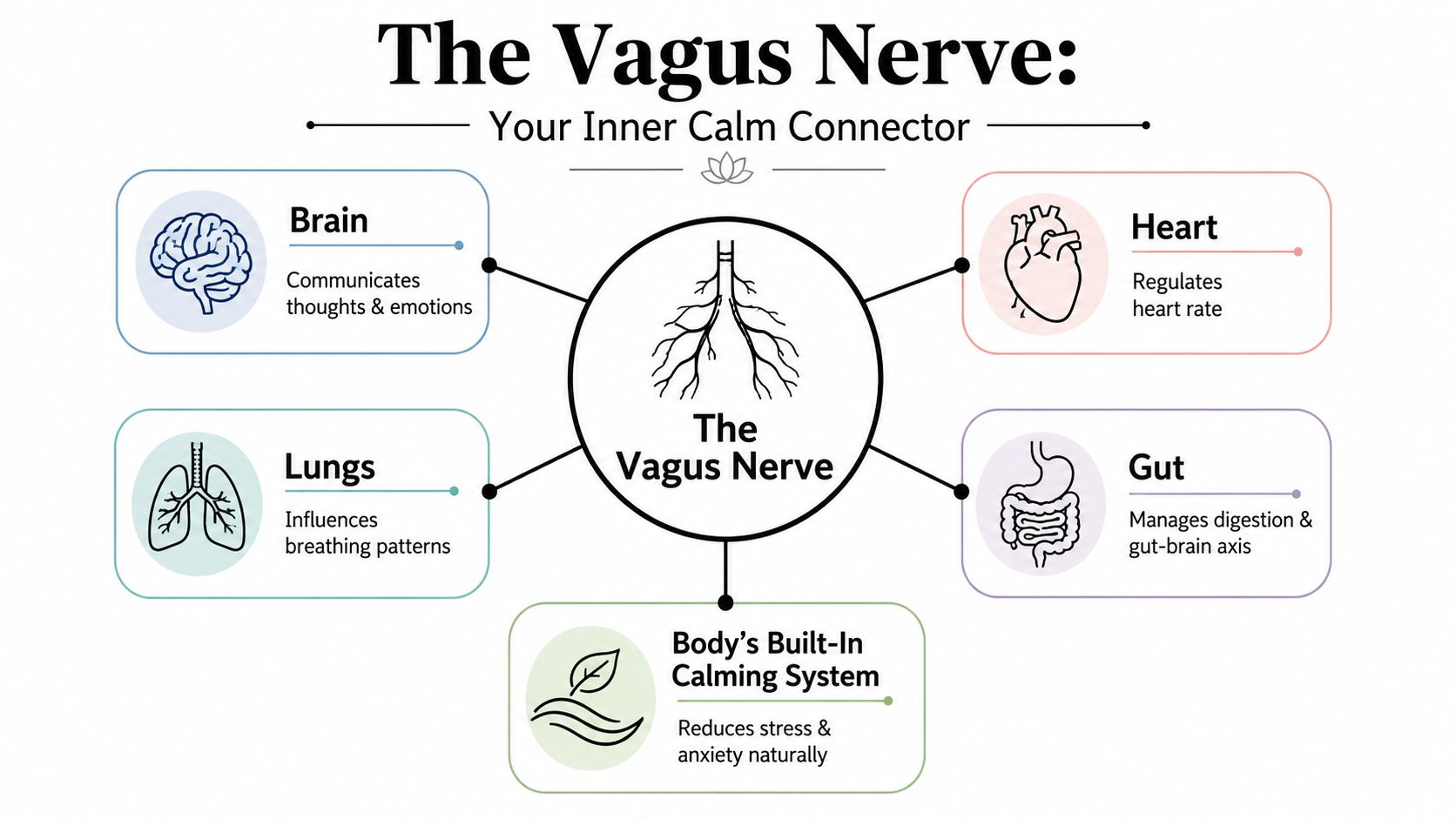
When people talk about vagal tone, they're talking about how well this calming system functions. Lower vagal tone can make it harder to recover from stress. Stronger vagal tone helps your system return to baseline more smoothly after a trigger.
That's the hopeful part. Vagal tone isn't fixed. It can be trained.
A useful piece of evidence comes from a study showing that a single session of deep and slow breathing significantly increased heart rate variability, a direct measure of improved vagal tone, and reduced state anxiety in both younger and older adults in the same session, which means relief is not limited to long treatment timelines according to this deep and slow breathing research.
Practical rule: If your body can shift in one session, it can also learn through repetition.
Why this should give you hope
Many people with panic secretly believe, “If this keeps happening, my body must be unsafe.” More often, the problem is that your alarm system has become too sensitive, not that you are beyond help. That difference matters because a sensitive alarm can be retrained.
You don't need to become a neuroscience expert to use this well. You just need a few reliable inputs that tell your body, again and again, that it can come down from high alert. For many people, that starts with breathing, temperature, sound, rhythm, and safe connection.
If you want a broader framework to learn about anxiety and panic attacks, it helps to understand that symptoms like dizziness, chest tightness, derealization, and stomach distress often come from a stressed nervous system doing its best to protect you, even when the alarm is false.
The Two Paths to Reclaiming Your Calm
Most advice on vagal tone exercises mixes everything together. That sounds harmless, but it creates a real problem. People try a long-term training tool during a full panic spike, don't feel instant relief, and assume the method failed. Or they use one emergency tool once, feel a little better, and expect it to permanently solve a stressed baseline.
SOS resets are not the same as training
There are two paths here.
The first path is SOS resets. These are for acute moments when panic is already rising. Their job is rapid de-escalation. They don't need to be elegant. They need to be simple enough to use when your thinking brain is barely online.
The second path is daily resilience practice. These are the habits that build a steadier nervous system over time. They work more like conditioning than rescue.
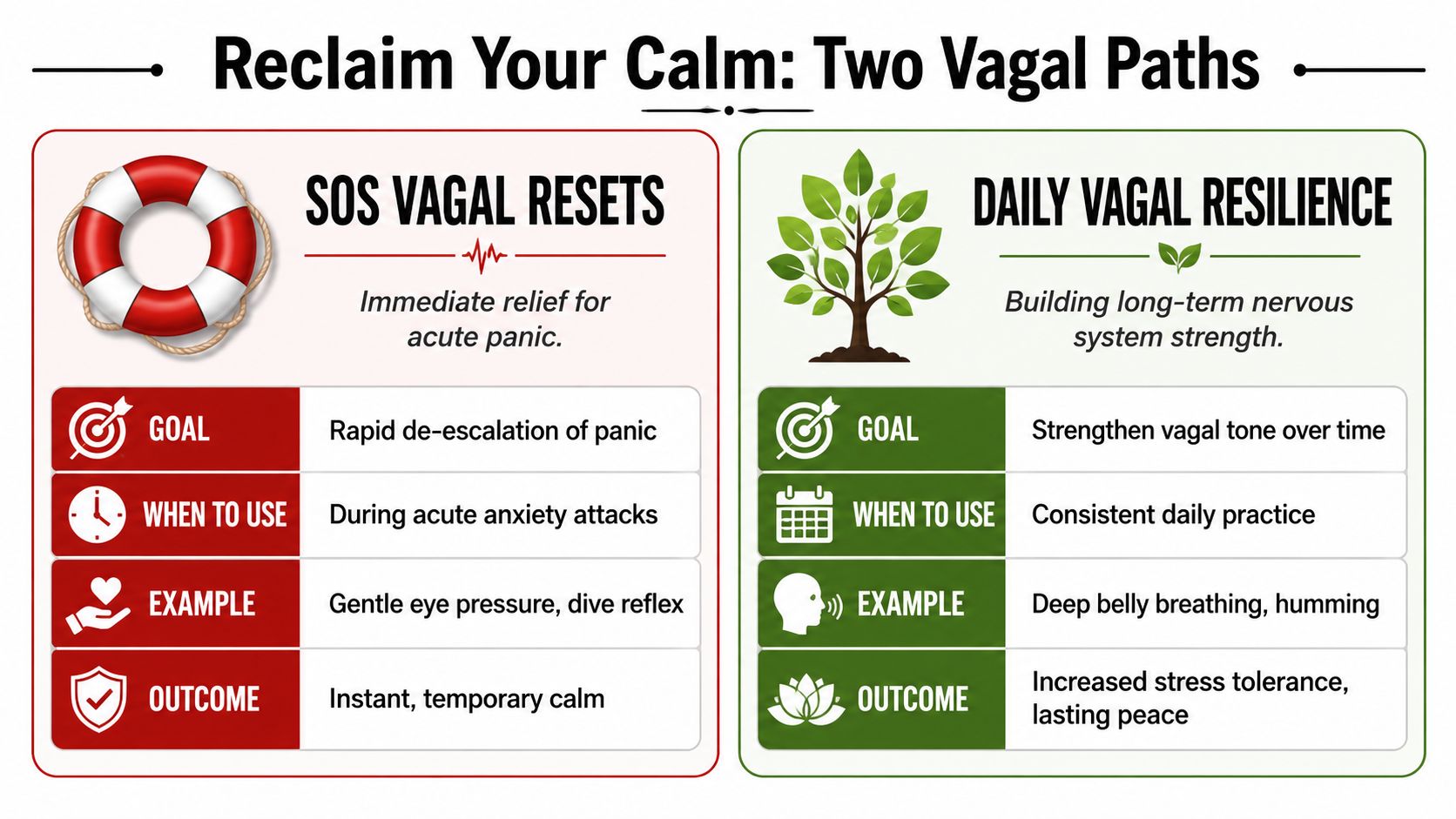
The difference is the same as putting out a kitchen fire versus making your home less flammable. Both matter. They just solve different problems.
This distinction fills a gap that many people feel but can't name. A review of current content noted that guidance often fails to separate acute panic relief from chronic tone building, even though resonance-frequency breathing tends to improve heart rate variability over several weeks, while splashing cold water on the face may offer the quickest acute vagal reset for panic spikes, as discussed in this PMC review on the timing gap in vagal exercises.
How to know which path you need
Use this quick filter:
| State | What it feels like | What helps most |
|---|---|---|
| Panic spike | Heart racing, terror, urgency, spiraling thoughts | SOS reset |
| Stress buildup | Edgy, tense, sleep off, reactive, easily overwhelmed | Daily practice |
| Recovery period | Tired after panic, body still activated | Gentle version of both |
If you're caught in the fear of having fear itself, that can strengthen the phobophobia and panic attack cycle. In that case, this two-path model becomes even more important. It gives you one plan for crisis, and another for healing the ground underneath the crisis.
One exercise can be helpful and still be the wrong tool for the wrong moment.
SOS Vagal Resets for In-the-Moment Panic
When panic is climbing, complexity is the enemy. You won't want a long routine or a perfect posture. You need a few direct actions that interrupt the spiral fast enough for your body to remember it can come down.

Cold water for a fast body-level interrupt
This is one of the most practical resets because it doesn't require concentration. Cold water face immersion is described as a validated immediate relief tool that needs only 30 seconds of exposure to splash cold water or use an ice roller on the face, creating a rapid physiological shift that calms the vagus nerve and reduces stress responses within minutes in this guidance on cold water face exposure for anxiety.
Try it like this:
- Go to a sink right away.
- Splash cold water across your face, especially the cheeks and around the eyes.
- Stay with the sensation instead of checking whether panic is gone.
- Repeat once if needed, then move into slower breathing.
Why it works: strong temperature input can interrupt the fight-or-flight loop through the body first, which is often easier than trying to reason your way out of panic.
Extended-exhale breathing when your thoughts are spiraling
If you can breathe with some control, use an exhale that's longer than the inhale. Clinical guidance for vagus nerve stimulation recommends diaphragmatic breathing where the exhale is exactly double the inhale, such as inhale for 4 seconds and exhale for 8 seconds, to activate the parasympathetic system for real-time panic control according to these vagus nerve breathing guidelines.
Use this sequence:
- Hand placement: Put one hand on your lower ribs or belly.
- Inhale gently: Breathe in through the nose for 4 seconds.
- Exhale slowly: Breathe out for 8 seconds.
- Keep it soft: Don't drag air in. Don't force air out.
- Continue: Stay with the rhythm until the intensity starts to drop.
If you need more support, these tools can help you manage anxiety with breathing.
Why it works: a longer exhale signals braking and helps shift the body toward rest-and-digest.
Here's a guided option if following a rhythm on your own feels hard in the moment:
Humming or chanting when you feel stuck
Some people can't access slow breathing during panic because it feels too exposed or too deliberate. Humming can be a better doorway.
Try this:
- Close your lips lightly: Keep your jaw loose.
- Hum on the exhale: Pick one low, steady note.
- Feel the vibration: Aim for the chest, throat, and face area.
- Continue briefly: Let the sound be ugly if it needs to be.
Why it works: vibration plus prolonged exhale gives your body another route into calming without requiring mental effort.
What to do if nothing works right away
Don't turn an exercise into a test. That's where people get stuck. Panic often gets stronger when you keep asking, “Is it working yet?”
Instead:
- Stay with one method long enough: Constantly switching tools can keep your brain in threat mode.
- Reduce the goal: Aim for “less escalated,” not “instantly peaceful.”
- Loosen the pressure: If breathing feels forced, return to normal breathing for a moment, then try a gentler version.
- Repeat without drama: A second round isn't failure. It's practice.
During panic, success doesn't mean feeling amazing. It means interrupting the climb.
Daily Practices to Build Lasting Vagal Resilience
Anxiety changes fastest in moments of crisis, but it changes deepest through repetition. The exercises in the last section are your SOS tools. These daily practices are how you teach your nervous system to recover more easily the next time stress hits.

Resonance breathing as a foundation
If you only build one daily habit, start here.
Gentle, paced breathing with a slightly longer exhale gives your body regular practice shifting toward safety. A practical method for respiratory vagal stimulation uses a 4:6 breathing ratio at a slow, comfortable rhythm for a few minutes a day. That longer exhale can help increase parasympathetic activity without asking you to force a huge breath.
Try it like this:
- Sit upright or lie somewhere comfortable.
- Inhale through your nose for 4 seconds.
- Exhale for 6 seconds.
- Let your lower ribs and belly move. Keep your shoulders quiet.
- Use less air than you think you need.
- Stop while it still feels manageable.
The trade-off matters here. If you push for a perfect count, your body can read the exercise as effort instead of safety. Quiet, light breathing works better than dramatic breathing.
A simple way to stay consistent is to tie it to an existing cue, such as after brushing your teeth or before opening your laptop. If tracking helps you follow through, the Anxiety Checklist app can give you a simple structure without turning your routine into a project.
Daily inputs that strengthen vagal tone
Breathing is one pillar. Your nervous system also responds to rhythm, movement, sound, temperature, and positive social emotion.
Useful options include:
- Regular movement: Walking, cycling, strength training, or other repeatable exercise can support vagal function over time.
- Laughter: Real laughter changes the breath, mobilizes the diaphragm, and often breaks the rigid body posture that comes with anxiety.
- Brief cold exposure: Cool water on the face or a short cool rinse can be enough. Bigger doses are not always better.
- Humming or chanting: Vibration through the throat and chest gives you another low-effort way to practice downshifting.
These strategies are discussed together in this overview of ways to improve vagal tone.
Keep the bar low enough that you will repeat the habit. A ten-minute walk counts. Humming in the car counts. Splashing cool water on your face after a stressful meeting counts.
The social side of long-term regulation
Vagal resilience also grows in safe connection. People with chronic anxiety often focus only on solo tools, then wonder why progress feels fragile. The nervous system learns safety through relationships too.
That does not mean forcing yourself into draining social situations. It means choosing contact your body can receive.
A few practical ways to do that:
- Talk with one steady person: Slow conversation can help your body settle, even if you are not discussing anxiety.
- Use a softer voice: Your tone affects your own state as well as the other person's.
- Pick low-pressure connection: A short walk, shared task, or sitting beside someone supportive may work better than intense eye contact.
- Use supportive touch when it feels safe: Massage and similar forms of calming touch may support vagal regulation in some people.
If you want a wider plan around body-based tools, it can also help to discover natural anxiety solutions that fit alongside these daily practices.
Daily resilience work is quieter than an SOS reset. It is also what makes the resets work better. Over time, you are not just calming anxiety after it spikes. You are building a system that spikes less easily and recovers faster.
Creating Your Personal Vagal Tone Toolkit
People do best when they stop searching for the perfect method and build a personal set of tools instead. Your toolkit should be small, flexible, and realistic enough to use on ordinary days, not just ideal ones.
A simple weekly rhythm
Here's a practical setup you can adapt:
| Time | Focus | Example |
|---|---|---|
| Morning | Baseline regulation | 4:6 breathing for a few minutes |
| Midday | Reset accumulated stress | Brief humming, short walk, or cool water on face |
| Evening | Downshift | Gentle breathing, soft music, quiet stretch |
| High-stress moment | SOS support | Cold water, 4:8 breathing, humming |
Some people also do well with theme days:
- Workday version: Keep it minimal and portable.
- Home version: Add a longer breathing session or light movement.
- Recovery day: Lower the demand and focus on comfort.
If you want to broaden your approach beyond vagal exercises alone, it can help to discover natural anxiety solutions that fit alongside the body-based practices in this article.
Troubleshooting common mistakes
The biggest mistake is forcing the breath. Clinical data indicates that deep and slow breathing with a low inhale-to-exhale ratio can improve vagal tone and reduce anxiety after even a single session, but over-breathing can backfire. The recommended correction is to slightly reduce air volume until you feel a “mild, comfortable need for air”, which helps prevent hyperventilation according to this research on deep and slow breathing and vagal tone.
Use this troubleshooting guide:
- If you feel dizzy: You're probably overdoing the inhale or the overall volume. Make the breath smaller.
- If panic increases during breathing: Drop the counting and just lengthen the exhale a little.
- If cold exposure feels too intense: Start with cool water on the face instead of a full cold shower.
- If humming feels awkward: Do it privately in the car or shower. The body doesn't care whether it sounds polished.
- If you miss days: Resume without trying to “make up” for it.
A good practice leaves you steadier, not exhausted.
How to stay consistent without becoming obsessive
Consistency matters. Obsession doesn't help. You don't need to monitor yourself all day, test every symptom, or turn calm into a project.
A better approach is to choose:
- One SOS tool
- One daily breathing tool
- One body-based habit
- One connection-based habit
That's enough for a strong start.
If tracking helps, keep it simple. A quick note in your phone, a checkmark in a paper planner, or support from the Anxiety Checklist app can make repetition easier without feeding the urge to constantly self-monitor.
You Have the Power to Heal Your Anxiety
Healing from anxiety often starts with a surprising shift. You stop asking, “How do I get rid of this feeling forever, right now?” and start asking, “How do I teach my body safety again?” That question is kinder, and it's more effective.
Healing is repetition not perfection
Your panic symptoms are real, but they are not a verdict on your future. They are body signals. Body signals can be influenced. When you use vagal tone exercises in the right lane, SOS resets during acute surges and daily practices for long-term resilience, you give your nervous system two things it needs most: immediate support and repeated evidence of safety.
That's how confidence returns. Not because you never feel anxious again, but because you know what to do when anxiety shows up.
If your mind tends to latch onto fear, rumination, and “what if” loops, learning how to stop overthinking and worrying can strengthen the same healing process from the cognitive side.
A panic-free life becomes more believable
For many people, “panic-free” doesn't begin as a bold declaration. It begins as a smaller thought: maybe I can interrupt this. Then: maybe I can recover faster. Then: maybe my body doesn't have to live on edge all the time.
That progression matters. It's how hope becomes believable.
You do not need to wait until you feel fearless to start healing. Start while you're still scared. Start with cold water on your face, a longer exhale, a daily rhythm, and a little less force than you think you need. The nervous system learns through safe repetition, and every calm repetition teaches your body that peace is possible.
If you want steady support while you practice, The Anxiety Checklist offers help for both urgent moments and long-term recovery. Its free SOS mode is designed for the times your mind goes blank, and its daily tools can help you build the kind of nervous system resilience that makes a panic-free life feel achievable.